

The couples match is absolutely not automatically “worth it” when your specialties almost never share programs in the same city. Sometimes it helps. Often it handcuffs you. You need to treat it like a business decision, not a romantic gesture.
Here’s how to think about it like an adult instead of like a Hallmark movie.
Step 1: Get Real About Your Actual Overlap
If your specialties rarely co-locate, you cannot skip this step and “hope it’ll work out.” You need data.
You’re asking: “Is couples match worth it?”
The real question is: “What are our odds of both landing in the same metro if we couple vs if we go solo?”
Build a basic spreadsheet. Spend an evening doing this; it’s not optional.
List:
- Every program for Partner A’s specialty you’d realistically apply to
- Every program for Partner B’s specialty you’d realistically apply to
- Cities/regions for each (treat large metro areas as one “location”)
Then:
- Mark which cities have both specialties but not necessarily at the same institution.
- Mark which locations have only one of you.
- Identify true co-location “clusters” where both could plausibly match within commuting distance (think: any reasonable daily commute ≤ 60 minutes).
You’ll end up with something like:
| City/Region | Partner A (Specialty 1) | Partner B (Specialty 2) | Co-Located (Same Metro) |
|---|---|---|---|
| Boston | Yes (3 programs) | Yes (1 program) | Yes |
| Chicago | Yes (4 programs) | No | No |
| Seattle | No | Yes (2 programs) | No |
| Philadelphia | Yes (2 programs) | Yes (1 program) | Yes |
| Medium Midwest City | Yes (1 program) | Yes (1 program) | Yes |
If you finish this exercise and find:
- 0–3 co-located metro areas: couples match is probably a net liability.
- 4–10 co-located metros with multiple programs each: couples match starts to make more sense.
10 co-located metros, including several large academic centers: couples match may be strongly in your favor.
Most couples never do this level of analysis. Then they’re “surprised” in March. Do not be those people.
Step 2: Understand What the Couples Match Actually Does (and Doesn’t Do)
The couples match does one thing: it lets your rank lists be linked, so the algorithm prioritizes pair outcomes over individual outcomes.
It does not:
- Create positions that don’t exist
- Force programs to coordinate with each other
- Guarantee you’ll be in the same city
- Automatically improve your chances
Here’s what changes when you couples match:
You rank pairs of programs (A program, B program). That means you’re not ranking:
- “Derm at Program X”
You’re ranking things like:
- (Derm at Program X, IM at Program Y in same city)
- (Derm at Program X, Prelim Medicine at Program X)
- (Derm at Program X, IM at Program Z 3 hours away)
- (No match, Derm at Program X) – yes, you can rank one unmatched
Your match probability becomes about combinations, not just your individual competitiveness.
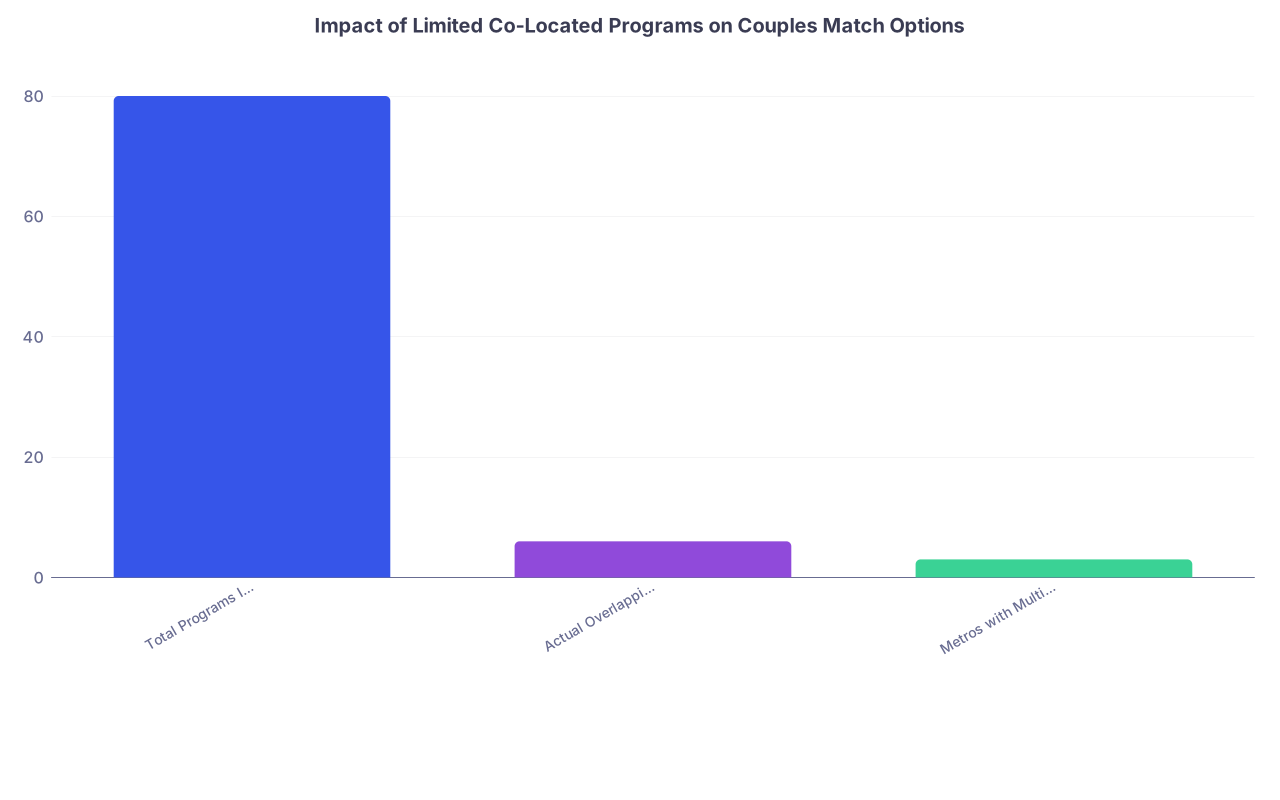
| Category | Value |
|---|---|
| Total Programs Individually | 80 |
| Actual Overlapping Metros | 6 |
| Metros with Multiple Options | 3 |
The fewer co-located options you have, the faster your joint rank list collapses into:
- One or both of you compromising heavily on program quality or location, or
- One of you risking not matching at all
That’s the tradeoff.
Step 3: When Couples Match Helps Despite Rare Co-Location
There are specific scenarios where couples match still makes sense even if your specialties don’t commonly share programs.
1. One Partner Is Much Stronger On Paper
Example:
- Partner A: Competitive specialty (Derm, Ortho, ENT), stellar stats
- Partner B: Less competitive specialty but solid (FM, IM, Psych), average stats
If you go solo:
- Partner A might match widely, maybe far from home
- Partner B might be more geographically constrained and less desirable to distant programs
In couples match, surprisingly, Partner B sometimes benefits. Programs know if they take B, they might also pull in a strong A nearby (at another program). Or vice versa: A might get a boost if B is loved locally.
This effect is inconsistent, but I’ve seen couples where the weaker application did noticeably better as part of a pair.
Use couples match here if:
- You have at least a handful of metros with strong options for both
- You’re both willing to compromise a little on prestige for geography
Skip it if your “overlap” is basically one random city with a single tiny program for one of you.
2. You’re Both OK With “Same Region, Not Same City”
If your true north is: “We’ll be in driving distance, see each other most weekends, and survive this,” and you define success as being within 1–3 hours of each other, couples match can be configured to reflect that.
You’d rank things like:
- (Partner A: Big City Academic, Partner B: Nearby Community 60–90 minutes away)
- (Partner A: Academic in Region X, Partner B: Any program in Region X within 2 hours)
This works better when:
- One or both fields are relatively uncompetitive
- You’re not fixated on top-tier name brands
- You’re realistic about commute and lifestyle
Where this fails: when one of you is in a tiny, super competitive field (e.g., Rad Onc, ENT, Urology) with only 1–2 programs in the entire state.
Step 4: When Couples Match Is Actively Dangerous For You
Now the part nobody likes to say out loud.
If your specialties rarely co-locate, couples match can absolutely:
- Reduce the number of programs you can realistically rank
- Drag down the stronger applicant
- Increase the risk that one (or both) of you don’t match
Here are red-flag patterns where I’d strongly question using couples match:
Pattern A: One Highly Competitive + One Geographic Straitjacket
Example I’ve actually seen:
- Partner A: Neurosurgery, strong applicant
- Partner B: Pediatrics, but needs to stay in one state for sick family
Neurosurg programs in that state: 1
Peds programs: several
Going in as a couple:
- A now has to essentially center their entire neurosurg future on a single program
- B might do fine anywhere, but is chained to A’s near-zero geographic flexibility
If A doesn’t match there? Now what.
Neurosurgery + couples match + single metro = disaster risk.
In this type of case, I’d usually say:
- A applies broadly, maximizes match chances
- B applies broadly but may plan to couples match or transfer later for fellowship or job, not for residency
Pattern B: Both in Moderate-to-Competitive Fields, Minimal Overlap
Say:
- Partner A: EM
- Partner B: Anesthesia
- Co-located cities with both fields: maybe 5–7 you’d actually want
As individuals:
- A could rank 40+ EM programs
- B could rank 40+ Anesthesia programs
As a couple with limited overlap:
- Your effective list becomes maybe 10–25 viable pairs, max
- Many of those pairs involve one person at a backup / lower-tier program they’d never pick solo
This is how people end up saying, “We matched together, but both at our #14 choice,” in cities they barely wanted.
Pattern C: Major Imbalance in Applicant Strength With No Geographic Give
If one of you is:
- DO or IMG in a field where that matters a lot
- Coming off a prior SOAP
- Multiple Step failures or red flags
And the other is:
- US MD, no red flags, above-average scores, same graduating year
Couples match forces programs to see you as a package, but the actual residency spots are not issued as packages. Each PD still has to be willing to take their half of the couple.
Result:
- Some programs who’d have jumped at the stronger partner may quietly back off
- Some okay or “safety” programs may see the duo as too complicated
- You shrink your safety net when you’re the one who can least afford to
In this case, you might be better off not coupling, then planning hard for future re-location.
Step 5: A Practical Framework – Decide in 3 Conversations
Here’s the decision process I walk couples through.
Conversation 1: Worst-Case Scenarios
Ask each other, and answer honestly:
Would I rather:
- Match my dream program and be long-distance for 3–5+ years, or
- Be together in a less desirable program/location?
What’s my line in the sand?
- “I won’t go unmatched for you.”
- “I won’t move to [rural, certain region, very low-tier program] just to be together.”
Are we actually okay with:
- 1–3 years of distance
- Maybe changing jobs or locations later (fellowship, attending) to be together?
If one of you leans “career first” and the other is “must be together at all costs,” couples match will magnify that conflict.
Conversation 2: Reality Check With Advisors
You each need separate honest input from:
- A PD or APD in your specialty
- A trusted advisor who knows your file (scores, red flags, letters, etc.)
Ask directly:
- “If I apply broadly as an individual, what’s my match probability range?”
- “How much geographic flexibility would you recommend?”
- “How would a couples match potentially change my risk?”
Then share the feedback with each other, unedited.
You’re looking for statements like:
- “You’re solid anywhere in the Midwest, but I’d be nervous about only 3 programs on the coasts.”
- “You are not in a position to geographically restrict. At all.”
If both advisors say you can’t afford to narrow, couples match is likely too risky with minimal co-location options.
Conversation 3: Rank List Strategy Preview
Before you decide to couples match, sketch your hypothetical joint rank structure.
Literally list:
- Top 5–10 “ideal” pairs (same metro, both happy)
- Next 10–20 “compromise” pairs (one happy, one okay but not thrilled)
- Bottom set of “we accept this reality” pairs (one in a backup, one maybe in prelim, maybe separated by a few hours)
If that combined rank list:
- Runs out of reasonable pairs quickly, or
- Includes multiple outcomes one of you would secretly resent for years
…that’s your answer. You shouldn’t couples match.
Step 6: Alternatives To Full Couples Match
If your overlap is low, you’re not stuck with binary “couple vs not.” There are hybrid strategies.
Strategy A: Apply Independently, Coordinate Geography Informally
You both:
- Apply broadly, solo
- Heavily prioritize overlapping cities in your ERAS lists
- Accept that the algorithm doesn’t link you, but your applications are still directionally aligned
You:
- Mention your partner in your personal statement or interviews when appropriate
- Communicate with each other constantly as interview invites come in
This keeps your individual safety nets intact but still increases the odds of landing near each other.
Strategy B: “Soft Couple” with a Backup Plan
You decide:
- “We’ll couples match only to these X metros that are truly good for both of us. If those don’t hit, we’re okay with going solo elsewhere.”
In practice, that might mean:
- Ranking some pairs at the top as a true couple
- Then each of you has additional solo ranks further down (where the other is unmatched)
You still officially couples match, but you don’t insist on being together at all costs.
Strategy C: Plan To Reunite at Fellowship / First Job
This is how a lot of real couples make it work.
- One of you does residency in City A, the other in City B
- You intentionally choose fellowships with geographic flexibility and options near each other
- You treat the 3–5-year separation as temporary, with a concrete plan
It’s not romantic, but it’s honest. And it often works better than tanking one career early.

| Step | Description |
|---|---|
| Step 1 | List Programs and Overlap |
| Step 2 | Apply Independently, Coordinate Geography |
| Step 3 | Assess Competitiveness and Flexibility |
| Step 4 | Use Couples Match with Hybrid Rank Strategy |
| Step 5 | Enough co-located metros? |
| Step 6 | Can you accept compromise outcomes? |
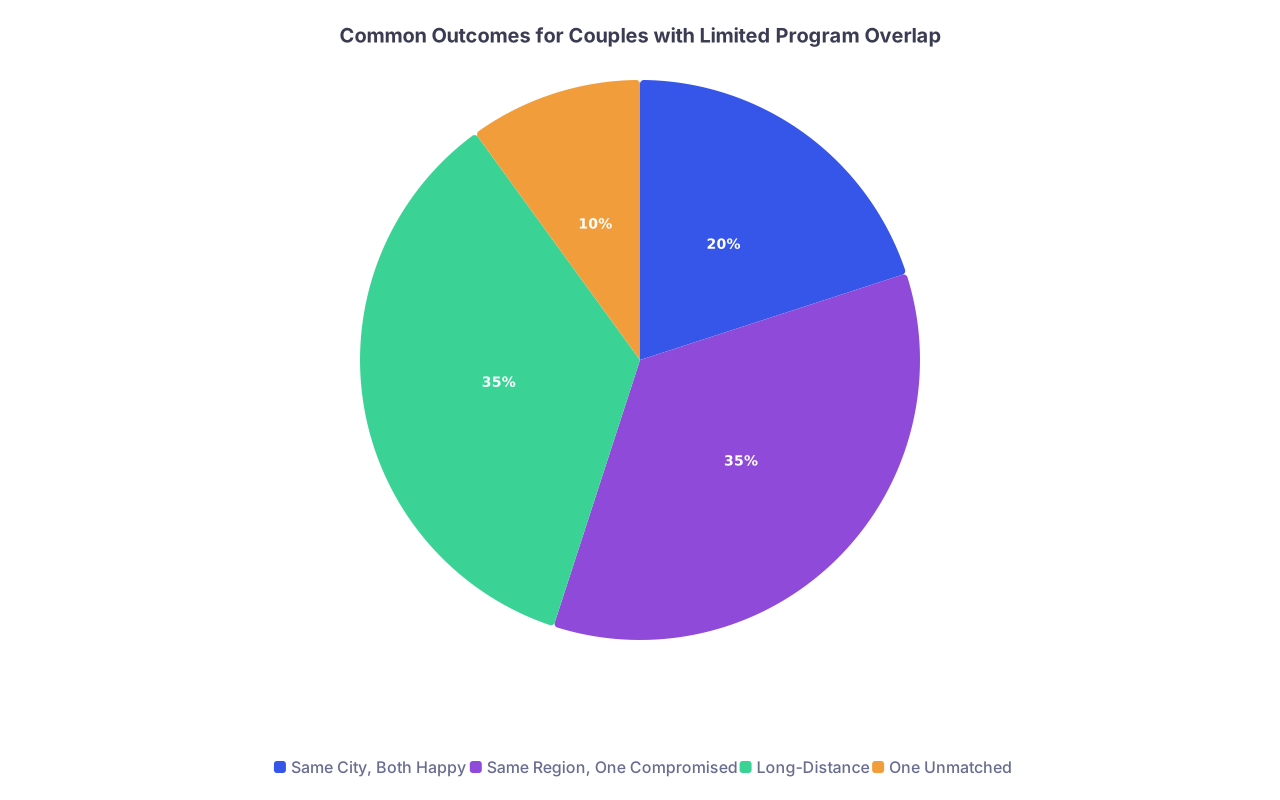
| Category | Value |
|---|---|
| Same City, Both Happy | 20 |
| Same Region, One Compromised | 35 |
| Long-Distance | 35 |
| One Unmatched | 10 |

When I’d Say Yes vs No
Let me be blunt.
Couples match is probably worth it for you if:
- You can list at least 5–8 metros with credible options for both
- You’re both willing to compromise somewhat on prestige for geography
- Neither of you is in a catastrophically risky position (multiple fails, ultra-competitive specialty with weak application)
- You’ve thought through specific backup pairs you’d genuinely accept
It’s probably not worth it if:
- You have 0–3 overlapping metros total
- One of you cannot safely restrict geography at all based on competitiveness
- Your hypothetical rank list forces someone into a program they’d never pick outside this relationship
- You both feel sick imagining being long-distance, but you also feel sick imagining several of the realistic outcomes together

Bottom line:
- Do the math. Count actual overlapping metro areas and translate that into a real joint rank list, not a fantasy.
- Be brutally honest about your competitiveness and risk tolerance; couples match is not a feel-good button, it’s a constraint.
- If your specialties rarely co-locate and your overlap is thin, strongly consider applying independently while informally coordinating geography, and treat reunion as a medium-term, not a Match Day, goal.


