The myth that “you cannot be a surgeon if your hands are not perfect” is outdated—and frankly lazy.
Fine motor limitations do change how you operate. They do not automatically decide whether you can operate. The gap between those two is filled with design, creativity, and brutally honest self‑assessment.
Let me break this down specifically.
1. What “Fine Motor Limitations” Really Mean in Surgery
People throw around “fine motor” like it is one thing. It is not. In the OR, you are dealing with at least five distinct domains:
- Strength and endurance of small hand muscles
- Dexterity and speed of finger movements
- Precision of fingertip control (especially with visual–motor integration)
- Range of motion and joint stability
- Sensory feedback (light touch, vibration, proprioception)
Now overlay that onto real surgical tasks:
- Holding and closing a needle driver dozens or hundreds of times
- Performing a running 6‑0 or 7‑0 suture under magnification
- Performing continuous camera steering in laparoscopy or robotics
- Maintaining a stable, non‑tremulous hold on a microinstrument
- Bimanual tasks with asymmetric demands (e.g., dominant vs nondominant hand roles)
Where limitations show up depends on the underlying condition:
- Congenital differences (e.g., limb difference, hypoplastic digits, amniotic band, radial club hand)
- Acquired neuromuscular conditions (e.g., mild cerebral palsy, peripheral neuropathy, post‑stroke weakness)
- Movement disorders (e.g., essential tremor, mild Parkinsonism)
- Joint disease or pain (e.g., rheumatoid arthritis, post‑traumatic deformity)
- Sensory loss (e.g., carpal tunnel, chemotherapy‑induced neuropathy)
The first hard truth: not every limitation is compatible with every surgical role. A dense peripheral neuropathy with no protective sensation is a nonstarter for high‑risk instrument work. But a mild tremor, reduced pinch strength, or limited wrist motion? Those are problems that can be engineered around far more often than people admit.
2. Breaking Tasks Down: Where the Bottlenecks Actually Are
If you just ask, “Can you be a surgeon with X?”, you will get useless opinions. The right question is, “Which tasks break down, and can we re‑engineer them?”
Think in terms of task components instead of labels like “suture” or “dissect.”
Core micro‑tasks in open and minimally invasive surgery
- Grasping and releasing small objects repeatedly (clips, needles, gauze tags)
- Controlled rotation (e.g., needle driver roll between thumb and index)
- High‑frequency small adjustments (camera steering, suction fine movements)
- Sustained precision posture (holding a retractor, stabilizing a field)
- Force grading (gentle tissue handling vs controlled traction)
Fine motor limitations usually manifest as:
- Early fatigue: hand cramping after 20–30 minutes, grip “giving out”
- Slowed pace: one or two orders of magnitude longer for knot tying or suturing
- Loss of precision under fatigue: tremor appears late in case, not early
- Difficulty with specific joint motions: thumb abduction, wrist supination, finger flexion beyond a certain range
- Inconsistent performance: good days and “everything feels off” days
If you skip this analysis, you will pick the wrong adaptations. I have seen residents jump to “I need a tremor‑filtered robot” when the actual problem was a poorly fitted loupes frame that forced an awkward wrist posture.
3. Categories of Adaptive Strategies: Not Just Gadgets
You have four main levers:
- Task modification
- Instrument and device adaptation
- Environmental / setup modifications
- Role redesign within the team
Most people jump to #2 (gadgets) and ignore the rest. That is a mistake.
4. Task Modification: Changing How, Not Just With What, You Operate
a. Technique substitutions
Certain traditional maneuvers are motor‑expensive for no good reason if your hands are limited.
Examples:
- Switching from hand‑tied intracorporeal knots to reliable laparoscopic knot‑tying devices or barbed sutures
- Using staplers or energy devices instead of tying multiple ligatures on vessels when appropriate
- Favoring interrupted sutures with simpler ergonomics over complex continuous sutures if speed is not limiting
A concrete example: a resident with mild hemiparesis struggled with classic one‑handed knot tying. The workaround was early, consistent adoption of:
- Two‑handed open knot technique with a fixed, reproducible sequence
- Strategic use of clips and staplers for vascular control
- Heavy use of barbed sutures in laparoscopic cases to avoid intracorporeal knot tying
No one in the room cared that the knots were “non‑traditional.” They were secure and efficient.
b. Sequencing and breaks
If fatigue is your limiting factor, you must structure cases differently:
- Plan hand‑intensive portions earlier in the case while fresh
- Alternate fine‑motor tasks with gross‑motor ones when possible (e.g., dissect, then step back to suction and visualization)
- Build in micro‑breaks: 30–60 seconds of hand opening, stretching, posture reset every 20–30 minutes during long cases
Surgeons without limitations do this unconsciously. You will do it deliberately.
c. Redistribution of micro‑tasks
You do not personally have to tie every knot or hold every camera.
- Junior assistant or PA can handle some suturing or retraction under your supervision
- You control the critical steps and decision points; they execute low‑risk repetitive tasks
This is not abdication; it is delegation with structured oversight. Very different.
5. Instrument and Device Adaptation: The Hardware
This is where things get interesting, and frankly, underdeveloped in most hospitals.
a. Grips, handles, and enlargement
Classic ring‑handled instruments (needle drivers, Metzenbaums) are hostile to people with limited finger mobility or pain.
Adaptations include:
- Over‑molded silicone or rubber sleeves to enlarge rings and reduce pressure
- 3D‑printed custom grips that slip over ring handles, contoured to your specific anatomy
- Ratcheting instruments with easier‑to‑engage locks to reduce sustained pinch force
There are commercial “ergonomic needle holders” with palm handles instead of finger rings; these can dramatically reduce small joint demands.
For power grip deficiencies, pistol‑grip or palm‑grip instruments can shift the load from fingers to the whole hand.
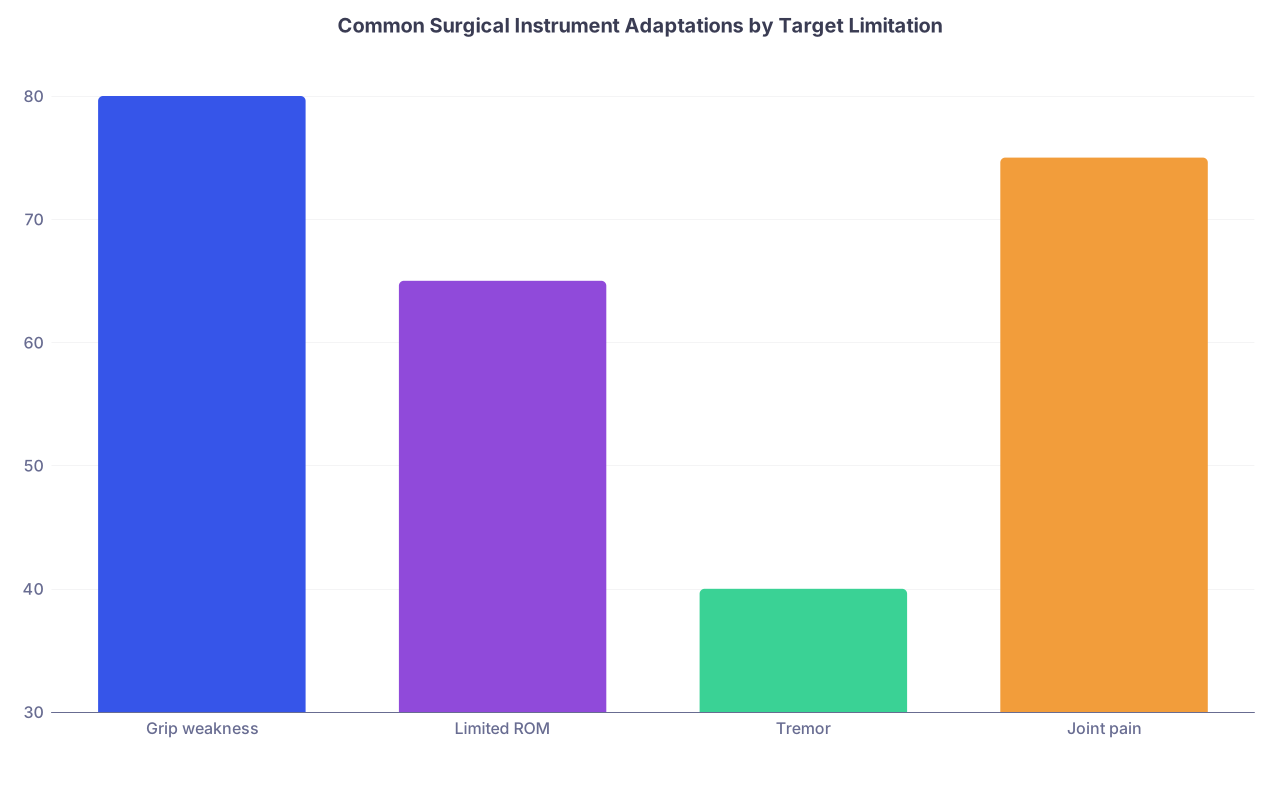
| Category | Value |
|---|---|
| Grip weakness | 80 |
| Limited ROM | 65 |
| Tremor | 40 |
| Joint pain | 75 |
(Values here represent approximate percentage of situations where thoughtful handle adaptation helps. This is not fantasy; in real ORs, better handles solve more problems than people think.)
b. Tremor‑reducing and stability‑assisting tools
For mild tremor:
- Use heavier, more balanced instruments; mass damps high‑frequency tremor
- Wrist rests or forearm supports on the Mayo or side table for micro work
- External stabilizers for endoscopic instruments (simple mechanical arms that hold the scope while you adjust)
For more significant tremor, you enter the realm of robotics and active tremor cancellation.
c. Robotics as a fine motor equalizer
Robotic systems (da Vinci and its competitors) already do three key things for you:
- Tremor filtering
- Motion scaling (large hand movement → small instrument movement)
- Ergonomic posture with armrests and more neutral wrist angles
For a surgeon with fine motor limitations but intact cognitive, visual, and gross motor function, robotics can be a massive enabler.
Scenarios where robotics may offset hand limitations:
- Essential tremor that is noticeable at rest but can be filtered out at the console
- Mild dystonia or spasticity in one hand; the console interface uses a different motor pattern than classic instrument holding
- Limited wrist range of motion; the robotic control handles can be adjusted and used in a more comfortable posture
The catch: you must still pass competency evaluations and handle emergencies. You need a plan for rapid conversion to open if robot fails. That means either your open skills must be adequate, or your team structure must include a co‑surgeon ready to step in for open conversion.
d. Sutures, clips, and closure devices
For people with reduced pinch strength or dexterity:
- Use larger needle sizes where safe; they are easier to control and load
- Use pre‑loaded knotless anchors in orthopedics or sports surgery when possible
- Use skin adhesives and closure strips instead of fine interrupted skin sutures for low‑tension closures
There is no valor in spending 20 minutes doing something a stapler can do in 40 seconds with better consistency.
e. Instrument set customization
This is underused but very powerful: build your own “personalized” tray.
You do not need a disability label to do this. But if you have fine motor issues, it becomes non‑optional.
Personal set might include:
- Specific brands and models of ergonomic needle drivers
- One or two heavier “stability” forceps you prefer for critical steps
- Custom grips or sleeves that scrub techs know to add before your case
- Dedicated micro‑rest platform for your forearms during long delicate work
| Modification | Primary Problem Addressed |
|---|---|
| Enlarged ring sleeves | Limited finger flexion |
| Palm‑grip needle holder | Weak pinch grip |
| Heavier forceps | High‑frequency tremor |
| Wrist/forearm rest platform | Instability, fatigue |
| Barbed sutures | Difficulty with knot tying |
6. Environmental and Setup Modifications
This is the most boring category on paper and the most decisive in practice.
a. Table height and ergonomics
Poor ergonomics amplify minor limitations into major ones.
- Operative field should be at about elbow height with relaxed shoulders
- If you have limited shoulder strength or motor control, you cannot afford elevated arm postures
- For laparoscopy, adjust port placement and monitor height aggressively to maintain neutral wrists
People often forget you can ask for:
- Adjustable standing platforms for you, not just for shorter assistants
- Custom positioning of Mayo stands to allow forearm support
- Different monitor configurations in multi‑screen setups
b. Optical aids
Fine motor work becomes exponentially harder if your visualization is marginal. With limitations, you cannot rely on “feel” as much.
- High‑quality loupes with proper declination angle to avoid neck flexion fatigue
- Use of microscopes for micro tasks even when some attendings “do it by feel”
- Better headlamps or overhead lighting to reduce compensatory postures
If you have mild sensory or proprioceptive deficits, vision becomes your primary feedback channel. Treat it that way.
c. OR workflow and staffing
If your hands have limited endurance, you want predictable, efficient turnover and minimal wasted time with instruments in hand.
- Clear communication with nurse and tech about when you anticipate critical fine motor phases
- Assigning a consistent scrub tech team when possible so they learn your patterns and preferences
- Pre‑briefing about instrument modifications or extra supports required
None of this is exotic. It is just intentional.
7. Role Redesign: Not Every Surgeon Needs the Same Hands
This is the part no one wants to admit out loud: there are different “flavors” of surgical careers. Some are hand‑heavy. Some are brain‑heavy. Some are both.
A surgeon with fine motor limitations might:
- Focus on procedures with larger working envelopes and less micro dexterity (e.g., open colorectal vs intracranial microsurgery)
- Choose subspecialties where planning and interpretation matter more than ultra‑fine manipulation (e.g., surgical oncology with heavy involvement in tumor boards, image‑guided biopsies rather than micro‑anastomoses)
- Move toward hybrid roles: part operative, part interventional, part perioperative leadership or QI
It is not “giving up” to acknowledge that doing coronary bypass grafting or microvascular free flaps may not be compatible with your particular neuromotor profile. It is being honest and strategic.
8. Training, Assessment, and Accommodations: How This Plays Out in Real Life
a. Disclosure and evaluation
In training environments (med school, residency, fellowship), the typical path for someone with fine motor limitations:
- Self‑recognition: You notice difficulty with suturing labs, simulator tasks, or early OR experiences.
- Formal evaluation: Occupational therapy / hand therapy evaluation; sometimes neurology consult if movement disorder suspected.
- Objective testing: Grip strength, range of motion, standardized dexterity tests (Purdue Pegboard, Box and Block, Nine Hole Peg Test, etc.).
- Simulation‑based performance: Virtual reality simulators or box trainers to see if performance improves with practice and modifications.
This matters for two reasons:
- It documents functional limitations for accommodations.
- It separates “I am untrained” from “I am truly limited.”
b. Reasonable accommodations in training
Common, defensible accommodations:
- Extended time on skills assessments (e.g., knot tying stations)
- Alternative equivalent procedures for demonstration of competency (e.g., using barbed sutures where appropriate)
- Access to adaptive instruments, custom grips, or loupes funded by the institution
- Modified call schedules if fatigue significantly worsens motor performance late in long shifts
Less defensible: asking to be exempt from core procedural skills that are intrinsic to the specialty (e.g., never having to perform suturing in a general surgery residency). Programs still have to ensure patient safety and meet accreditation standards.

| Step | Description |
|---|---|
| Step 1 | Notice difficulty with fine tasks |
| Step 2 | Seek evaluation OT or hand specialist |
| Step 3 | Objective motor testing |
| Step 4 | Simulation with standard tools |
| Step 5 | Train and monitor |
| Step 6 | Introduce adaptations |
| Step 7 | Repeat simulation |
| Step 8 | Implement in OR |
| Step 9 | Reconsider role or specialty |
| Step 10 | Performance adequate? |
| Step 11 | Safe and efficient? |
c. Legal and ethical frame (briefly)
- Under disability law in many countries (e.g., ADA in the US), institutions must provide reasonable accommodations that do not fundamentally alter essential job functions or compromise safety.
- Essential functions in surgery include safe performance of procedures, not necessarily performance in a specific traditional way.
The ethical core: patients must not be put at risk by hidden limitations. That means transparent, honest assessment and, when in doubt, supervised practice until outcomes match peers.
9. Future Devices and Directions: Where This Is Actually Going
We are just scratching the surface. Expect three big shifts.
1. Smarter, adaptive instruments
Think of:
- Needle drivers with integrated haptic assist: subtle resistance that keeps your motion on a smoother trajectory
- Powered micro‑instruments that amplify gross motion into fine, filtered motion at the tip
- Real‑time tremor cancellation handpieces similar to what exists in neurosurgical research prototypes
2. Expanded use of teleoperation and shared‑control robots
Not just big robots for pelvis or chest.
- Compact, affordable teleoperated platforms for microsurgery, ophthalmology, ENT
- “Shared control” where the system knows the optimal path or plane and subtly resists deviations, preventing motor slips
For a surgeon with imperfect hands but excellent judgment, this is a leveling field.
3. Better training pipelines for surgeons with disabilities
I expect to see:
- Skills labs explicitly designed for diverse motor profiles, not just the mythical “normal hand”
- Formalized pathways where medical students with disabilities can have early, honest assessment plus exposure to adaptive tech before choosing a specialty
- Cross‑disciplinary partnerships between surgeons, rehabilitation engineers, and occupational therapists
Right now, many surgeons with mild limitations improvise alone. The next generation will not have to.
10. Case‑Style Scenarios: What This Looks Like in Practice
Scenario 1: Mild essential tremor, aspiring general surgeon
Problem: Visible but mild tremor at rest, worse with fatigue. Excellent visual and cognitive abilities.
Adaptive approach:
- Early heavy use of laparoscopic simulation with attention to camera control and instrument stability
- Preference for minimally invasive and robotic approaches where tremor filtering helps
- Selection of slightly heavier, well‑balanced open instruments for vascular control and suturing
- Ergonomic optimization, strict caffeine control on OR days, and sleep hygiene to minimize physiologic tremor
Outcome: Fully functional general surgeon; avoids ultra‑fine reconstructive microsurgery, focuses on colorectal and upper GI with robotics.
Scenario 2: Congenital absence of two digits on nondominant hand
Problem: Limited ability to perform classic two‑hand knot tying and retraction patterns.
Adaptive approach:
- Customized instrument grips to improve hold with altered anatomy
- Modified knot‑tying techniques using instrument‑assisted throws
- Assistant‑heavy approach to tasks requiring bimanual equal dexterity, with surgeon directing and performing key steps (dissection, decision making, anastomoses with adapted grips)
Outcome: Successfully operating within chosen field, documented competency using adapted techniques, patient outcomes comparable to peers.
FAQ (5 Questions)
1. Can someone with a significant hand tremor safely perform surgery?
Sometimes, but not always. Mild to moderate tremor can often be managed with a combination of ergonomics, instrument choice, medication, and especially robotics, which provides tremor filtering. However, if the tremor remains uncontrolled during critical tasks, particularly in microsurgery or high‑risk fields like neurosurgery, it may not be safe. The decision has to be based on objective performance data in simulation and supervised cases, not on self‑confidence alone.
2. Are residency programs actually willing to provide adaptive instruments and accommodations?
Some are, some drag their feet. The ones that understand both disability law and workforce reality are increasingly open to customized trays, ergonomic supports, extended training time, and altered workflows. You usually need formal documentation, a clear functional assessment, and concrete proposals that do not undermine patient safety. Having occupational therapy and disability services involved helps a lot.
3. Is robotics the answer for all fine motor problems?
No. Robotics helps with tremor, motion scaling, and ergonomics. It does not fix slow decision‑making, poor spatial understanding, or complete absence of hand control. And you still need enough motor function to manage emergencies, convert to open when required, and perform basic procedures in non‑robotic environments. Robotics is a powerful tool, not a magic equalizer.
4. How early should a medical student with fine motor issues seek evaluation if they are considering surgery?
Early. Ideally before or during the first serious exposure to procedural skills—suture labs, early OR or simulation experiences. Waiting until late in clinical years or after matching into a surgical specialty is a recipe for stress and limited options. Early assessment lets you (1) train smarter, (2) test adaptations in simulation, and (3) make an informed decision about which specialties and roles are realistic.
5. Are there surgical specialties that are generally more compatible with fine motor limitations?
Broadly, fields that rely less on ultra‑fine microsurgery and more on macro‑level dissection and decision making are more compatible. For example, some areas of general surgery, surgical oncology, and trauma may be more forgiving than plastic microsurgery, ophthalmology, or complex neurosurgery. But this is not absolute. The better approach is to map your specific limitations against the actual task profiles of particular subspecialties and procedures.
Key points to walk away with: fine motor limitations do not automatically end a surgical career; they demand ruthless task analysis and honest assessment. Adaptive strategies span far beyond gadgets—technique, roles, environment, and robotics all matter. And the future of surgery will likely be much more inclusive, because the tools are finally catching up to the talent.