What if that one failed exam you took without accommodations is the thing that quietly kills your future in medicine—and you won’t even know until it’s too late?
That’s the kind of thought that sits in my brain at 2 a.m. and refuses to leave. You probably know the one I mean:
“I failed this because I didn’t have accommodations. Now it’s on my record. Programs will see it. They’ll judge me. They’ll assume I’m just ‘not cut out for it.’ And I can’t undo it.”
So let’s actually walk through this. Because pretending “it’s fine, don’t worry” doesn’t help when your brain is busy building worst‑case scenarios.
First: Is One Failed Exam Without Accommodations Fatal?
Short answer: no. Annoying answer: it depends what exam, what pattern, and what you do next.
There are three big questions that really matter:
- What exam did you fail?
- Was this a one‑off, or part of a pattern?
- Did you eventually get accommodations and improve?
| Exam Type | Typical Impact if Failed Once | Can It Be Recovered From? |
|---|---|---|
| Undergrad midterm/final | Low–moderate | Almost always |
| Undergrad course (F/withdraw) | Moderate | Usually, with context |
| MCAT | Moderate | Yes, with retake + story |
| Medical school course exam | Moderate | Yes, if trend improves |
| Shelf exam | Moderate–high | Yes, but needs explanation |
| Step/Level 1 or 2 | High | Sometimes, with strong plan |
You failing:
- An undergrad orgo midterm without extra time? Annoying but fixable.
- A med school systems exam before you got ADHD/LD formally diagnosed? Hard, but explainable.
- Step 1 or Step 2 without accommodations? That’s rough, but not an automatic “you’re done.”
Programs don’t only look at scores. They look at:
- Trends (did you adapt and get better?)
- Context (disability, life events, timing)
- What happened after (did you secure accommodations, retake, improve?)
The piece that keeps you up at night is the permanence. You can’t delete that failure. It’s in a transcript, in an internal file, in some dean’s letter draft. Feels like a tattoo you didn’t consent to.
But in actual practice? Faculty are used to seeing imperfect humans. They see:
- People who bombed pre‑accommodation and then stabilized.
- People whose disability diagnosis came late.
- People who took way too long to admit they were drowning.
I’ve watched committees talk. I’ve heard the literal phrases:
- “This failure is pre‑diagnosis and pre‑accommodations. Look at the improvement after.”
- “There’s a clear explanation in their dean’s letter. I’m not worried about this now.”
- “They failed early and then consistently passed Step exams with support. I’m okay with that.”
One failure does not kill you. Silence and no pattern of improvement—that’s what makes them nervous.
The “Without Accommodations” Part: Does Anyone Care About That Detail?
This is where it gets twisted in your head.
You think:
“They’ll see I failed. They won’t see I had untreated ADHD/dyslexia/anxiety and no extra time or quiet room. So they’ll misjudge me.”
Reality is more nuanced.
Programs don’t see the behind‑the‑scenes of your accommodations process unless:
- You explain it in your application/disability essay/secondary.
- It’s summarized in your dean’s letter/MSPE.
- You talk about it in an interview.
They usually don’t see: “This exam was taken without accommodations, but all future ones were with.”
So that “without accommodations” detail matters mostly in two places:
How you interpret your own potential.
Right now, you’re probably thinking, “Maybe this shows my true ability without help.”
No, it shows your performance without the legally allowed support that you qualify for. That’s not “true ability,” that’s “untreated barrier.”How you explain the turnaround.
If you have a clear story like:- Failed X exam
- Got evaluated
- Received formal diagnosis
- Implemented accommodations
- Improved performance
That story is actually compelling to a lot of people. It reads as insight, advocacy, and resilience—not as weakness.
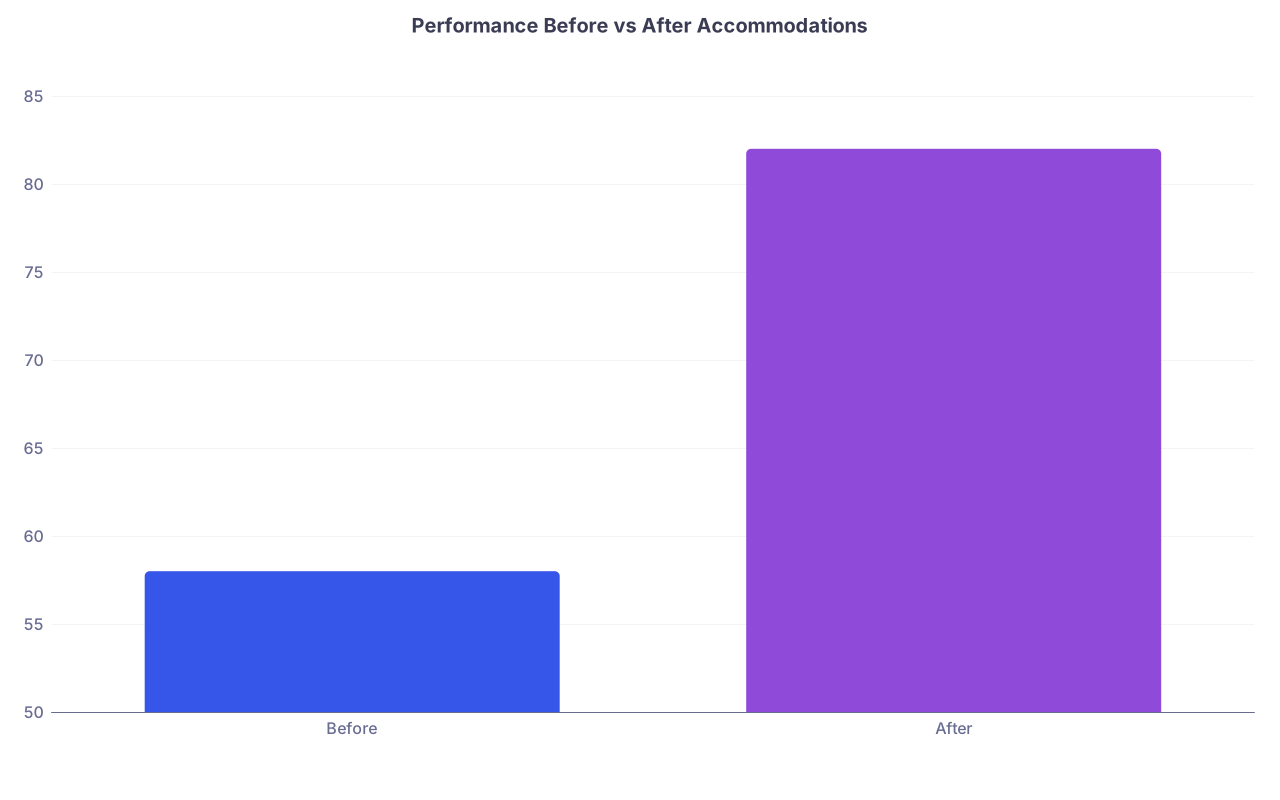
| Category | Value |
|---|---|
| Before | 58 |
| After | 82 |
No one is thrilled to see a failure. Let’s be honest. But most doctors understand two things:
- Disabilities get missed for years.
- Systems are slow and resistant to granting accommodations.
So “I failed this because I didn’t have accommodations yet” isn’t a random excuse. It’s how this usually unfolds in real life.
Will Programs Think I’m “Gaming the System” If I Bring This Up?
This is the paranoid, ugly fear:
“If I explain the failure by pointing to my disability, they’ll think I’m blaming or manipulating.”
Some people will think that, yes. Some will always be suspicious of accommodations. You don’t want to train under them anyway.
But most decent programs aren’t mad that you needed support. They’re worried about one thing:
“If we train this person, can they safely and reliably meet the demands of residency with the support they’re likely to have?”
Brutal, but that’s the operational question.
So your job isn’t to convince them you’re “just like everyone else.” Your job is to show:
- You understand your disability and how it shows up.
- You’ve already done the hard work to get evaluated and get accommodations.
- With appropriate support, you have already functioned at the needed level (passing courses, boards, etc.).
I’d frame it this way in your own head:
- Not: “I failed because of my disability, feel bad for me.”
- Instead: “My path to diagnosis was delayed, which affected my early performance. Once I had accommodations, my performance stabilized and now reflects my true capacity.”
That’s not gaming the system. That’s using the system as it’s supposed to work, even though it came late.
What If the Failure Is on a High‑Stakes Exam (Like Step/Level)?
Okay, let’s go darker, since your brain is going here anyway.
Say you:
- Took Step 1 or Step 2 without accommodations.
- Failed.
- Later got a formal diagnosis and now qualify for accommodations.
- Retook and passed (maybe higher, maybe just barely).
Is that a problem? Yes. Is it automatically game‑over? No.
Here’s how programs tend to mentally sort this:

They may think:
- “This person struggled at the highest‑stakes level.”
- “But they improved after diagnosis/accommodations.”
- “Can they handle our specialty? What support do we have?”
Some specialties are ruthless. Derm, plastics, ortho—the bar is higher and one failure hurts more. But in more holistic fields (FM, psych, peds, IM, etc.), I’ve seen people match after a failed Step—especially with a clear disability story and strong subsequent performance.
Where you get into trouble is:
- Failure + no later explanation
- Failure + no sustained improvement
- Failure + chaotic narrative (“I just had a bad day” x3)
If your record shows:
- One failed attempt without accommodations
- Followed by: diagnosis, documentation, approved accommodations
- Followed by: passing score, stable in‑school performance, decent clinical evals
Then your story becomes: “I struggled until my disability was treated as real, and then I normalized.”
That is not a death sentence. That is exactly the kind of narrative committees can work with.
What Should I Actually Do Now? (Not Vague “Advocate for Yourself” Stuff)
The worst feeling is: “I messed up, and now I just have to sit with it.” You don’t.
Here’s what I’d be doing, step by step, if I were in your exact situation.
1. Lock Down Your Diagnosis and Documentation
If you suspect a disability but don’t have formal paperwork yet:
- Get on a waitlist for proper testing or evaluation.
- Push for it. Politely, but annoyingly.
- Ask disability services what exactly they need for exam accommodations in your setting (med school, MCAT, NBME, etc.).
Until it’s formal, it doesn’t exist in the eyes of testing bodies. That’s harsh, but true.
2. Secure Accommodations for Every Future High‑Stakes Exam
Priority list:
- Any remaining school course/shelf exams
- Step/Level exams (if not done yet)
- OSCEs/clinical skills stuff
- In‑training exams in residency (down the line)

| Step | Description |
|---|---|
| Step 1 | Failed exam without accommodations |
| Step 2 | Suspect disability |
| Step 3 | Formal evaluation |
| Step 4 | Diagnosis documented |
| Step 5 | Apply for accommodations |
| Step 6 | Accommodations approved |
| Step 7 | Retake or future exams |
| Step 8 | Improved performance trend |
| Step 9 | Explain story in applications |
Even if you think, “I don’t want to look weak, I’ll just power through,” remember: the first failure is already “on the record.” Refusing accommodations now doesn’t erase that. It just increases the odds of a second hit.
3. Start Building the “Before vs After” Story—With Actual Data
Programs like numbers.
If you can show:
- Pre‑accommodations: inconsistent, borderline, or failing
- Post‑accommodations: passing, stable, maybe even improving
That’s not just a nice story, that’s evidence.
Track:
- Course grades before vs after support
- Practice test scores with vs without your accommodations setup
- Actual exam performance over time
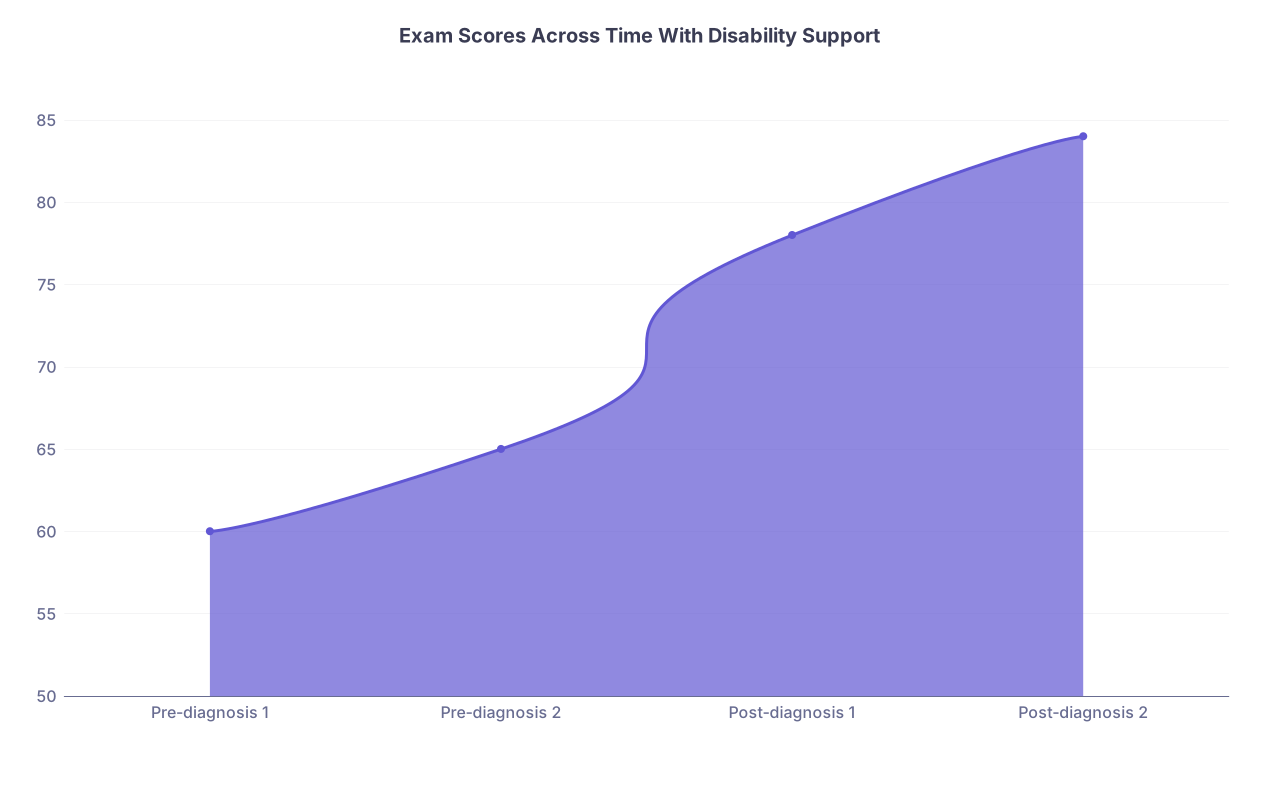
| Category | Value |
|---|---|
| Pre-diagnosis 1 | 60 |
| Pre-diagnosis 2 | 65 |
| Post-diagnosis 1 | 78 |
| Post-diagnosis 2 | 84 |
You can literally say in an essay or conversation:
“Before formal evaluation and accommodations, my exam performance was unstable, including a failing score on [exam]. After diagnosis and consistent accommodations, my scores have been [X–Y range] and I’ve passed every subsequent high‑stakes assessment.”
That’s not spin. That’s just describing what happened.
The Part Nobody Says Out Loud: Internalized Ableism
Let’s be blunt: a lot of the panic around “I failed without accommodations” isn’t just fear of programs. It’s self‑judgment.
Some part of you is asking:
- “If I need extra time, am I actually good enough for this field?”
- “Does that failure show who I really am when no one is helping me?”
- “Am I going to be unsafe as a doctor if I can’t test like everyone else?”
Here’s the messed‑up truth: medicine is built on this myth of the “perfect, tireless brain” that never needs adjustments. That myth is a lie.
Real practice is:
- Using references
- Consulting colleagues
- Having nurses/residents/EMR systems catch things
- Working in teams
- Having checklists and timers and alarms
Accommodations in training are not cheating. They’re a bridge between how your brain is wired and how the system decides to measure you.
You failing without accommodations doesn’t prove you’re incapable. It proves the system measured you in a way that wasn’t aligned with your actual functioning.
You passing with accommodations proves something much more important:
With the support you qualify for, you can do the work.
That’s what matters in the long run.
How Do I Talk About This Without Sounding Like I’m Making Excuses?
This is where you need to thread a needle: take responsibility and acknowledge barriers.
You don’t say:
- “I failed, but it wasn’t my fault at all.”
- “My disability made me do it.”
You say something more like:
- “I struggled early because my disability wasn’t diagnosed yet, and I didn’t know how to ask for help.”
- “Once I understood what was going on and got formal support, my performance stabilized.”

Framework that tends to land well:
- Briefly name the problem (failure, struggle).
- Connect it to the missing piece (undiagnosed disability, lack of accommodations).
- Describe what you did about it (evaluation, therapy, coaching, time management, official accommodations).
- Show the result (stronger performance, more sustainable functioning).
You’re not asking them to ignore the failure. You’re asking them to interpret it within the right story arc.
Okay, But Honestly—Did I Ruin My Chances?
No. You changed the shape of your path, but you did not end it.
Here’s the reality, stripped of sugarcoating:
- Some opportunities might be harder now. Certain hyper‑competitive specialties or “top 5” programs may be less realistic, depending on the rest of your record.
- Many, many programs and specialties will not care about a single failure if:
- It’s not part of a long pattern.
- You have a documented disability.
- Your later performance is solid.
Medicine is full of people with:
- Step failures
- Course repeats
- LOAs
- Mental health breaks
- Late diagnoses
They don’t advertise them on Instagram, but they’re there. Teaching. Operating. Running clinics. Matching residents.
Your job from here:
- Stop trying to retroactively erase what happened. You can’t.
- Build the strongest possible “after accommodations” record.
- Get honest with yourself about where your record is competitive—and where it’s not.
- Protect your brain and body so you don’t keep paying for a system that already under‑supported you.

You didn’t ruin your chances. You hit a wall that showed you what support you actually need to keep going.
That’s not the end. That’s the pivot point.
FAQ (Exactly 5 Questions)
1. Should I retake an exam I failed only to show what I can do with accommodations?
If it’s a high‑stakes exam you’re allowed to retake (MCAT, a course, sometimes a shelf), and your future path depends on that score, then yes, a retake with accommodations can be powerful. But don’t retake casually. Make sure:
- You have official accommodations in place.
- Your practice scores with accommodations are clearly higher.
- You have the time/energy to prep properly.
For something like Step 1, you often can’t just “retake to prove yourself” unless you failed—so the window is narrow.
2. Do I have to disclose my disability in applications to explain the failure?
No, you don’t have to. But if you don’t, then committees just see “failure” with no context. If you’re comfortable, a brief, clear explanation tied to a now-diagnosed and accommodated disability usually helps more than it hurts—especially if your later record is stronger. You can also keep details minimal: name the type of challenge (learning/attention) without listing every diagnosis.
3. Will residency programs know my exact accommodations history?
Generally, no. They don’t get a report that says, “This person had 50% extra time + separate room.” They see your scores, your transcript, dean’s letter, and what you choose to share. If you need accommodations during residency, that becomes a conversation with GME and HR later—not something automatically transmitted from med school.
4. What if my school or testing body denied my accommodations request and I failed—am I just stuck with that?
It’s awful, but it happens. You’re not stuck in the sense that you can’t move forward, but you may have to:
- Appeal or reapply for accommodations with stronger documentation.
- Get your disability office to write a letter explaining the timing and struggle.
- Make your case in your application narrative.
Denial doesn’t mean you didn’t need the support. It often just means the paperwork or timing wasn’t what that particular committee wanted.
5. How many failures are “too many” before it really does start closing doors?
One isolated failure with a clear disability story and solid later performance? Usually survivable. Two? Still workable in some contexts, but you’ll need strong improvement and honest advising. More than that, especially across multiple stages, and some doors will absolutely close. That’s when you have to be strategic about specialty, program type, and where you can realistically thrive. But even then, “closed doors” is not the same as “no doors.” People with messy transcripts still end up as good doctors.
Key points to hold onto:
- One failed exam without accommodations did not end your career; it just changed your narrative.
- Your power now is in getting formal support, building a strong “after accommodations” record, and telling that story clearly.
- You’re not broken for needing accommodations. You’re just finally playing by rules that were always supposed to apply to you.