The fear that appealing an accommodation denial will ‘mark you forever’ is massively exaggerated.
I’m saying that bluntly because I know the loop your brain is stuck in:
“If I push back, they’ll think I’m difficult. If I accept it, I might fail. If I appeal and lose, I’ll be blacklisted. If I don’t appeal, I’ll regret it forever.”
Welcome to the fun mental prison of needing disability accommodations in medicine.
Let’s walk straight into the ugliest fears and deal with them one by one. Not sugarcoated. But also not amplified beyond reality.
The Core Fear: “If I Appeal, They’ll Punish Me”
Here’s the nightmare version your brain is running:
You file an appeal after a denial from a school, board, or testing agency (NBME, USMLE, NBOME, MCAT, COMLEX, etc.).
They get annoyed. They quietly flag your file. They deny everything forever. They maybe even retaliate or “make an example” of you.
I’ve heard people say this out loud in advising sessions:
- “If I appeal, will they be harsher with me next time?”
- “What if they write in my file that I’m a problem student?”
- “Can they tell residency programs I asked for accommodations?”
Here’s the unpleasant but honest answer:
- They’re not supposed to retaliate. Like, legally. Disability laws (ADA in the U.S., similar laws elsewhere) treat retaliation very seriously.
- Most large testing agencies and schools are terrified of being sued for retaliation. They move cautiously, document everything, and care way more about legal exposure than about punishing you for asking.
- But. They’re also human. Bureaucratic, conservative, slow, defensive humans. And that feels like punishment, even when it’s just red tape.
So can appealing “backfire”? In the huge majority of cases, no, not in the catastrophic way your brain is imagining. You don’t get blacklisted because you politely and properly used the process they themselves created.
What you might experience instead: stress, delays, extra paperwork, and a feeling that you’re shouting into a void. Which is awful, but different from “they’ll destroy my career.”
What Actually Happens When You Appeal
Let’s demystify this, because the unknown is what fuels the terror.
Most accommodation appeal processes on tests (Step, COMLEX, MCAT, shelf exams, etc.) look something like this:

| Step | Description |
|---|---|
| Step 1 | Initial Denial |
| Step 2 | Read Denial Rationale |
| Step 3 | Gather Additional Documentation |
| Step 4 | Submit Appeal Packet |
| Step 5 | Review by Different Reviewer or Committee |
| Step 6 | Accommodation Granted |
| Step 7 | Options - Reapply or Legal Advice |
| Step 8 | Decision |
Notice a few things:
The appeal is usually reviewed by a different person or a small committee. There’s a structure. They’re not supposed to just rubber-stamp “no” out of spite because you dared to ask again. They have procedures and checklists and legal counsel breathing over their shoulder.
You’re not “complaining.” You’re using the formal mechanism they designed for exactly this situation: when a denial doesn’t seem to match your documented disability and functional impairments.
Does it feel like you’re being difficult? Absolutely. Especially if you’re already someone who hates “making waves.”
But in their world, you’re Case #178 this month.
That’s actually good for you.
The Real Risks (They’re Different Than You Think)
Let me be depressing for a second, but constructively.
The bigger real risks of appealing are usually:
- Time delays. If your appeal drags on, it can affect when you test, when you can schedule rotations, or if you can graduate on time.
- Emotional burnout. Writing yet another explanation about why your brain or body works differently is exhausting. Re-reading DSM codes and psych reports about yourself is not fun.
- Financial strain. Updated evals, extra testing, letters—this stuff is expensive and rarely fast.
Those are real. They’re not imaginary.
But they’re not the same as: “If I appeal, they’ll hate me and ruin my future.” That’s anxiety talking.
If you’re going to be afraid (and let’s be honest, you already are), at least be afraid of the right things so you can plan for them.
Does Appealing Hurt You in the Future?
Let’s hit a few specific “what if they…” scenarios that bounce around at 3 a.m.
“What if they remember me as the ‘difficult one’?”
For big national exams (NBME, NBOME, AAMC, etc.): you are a file number. Unless you’ve threatened people personally or sent unhinged emails, they’re not sitting there gossiping about you in committee meetings. They absolutely care more about compliance and consistency than about petty grudges.
For your medical school: there’s a bit more nuance. Schools are smaller. People talk. But here’s the key distinction:
- Asking for accommodations.
- Appealing a denial through the official process.
- Working with disability services, providing documentation.
These are all normal, expected, and (legally) protected.
What gets remembered negatively is usually:
- Aggressive or hostile emails.
- Threatening staff personally.
- Going around the process 10 different ways and trying to pit people against each other.
If you’re respectful but firm, clear, and documented? You’re more likely to be remembered as “organized and persistent” than “problematic.”
“Can they tell residency programs I asked for accommodations?”
Almost always: no.
Residency programs don’t get a little note on ERAS saying “By the way, this person had extra time on Step 2” or “Used testing accommodations.” Testing agencies don’t publish that. It’s not on your score report.
Your school also isn’t supposed to tell programs you’re disabled or used accommodations unless you disclose it or there’s some directly relevant thing (like a leave of absence that shows on your transcript and you choose to explain).
Some people actually choose to mention their disability and accommodations as part of their story. That’s a separate conversation. But it’s voluntary.
When Could an Appeal Actually “Backfire”?
Let’s be brutally honest about the edge cases, because pretending they don’t exist doesn’t help.
Here are the rare but real ways things can go sideways:
- You appeal with obviously weak or inconsistent documentation, and now they’re much more alert and strict in future requests from you because your case looks shaky on paper.
- You behave in a way that crosses lines—harassment, personal attacks on staff, threats—and now they involve legal/administrative channels, and that absolutely can affect your relationships and reputation.
- You drag out a battle so long that it collides with deadlines (exam registration, progression requirements, graduation timelines), and that indirectly hurts you even if your request was reasonable.
Notice that these are all about process, behavior, and timing. Not the bare fact of appealing itself.
Appealing, done properly, doesn’t mark you as toxic. It marks you as someone who used the system available to you.
How to Appeal Without Destroying Your Sanity (or Case)
Let’s get practical, because anxiety hates vagueness.
If you decide to appeal, you want two things at the same time:
- To maximize your actual chances of success.
- To minimize the emotional carnage to yourself.
A few things that help:
1. Treat your appeal like a legal document, not a vent diary.
You can scream into your pillow. You cannot scream into the PDF. Your written appeal should answer:
- What’s my diagnosis?
- What are my functional impairments (what I can’t do in a standard testing environment)?
- What accommodations am I requesting, and why do they directly address those impairments?
- How does my documentation support this?
2. Use their language against them (politely).
If their denial letter says: “Insufficient evidence of functional impairment,” then your appeal should literally structure itself around “Evidence of functional impairment,” with concrete examples from testing history, school records, and clinical or academic situations.
3. Strengthen your documentation, don’t just resend it.
Appeals that say “see attached, again” usually go nowhere. Things that can bolster your case:
- Updated neuropsych evaluation with specific test scores and explicit accommodation recommendations.
- Letters from treating clinicians that describe functional impairment in testing conditions, not just “has ADHD/anxiety/depression/LD.”
- Academic records showing a pattern: significant gap between knowledge and timed performance, repeated failures without accommodations, improvements when you have informal accommodations.
4. Keep all your communication in writing.
Phone calls are tempting, but you need a paper trail. If you do speak by phone, send a follow-up email: “To summarize our call today…” You’re not being paranoid. You’re being smart.
5. Get help if you can.
Disability services, a trusted dean, sometimes even a disability rights attorney. There are also organizations and advocacy groups that have literally read hundreds of these denials and know what works.
Comparing Doing Nothing vs Appealing
Your brain is probably spinning between “What if I make it worse?” and “What if I ruin my life by doing nothing?”
Let’s put those side by side.
| Option | Main Risk | Main Benefit |
|---|---|---|
| Appeal | Time, stress, possible delay | Chance at fair accommodations |
| Do Nothing | Underperform, burnout, failure risk | No conflict, no delays |
| Reapply Later | More waiting, added cost | Stronger documentation, fresh review |
The “do nothing” path feels safer because it doesn’t trigger confrontation. But the quiet risk of failing an exam you could’ve passed with proper support? That’s not a small thing. That’s the part people regret years later.
What If I Appeal and Still Get Denied?
This is the fear under all of it: you fight, you expose your vulnerabilities, you relive every failure in print, and they still say no.
What then?
You still haven’t “ruined” anything by appealing. What you have done is:
- Created a written record that you asked for help and were denied.
- Clarified what documentation they consider “not enough,” which is weirdly useful if you decide to escalate legally or try again later.
- Tested their system. You now know: this isn’t just an oversight; they are currently not willing to grant this.
From there, your options are more concrete:
- Sit for the exam without accommodations and have realistic backup plans if the score is not what you want.
- Delay and build stronger documentation, then re-request or appeal again later.
- Talk to a disability rights attorney or advocacy org about whether your denial is potentially unlawful or out of line with typical standards.
- Adjust your plans or timeline in a way that doesn’t destroy you (extra prep time, changing test dates, staying on lighter rotations while studying).
None of these are fun. But none of them are “your career is over because you dared to appeal.”
The Quiet Truth: Medicine Is Still Bad at Disability… But You’re Not Wrong for Asking
Here’s the part nobody likes to say out loud:
Medicine likes to talk about resilience, grit, and “wellness.” It’s still deeply uncomfortable with disability, especially invisible disability. There’s still suspicion. Still “Are you just looking for an advantage?” whispered under the surface.
So if you feel like a burden for asking, that’s not in your head. That’s the culture leaking into you.
But here’s what’s also true:
You didn’t ask to have ADHD, dyslexia, a learning disability, anxiety that explodes under timed conditions, chronic illness, or any of it. You’re not asking for an unfair leg up; you’re asking not to be crushed by a system designed for neurotypical, non-disabled people who can sit for 8 straight hours like robots.
Appealing a denial is not a character flaw. It’s not “gaming the system.” It’s you saying, “I know I’m capable, and I’d like to be tested on my knowledge, not my limitations.”
That’s not selfish. That’s survival.
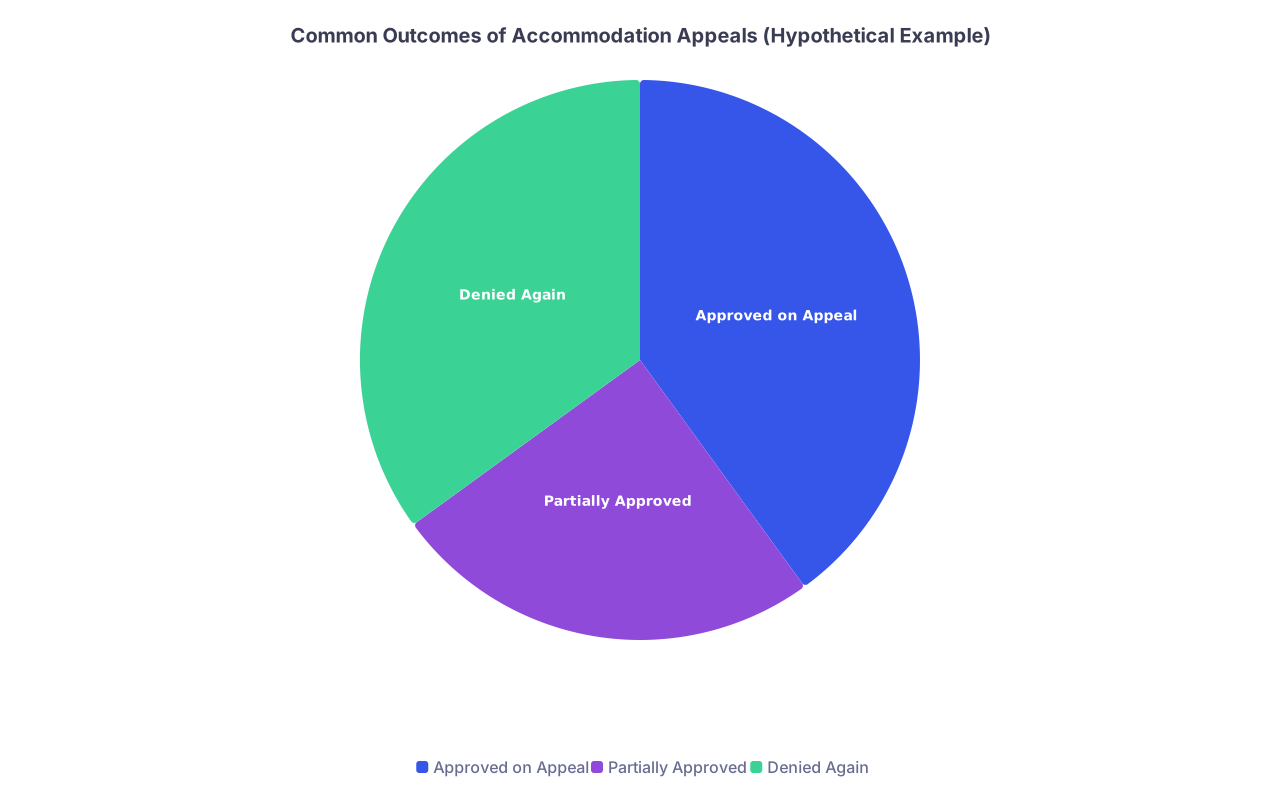
| Category | Value |
|---|---|
| Approved on Appeal | 40 |
| Partially Approved | 25 |
| Denied Again | 35 |
Even if the numbers in real life vary, a significant portion of appeals do get approvals or partial wins. The idea that “no one ever gets approved on appeal” is just not true.

How to Decide If You, Specifically, Should Appeal
Here’s the uncomfortable but necessary self-interrogation:
- Would taking this exam without accommodations put you at high risk of failing or underperforming compared to your actual knowledge?
- Do you have at least some documentation that a reasonable person could look at and say, “Yeah, that tracks”?
- Is your mental health in a place where going through more paperwork and waiting won’t completely destabilize you?
If the honest answers are:
- Yes, I’m at real risk without accommodations.
- Yes, my documentation is imperfect but real.
- I’m anxious but can get support and survive the process.
Then appealing is usually the less damaging path long-term, even if it feels like stepping into enemy territory.
If instead you’re thinking:
- My symptoms are milder or newer; I have almost nothing documented.
- The test date is very soon; any delay would wreck my graduation or visa or life.
- I’m barely holding it together as it is.
Then you might still appeal, but you’d also immediately start planning alternate routes and timelines. That’s not failure. That’s strategy.
A Quick Reality Check on Worst-Case Thinking
Your brain is probably running some version of: “If I appeal and upset them, I’ll never match, everyone will know, my career is over.”
Let’s test that against reality:
- Programs don’t see your accommodation history.
- Testing agencies are not allowed to retaliate against you for using their official process.
- There are plenty of doctors who used accommodations on big exams and are now practicing. Patients don’t get a pop-up saying “your doctor had 50% extra time on Step 2.”
You’re not asking for something outrageous. You’re asking to be allowed to show what you can actually do.
And honestly? The bigger tragedy I see is not people who appealed and “ruined” things. It’s people who were too scared to appeal, took the exam without what they needed, underperformed, and then spent years rebuilding confidence and scrambling around that one bad score.
That regret is heavy.

FAQ (Exactly 4 Questions)
1. Could appealing my accommodation denial make them stricter with me in the future?
They might scrutinize your documentation more closely after a denial and appeal, but that’s about consistency and legal protection, not punishing you. As long as you’re respectful and your documentation is honest and strengthening over time, you’re not branding yourself as “trouble.” You’re showing persistence and seriousness. That’s not a bad thing.
2. Will residency programs or future employers know that I appealed or used accommodations?
No, not from the testing agency or your score report. Your Step, COMLEX, or MCAT score doesn’t list “tested with accommodations.” Programs don’t get a secret memo. The only way they’d know is if you or your school disclose it directly or indirectly (e.g., if you choose to talk about your disability in your personal statement or an LOA is on your transcript and you explain why).
3. What if my documentation isn’t perfect—should I still appeal?
If your functional impairments during testing are real and significantly affecting your performance, and you have at least some credible documentation, appealing can still be reasonable. But you should treat the appeal as a chance to upgrade that documentation: updated evals, clearer letters, more detailed explanations. If you know your file is very thin, consider whether a short delay to get stronger evidence is better than rushing a weak appeal.
4. Is it ever smarter not to appeal a denial?
Yes. If appealing would create a timing disaster (like missing a critical exam window), or your documentation is genuinely not ready, or your mental health is so fragile that another round of denials would be dangerous for you, it can be strategic to regroup instead. That might mean testing without accommodations with backup plans, or delaying the test to build a stronger case. Not appealing right now doesn’t mean you gave up forever; it means you’re choosing the battle you can survive.
Key takeaway #1: Appealing an accommodation denial almost never “blacklists” you or ruins your career. The horror story your brain is telling you is louder than reality.
Key takeaway #2: The bigger risks are stress, delay, and weak documentation—not retaliation. If you appeal, do it strategically, calmly, and with stronger evidence.
Key takeaway #3: You’re not wrong, selfish, or difficult for asking to be tested on your knowledge instead of your disability. That’s not gaming the system. That’s leveling the field.