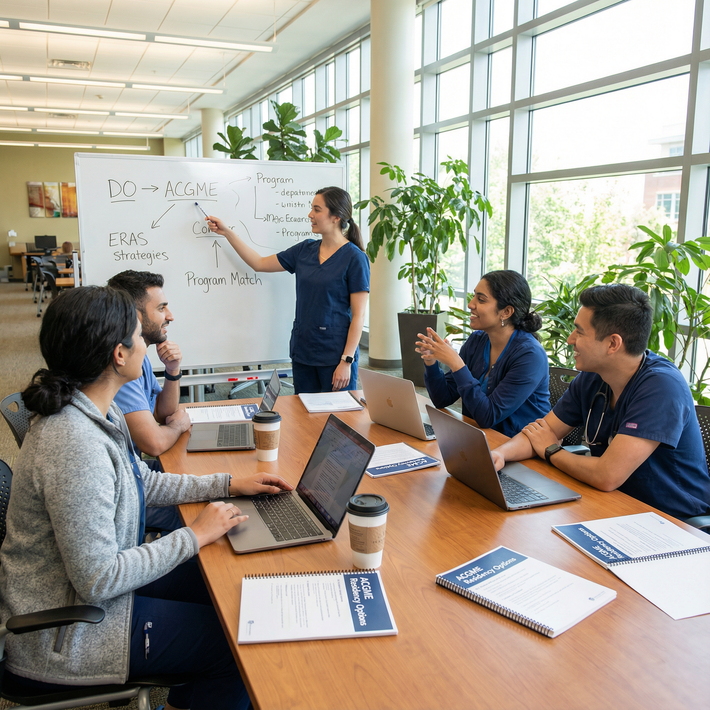
The biggest mistake third‑year DO students make is treating rotations like random clinical experiences instead of a deliberate visibility campaign for ACGME programs.
You’re not just learning medicine this year. You’re quietly auditioning. For PDs who still don’t fully ‘get’ osteopathic training, your schedule is your argument.
Here’s how to build that argument month‑by‑month.
Big Picture: Your ACGME Visibility Strategy
Before we go month‑by‑month, you need the core framework. Otherwise you’ll just rearrange chaos.
There are four visibility pillars you’re trying to hit:
- Early competence – Show by late 3rd year that you’re solid on the floor and in clinic.
- Strategic ACGME exposure – Be physically present at ACGME programs that actually take DOs.
- Letters with ACGME credibility – LORs from faculty who sit on ACGME selection committees or are well known in the specialty.
- Timing that matches the application cycle – Rotations completed early enough that letters and evaluations hit ERAS before programs really scrutinize apps.
At this point, if you’re at the start of third year, your job is to map:
- Which core rotations are fixed by your school
- Which elective/selective blocks you can move
- When your school expects you to take COMLEX Level 2 / USMLE Step 2
- Which specialties and regions you’re realistically targeting
Only then do you start plugging in ACGME‑facing rotations.
Third Year Overview: What Needs To Happen When
Let’s assume a pretty common 3rd‑year calendar: July–June. If your year starts in May or June, shift everything earlier by 1–2 months.
Here’s the year in quarters first, then we’ll go month‑by‑month.
| Quarter | Main Focus | ACGME Visibility Goal |
|---|---|---|
| Q1 (Jul–Sep) | Core skill building | Do well in IM/Surgery; identify target specialties/programs |
| Q2 (Oct–Dec) | Performance + networking | Start ACGME exposure at local/regional sites |
| Q3 (Jan–Mar) | Letters + exam timing | Secure strong LORs; schedule Level 2/Step 2 window |
| Q4 (Apr–Jun) | Early 4th-year audition setup | Book July–September 4th-year ACGME audition rotations |
Now let’s break this down with actual months and “at this point you should” tasks.
July–September (M3 Months 1–3): Foundation + Target Scouting
Rotations usually: Internal Medicine, General Surgery, Family Med, or OB/GYN.
At this point you should:
- Treat these as performance rotations, not just learning:
- Honors / High Pass in early core IM/Surgery still moves the needle on ACGME screens.
- Shelf/COMAT scores now influence which letters you’ll actually feel good about asking for.
- Start a running list of:
- What you like: inpatient vs outpatient, procedure‑heavy vs cognitive
- What you cannot stand: brutal call, chaotic clinic, certain team cultures
ACGME Visibility Moves (Jul–Sep)
Identify ACGME‑friendly programs in your regions.
Use:- FREIDA search
- Program sites’ “current residents” pages – count DOs
- Talk to recent DO grads from your school
Rough‑draft your specialty interest by September.
I’m not saying you need to swear blood oath to IM vs EM vs Peds.
But by end of September, you should:- Narrow to 1–2 likely specialties
- Know which ones are ACGME‑heavy and historically DO‑friendly
Push for strong evaluations from at least one early core.
Because:- That IM or Surgery attending might be your first “big” letter.
- ACGME PDs still respect core IM/Surgery comments like “top 10% of students I’ve worked with.”
At this point: you’re not scheduling ACGME audition aways yet. You’re proving you’re safe and competent so your letters will actually mean something.
October–December (M3 Months 4–6): First Deliberate ACGME Exposure
Rotations now often include: Peds, Psych, more IM/FM, maybe EM or OB depending on your school.
This is where most DO students fall behind. They treat M3 as “home rotation only” and wait until MS4 to think about ACGME presence. That’s late.
At this point you should:
Clarify your specialty decision by December.
If you’re split between, say, IM and EM, you need to know which one you’re going to optimize for ACGME‑wise. You can apply to a second specialty later, but your schedule must favor one.Know your exam plan:
- Rough Level 2/Step 2 test range (usually May–August before M4 apps).
- This timing influences where you put your heaviest, highest‑yield ACGME rotations.
Start ACGME‑Facing Rotations Locally (Oct–Dec)
If your school has affiliated ACGME sites (many DO schools do now), this is the quiet visibility goldmine.
At this point you should try to:
Do an IM or EM month at an ACGME hospital that:
- Has an ACGME residency in your specialty of interest, OR
- Has faculty who moonlight as core faculty at those programs.
Act like it’s an audition, even if it’s “just” a core.
- Be early.
- Know your patients cold on rounds.
- Ask for feedback mid‑rotation and adjust.
- Make yourself known to the PD or APD if they’re around, even briefly.
Request your first ACGME‑credible letter.
- Target: 1 strong IM/Peds/EM letter from this time frame.
- Timing: Ask in person the final week while they still remember you.
- Make clear you’re planning on applying to ACGME programs and value their perspective.
You’re still early in the year. This first exposure isn’t usually your “biggest” audition yet. It’s proof of concept: “Yes, I can perform in an ACGME‑style environment.”
January–March (M3 Months 7–9): Lock Letters, Plan Exam, Book Aways
This is where the timeline starts to squeeze.
At this point you should have:
- A primary specialty chosen
- A rough geographic strategy (home region + 1–2 backup regions)
- At least one solid letter source already committed
Now the priorities shift to timing and bookings.
January: Build the 4th-Year Skeleton
At this point you should:
Sketch your July–November of 4th year.
Those 5 months are prime audition season.For ACGME visibility, the usual pattern that works:
- July – Home or affiliated ACGME rotation in your specialty
- August – Away audition #1
- September – Away audition #2 OR strong home sub‑I
- October – Backup specialty or additional home sub‑I
- November – Lighter or non‑audition elective (interviews start)
Decide which months you want for ACGME away auditions.
- Programs pay attention to July–September.
- October is still fine, but letters might cut it close.
- November is late for LOR impact unless programs are very DO‑friendly and slow.
Check VSLO/VSAS and program sites for application open dates.
- Many competitive specialties open February–March for July–September rotations.
- If you’re in EM, Ortho, Derm, etc., you cannot wait until April.
February–March: Execute on Aways + Exams
Now you actually start submitting.
At this point you should:
Submit VSLO/VSAS or direct applications for July–September ACGME away rotations. Aim for:
- 1–2 away rotations at ACGME programs that:
- Historically take DOs
- Fit your Step/Level profile
- Are in cities/regions you’d realistically live in
- 1–2 away rotations at ACGME programs that:
Book a heavy, high‑yield core rotation just before your exam window.
If you’re planning Step 2 / Level 2 in:- Late May/June – Do IM or a sub‑I in April/May.
- June/July – Put a demanding, exam‑helpful month right beforehand.
Lock in at least 2 strong letter writers by March. Minimum ideal set by end of third year:
- 1 core specialty letter (e.g., IM for IM, EM SLOE if EM, etc.)
- 1 strong core Medicine or Surgery letter
- 1 “character + work ethic” letter from someone who actually knows you
Think ahead: ACGME programs will be reading these letters around September–October of your 4th year. That means the rotations generating them must be finished—and letters requested—by August at the latest.
You’re building toward that now.
April–June (M3 Months 10–12): Clean Up, Test, and Avoid Landmines
This stretch makes or breaks your ability to shine during early 4th‑year ACGME auditions.
At this point you should:
- Finalize your exam date and protect it.
- Ensure third‑year ends without any academic drama—no remediation, no incomplete COMATs, no professionalism flags. Those kill ACGME traction faster than a mediocre score.
April–May: Light Enough to Study, Strong Enough to Impress
If possible, schedule:
- A moderately demanding but predictable rotation:
- Outpatient IM/FM
- Lighter Peds or Psych
- Anything with consistent daytime hours
Do not put a brutal night‑float or 80‑hour trauma month right before your Level 2/Step 2 window if you can help it. You will simply not study.
At this point you should:
Confirm all 4th‑year rotations, especially July–September, are actually approved.
- Double check with your school’s clinical office.
- Confirm with away sites (acceptance emails, onboarding steps).
Send your best letter writers updated CVs and personal statements drafts.
- Even if rough, they need a sense of your ACGME target list and specialty rationale.
- This is how you get letters that specifically mention your suitability for ACGME programs.
Finish third year with a strong, upward trend.
- If your first few rotations were shaky, you want your late M3 evaluations to read “major improvement, now functioning at the level of an intern.”
- ACGME PDs like arcs. “Started average, finished strong” is fine.
June: Transition and Buffer
If your exams are around here, protect that time.
At this point you should:
Avoid a critical audition or sub‑I in June.
- You’ll be half in test mode, half checked out after a long year.
- Save your best performance for July/August.
Clarify any gaps or oddities in your schedule.
- If you had a leave, remediation, or gap, have a clean explanation ready.
- YOU don’t need to broadcast it yet, but you should know how you’ll phrase it to ACGME PDs.
How Early Is “Early Enough” for ACGME Visibility?
Here’s the tension:
You want to be good enough clinically before you walk into a true ACGME audition. But you also need those rotations early enough to generate letters for ERAS.
Here’s the practical balance:
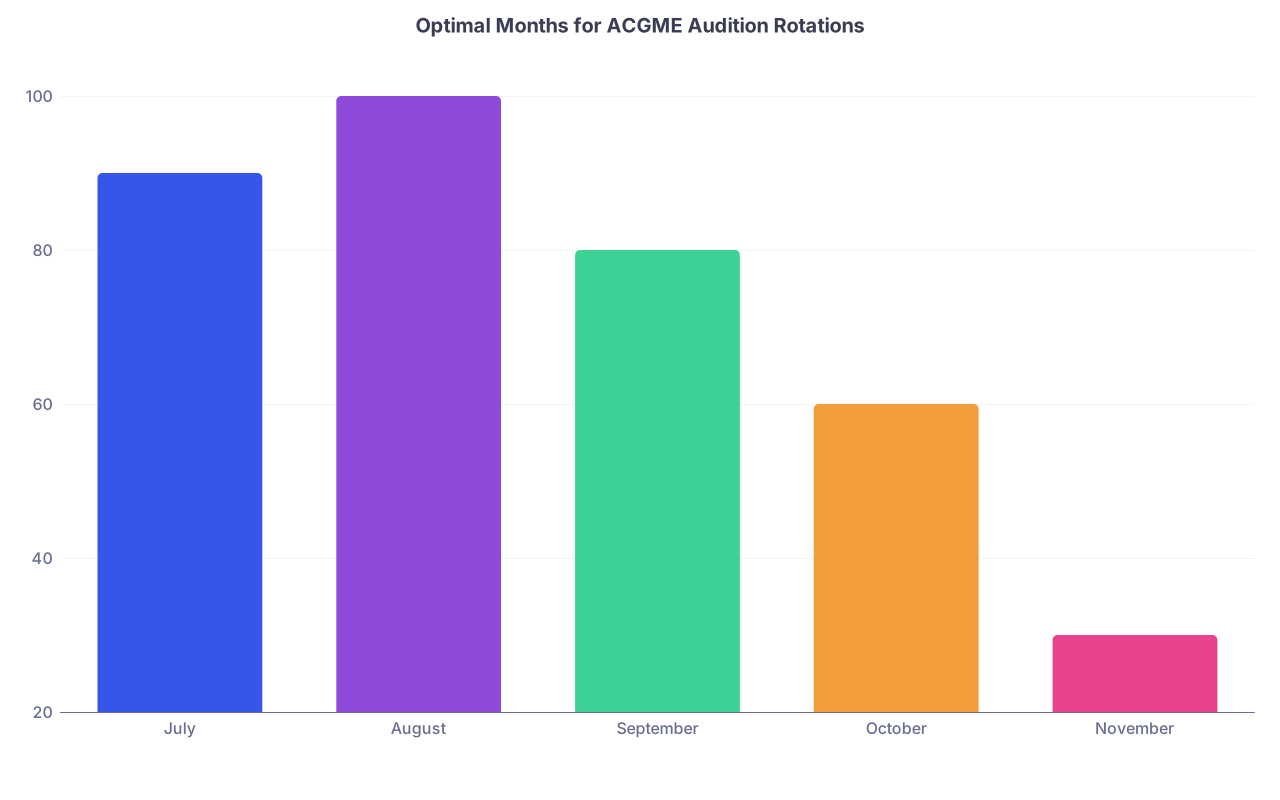
| Category | Value |
|---|---|
| July | 90 |
| August | 100 |
| September | 80 |
| October | 60 |
| November | 30 |
Interpretation (rough, but realistic):
- August is ideal – you’ve shaken off new‑intern rust, but letters can still be ready for early ERAS review.
- July is great if you’re already strong and want to show early interest at a top‑choice ACGME program.
- September is still solid for visibility, but letters may arrive mid‑cycle.
- October–November: Good for back‑up programs or DO‑friendly sites that don’t screen as harshly early.
At this point going into 4th year, your third‑year work has set this up:
- You know which programs to target.
- You aren’t scrambling for Step 2/Level 2.
- You already have 1–2 anchor letters, with more coming from these early 4th‑year rotations.
Sample Month‑by‑Month Third‑Year Plan for ACGME Visibility
Let me put this into a concrete skeleton for a DO student targeting ACGME Internal Medicine.
Assume M3 = July–June. Adjust dates as needed.
| Month (M3) | Rotation Focus | ACGME Visibility Task |
|---|---|---|
| Jul | IM Core (home) | Crush basics, identify IM interest, impress attendings |
| Aug | Surgery Core | Show work ethic, get strong evals |
| Sep | FM or OB | Clarify specialty lean; start program list |
| Oct | Peds Core | Research ACGME IM programs, DO-friendly sites |
| Nov | Psych Core | First ACGME-affiliated IM or subspecialty month if available |
| Dec | EM or another IM month | Ask for first ACGME-credible letter |
| Jan | IM at ACGME hospital | Perform like an audition; meet PD/APD if possible |
| Feb | Lighter outpatient rotation | Submit VSLO apps for July–Sep 4th-year IM away rotations |
| Mar | IM or sub-I type month | Lock in second letter; plan exam date |
| Apr | Moderate IM/FM | Study alongside; confirm away rotation acceptances |
| May | Study-friendly rotation | Dedicated Level 2/Step 2 prep near end of month |
| Jun | Exam + buffer | Take exams, rest before 4th-year July IM sub-I/audition |
If you’re going into EM, Surgery, or another competitive field, the structure is similar—but the pressure for early away rotations is even higher, and you’ll front‑load more specialty‑specific exposure.
Where Third‑Year DOs Get This Wrong
I’ve watched this play out too many times.
Common self‑sabotaging patterns:
Random electives with no ACGME tie‑in.
Two random community FM months at hospitals with no residencies? Fine for learning. Useless for visibility.Taking COMLEX Level 2 / Step 2 in peak audition season.
If you block off August for your exam, you’ve just kneecapped your best audition month.No early letter planning.
Asking an attending in August of 4th year to write something “by Friday” for ERAS. You get a generic, late letter. PDs can spot those instantly.Trying to fix a weak file with a single heroic late away in October/November.
By then, ACGME programs have quietly ranked their early favorites from the July–September crowd.
Do not be that student. Build the arc during third year so 4th‑year you isn’t constantly in damage‑control mode.
Visual: Your M3–Early M4 Visibility Arc
Here’s how the pressure and importance ramp up.
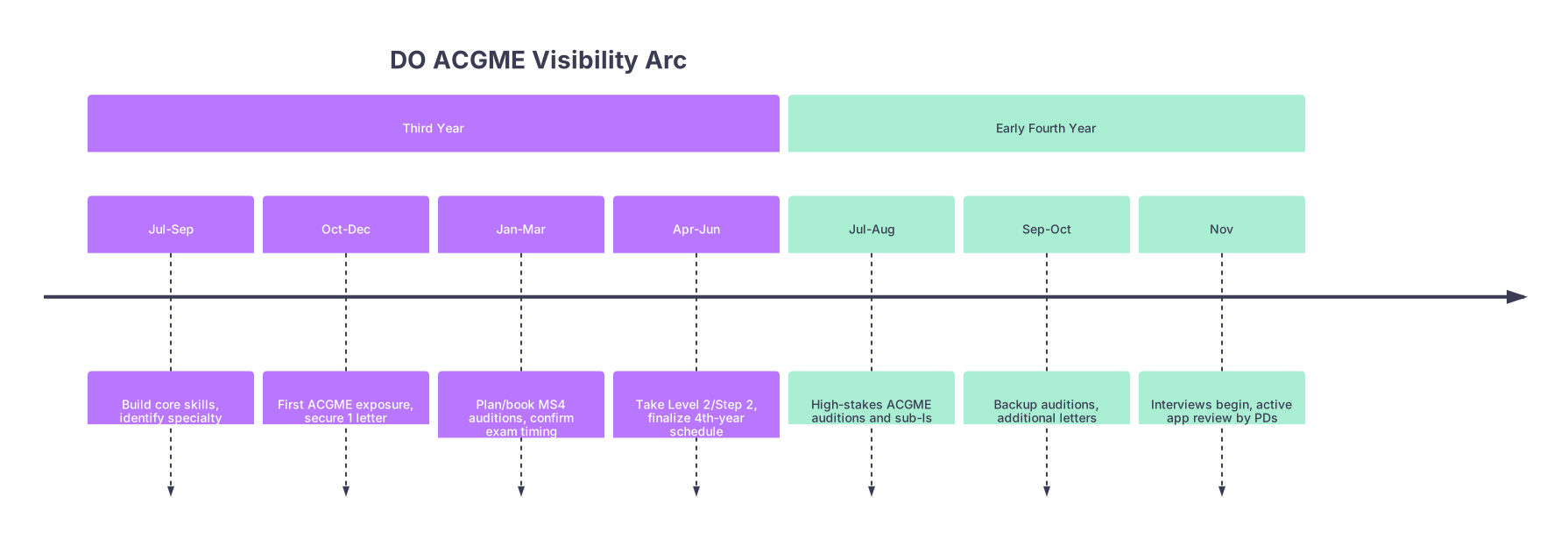
| Period | Event |
|---|---|
| Third Year - Jul-Sep | Build core skills, identify specialty |
| Third Year - Oct-Dec | First ACGME exposure, secure 1 letter |
| Third Year - Jan-Mar | Plan/book MS4 auditions, confirm exam timing |
| Third Year - Apr-Jun | Take Level 2/Step 2, finalize 4th-year schedule |
| Early Fourth Year - Jul-Aug | High-stakes ACGME auditions and sub-Is |
| Early Fourth Year - Sep-Oct | Backup auditions, additional letters |
| Early Fourth Year - Nov | Interviews begin, active app review by PDs |
Final Checkpoints Before You Start Third Year
If you’re about to walk into M3 and want ACGME programs to take you seriously as a DO, lock these in now:
Have a draft year plan with:
- Likely cores by month
- 2–3 flexible spots for ACGME‑affiliated rotations
- A tentative Level 2/Step 2 window that doesn’t cannibalize auditions
Create and update a living ACGME program list:
- Target regions
- DO percentage in current residents
- Rough score expectations vs your practice range
Commit to performing like every ACGME‑adjacent rotation is an audition.
Because in practice, it is.
You don’t control PD bias. You do control where you show up, when you show up, and how prepared you are when you get there. Third year is when that control actually matters. Use it.