The biggest mistake DO students make with COMLEX and USMLE is pretending they can “fit in” two exams around an ACGME application season. You cannot. You plan it backwards or you get crushed.
You want ACGME programs to take you seriously. That means:
- Two exams.
- One clean, coherent timeline.
- Zero panic reschedules.
I will walk you month by month, then zoom into weeks and critical weeks-by-week blocks. Assume:
- You are a DO student
- You want both COMLEX Level 1/2 and USMLE Step 1/2
- You are targeting the ERAS season where applications open in September and MS3 runs July–June
Adjust exact months by shifting a year earlier if needed, but the sequence stays the same.
Big-Picture Timeline (Overview First)
Here is the skeleton. Then we will fill in the muscle.
- MS2 Fall–Winter (Sep–Dec): Light foundation, resources, and schedule building
- MS2 Spring (Jan–Mar): Heavy pre-dedicated ramp-up
- MS2 Late Spring (Apr–May): Dedicated Step 1 + COMLEX Level 1 prep
- Early Summer (May–Jul): Take USMLE Step 1 and COMLEX Level 1
- MS3 Fall–Winter: Clerkships + collected, steady prep for Step 2 / Level 2
- MS3 Spring–Early Summer: Dedicated Step 2 CK / COMLEX Level 2-CE
- MS4 Early (Jun–Sep): ERAS build, letters, ACGME strategy
Here is what the dual-exam window usually looks like when done right:
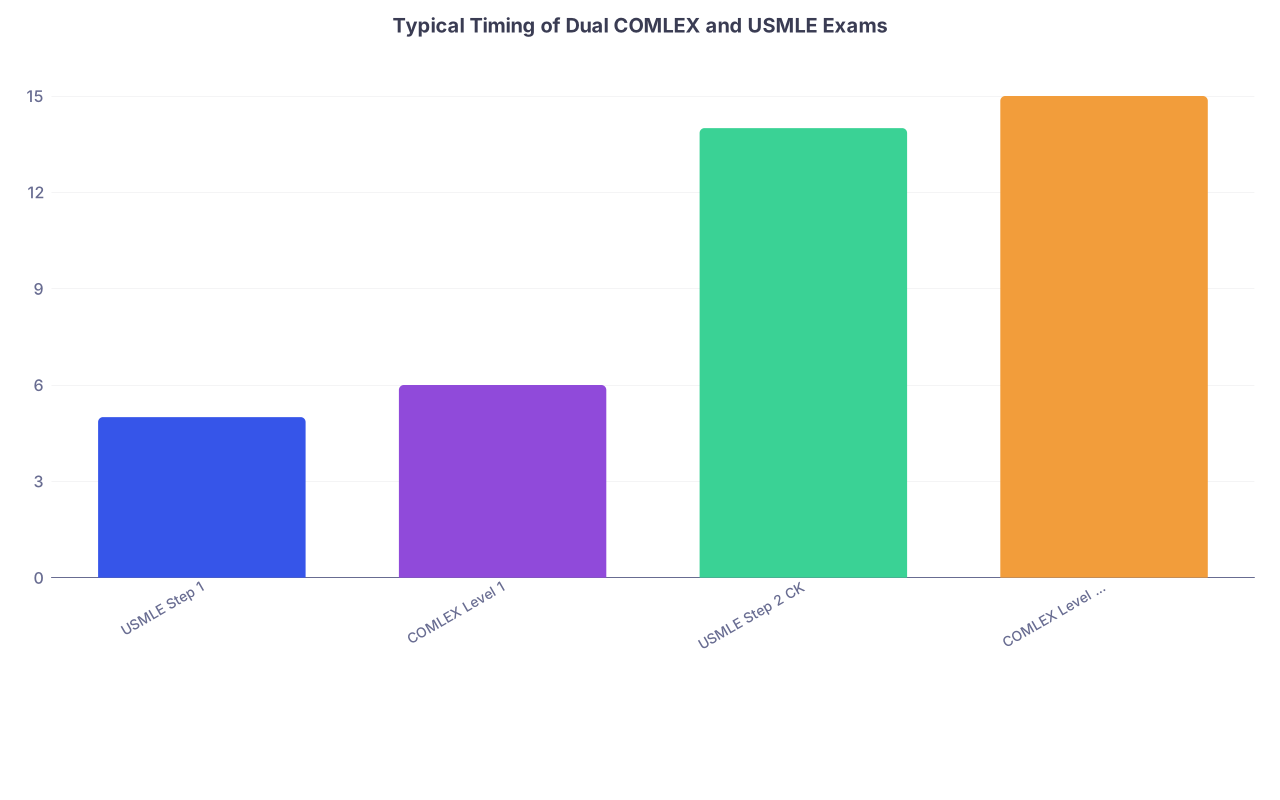
| Category | Value |
|---|---|
| USMLE Step 1 | 5 |
| COMLEX Level 1 | 6 |
| USMLE Step 2 CK | 14 |
| COMLEX Level 2-CE | 15 |
(Values here are “months after MS2 start,” just to show spacing; exact months vary by school.)
MS2 Fall: Lay the Groundwork (September–December)
At this point you should not be “studying for boards” full-time. You should be building infrastructure.
September
At this point you should:
- Decide definitively if you are taking USMLE as well as COMLEX. No half-hearted “maybe”. Programs will not wait for you to figure it out in March.
- Pick your core resources:
- For USMLE-style content: UWorld, CAP from your school, Anki (Lightyear/AnKing), Boards & Beyond/Pathoma/Sketchy as needed.
- For COMLEX-specific content: COMBANK or COMQUEST, Savarese OMT Review.
- Map your academic calendar:
- Identify the earliest 4–6 week block after MS2 finals for dedicated.
- Check your school’s COMLEX Level 1 deadline and any Step 1 rules.
- Build a rough dual-exam plan:
- Target window for Step 1: ~2–3 weeks before COMLEX Level 1.
- That ordering is not negotiable. Step first, COMLEX after, while material is freshest.
October
At this point you should:
- Start low-volume board-style questions:
- 10–15 UWorld questions/day (tutor mode is fine now).
- 5–10 COMLEX-style questions 3 days/week, especially OMM and ethics.
- Align class studying with board resources:
- Use First Aid/Boards & Beyond as your primary explanation framework, not slides alone.
- Build your daily micro-habits:
- 30–60 minutes of Anki.
- 10–20 practice questions.
- 10–15 minutes of OMM review twice weekly.
Your goal this month is rhythm, not heroics.
November
At this point you should:
- Increase to 20–30 UWorld questions/day, timed blocks once or twice a week.
- Start tracking weak systems:
- Have a running list: cardio, renal, biochem, pharm, OMM techniques, etc.
- Note: COMLEX will test weirder biostats, ethics, and vague vignettes. Flag those early.
- Schedule your first NBME baseline for late November:
- Do not wait until dedicated to learn that your baseline is 195.
December
At this point you should:
- Take:
- 1 NBME (for Step 1 benchmark).
- 1 COMSAE or school COMLEX-style exam.
- Review results and lock in:
- How many weak systems need focused blocks in spring.
- If dual-exam is still realistic based on baseline (it usually is with decent planning).
- Pencil in exact exam weeks on a calendar:
- Example: Step 1 = May 25, COMLEX Level 1 = June 8.
You are not committed until you pay, but you need dates on a wall.
MS2 Spring: Ramp-Up and Pre-Dedicated (January–March)
Spring is where people either set themselves up for a smooth dual run or guarantee a meltdown.
January
At this point you should:
- Increase to:
- 40 UWorld questions/day, 5–6 days/week.
- 10–15 COMLEX questions/day, 3 days/week.
- Start serious OMM integration:
- One focused OMM session per week:
- Reflexes, Chapman points, autonomics, common dysfunction patterns.
- One focused OMM session per week:
- Build your content pass checklist by organ system:
- Example for cardio:
- Path: ischemia, arrhythmias, CHF, valvular disease.
- Pharm: antiarrhythmics, antihypertensives, heart failure drugs.
- Physio: curves, murmurs, pressures.
- Example for cardio:
February
At this point you should:
- Take a second NBME and a COMSAE.
- Evaluate gap to targets:
- If your NBME is <200 and COMSAE scaled <400, you need:
- Higher question volume.
- Dedicated blocks of content review (not just questions).
- If your NBME is <200 and COMSAE scaled <400, you need:
- Adjust question strategy:
- Move more UWorld to timed, random blocks.
- Keep COMLEX questions system-based for now to build comfort.
March
At this point you should:
- Finalize exam registrations and firm dates.
- Build your dedicated study schedule on a daily basis:
- Each day labeled with:
- AM: UWorld blocks (timed).
- Midday: Review + content videos.
- PM: COMLEX OMM/ethics + mixed COMLEX Qs.
- Each day labeled with:
- Decide your target scores for program types (community vs university, competitive vs less competitive).
To make this real, here is how minimum competitive targets often play out:
| Target Program Type | USMLE Step 1 Target | COMLEX Level 1 Target |
|---|---|---|
| Community IM/FM | 220+ | 450+ |
| Mid-tier ACGME IM/Peds | 225–230+ | 500+ |
| Competitive IM/Anes/EM | 235–240+ | 550+ |
| Most Surgical specialties | 240+ | 575–600+ |
You do not need perfection. You do need to be realistic about your goals.
Dedicated for Step 1 + Level 1 (April–June)
This period makes or breaks your ACGME competitiveness. The order below is non-negotiable in my opinion.
Month 1 of Dedicated (April–Early May)
At this point you should:
- Be fully in board mode, classes minimized or set aside if allowed.
- Structure your days roughly like this:
- Block 1 (AM): 40 UWorld questions, timed, random.
- Block 2 (Midday): 40 UWorld questions, timed, random.
- Block 3 (PM): 20–40 COMLEX questions (COMBANK/COMQUEST), system or mixed.
- OMM: 30–45 minutes focused (Savarese + flashcards) 4–5 days/week.
- Take a NBME every 1.5–2 weeks, and one COMSAE every 2–3 weeks.
Your focus in this month is USMLE-style thinking with deliberate daily COMLEX exposure so OMM is never cold.
Month 2 of Dedicated (Mid May–June): The Two-Exam Window
At this point you should be entering your exam stretch. Example sequence:
- Week 1–2 of Month 2: Final heavy USMLE push
- End of Week 2: Take USMLE Step 1
- Week 3–4: Pivot hard to COMLEX-specific prep
- End of Week 4: Take COMLEX Level 1
Let me break that out week-by-week.
Week -2 to -1 Before Step 1
At this point you should:
- Be at:
- 2 UWorld blocks/day.
- 1 COMLEX block/day (shorter, 20–30 questions).
- Take:
- 1 NBME (10–7 days before exam).
- Identify 2–3 “non-negotiable weaknesses”:
- Example: Biostats, acid–base, renal phys, neuroanatomy.
- Build micro-drills for those weaknesses each evening.
Step 1 Week
At this point you should:
- Take final practice:
- UWSA1/2 earlier in the week if not already done.
- Two days before Step 1:
- Drop to 1 light question block.
- Do high-yield Anki + OMM review only.
- Day before:
- No new content. Short OMM and ethics quick-look are fine.
- Exam Day: Step 1 done. Walk out. Do not instantly start COMLEX questions that night. Sleep.
The Pivot: 10–14 Days Between Step 1 and Level 1
This is where most DO students screw up: they keep doing UWorld and barely touch OMM. Wrong.
At this point you should:
- Shift to COMLEX-first:
- 2 COMLEX blocks/day (40–80 questions).
- 1 short UWorld block every other day, just to maintain sharpness.
- Do daily:
- Savarese run-through: Autonomics, Chapman points, cranial, viscerosomatic levels.
- Osteopathic principles, models, and classic COMLEX-style vague vignettes.
- Take:
- 1 COMSAE about a week before exam.
- If performance is wildly discordant with your Step metrics, re-assess problem areas:
- Often OMM and COMLEX-style test-taking, not core knowledge.
Your brain will want to stay in USMLE mode. You have to consciously practice COMLEX style: shorter stems, weird distractors, sometimes under-specified vignettes. Do not underestimate that.
MS3 Year: Clerkships + Step 2 / Level 2 Planning (July–March)
Now you move into the combined board + residency application phase.
MS3 Early (July–September)
At this point you should:
- Learn how your hospital days actually flow:
- When can you reliably study? Early AM? Post-call? Evenings?
- Start low but steady Step 2/Level 2 prep:
- 10–20 UWorld Step 2 questions/day related to your current rotation.
- 10 COMLEX Level 2 questions 2–3 days/week.
- Keep OMM from dying:
- One 30-minute OMM review block on a day off each week.
- Track shelf performance:
- You want to see upward trends. Weak shelves usually predict rough Step 2.
MS3 Mid-Year (October–December)
At this point you should:
- Start thinking about your specialty with some firmness.
- Backward-plan Step 2 / Level 2 from ERAS timeline:
- To be maximally useful:
- USMLE Step 2 CK ideally taken by June–July before ERAS opens.
- COMLEX Level 2-CE completed no later than July–August.
- To be maximally useful:
- Build a rough 3–4 week dedicated block in late spring/early summer:
- Coordinate with lighter rotations or protected board time.
MS3 Spring–Early Summer: Dedicated for Step 2 CK + Level 2-CE
Step 2 and Level 2 matter more now that Step 1 is pass/fail. ACGME programs are looking hard at them, especially for DOs.
March–April: Pre-Dedicated Ramp
At this point you should:
- Be on your second pass of UWorld or close to finishing first.
- Start mixing question styles:
- Half days:
- UWorld Step 2 CK blocks.
- COMLEX Level 2-CE style questions.
- Half days:
- Schedule:
- A CCS/clinical reasoning run (if using a Step 2 prep platform that supports cases).
- A Level 2 COMSAE for baseline.
May–June: Step 2 Dedicated
Ideal sequence:
- Step 2 CK first
- COMLEX Level 2-CE second
Same logic: cleaner vignettes and scoring first, then adapt to COMLEX weirdness.
At this point you should:
- Build a 4–5 week dedicated period similar to Step 1 dedicated:
- AM: 40 UWorld questions (random, timed).
- Midday: Review + targeted reading.
- PM: 20–40 COMLEX Level 2 questions or OMM refresh.
- Take:
- 1–2 NBMEs for Step 2 CK.
- 1 COMSAE for Level 2-CE.
Aim to have Step 2 CK done by late June or very early July.
The 10–14 Days Before COMLEX Level 2-CE
Same pivot rules as Level 1.
At this point you should:
- Emphasize:
- OMM applications to clinical cases.
- COMLEX-specific:
- Ethics.
- Patient safety.
- Broad primary care screening and prevention.
- Use:
- COMQUEST/COMBANK Level 2-CE questions heavily.
- Rapid OMM passes (Savarese plus school notes).
MS4 Early: ERAS and ACGME Season (June–September)
If you timed things correctly, your major exams are behind you by now.
June
At this point you should:
- Have:
- Step 2 CK score pending or already back.
- COMLEX Level 2-CE scheduled or completed.
- Start ERAS preparation:
- Draft personal statement.
- Update CV with:
- Research.
- Presentations.
- Leadership.
- Identify letter writers:
- At least one ACGME faculty if you can.
- Strong clinical rotation attendings.
July
At this point you should:
- Have:
- Finalized Step 2 and Level 2-CE (or they are very soon).
- Do:
- Program list building:
- Category: ACGME-only, ACGME + AOA-heritage, your state programs, reach vs safety.
- Confirm they accept COMLEX-only vs require USMLE:
- You have both, but it matters where they emphasize which score.
- Program list building:
- Begin:
- ERAS data entry.
- Tailoring experiences and explanations for dual-exam path if needed.
Here is a simplified view of how your exam and ERAS pieces line up over two academic years:
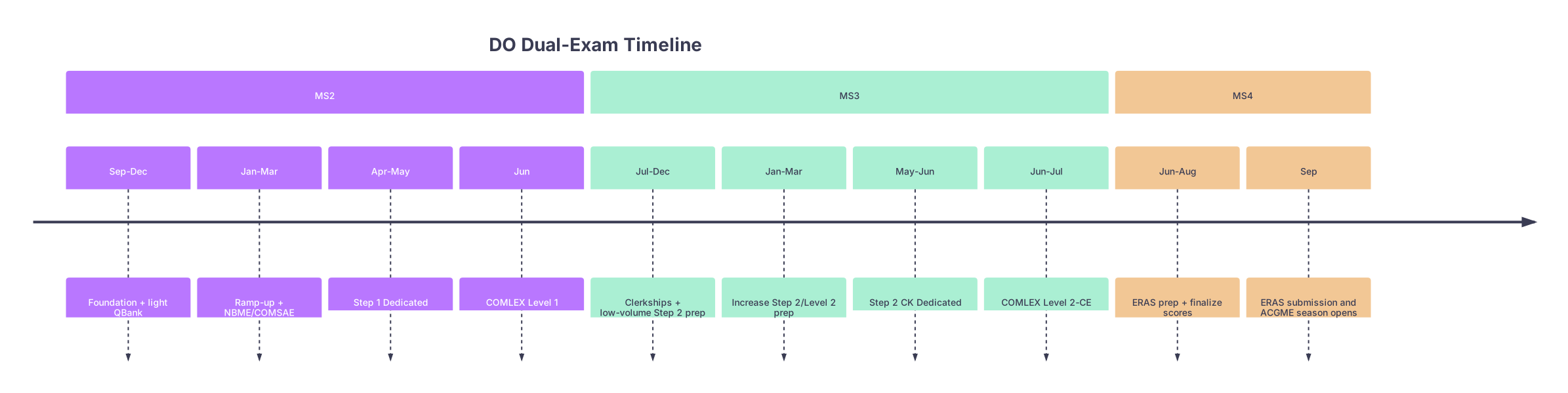
| Period | Event |
|---|---|
| MS2 - Sep-Dec | Foundation + light QBank |
| MS2 - Jan-Mar | Ramp-up + NBME/COMSAE |
| MS2 - Apr-May | Step 1 Dedicated |
| MS2 - Jun | COMLEX Level 1 |
| MS3 - Jul-Dec | Clerkships + low-volume Step 2 prep |
| MS3 - Jan-Mar | Increase Step 2/Level 2 prep |
| MS3 - May-Jun | Step 2 CK Dedicated |
| MS3 - Jun-Jul | COMLEX Level 2-CE |
| MS4 - Jun-Aug | ERAS prep + finalize scores |
| MS4 - Sep | ERAS submission and ACGME season opens |
August–September
At this point you should:
- Finalize:
- ERAS application (no typos, coherent narrative).
- Program list (broad enough; most DOs under-apply to ACGME).
- Ensure:
- All scores are uploaded and visible:
- Step 1.
- Step 2 CK.
- COMLEX Level 1.
- COMLEX Level 2-CE.
- All scores are uploaded and visible:
- Submit ERAS as early in the window as possible.
During this period, your boards work is behind you. The only “board-related” tasks left:
- Answering the occasional interview question about:
- Why you took both exams.
- Any score discrepancies (e.g., stronger USMLE vs COMLEX or vice versa).
How Your Weekly Rhythm Should Look in Each Key Phase
To make this more concrete, here is a simple weekly structure comparison at different phases.
| Phase | Questions/Day | OMM Time/Week | Practice Exam Frequency |
|---|---|---|---|
| MS2 Fall | 10–20 mixed | ~1 hour | None or school exams |
| MS2 Spring (ramp) | 40–50 mixed | ~2 hours | NBME/COMSAE monthly |
| Step 1 Dedicated | 80–120 mixed | 3–4 hours | NBME/COMSAE q1–2 weeks |
| Level 1 Pivot (10–14 d) | 40–80 COMLEX-heavy | 4–5 hours | 1 COMSAE |
| Step 2 Dedicated | 80–120 mixed | 2–3 hours | NBME/COMSAE q1–2 weeks |
| Level 2 Pivot (10–14 d) | 40–80 COMLEX-heavy | 3–4 hours | 1 COMSAE |
Common Failure Patterns (And When to Fix Them)
You will probably see yourself in at least one of these. Fix it early.

Failure Pattern 1: Indecision About USMLE
- Symptom: It is February of MS2 and you still “have not decided” about USMLE.
- Fix (by January–February):
- Decide based on:
- Specialty competitiveness.
- Programs you are eyeing (look at their websites—many state their expectations).
- If you decide “yes”, commit to Step-first scheduling immediately.
- Decide based on:
Failure Pattern 2: Treating COMLEX as “Just Step With OMM”
- Symptom: You crush UWorld but bomb COMSAEs.
- Fix (March–April):
- Dedicate specific COMLEX study blocks.
- Learn:
- OMM details.
- COMLEX-style question interpretation.
- Use COMBANK/COMQUEST seriously, not as an afterthought.
Failure Pattern 3: Overbooking Rotations Around Step 2 / Level 2
- Symptom: You think you can do ICU, Step 2 dedicated, and research all in May.
- Fix (January–February MS3):
- Schedule lighter rotations around your dedicated windows.
- If your school permits, protect at least 3–4 weeks for serious Step 2 prep.
Visualizing Your Own Plan
I recommend you literally draw this on a whiteboard or digital planner. Something like:

Then refine it online:
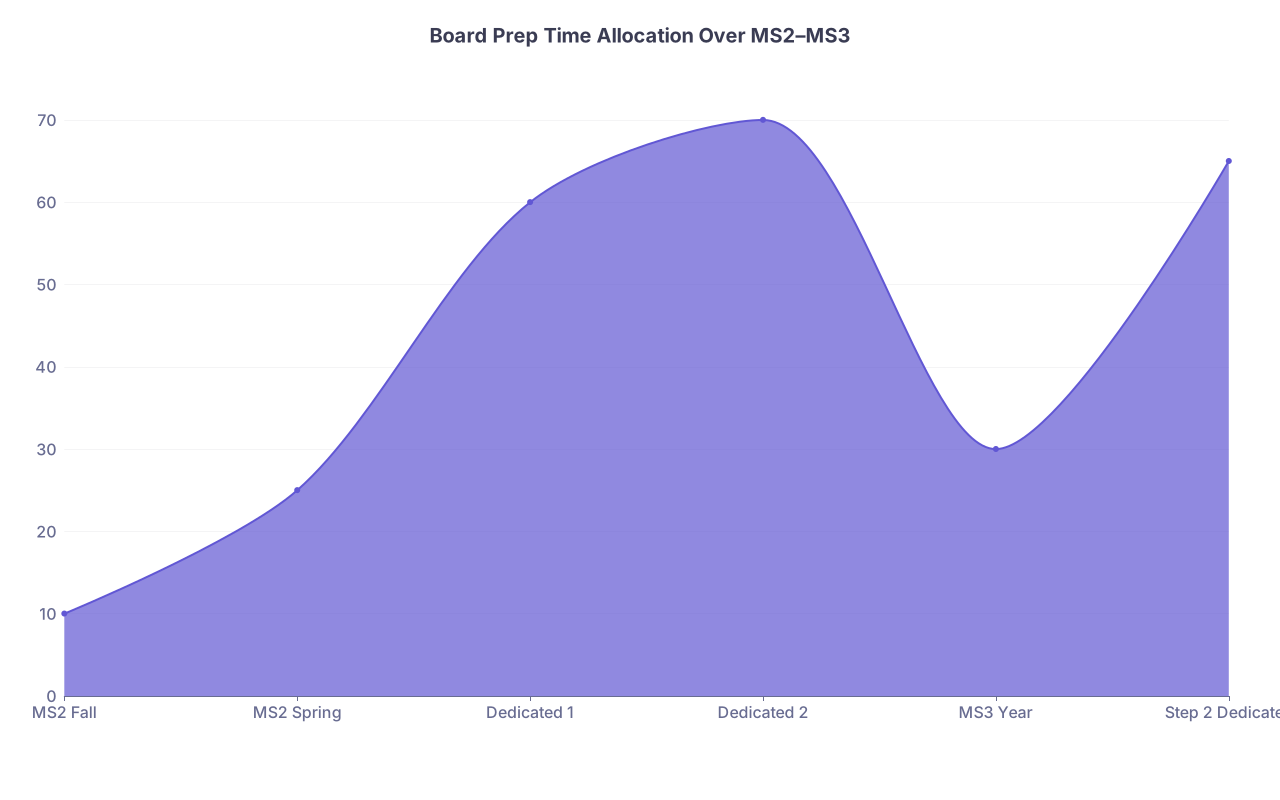
| Category | Value |
|---|---|
| MS2 Fall | 10 |
| MS2 Spring | 25 |
| Dedicated 1 | 60 |
| Dedicated 2 | 70 |
| MS3 Year | 30 |
| Step 2 Dedicated | 65 |
(Values here are “average study hours per week” for board prep, not counting regular classes or rotations.)
This is not about perfection. It is about predictability. You want to know, in any given month, what your primary objective is:
- Build foundation.
- Ramp up.
- Execute dedicated.
- Pivot COMLEX-style.
- Stabilize during clerkships.
- Nail Step 2 / Level 2 before ERAS.
Final Thoughts
Three points and you are done:
- Plan backward from ERAS September and from your school’s COMLEX requirements; then insert USMLE in front of each COMLEX exam. Step first, COMLEX second.
- COMLEX success does not happen automatically from USMLE prep. You must deliberately train OMM and COMLEX-style reasoning in the 10–14 days after each USMLE exam.
- Your weekly rhythm matters more than any single “grind week.” Consistent questions, steady OMM, and timely practice exams will put you in the top tier of DO applicants walking into the ACGME season.