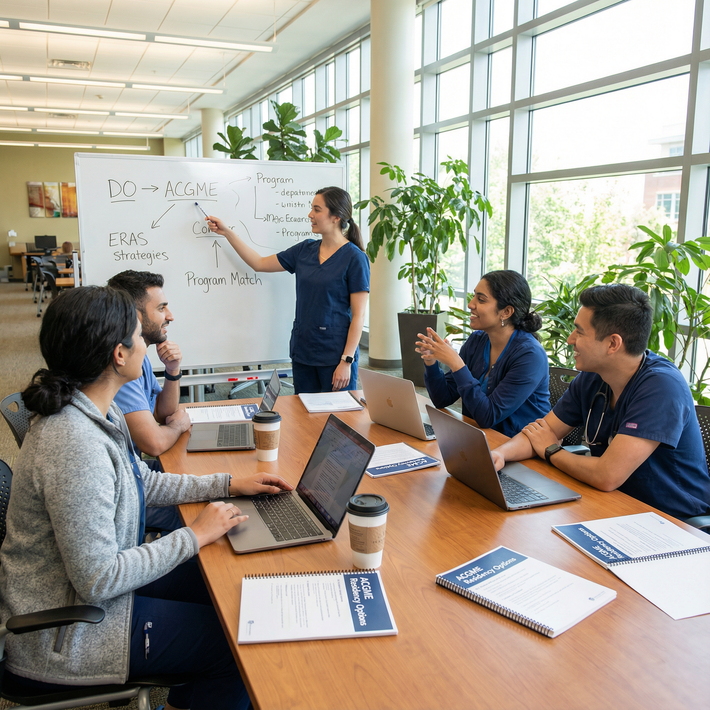
The ERAS season punishes DO students who “wait and see.”
If you are osteopathic and targeting ACGME programs, you do not have the luxury of vague plans. You need a week‑by‑week attack strategy. Or you will watch MD classmates slide into interviews that should have been yours.
Below is exactly that strategy.
Big Picture: Your ERAS Season Roadmap (For DOs Aiming at ACGME)
At this point you should accept one uncomfortable truth: DO applicants are still screened harder at many ACGME programs. The bar is not impossible. It is just higher and stricter.
So your timeline has to be tighter.
Think of the season in four phases:
- Build & Position (May–June) – Letters, CV polish, strategy, program list.
- Assemble & Lock (July–mid‑September) – ERAS completion, personal statements, MSPE, Step/COMLEX timing.
- Launch & Interview (mid‑September–December) – Application release, invites, interview season logistics.
- Close & Rank (January–March) – Late interviews, rank list, SOAP backup.
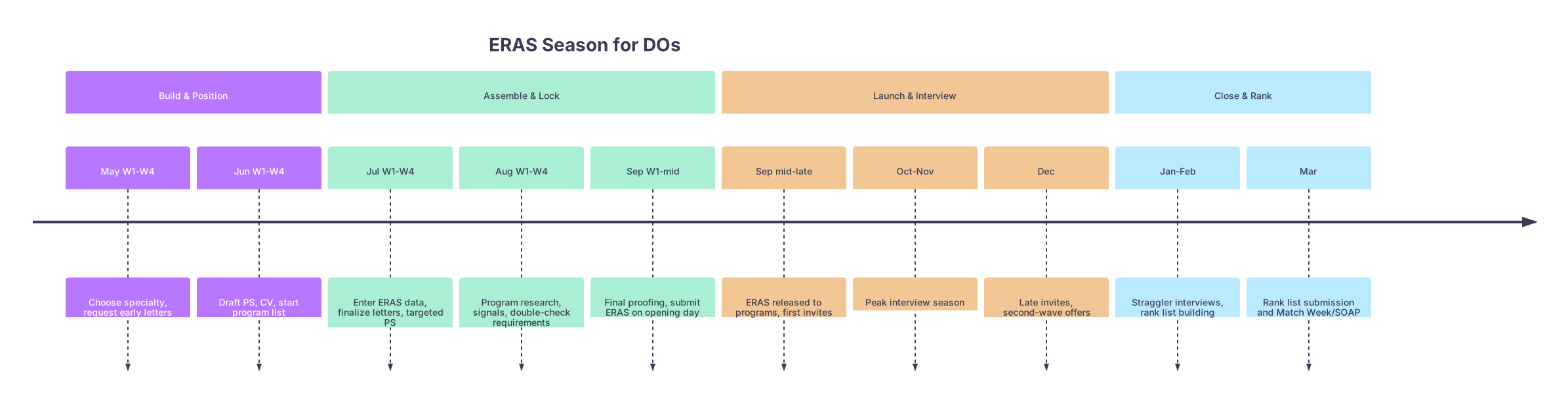
Here’s how the work actually breaks down week by week.
| Period | Event |
|---|---|
| Build & Position - May W1-W4 | Choose specialty, request early letters |
| Build & Position - Jun W1-W4 | Draft PS, CV, start program list |
| Assemble & Lock - Jul W1-W4 | Enter ERAS data, finalize letters, targeted PS |
| Assemble & Lock - Aug W1-W4 | Program research, signals, double-check requirements |
| Assemble & Lock - Sep W1-mid | Final proofing, submit ERAS on opening day |
| Launch & Interview - Sep mid-late | ERAS released to programs, first invites |
| Launch & Interview - Oct-Nov | Peak interview season |
| Launch & Interview - Dec | Late invites, second-wave offers |
| Close & Rank - Jan-Feb | Straggler interviews, rank list building |
| Close & Rank - Mar | Rank list submission and Match Week/SOAP |
May–June: Foundation Phase (Before ERAS Opens)
Late May (4–5 Months Before Application Release)
At this point you should stop pretending you “might do three different specialties.”
Your tasks this week:
- Lock primary specialty.
- Choose the one you will actually apply to.
- Decide now if you will do a realistic secondary “backup” specialty or not.
- Clarify exam position:
- Do you have:
- COMLEX 1 & 2?
- USMLE Step 1 and/or Step 2 CK?
- For ACGME‑heavy fields (IM at university hospitals, EM, anesthesia, surgery), you should strongly consider having Step 2 CK by application release. Programs say “COMLEX accepted,” but their filters often say otherwise.
- Do you have:
- Identify letter writers:
- Aim for 3–4 letters lined up:
- 1–2 in your chosen specialty (ideally ACGME faculty).
- 1 strong general medicine/surgery attending if applicable.
- Optional: Research mentor if relevant and actually knows you.
- Aim for 3–4 letters lined up:
Early June (12–14 Weeks Before ERAS Submission)
At this point you should be talking to people with real influence.
Your tasks this week:
- Ask for letters of recommendation. Properly.
- Email or in-person ask: “Would you be able to write a strong, supportive letter for my application to [specialty]?”
- Provide:
- CV
- Draft personal statement
- Bullet list of projects, cases, responsibilities you had with them
- Start your core personal statement draft.
- One master statement for your primary specialty.
- Do not try to write “universal” fluff. Programs can smell it.
- Rough CV outline:
- List:
- Education
- Exams (COMLEX/USMLE with dates and scores if available)
- Clerkships (with honors / distinctions)
- Research, posters, QI projects
- Leadership / service
- List:
Late June (8–10 Weeks Before ERAS Submission)
At this point you should be pushing from vague to concrete.
Your tasks this week:
- Version 1.0 personal statement finished.
- Length: ~650–750 words.
- Show it to:
- One attending in your specialty.
- One person who knows your writing (advisor, mentor).
- CV refined.
- Translate your CV into ERAS‑style bullets:
- Action verb + what you did + outcome/impact.
- Translate your CV into ERAS‑style bullets:
- Program universe scan.
- Build a draft list of programs:
- Community vs university.
- DO‑friendly vs unknown vs historically hostile.
- Use:
- FREIDA
- Program websites for “COMLEX accepted” language.
- Recent DO grads at your school—ask who interviewed where.
- Build a draft list of programs:

July: ERAS Opens – Data Entry and Document Control
First Week of July (ERAS Opens to Applicants)
At this point you should touch ERAS every single weekday.
Your tasks this week:
- Register in ERAS and open every section.
- Personal info
- Education
- Exams (enter COMLEX and USMLE data accurately)
- Experiences
- Licensure (if any)
- Start dumping your experiences in.
- Do not wordsmith yet. Get all entries in:
- Jobs
- Leadership roles
- Volunteering
- Research
- Teaching/tutoring
- Do not wordsmith yet. Get all entries in:
- Request transcripts and COM/Dean’s letter pipeline info.
- Your school will manage MSPE, but you must know deadlines and what they need from you.
Mid‑July (8–9 Weeks Before Application Release)
At this point your ERAS should be >50% populated.
Your tasks this week:
- Refine experience descriptions.
- For each entry:
- Cut fluff.
- Add quantification where possible (“led 10‑member team…”, “improved clinic throughput by 15%”).
- For each entry:
- Categorize DO‑specific strengths.
- OMM / OMT teaching roles.
- OMM in clinical settings (if relevant to your specialty).
- Any leadership in osteopathic student groups (SOMA, etc.).
- Personal statement 2.0.
- Based on feedback, finalize near‑final version for primary specialty.
- Identify where you may need:
- A separate PS for your backup specialty.
- A slightly tweaked “academic vs community” version (not always needed, but sometimes useful for highly competitive fields).
Late July (6–7 Weeks Before Application Release)
At this point you should be closing loops with letter writers.
Your tasks this week:
- Check on letters of recommendation.
- Politely follow up with any writer who has not submitted or at least confirmed progress.
- Make sure they know:
- Where to upload (ERAS instructions).
- Your target submission date (mid‑September).
- Preliminary program list by tier.
- Create a 3‑tier list:
- Tier 1: Dream / reach programs.
- Tier 2: Solid realistic programs.
- Tier 3: Safety programs (historically DO‑friendly, community‑based, newer programs).
- Create a 3‑tier list:
- Decide on signaling strategy (if your specialty uses ERAS signals):
- Where will you spend those limited signals?
- DO applicants should not waste signals on programs with a known “we do not like DO” culture unless they have some existing relationship there.
| Tier | Program Type | Example Count |
|---|---|---|
| 1 | University, big city | 10 |
| 2 | University-affiliated | 20 |
| 3 | Community DO-friendly | 20 |
August: Program Targeting, Polishing, and Filters
Early August (5–6 Weeks Before Application Release)
At this point you should be ruthless about fit.
Your tasks this week:
- Deep dive on program requirements.
- For each program on your list, check:
- Do they accept COMLEX only?
- Do they require USMLE?
- Minimum score “cutoffs” stated or implied.
- Do they mention DOs in their “current residents” or past residents list?
- For each program on your list, check:
- Remove obvious dead ends.
- Example: You have only COMLEX, and a program explicitly says “USMLE required.” Drop it unless you will have Step 2 CK posted by release.
- Draft email templates for later:
- Post‑interview thank‑you.
- Post‑interview “continued interest” update.
- Short, professional outreach email in case you need to ask PDs legitimate questions later.
Mid‑August (4 Weeks Before Application Release)
At this point your application is moving from 90% to 99%.
Your tasks this week:
- Final‑pass edit on experiences and PS.
- Check for:
- Inconsistencies in dates.
- Typos.
- Repetitive language.
- Check for:
- Photo decision.
- Get a professional‑looking photo:
- Solid background.
- Business attire.
- No white coat stethoscope glamour shot.
- Get a professional‑looking photo:
- Check letter availability in ERAS.
- Confirm:
- All expected letters are uploaded or very close.
- You know which letters you will assign to which programs (some specialties want at least 1–2 from their field).
- Confirm:
| Category | Value |
|---|---|
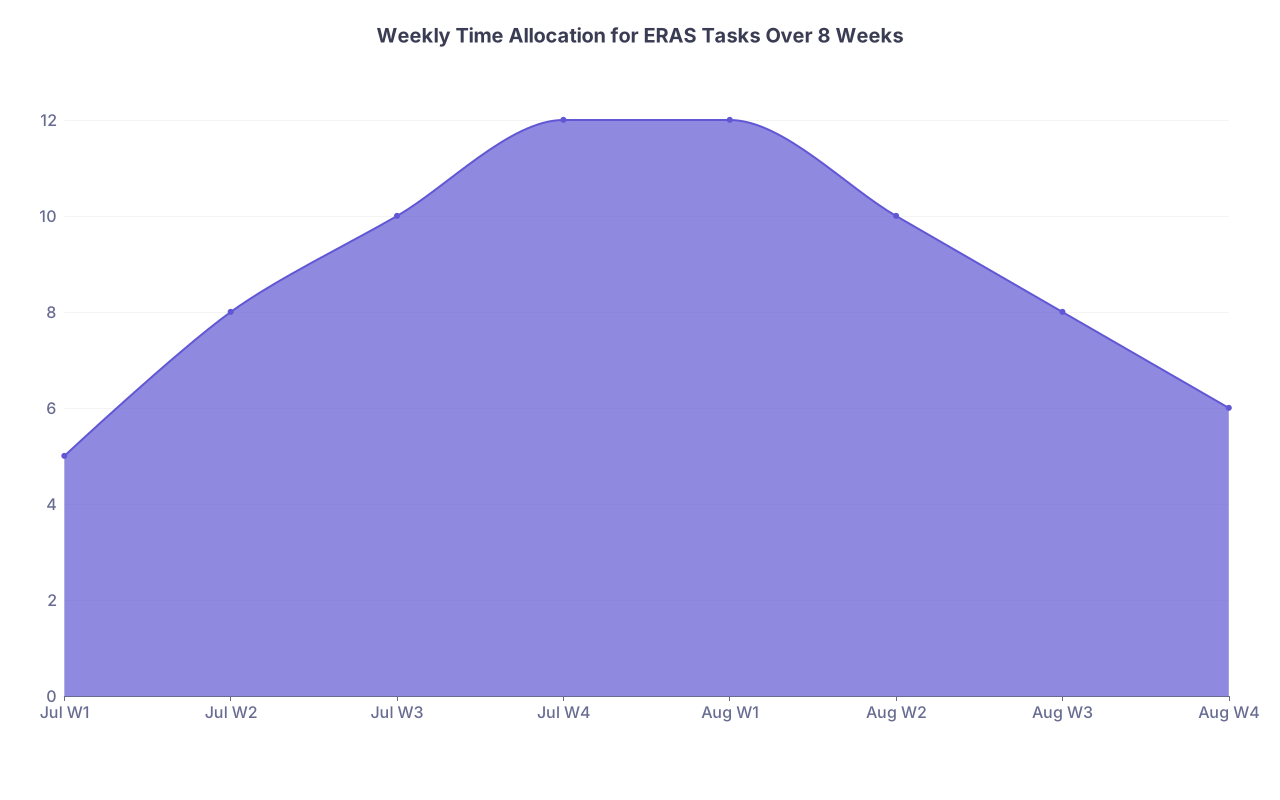
| Jul W1 | 5 |
| Jul W2 | 8 |
| Jul W3 | 10 |
| Jul W4 | 12 |
| Aug W1 | 12 |
| Aug W2 | 10 |
| Aug W3 | 8 |
| Aug W4 | 6 |
Late August (2–3 Weeks Before Application Release)
At this point you should be rehearsing, not building.
Your tasks this week:
- Mock interviews start.
- At least:
- 1 general behavioral interview.
- 1 specialty‑specific mock (with someone in the field if possible).
- At least:
- Prepare your “DO narrative.”
- You will be asked:
- “Why DO?”
- “How does your osteopathic training influence your approach?”
- Have concrete examples from rotations, OMM use, or patient interactions.
- You will be asked:
- Refine program list numbers.
- Decide, based on competitiveness, how many programs:
- For competitive specialties, DO applicants often need 40–60+ applications.
- For more DO‑friendly fields, 25–40 might be enough if you are a strong candidate.
- Decide, based on competitiveness, how many programs:
Early–Mid September: Submission and Release
First Week of September (1–2 Weeks Before Application Submission Opens)
At this point your application should be ready to hit “submit” the day ERAS allows.
Your tasks this week:
- Run the “print view” test.
- Generate PDF views of:
- Application.
- Personal statement.
- Read them out loud. You will catch errors.
- Generate PDF views of:
- Assign letters to programs.
- Specialty‑specific LORs go to all programs in that field.
- Research letters: only if strong and relevant.
- Finalize program list and signals.
- No more adding random places out of fear unless they are:
- DO‑friendly.
- Realistic.
- No more adding random places out of fear unless they are:
ERAS Submission Opening Week (Typically Around Sept 6–8)
At this point you should submit on the first possible day or within 24 hours, especially as a DO.
Your tasks this week:
- Submit your ERAS application.
- Double‑check payment, program assignments, PS assignments.
- Verify all standardized test scores are released.
- COMLEX and USMLE score reports linked.
- Check that all letters you counted on are uploaded.
- If one is missing, you can still submit, but understand that some programs will not fully review until letters arrive.
Mid‑September: ERAS Release to Programs & Early Invites
ERAS Release Day to Programs (Usually Sept 15–16)
At this point you should not touch your personal statement again.
Your tasks this week:
- Confirm with your school that MSPE is on track for the standard release date (usually Oct 1).
- Set up your interview infrastructure.
- Shared calendar for interview dates.
- Email filters for “interview” and program names.
- Voicemail greeting that does not sound like a college dorm.

Late September (Week 2–3 After Release)
At this point you may or may not have invites yet. Do not panic too early.
Your tasks this week:
- Track invites and rejections in a simple spreadsheet.
- Columns:
- Program
- Date applied
- Date of invite / rejection / silence
- Interview date
- Columns:
- Begin interview practice in earnest.
- Focus on:
- “Tell me about yourself.”
- “Why this specialty?”
- “Why this program?”
- “How has your DO training prepared you differently?”
- Focus on:
October–November: Peak Interview Season
Early October (MSPE Release + Invite Surge)
At this point you should expect a jump in interview traffic right after MSPE release.
Your tasks this week:
- Respond to invitations quickly.
- Same day. Ideally within 1–2 hours.
- Prioritize dates.
- Schedule:
- Top‑choice programs earlier (but not your very first 1–2 interviews).
- Spreads so you are not doing 5 interviews in 5 days if you can avoid it.
- Schedule:
- Maintain clinical performance.
- PDs do talk to each other. Slacking on rotations during interviews is noticed.
Late October (Interview Rhythm Established)
At this point you should be in a weekly cycle.
Your pattern each week:
- 2–4 nights before each interview
- Read the program website deeply:
- Mission, tracks, fellowships.
- Residents’ backgrounds—any DOs? Any from your school?
- Read the program website deeply:
- Night before
- Prepare:
- 2–3 specific questions for that program.
- Examples that illustrate:
- Teamwork.
- Conflict resolution.
- Handling a mistake.
- Prepare:
- 24 hours after
- Send concise thank‑you notes:
- 2–4 sentences.
- One specific detail from your conversation.
- Send concise thank‑you notes:
| Category | Value |
|---|---|
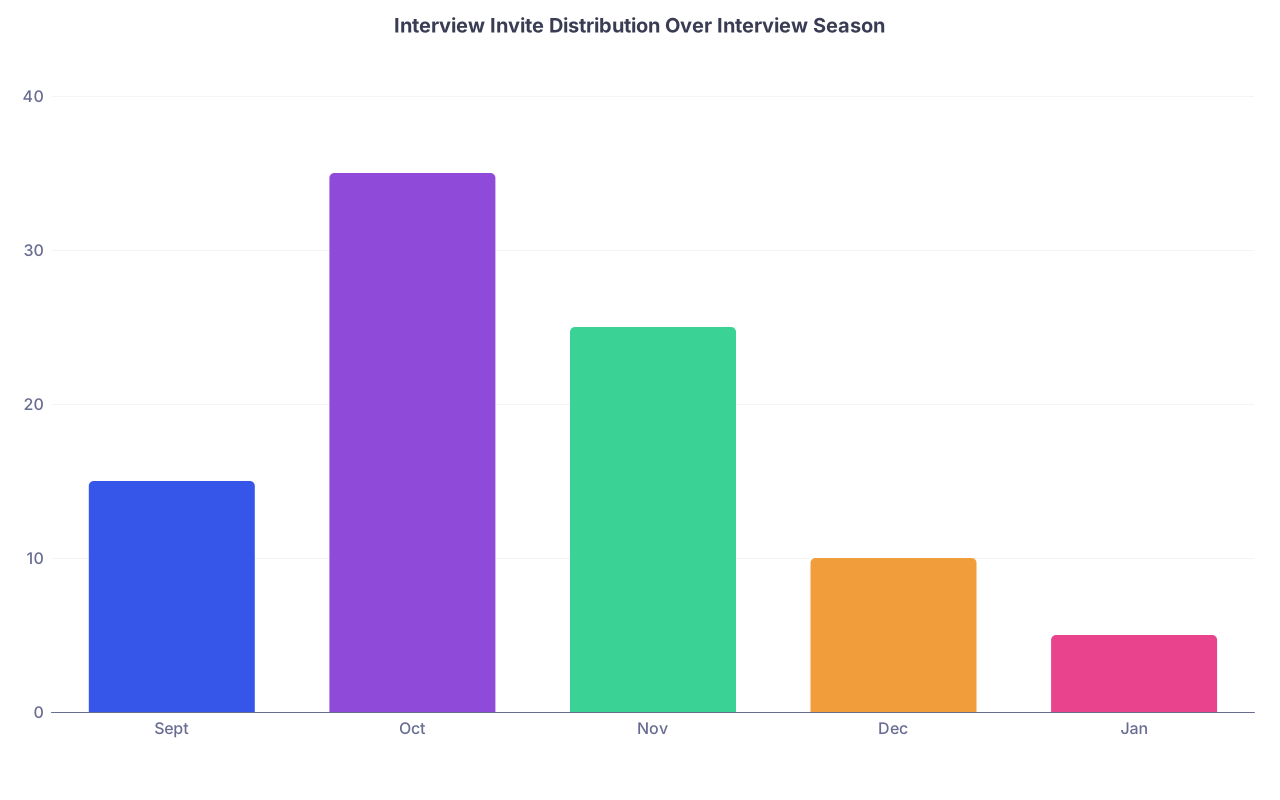
| Sept | 15 |
| Oct | 35 |
| Nov | 25 |
| Dec | 10 |
| Jan | 5 |
November (Second Wave and Silence Management)
At this point you have a reasonable sense of whether your application is “landing.”
Your tasks this month:
- If you have low interview numbers by mid‑November:
- Talk to:
- Your school’s advising office.
- A trusted faculty mentor.
- Consider:
- Targeted, professional interest emails to a small number of programs where you are regionally appropriate or have a connection.
- Talk to:
- Keep documenting everything.
- You may need this if you end up in SOAP:
- Number of programs applied to.
- Number of interviews.
- Types of programs that have shown interest.
- You may need this if you end up in SOAP:
December–January: Late Interviews, Reassessment, and Rank Drafting
Early December
At this point the majority of interview offers have gone out, but DOs often get “late” love from community and newer programs.
Your tasks this month:
- Continue attending all reasonable interviews.
- Do not cancel lower‑tier programs prematurely. As a DO, that “safety” program may be the one that ranks you to match.
- Start informal ranking notes.
- After each interview, write:
- Pros
- Cons
- Gut feeling (1–10)
- Do it that night. Memory fades.
- After each interview, write:
Early January
At this point you should shift from “collect invites” to “optimize rank list.”
Your tasks this week:
- Finalize any remaining interviews.
- Some specialties will still interview in January.
- Review your season data.
- Where did you get interviews?
- Which program types liked you most? That often predicts where you will be ranked well.

February–March: Rank List and Match Week (Including SOAP Backup)
February (Rank Order List Construction)
At this point you must stop overthinking and start ranking honestly.
Your tasks this month:
- Build your rank list top‑down:
- Rank programs in true preference order, not where you “think” you will match.
- Do not push DO‑friendly programs down the list because of ego. If you would be happy there, rank them appropriately.
- Reality check with mentor/advisor.
- Show them your list and your interview count.
- Ask plainly: “Is this safe enough for me as a DO applicant in this specialty?”
- Lock backup plan understanding.
- Learn basic SOAP mechanics from your school:
- Timeline.
- Required documents.
- How quickly you will need to respond.
- Learn basic SOAP mechanics from your school:
Early March – Rank List Deadline
At this point there is exactly one correct move: submit a carefully considered list before the deadline.
Your tasks this week:
- Submit and verify your rank list.
- Double‑check:
- No program included twice in different tracks in a way that misrepresents your preference.
- No accidental missing program you genuinely liked.
- Double‑check:
- Stop sending “love letters” to programs.
- A single, honest “this program is my top choice” note (if true) was appropriate earlier. Doing it now to multiple programs is dishonest and pointless.
Match Week (Mid‑March)
At this point, emotions will be louder than logic. Have a plan written down before that Monday.
If you match:
- Breathe.
- Email PD and coordinator a brief thank you and expression of excitement.
If you do not match (SOAP time):
Your tasks on Monday–Thursday of Match Week become brutally time‑sensitive:
- Monday:
- Meet immediately with your dean/advising office.
- Review unfilled list and identify realistic programs given:
- Your scores.
- Your clinical background.
- Tuesday–Thursday:
- Submit SOAP applications as guided.
- Be available by phone at all times.
- Use your existing materials—this is not the time to rewrite everything.
Today, do one concrete thing that moves you from vague anxiety to structured action: open a blank document and create a week‑by‑week calendar from now until ERAS submission, then plug in the specific tasks from the month you are currently in. If the page stays mostly empty, you are already behind. Fill it.