

The prestige game in residency applications is wildly overrated—and also, annoyingly, not completely fake.
That’s the uncomfortable truth. People will tell you, “If you’re a good applicant, it doesn’t matter where you went to school.” And you’ll smile and nod while your brain is screaming, “Yeah, but what if they’ve literally never heard of my DO school?”
You’re not crazy for worrying. I’ve heard faculty say this out loud in ranking meetings:
“Where is that school again?”
“Is that a new DO program?”
“Anyone know how rigorous their clinical rotations are?”
So yes, “weak name recognition” is a thing. But it’s not the death sentence your 2 a.m. brain says it is.
Let’s walk through what actually happens when your school doesn’t ring a bell in ACGME programs—and what you can do so you’re not crushed by some brand-name hierarchy you never signed up for.
How Much Does School Name Really Matter?
Let me be blunt: it matters. But not in the cartoonish way people imagine.
Programs aren’t sitting around saying, “We only take DOs from PCOM, MSU, UNE, etc., everyone else in the trash.” That’s not how it plays out. What actually happens is more subtle and more annoying.
When a PD or faculty doesn’t know your school, they have three gut reactions:
- They don’t know how to interpret your grades. Is Honors there equivalent to Honors somewhere else?
- They don’t know how strong your clinical training is.
- They use your other metrics as a “proxy” for school quality.
So your anxiety is basically: “Will the name of my school make them doubt me before they even look at my file?” Sometimes, yes. But then they keep looking—if you give them reasons to keep looking.
Here’s the hierarchy programs actually use (even if they don’t admit it):
| Priority Order | Screening Factor |
|---|---|
| 1 | Board scores (COMLEX/USMLE) |
| 2 | Class rank / grades |
| 3 | Clinical rotations & evals |
| 4 | Letters of recommendation |
| 5 | School reputation/name |
Notice where school name really sits. It’s not nothing. But it’s rarely #1 or #2.
If you’re below a program’s score cutoffs, the fanciest DO school in the country won’t save you. If you’re above them with strong clinical stuff, a lesser-known school won’t automatically sink you.
So your job isn’t “fix school name.” You can’t. Your job is to overwhelm that doubt with evidence.
The Real Worst-Case Scenarios (And How Likely They Actually Are)
Let’s just say the quiet parts out loud, because I know what your brain is doing.
Worst-case fear #1: “Programs will auto-reject me because they don’t know my school.”
Some will. Not many, but some. Especially big-name academic places that already get 5,000 apps and need excuses to narrow the pile.
The more common scenario is less dramatic:
- They see a school they don’t recognize.
- They squint at your scores and letters.
- If you’re borderline, they pass. If you’re clearly strong, they shrug and keep you in.
This hits hardest if:
- You’re applying to ultra-competitive specialties (derm, ENT, ortho, plastics).
- You’re in a newer DO school with barely any match history.
- Your board scores/grades are average or below for that specialty.
So if you’re gunning for something like ortho from a brand-new DO program with a 518 COMLEX Level 1 and no Step, yeah, that’s an uphill battle.
But for IM, FM, psych, peds, EM (even gen surg in many places), a “unknown” DO school with solid numbers is far from doomed.
Worst-case fear #2: “I’ll get zero interviews because of my DO school.”
I’ve seen applicants like this:
- Mid-520s COMLEX Level 1
- Took and passed Step 1 and 2 with mid‑230s to 240s
- Top half of class, a couple of posters, okay letters
- School: newer DO program, no one has heard of it
They didn’t get zero interviews. They didn’t get 40 interviews either. But they landed around 10–15 in core specialties. That’s enough.
The actual “zero interview” situations usually involve:
- Red flags (failed boards, professionalism issues)
- Very late applications
- Very limited geographic preferences + narrow specialty target
- And then maybe, yes, an unknown school layered on top
Your school is usually the multiplier, not the primary cause.
Worst-case fear #3: “Even if I match, I’ll only match to low-tier community programs.”
That might happen. But then you have to ask: what’s your actual goal?
- If your goal is to become a solid internist or hospitalist, a “low-tier community program” can be perfectly fine.
- If your goal is cardiology at a big-name academic center, yes, the path is harder from a small community IM program.
But people do it. I’ve watched DO grads from tiny community IM residencies end up in GI, cards, even Pulm/CC. They just had to grind: research, conferences, networking.
Your school’s name might shift where you start. It doesn’t write your entire story.
How Programs Actually Judge an Unknown DO School
Programs do three things when they see a school they don’t recognize.
1. They look at other applicants from your school
If they’ve ever had:
- A resident from your school who turned out strong → you get a quiet bump.
- Someone who struggled → you get quiet skepticism.
But if your school is new enough or underrepresented, they might have no prior data. Then…
2. They lean harder on metrics
If they don’t have a mental “anchoring” for your school, they anchor to what they do know:
- COMLEX 1/2 (and Step 1/2 if you took them)
- How your scores compare to their usual range
- Whether your letters come from names/places they know
- How your clinical experiences line up with “normal” expectations
This is where it stings. A 550 COMLEX from a big “name” DO school might be glanced at as “solid.” The same 550 from an unknown school might get more scrutiny. Not rejection. Just more doubt.
That’s why I tell people: if your school’s name doesn’t do any work for you, your numbers and letters have to. There’s no coasting.
3. They quietly test you with interviews and sub‑Is
For applicants from lesser-known schools, audition rotations and interviews become “proof of concept.”
Rotations:
If you rotate at their hospital and:
- Show up early
- Present clearly
- Know your patients cold
- Don’t act entitled
You can single‑handedly upgrade your school’s reputation in that PD’s mind. Conversely, if you flounder, you reinforce their worst suspicions.
Interviews:
They’re listening for things like:
- Can you talk about your curriculum without sounding defensive?
- Do you own your training, or constantly compare yourself to MD schools?
- Do your stories suggest you actually saw and did real stuff, or just shadowed?
You can’t control the past perception. But you absolutely can change what they think by the end of a month-long rotation or a 20-minute conversation.
What You Can Actually Do If Your DO School Has Weak Name Recognition
Here’s where you have some control again. You can’t change where you went. But you can change what else they see.
1. Be brutally strategic about specialty
If you’re at a low‑name DO school plus:
- Middle‑of‑the‑road scores
- Limited research
- No huge connections
Then trying for derm, ENT, plastics, or urology is like starting a marathon at mile -10. You can still run, but you’re not starting at the same line.
If you’re anxious about matching at all, choose a specialty where:
- DOs routinely match
- Your specific school has at least some match history (even if tiny)
- Community and hybrid programs are common
Family med, IM, psych, peds, neurology, PM&R, EM (in many regions) are far more forgiving if your file is strong.
2. Crush boards. Yes, that cliché. But for you, it matters more.
When your school name doesn’t do any lifting, your numbers do more work.
If you’re early enough in school, your new mental model is:
- “I don’t get to be average on COMLEX.”
- “If I don’t take Step, I need legitimately strong COMLEX scores.”
- “If I do take Step, it needs to be a clear asset, not a barely‑passing risk.”
You’re competing with DOs from more established programs. Many of them will also have Step.
Programs might not care that you went to X-Brand-DO-College if they’re staring at:
- 600+ COMLEX
- 240+ Step 2
- Strong letters
- Clean narrative
That’s how you blunt the name‑recognition hit.
3. Use audition rotations like weapons, not vacations
If your school isn’t famous, your performance has to be.
Rotate at:
- Programs in your target region
- Community or hybrid academic programs known to take DOs
- Places where DO leadership or DO-friendly faculty exist
On those rotations, you’re not trying to be liked. You’re trying to be remembered as:
- The student who knew their patients inside out
- The one who followed up, asked good questions, and didn’t vanish at 3 p.m.
- The DO from “that school… what was it called? But they were excellent.”
One smart move: if your school has a couple of alumni at decent programs, try to rotate there. An alum advocate can neutralize the “never heard of that school” concern in the room.
4. Letters: get them from people whose names carry weight
If your school doesn’t have clout, borrow some.
Two applications that both say “Osteopathic School I’ve Never Heard Of” look very different if:
Applicant A:
- 3 letters all from your home institution faculty
Applicant B:
- 1 home DO faculty letter
- 1 letter from a well‑regarded community PD
- 1 from an academic attending at a regional center
Even if they don’t know your school, they know that attending at Regional Medical Center or that PD with a recognizable name who says, “This student performed at the top level of our rotators.”
That matters. A lot.
5. Apply broadly, and get over the pride thing
Programs don’t care that you applied to 60 places. You’re the only one who sees that list.
If you have:
- Lesser‑known DO school
- Solid but not stellar stats
- No inside connections
Then putting 20 programs on your ERAS list is not “being selective.” It’s being reckless.
Think in tiers:
- Some reach programs you’d love
- A large core of realistic community and mid‑tier ACGME programs
- A few ultra‑safety options where you’d 100% clear their bar
Name recognition becomes less punishing when you cast a wide enough net.
Coping With the Mental Side: Constant Comparison and Regret
Let’s hit the part no one talks about.
You see classmates from “better” DO schools or MD schools posting their insane match lists on GroupMe or Instagram. Your brain does the toxic thing:
“If only I’d gotten into X school, I’d be set.”
“If I don’t match, it’ll be because I went here.”
“I screwed up at 21 and I’m paying for it forever.”
Here’s the reality:
- Some people from “top” DO schools fail boards
- Some people from tiny unknown DO schools match insanely well
- Programs are increasingly used to reading DO applications from everywhere post‑merger
You can’t fix the past choice. You can only decide whether you make yourself the strongest possible resident candidate from this school.
Resentment and regret don’t add one point to your COMLEX score or get you one extra interview. They just eat bandwidth.
Your fear isn’t irrational. It’s just incomplete. Yes, your school’s reputation creates friction. It does not slam the door shut.

| Step | Description |
|---|---|
| Step 1 | Unknown DO School |
| Step 2 | Programs keep reading |
| Step 3 | More likely to be screened out |
| Step 4 | Competitive for many ACGME programs |
| Step 5 | Limited to more DO-friendly/community programs |
| Step 6 | Apply more broadly & adjust specialty |
| Step 7 | Strong Boards? |
| Step 8 | Good Rotations & Letters? |
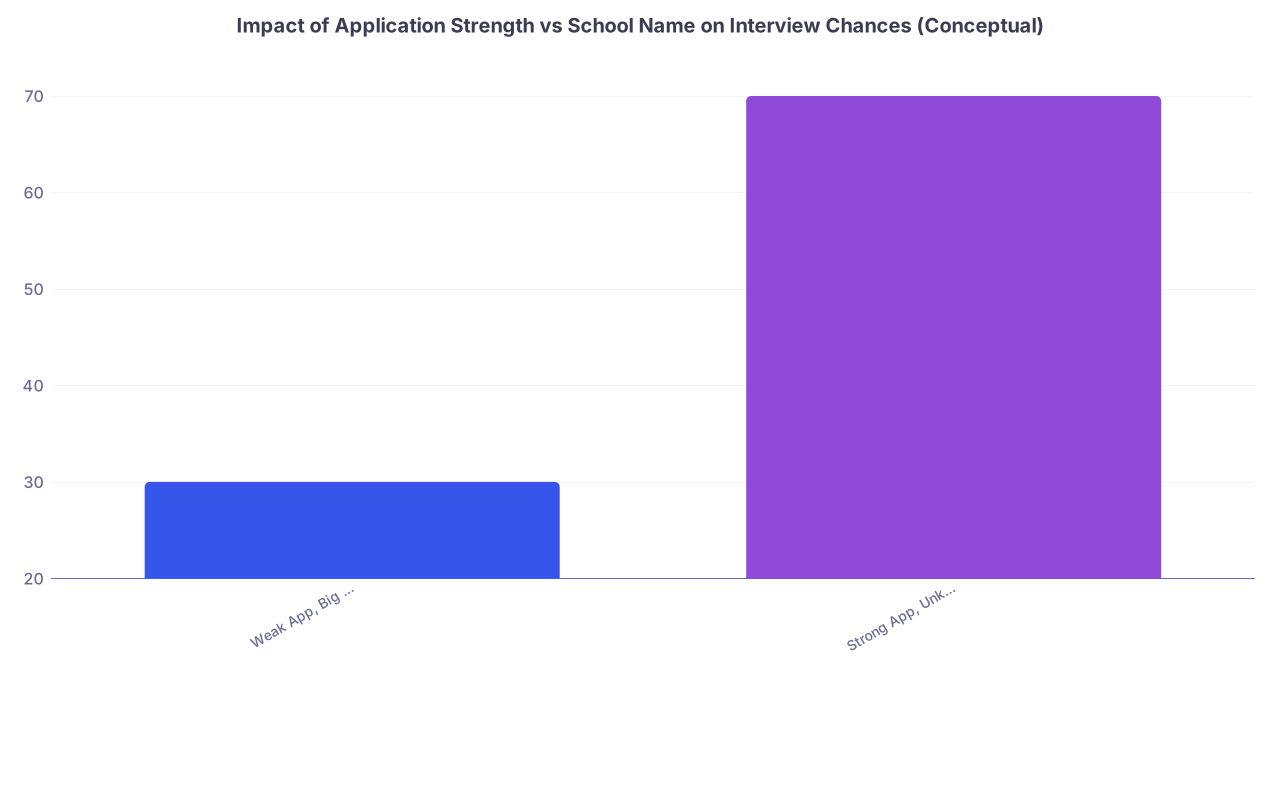
| Category | Value |
|---|---|
| Weak App, Big Name | 30 |
| Strong App, Unknown DO | 70 |

FAQ – Exactly What Your Brain Is Spiraling About
1. Do ACGME programs secretly rank DO schools?
Informally, yes. Not with an official list on the wall, but in their heads. Programs get a sense over time: “We’ve had good experiences with graduates from X, Y, Z schools” and “We’ve struggled with grads from A, B, C.” Your unknown school just isn’t on their internal map yet. That’s not fatal; it just means you need stronger individual signals—scores, rotations, letters—to compensate.
2. Should I take USMLE if my DO school isn’t well known?
If you’re early enough and your anxiety is already screaming about “weak name recognition,” then yes, I’d strongly consider Step 2, especially for anything even mildly competitive. Programs know how to interpret USMLE. It gives them a clean comparison tool. Don’t take it lightly, though—only if you can prep to do well. A weak Step score can hurt more than no Step at all.
3. Will an audition rotation at a big-name place cancel out my school’s lack of reputation?
No. It won’t cancel it out. But a strong rotation can override a lot of the initial doubt at that specific program. Where it really helps is with your letter: “We don’t know their school, but we trust Dr. X, and Dr. X says this student was excellent.” That’s powerful. Just don’t treat the rotation like sightseeing. Those four weeks matter more for you than for the MD student from a famous school standing next to you.
4. How many programs should I apply to if my DO school isn’t well known?
More than you’re comfortable with. For core fields like IM or FM, 40–60 isn’t crazy if your stats are decent but not superstar-level. For slightly more competitive fields—EM, anesthesia, neuro—you might be looking at 60–80. It feels excessive and expensive, but getting too “choosy” from a low‑name school is how people end up with 3 interviews and a panic attack in January.
5. Will programs ask me directly about my school’s quality or reputation?
Sometimes they ask sideways: “Tell me about your clinical training,” or “What was your third-year structure like?” They’re trying to figure out if your education was legit without saying, “We’ve never heard of your school; is it any good?” You don’t need to get defensive. Just be specific: where you rotated, volume of patients, acuity, responsibilities. Sound proud of what you actually did, not apologetic about the logo on your badge.
6. If I don’t match where I want because of school name, am I basically stuck forever?
No. But your path may be less linear. You might match IM at a smaller community program instead of a big academic one, then use research, conferences, and networking to get a fellowship you care about. Or you might do a prelim year and reapply. Or match FM and later build a niche practice that looks a lot like what you originally pictured. Your school’s name can make the first door harder to open. It doesn’t decide every door after that.
Keep three things straight in your head:
- Your DO school’s weak name recognition is a real factor—but it’s not the main factor unless you let everything else be mediocre.
- Strong boards, strong rotations, and strong letters can absolutely drown out the “never heard of this school” reaction for most ACGME programs.
- You can’t rewrite where you went to school, but you still have a lot of control over how you show up on paper, in person, and on the wards—and that’s what actually gets you a spot.


