
You are a junior in college. Your spreadsheet has three tabs open: “MD,” “DO,” and “Dual Degree.” Your mentor just told you, “If you want leadership or policy, you should probably go MD-MPH or MD-MBA.” Then your friend in the pre-DO club swears, “Plenty of DO schools have that too, you just combine it.”
You are stuck in the same place a lot of good students get stuck:
If you care about an MBA, MPH, or PhD, does MD vs DO actually matter? Or can you get to the same endpoint either way?
Let me break this down, specifically, and not in vague brochure language.
1. The real question: “Built-in” vs “Figure-it-out-yourself”
Most students ask, “Can I do an MD-MBA?” or “Can I do a DO-MPH?” That is the wrong first question.
The right questions:
- Does the school have a formal, structured dual degree track (specified curriculum, defined timeline, clear tuition/financial structure, coordinated advising)?
- Or is it a DIY combination (take a leave of absence, do the other degree separately, hope the scheduling works, and negotiate every step)?
Because both MD and DO students can earn MBAs, MPHs, and PhDs. The difference is:
- MD schools: Far more formal, advertised dual-degree programs.
- DO schools: Far more “you can do it, but you have to build it” arrangements, with a handful of truly structured options.
So MD vs DO does not decide if it is possible. It decides how much friction you will face.
2. MD schools: how dual degrees typically work
At most U.S. MD schools, you will see a separate “Dual Degree” or “Combined Degree” tab on their website. They tend to organize around a simple pattern:
- MD-MBA: 5 years total (occasionally 4 if highly integrated)
- MD-MPH: 5 years total (some 4-year accelerated formats)
- MD-PhD (MSTP or equivalent): 7–8 years, fully planned, usually with substantial funding
These are not theoretical. They are operational pipelines.
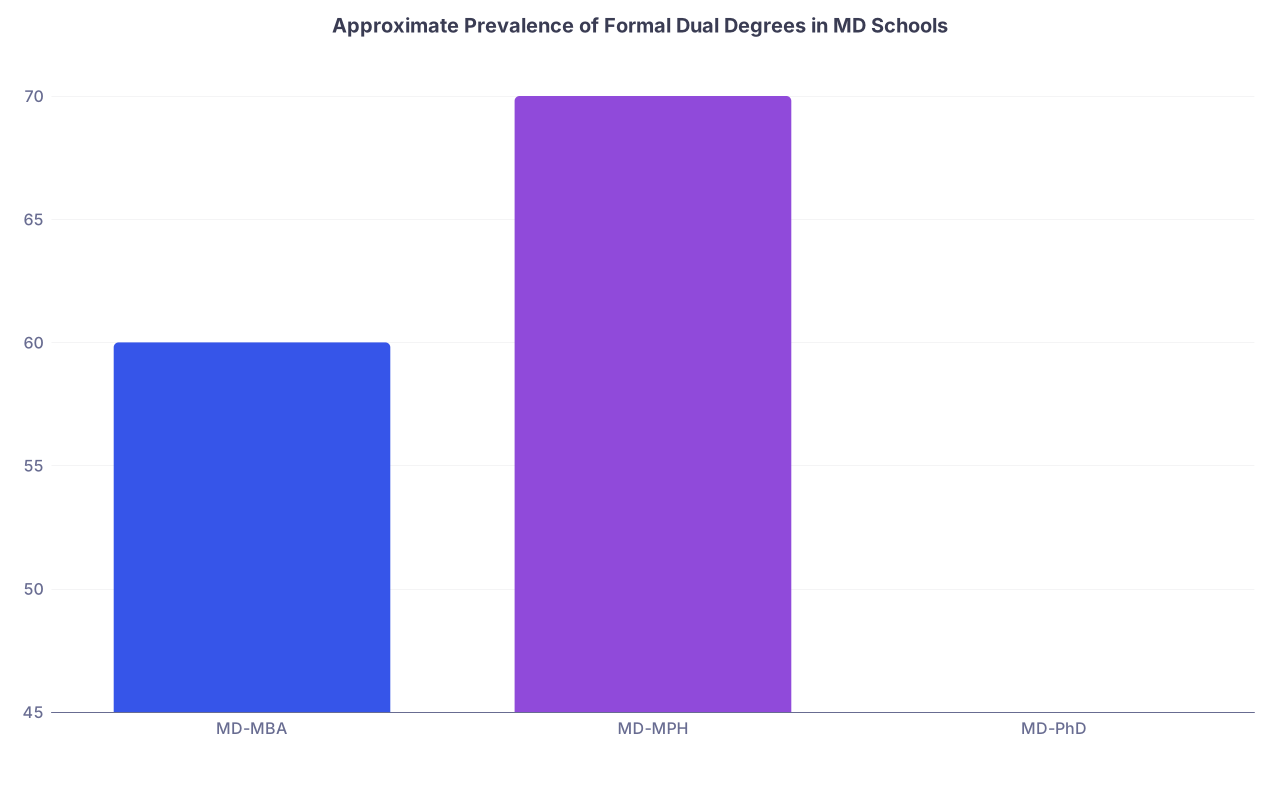
| Category | Value |
|---|---|
| MD-MBA | 60 |
| MD-MPH | 70 |
| MD-PhD | 45 |
Those numbers are rough and vary a bit year-to-year, but the pattern holds: if you look across LCME-accredited MD programs, a majority have at least MD-MPH and/or MD-MBA, and a substantial subset have MD-PhD.
How MD-MBA usually looks
Example: University of Pennsylvania (Perelman) / Wharton, or Michigan, or Baylor. Pattern:
- First two years: preclinical MD
- Then 1 dedicated business year (or 3–4 full-time semesters integrated with clinical years)
- Then you finish clinical rotations, sometimes with shared credit so it all fits in 5 years
- Advising: you are placed into a cohort of MD-MBA students, with clear expectations and a defined path
- TUITION: sometimes higher, but there can be joint degree discounts or scholarships via the business school
Hospitals hiring for administrative fellowships, consulting firms that like MD-MBAs, and health systems looking for physician-executives all recognize these pairings instantly. You are not the first one to do it from that school. That matters.
How MD-MPH usually looks
Think places like UNC, Johns Hopkins, Boston University, University of Washington.
- Either you insert a dedicated MPH year between M2 and M3
- Or the MPH is integrated (especially if the med school and public health school share the same university)
- Often, there are pre-set concentrations that make sense for physicians: epidemiology, health policy, global health, community health
These programs frequently have:
- Defined application windows just for med students
- Advising tracks for “MD-MPH students”
- Opportunities tailored to dual-degree people (summer projects, research mentors, capstones intertwined with clinical work)
How MD-PhD (MSTP) looks
MD-PhD in the MD world is its own beast.
- Structured, funded training pipeline: 7–8 years
- Front-loaded with PhD methods and research
- Usually with tuition remission + stipend, especially at MSTP-funded programs (NIH-supported)
You are admitted either directly as MD-PhD or occasionally you transfer into MD-PhD early in med school. There is a culture of physician-scientists at these places. Entering as “MD-only” and later deciding “I also want a PhD” is possible, but often not as smooth as entering an established track from day one.
3. DO schools: what exists vs what you can create
Now the DO side. This is where premeds get confused because websites can be vague, and advising can be… wildly variable.
Here is the honest breakdown:
- Some DO schools do have formal dual degrees: DO-MPH is most common; DO-MBA is present but less common; DO-PhD is rare and often very research-focused programs at a few institutions.
- Many DO students still earn MBAs/MPHs, but they do this through:
- Online or part-time programs
- Separate universities during a gap/leave
- Post-residency or late residency
So you need to distinguish formal institutional dual degree vs you taking on an extra degree while also a DO student.
Examples of dual-degree patterns in DO schools
You will see language like:
- “DO/MPH available in collaboration with [X] School of Public Health”
- “Joint DO/MBA degree with the [Name] College of Business”
- Or occasionally: “Students may pursue a concurrent master’s degree with dean’s approval”
The last one is code for: you can attempt it, but you are on your own to prove it will not wreck your academic standing.
| Dual Degree | MD Schools (LCME) | DO Schools (COCA) |
|---|---|---|
| MBA | Common, many formal MD-MBA tracks | Present at a subset, often fewer structured options |
| MPH | Very common, often well-integrated | Moderately available, sometimes via partner institutions or online |
| PhD | Structured MD-PhD tracks at many academic centers | Rare, usually niche and heavily research-focused |
Is it impossible to be a DO-MBA or DO-MPH? No. I know DOs who did exactly that. But:
- MD schools often say: “Here is our MD-MPH track.”
- DO schools often say: “You may also consider an MPH; talk to the dean.”
Those are very different operational realities.
4. MBA: MD vs DO paths if you care about leadership or business
If you are serious about the MBA, ask yourself what kind of MBA you actually mean.
There are roughly three categories:
- Top-name full-time MBA (Wharton, Booth, Kellogg, etc.) integrated with medical school
- Solid regional MBA tied to a university’s business school
- Online or flexible MBA during or after training, often while working
MD-MBA: why it is more established
At MD programs associated with large universities, MBAs are baked into the structure.
- Established crossover: business schools know exactly what to do with med students.
- Brand alignment: MD from a big-name med school + MBA from same university or top nearby program.
- Alumni networks: there is often a track record of MD-MBA grads in healthcare consulting, hospital leadership, pharma.
That matters if you want:
- Strategy roles at large health systems
- Jobs at McKinsey/BCG/Bain doing healthcare
- Early leadership roles in academic medical centers
Is it impossible with a DO-MBA? No. But you will do more explaining. You will rely more on your performance, networking, and story rather than the ready-made brand package.
DO-MBA: how it usually works in real life
DO students who end up with MBAs typically fall into a few patterns:
- Joint or linked programs at a subset of DO schools (often regional MBAs)
- An online or hybrid MBA started during 3rd/4th year or early residency
- An executive or part-time MBA pursued after you are already a practicing physician
What you lose vs MD-MBA:
- Less structured integration; more schedule juggling
- Fewer cohorts of other physician-MBAs at your exact institution
- Generally less institutional prestige in the MBA world (depends heavily on the specific business school)
What you keep:
- Degree signal: “This person knows finance/operations/management beyond the average physician”
- Practical skills: budgeting, strategy, basic accounting, operations, health systems, etc.
So the MD route is friendlier, better branded, and cleaner structurally for an MBA, especially if you are targeting higher-level leadership early. DO route is more flexible/DIY and often delayed.
5. MPH: public health, policy, and global health – DO vs MD
Here the gap is narrower, but still present.
The MPH is the most “agnostic” master’s relative to MD vs DO. Public health programs care more about:
- Your commitment to public health
- Your ability to handle quantitative and policy coursework
- Your practical/public health experiences
They do not particularly care if you are an MD or DO.
MD-MPH: advantages
At MD-heavy academic centers like:
- Johns Hopkins
- UNC
- Emory
- Boston University
- University of Washington
MD-MPH students have:
- Well-oiled joint programs
- Summer research placements, practicum sites, and capstones pre-aligned with physician training
- Faculty who have seen many MD-MPHs come and go, so expectations are realistic
The MPH is used as a lever for:
- Health policy fellowships
- Academic general internal medicine careers
- Leadership in public health departments or NGOs
- Epidemiology and outcomes research roles
DO-MPH: what I see in the real world
On the DO side:
- Quite a few DO schools are newer and do not have a full public health school in-house.
- So they partner with nearby universities or offer online MPH programs.
- Some DO students do a post-doc MPH after residency or as a flexible online degree while working.
This can absolutely work if you:
- Want to run a community clinic, FQHC, or local public health project
- Want to be involved in quality improvement and population health in your health system
- Want some credibility in public health without a purely academic career
The big difference: MD schools with in-house SPH (schools of public health) create a public health ecosystem; DO schools more often create a pathway.
If you are dead serious about CDC, WHO, major policy shops, or academic public health, an MD-MPH from a major academic center puts you in the middle of that pipeline. A DO-MPH can get you there, but you will work more off-network and rely heavily on your own research, advocacy, and networking.
6. PhD: physician-scientist ambitions – this is where MD really pulls away
If you are asking about PhD combinations, the MD vs DO difference is not subtle.
MD-PhD (MSTP) reality
At MD schools:
- MD-PhD programs (especially MSTP-funded ones) are specifically designed to produce physician-scientists.
- Funded training: tuition usually covered, stipend for living expenses.
- Integrated mentorship: combined programs, retreats, research-in-medicine curricula.
You graduate with:
- A defined research portfolio
- A track into research-heavy residencies and, eventually, tenure-track academic jobs if you want them
This is the standard, recognized pathway to high-end physician-scientist careers in the U.S.
DO-PhD: the honest picture
There are a few DO-granting institutions that have DO-PhD or DO/MS programs, often with strong basic or translational science departments. But:
- They are far fewer in number.
- They typically do not have the same NIH MSTP scale or brand recognition.
- Many DO schools are not deeply research-heavy; they are clinically oriented and community-focused.
Can a DO do a PhD? Yes:
- Some do a separate PhD before or after DO (painful timeline).
- Others enter research-oriented fellowships and build research careers without the PhD.
- A few use DO-PhD combined offerings at institutions that have meaningful research infrastructure.
But if you already know:
- “I want to be a physician-scientist with a lab, R01s, and major academic footprint,”
then MD-PhD at a mature program is simply a stronger, cleaner, better-supported route. I am not going to sugarcoat that.
7. How to actually use this when choosing MD vs DO
Let’s translate all this into what you should actually do as a premed or early med student.
Step 1: Rank your priorities clearly
Ask yourself:
- Is the dual degree central to what I want to do or just “nice to have”?
- Which one is most important: MBA, MPH, or PhD? Rank them.
- Am I prestige-driven, outcome-driven, or flexibility-driven?
If your top priority is:
- PhD-style research career → strong lean toward MD, and realistically MD-PhD if you can get in.
- High-level health system leadership / consulting → moderate lean toward MD if you want a big-name MBA; DO still viable if you are okay with regional or later-career MBAs.
- Community/public health work → MD or DO both fine; specific MPH program quality + your experiences will matter more than the letters.
Step 2: Ignore generic “MD vs DO” talk and look at actual schools
Do not ask, “Do DO schools offer MPH?” Ask:
- “Does this DO school I am considering have a formal DO-MPH program with a set curriculum, or are they just saying ‘you may pursue an MPH elsewhere’?”
Same for MD. Not every MD school has good dual-degree options either. Some are quite bare-bones.
Go to school websites. Look for:
- Explicit program names: “MD-MBA,” “DO-MPH,” “Physician Leadership Track with MBA”
- Described timelines: “5-year MD-MPH combined program”
- Application process sections explicitly for current medical students
If they cannot describe it in a paragraph and a timeline, it probably is not a mature program.

| Step | Description |
|---|---|
| Step 1 | Start: Considering Dual Degree |
| Step 2 | Prefer MD, target MD-PhD |
| Step 3 | Prefer MD with formal MD-MBA |
| Step 4 | MD or DO with MBA options, including online |
| Step 5 | Prefer MD with strong MD-MPH at academic center |
| Step 6 | MD or DO with accessible MPH pathway |
| Step 7 | Top Priority? |
| Step 8 | Need Top MBA Brand? |
| Step 9 | Academic Policy Career? |
Step 3: Be realistic about your leverage
MD-PhD and many MD-MBA/MPH tracks are competitive even within medical school. You generally need:
- Strong Step/COMLEX or preclinical performance
- Clear rationale for the extra degree
- Some pre-existing research or leadership experience
Do not assume that just because a school lists “MD-MBA” you are automatically in. Same with DO side. But the existence of a program increases your odds dramatically because at least there is a defined gate and path.
8. Common myths and bad advice you will hear
You will hear a lot of nonsense. Let me clean some of it up.
“DO schools don’t do research / don’t have PhD options.”
- Oversimplified. Some are doing more research than many mid-tier MDs. But as a system, MD schools dominate the physician-scientist pipeline and MD-PhD infrastructure. That is just reality.
“An MPH is the same no matter what med degree you have.”
- On paper, yes. In practice, the ecosystem around an MD-MPH at a big academic center and a DO-MPH done online while you are an intern are not the same experience. Both valuable, but different in connections and momentum.
“MD-MBA is necessary if you want to be in leadership.”
- Flatly wrong. There are plenty of CMOs and chairs with no MBA. Experience and informal leadership can outrun degrees. But an MBA, especially from a strong program, is gasoline on the fire if you are already on a leadership trajectory.
“DO-MBA or DO-MPH won’t be respected.”
- Also wrong. I have seen DOs with MBAs and MPHs running programs, leading service lines, and doing policy work. It is just that the pathway is usually less packaged and more self-assembled.
9. Strategy if you are still early premed
If you are in college and just starting:
- Cast a wide net: Apply to both MD and DO unless you are non-competitive for one side.
- While building your school list, flag:
- MD schools with strong dual-degree offerings in your area of interest
- DO schools that explicitly support the same (especially DO-MPH or DO-MBA)
- During interviews and second looks, ask specific questions:
- “How many students actually complete the MD-MBA each year?”
- “Is there protected time or a formal year for the MPH?”
- “Do you have DO-PhD students currently, and are they funded?”
Vague answers usually mean weak infrastructure.
If you end up with multiple acceptances, then and only then should you weigh:
- A strong DO with a clear DO-MPH vs a weaker MD with no dual degree options
- Or a top MD with formal MD-MBA vs a DO where you would patch together an MBA online later
Sometimes the right move is a DO with actual support over an MD with nada.
10. Bottom line: MD vs DO for dual degrees
Strip everything else away and the pattern looks like this:
MBA
- MD: Clear advantage for structured MD-MBA pairings, especially at large academic centers and with well-known business schools.
- DO: Possible, often via regional or online programs; more DIY, less brand synergy, but still useful.
MPH
- MD: Strong advantage for integrated MD-MPH in academic public health powerhouses; better for high-end policy / academic PH careers.
- DO: Fully feasible; many DOs succeed in public health. Pathways are more scattered and often less formal, but the MPH itself is widely respected.
PhD
- MD: Dominant. MD-PhD/MSTP is the gold-standard pathway to physician-scientist careers.
- DO: Rare and more niche; serious research careers are possible but less structurally supported and often more uphill.
If dual degrees are a nice bonus, MD vs DO should still be decided mostly on fit, cost, geography, and your competitiveness.
If dual degrees are central to your long-term identity—you see yourself as a physician-executive, health policy architect, or lab-based scientist—then you cannot ignore how much more built-out and standardized dual degree options are on the MD side, especially for MD-PhD and high-prestige MD-MBA/MPH tracks.
Key takeaways:
- Both MD and DO students can get MBAs, MPHs, and PhDs, but MD schools have far more formal, integrated dual-degree tracks, especially for MD-PhD and MD-MBA/MPH.
- DO routes to dual degrees are often possible but more self-assembled, with fewer structured pipelines and more reliance on online or external programs.
- If research (PhD) or high-level academic/public health careers are central to your plan, the MD route—ideally with a formal dual degree—is a significant structural advantage.