
Academic Promotion Paths: DO vs. MD Credentials in Faculty Hiring
It is late afternoon and you are sitting in a premed advising office. Your advisor just said, “If you want a traditional academic career, MD gives you more options. DO is catching up, but it is different.” You nodded, pretended you understood, and walked out more confused than when you walked in.
You are not asking whether DOs can be good doctors. You are asking a sharper question:
If you want to become faculty, get promoted, maybe even be program director or department chair one day… does choosing DO vs. MD now actually change that path?
Let me break this down specifically, the way faculty search committees actually think about it.
1. The Real Hierarchy: Where Your Degree Matters (And Where It Does Not)
Here is the part most people get wrong. Academic promotion is not “MD vs DO.” It is:
- Type of institution hiring you
- Your track (clinical vs clinician‑educator vs research)
- Your productivity (RVUs, teaching, publications, grants, leadership)
- Your degree (MD vs DO) – which is usually a proxy for other things
At many places, the letters after your name do not block you. They just set the “default assumptions” the committee makes about your training, research exposure, and network.
Broadly, institutions fall into a few buckets.
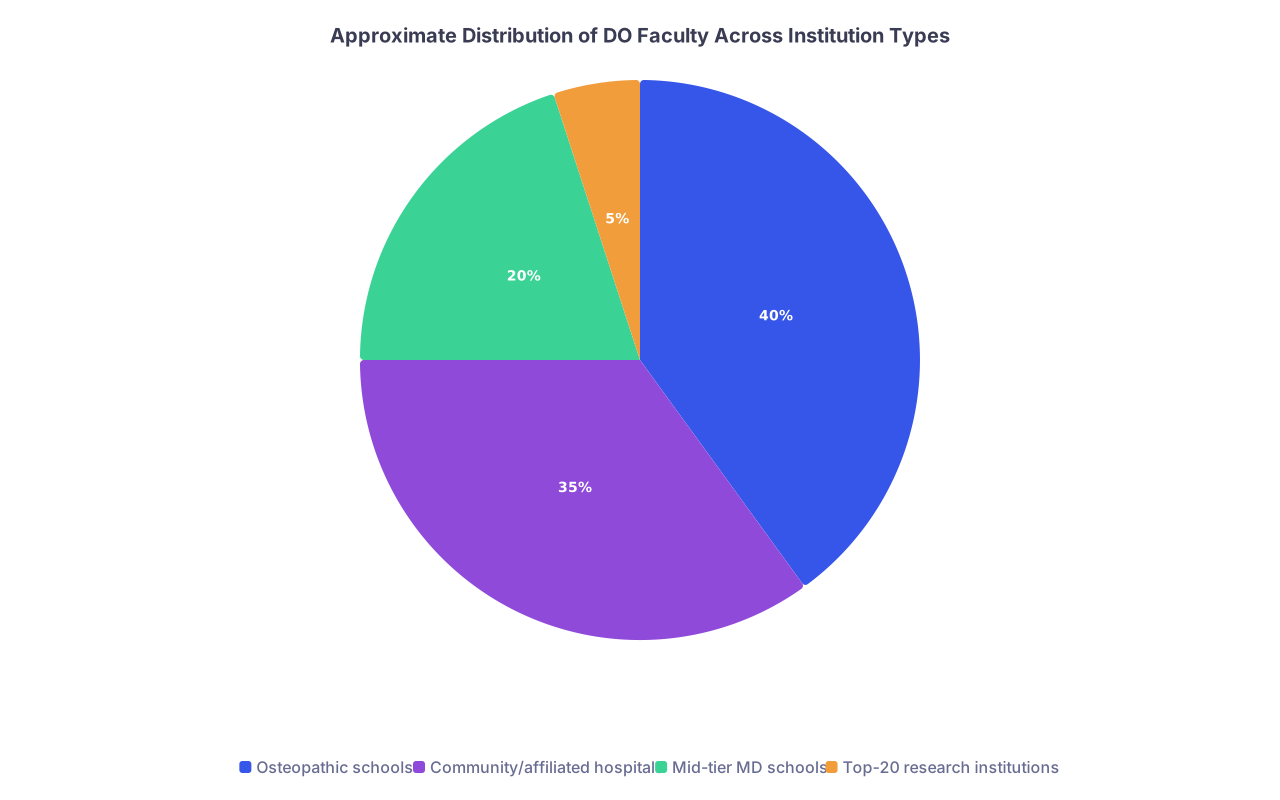
| Category | Value |
|---|---|
| Osteopathic schools | 40 |
| Community/affiliated hospitals | 35 |
| Mid-tier MD schools | 20 |
| Top-20 research institutions | 5 |
Is this exact? No. Is this roughly what I have seen across multiple institutions? Yes.
Major MD-Granting, Research-Heavy Universities
Think: Hopkins, UCSF, Penn, Michigan, Duke.
For tenure‑track, R01‑level research positions, MD vs DO matters because:
- Historically, DO schools have had weaker research infrastructure.
- Fewer DO graduates come with PhDs, strong first‑author papers, or serious grant experience.
- Search committees equate MD (especially from certain schools) with “already comfortable in the NIH ecosystem.”
The bias is not about osteopathic manipulation; it is about research pedigree and networks.
Can a DO land a tenure‑track job at a top‑20? Rare, but absolutely possible if:
- You did competitive residency/fellowship at a major academic center.
- You have a serious publication record.
- You often also have a PhD or equivalent research experience.
The MD, especially from a research‑heavy school, simply makes that path more “default.”
Mid‑Tier MD Schools, Regional Universities, Large Health Systems
Think: state schools, many university‑affiliated hospital systems, mid‑tier academic centers.
Here, DO vs MD is much less of a wall. I have seen plenty of:
- DO hospitalists as clerkship directors.
- DO surgeons on clinical faculty tracks.
- DO internists becoming program directors in community/university hybrids.
The hiring logic is straightforward:
- Are you board certified?
- Did you train at a respected residency/fellowship?
- Can you teach?
- Do you show up, get along with people, and not create headaches?
Your degree matters much less than your training and performance.
Osteopathic Medical Schools
If you are DO and you want to be core faculty, course director, or dean at a COM (College of Osteopathic Medicine), then DO is either neutral or advantageous.
These schools usually like:
- Faculty who understand osteopathic principles.
- Faculty who can model the DO professional identity for students.
- People who actually know what COMLEX is and do not roll their eyes at it.
MDs still get hired at DO schools, especially in subspecialties with fewer DOs, but DOs are often preferred for leadership roles in curriculum and administration.
2. Faculty Tracks: How Promotion Actually Works
Promotion is not one ladder. It is three or four different ladders, and which ladder you choose changes how much your degree matters.

| Step | Description |
|---|---|
| Step 1 | Assistant Professor |
| Step 2 | Clinician-Educator |
| Step 3 | Clinical/Non-Tenure |
| Step 4 | Research/Tenure-Track |
| Step 5 | Associate Professor |
| Step 6 | Full Professor |
| Step 7 | Track? |
1. Pure Clinical Track (or “Clinical Instructor / Clinical Assistant Professor”)
Common in large health systems and many community teaching hospitals.
Promotion criteria are usually:
- Clinical productivity (RVUs, patient satisfaction)
- Teaching evaluations (students, residents)
- Service (committees, quality improvement, protocols)
Publications help, but are not required at many places.
For this track, MD vs DO has minimal impact. What matters more:
- Can you cover the service?
- Are you good with learners?
- Do you get along with nursing and administration?
I have seen DOs promoted on this track as fast as MDs when they fulfill those boxes.
2. Clinician–Educator Track
This is where teaching actually “counts” toward promotion. Criteria typically include:
- Teaching evaluations and teaching hours
- Educational leadership roles (course director, clerkship director)
- Curriculum development
- Educational scholarship (med ed research, presentations, review articles)
Here again, DO vs MD is mostly irrelevant. The real differentiation:
- Did you train where education is taken seriously (e.g., strong academic residency)?
- Are you doing formal med ed work (simulation, OSCEs, curriculum design)?
- Are you producing any scholarship at all?
A DO who becomes clerkship director, runs simulation, and publishes a few med‑ed papers will outrun an MD who just sees patients and gives a few noon conferences.
3. Research/Tenure‑Track
Now the game changes.
Promotion criteria:
- Peer‑reviewed publications (first/last author, not just middle)
- Grants (NIH, foundation, industry – but serious money)
- National reputation (invited talks, guideline committees)
- Sometimes PhD or equivalent research credentials
Here is where MD has a clear systemic advantage:
- More MDs come from research‑intense environments.
- More MDs enter MD/PhD or research‑heavy residency tracks.
- Committees reviewing R01s and research hires have historically been MD/PhD‑dominated.
DOs who succeed on this track almost always have:
- Extra research training (MS, PhD, clinical research fellowship).
- Publications starting early (med school or early residency).
- Post‑doc or advanced research fellowship at big‑name centers.
So if you are premed and already dead certain you want hard‑core academic research, the MD route (especially MD/PhD or at least an MD at a research‑heavy school) is usually the smarter bet.
3. Faculty Hiring: What Search Committees Actually Look At
Forget the official HR posting. In internal meetings the conversation about a faculty candidate sounds more like:
- “Where did they train?”
- “Anyone know them?”
- “Do they actually teach well or are they just filling FTE?”
- “Are they going to bring in grants / RVUs / stability?”
Your degree is one line item in that context. Three things usually outrank it.
1. Residency and Fellowship Pedigree
If you are DO but did residency/fellowship at:
- Mayo
- Cleveland Clinic
- Michigan
- Mass General
- UNC, UCSF, etc.
You are in a massively better position than an MD who trained at a weak, non‑academic program with no teaching culture.
I have seen this play out in hiring meetings: “Yes she is DO, but she trained at X and everyone there says she is excellent.” That overrides the letters on the diploma.
2. Board Certification and Licensure
Non‑negotiables:
- ABMS or AOA board certification (increasingly ABMS preferred because ACGME now unifies accreditation and many places are ABMS‑centric).
- Clean licensure, no major disciplinary issues.
Your degree has to be compatible with your boards:
- DO → can sit for AOB (osteopathic) boards and, depending on training, ABMS boards.
- MD → ABMS boards.
Some higher‑profile academic departments lean heavily toward ABMS‑boarded physicians; that indirectly disadvantages DOs who stayed on the osteopathic board route only. But many DOs now hold ABMS certification, defusing that issue.
3. Existing Academic Footprint
The committee will look for:
- Have you published anything at all?
- Have you presented at national meetings?
- Have you mentored students or residents?
- Did you hold any leadership roles in training (chief, QI fellow, etc.)?
Again, it is not DO vs MD. It is emptiness vs something. A DO with even modest, consistent academic activity beats an MD with none.
4. Promotion Criteria: What Actually Gets You Moved Up the Ladder
Promotion guidelines vary, but they cluster around four buckets.
| Track | Core Requirements | Weight of Research | Typical DO Representation |
|---|---|---|---|
| Clinical | RVUs, teaching evals, service | Low | High |
| Clinician-Educator | Teaching, curriculum, med-ed scholarship | Moderate | Moderate-High |
| Research/Tenure | Grants, publications, national reputation | Very High | Low-Moderate |
| Administrative | Leadership roles plus one of above | Variable | Growing |
Clinical Productivity
If you are on a clinical track, promotion from Assistant to Associate often looks like:
- Years in rank (5–7 years)
- Consistent high RVU production
- Good to excellent patient satisfaction scores
- Solid teaching scores
Your degree is irrelevant here in most systems. Administration cares about:
- Revenue
- No major complaints
- Stable coverage
Teaching and Educational Impact
For clinician–educator tracks, promotion committees will scan:
- Documented teaching hours (lectures, small groups, bedside teaching)
- Teaching evaluations (students/residents)
- Roles: course director, clerkship director, fellowship PD
- Educational materials developed (modules, OSCE cases, curricula)
- Educational scholarship: workshops, med‑ed abstracts, papers
Again, DO vs MD is nowhere in the formal criteria. The person who does the work and documents it wins.
Research Output
Benchmarks vary by institution, but patterns are consistent:
Assistant → Associate (research track) typically requires:
- A clear line of scholarly work (multiple related papers)
- Some external funding (career development award, foundation grant, early R‑series)
- Regional to national recognition in your niche
Associate → Full Professor:
- Sustained, independent funding (often R01 or equivalent)
- Senior‑author publications
- National/international recognition
DOs who hit these marks absolutely get promoted. The problem is fewer DOs end up in the pipeline that leads there. The bottleneck is earlier: research training and early‑career support, not the promotion committee itself.
5. DO vs MD by Specialty: Where the Gaps Actually Show Up
Some specialties are academic‑heavy by default. Others, not so much.
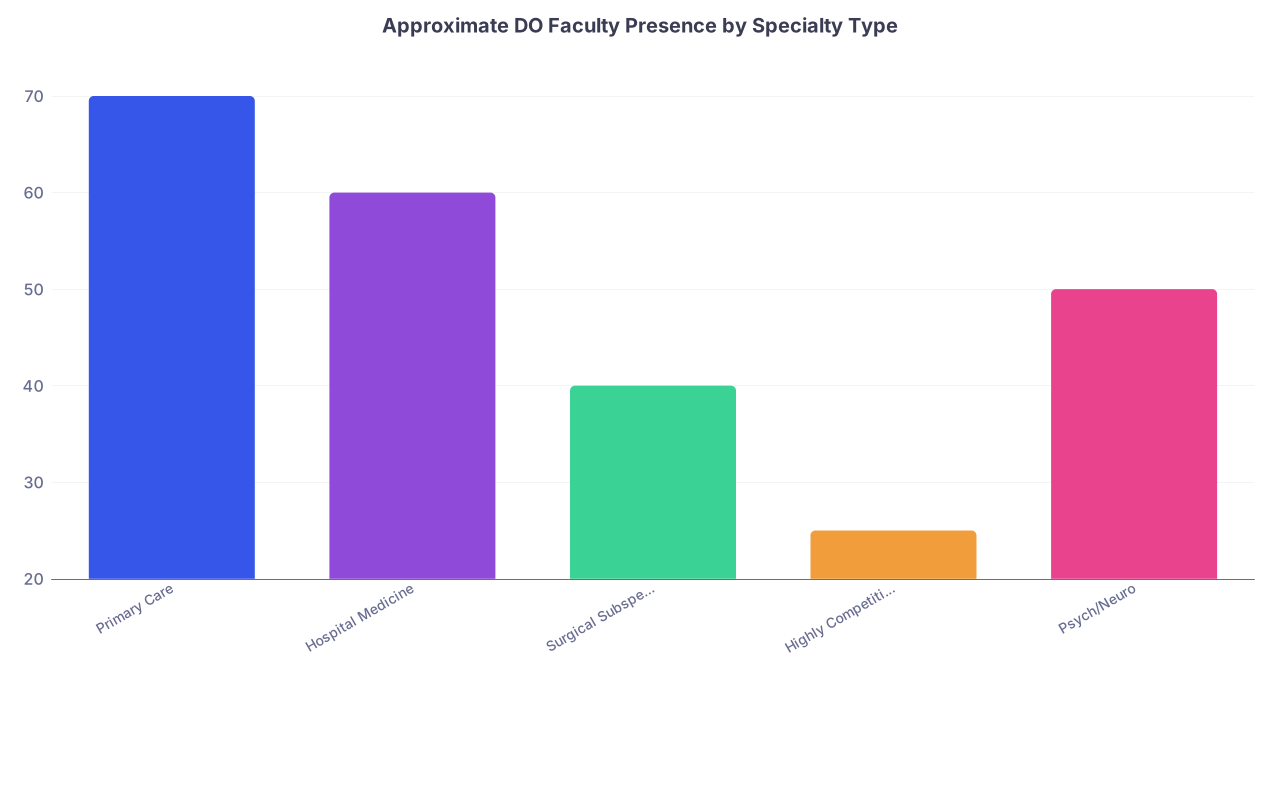
| Category | Value |
|---|---|
| Primary Care | 70 |
| Hospital Medicine | 60 |
| Surgical Subspecialties | 40 |
| Highly Competitive Subspecialties | 25 |
| Psych/Neuro | 50 |
Again, rough but directionally accurate.
Primary Care (FM, IM, Peds)
- Many DOs.
- Academic positions at community affiliates, regional universities, and osteopathic schools are very realistic.
- Clinician‑educator and clinical tracks are quite open.
If you want to be a clerkship director in family medicine at a regional school as a DO? Very doable.
Hospital Medicine
Hospitalists with DO degrees are ubiquitous.
Faculty roles:
- Site director for hospitalist teams
- Core residency faculty
- In some programs, APD (associate program director) or even PD
Promotion is more tied to QI projects, teaching, and reliability than to your initials.
Surgical Fields
More stratified.
- Community and regional academic programs: DO surgeons are common, and faculty roles are realistic.
- Top‑tier surgical programs: DO surgeons are less common, mainly because matching into those residencies is still more competitive for DOs.
Again, the degree is not the true filter. The residency pedigree is.
Highly Competitive Subspecialties (Derm, Plastics, ENT, Rad Onc, etc.)
If you are DO, the challenge is matching into the few academic‑heavy residencies that set you up for faculty roles at major centers.
Can it be done? Yes.
Is the default path steeper than for MDs? Yes.
If you are premed and absolutely certain you want to be an academic dermatology researcher at a top‑10 center, MD gives you a simpler path. That is just reality right now.
6. Leadership Roles: Program Director, Chair, Dean – DO vs MD
You are probably not just asking about “being faculty.” You are thinking about eventually running something.
Program Director / Associate Program Director
At community‑based and many university‑affiliated programs:
- DO program directors are common in FM, IM, EM, psych, some surgical programs.
- What matters: your performance as faculty, your investment in residents, your ability to handle ACGME paperwork, milestones, and recruitment.
At the largest, brand‑name university residencies:
- DO PDs are less common. Not forbidden. Just rarer.
- The gate is again: where did you train, what is your academic output, how are you viewed nationally?
Department Chair
At osteopathic schools or DO‑heavy systems: DO chairs are normal.
At MD‑granting research universities:
- Chairs are still predominantly MD or MD/PhD.
- The underlying filter: strong research funding history, national leadership, heavy publication record.
You can be a brilliant clinician‑educator and still hit a ceiling at some of these places because they want grant money at the top.
Dean / Associate Dean
Osteopathic medical schools:
- Many DO deans and associate deans. Good path if you are committed to osteopathic education.
MD‑granting schools:
- Most deans are MD or MD/PhD. Occasional DO, especially in newer schools or clinically‑heavy institutions.
If high‑level MD‑school administrative leadership is your absolute main destination, MD is still the more conventional route.
7. If You Are Premed: How To Think About DO vs MD for an Academic Career
Let me be blunt. There is no one correct answer. But there are smarter and dumber ways to frame the decision.
Scenario A: “I 100% want to be an NIH‑funded researcher at a top‑20 MD school”
Then you should:
- Strongly favor MD, ideally at a research powerhouse.
- Consider MD/PhD or heavy research exposure early.
- Build publications in med school, then match into a research‑intense residency/fellowship.
Could a DO theoretically get there? Yes. But you would be fighting the current the entire way.
Scenario B: “I want to teach, maybe be clerkship director, work in academic environment, but I do not need hardcore research”
For this, DO vs MD matters less.
You should be thinking about:
- Can this path get me into a solid, teaching‑oriented residency?
- Will I be in a system where students/residents rotate and faculty teaching actually matters?
- Can I pick a specialty and environment where clinician–educator roles exist?
Both DO and MD can get you there at:
- Community programs with academic ties
- Osteopathic schools
- Many regional MD schools
Scenario C: “I want flexibility. Maybe community, maybe academic, keep doors open”
Then your priorities are:
- Strong residency program (teaching culture, academic optionality)
- Good mentorship in whatever path you lean toward
- Avoiding excessively narrow or weak training sites
MD still keeps more doors open at the far, research‑heavy end. But a DO from a strong ACGME program with some publications and good teaching evaluations has plenty of academic options.
8. Concrete Moves That Matter More Than DO vs MD
Here is where you should actually obsess, regardless of degree:
Choose your medical school strategically.
- Research‑heavy MD schools → better for hardcore academic research.
- Established DO schools with strong affiliations → good for teaching‑oriented and clinical academic roles.
Maximize research if you care about academics.
- Aim for at least a few peer‑reviewed publications by the end of residency.
- Present at national meetings in your specialty.
- Work with faculty already in academic positions.
Pick residencies with real academic culture.
- Ask how many grads go into faculty roles.
- Look at whether faculty are publishing or doing QI.
- Check if they have students rotating there (MD or DO).
Document your teaching.
- Volunteer for teaching as a resident: med student lectures, bedside teaching, OSCEs.
- Keep records. Promotion committees love documentation.
Understand your track early in your first faculty job.
- Ask: “What do I need to be promoted on this track?”
- Get it in writing. Keep a running CV and teaching portfolio.
- Do not assume “working hard” leads to promotion. It does not. Aligned output does.
FAQ (Exactly 6 Questions)
1. Can a DO become a full professor at an MD‑granting medical school?
Yes. It happens. The typical pattern: DO → strong ACGME residency/fellowship → faculty at a teaching hospital → consistent teaching plus publications → promotion. At top‑20 research institutions it is less common, mostly because fewer DOs are on hardcore research tracks, not because promotion policies exclude them.
2. Is MD always better than DO for an academic career?
For pure research, especially if you want NIH R01 funding and tenure at a major MD‑granting university, MD is generally the safer bet. For clinical and clinician‑educator roles, DO and MD are functionally comparable as long as you have strong training, some scholarship, and good teaching evaluations. The “always better” framing is too simplistic.
3. Do osteopathic medical schools prefer to hire DO faculty?
Yes, in many cases. Osteopathic schools value faculty who understand and model osteopathic principles, can teach OMM/OMT, and embody the DO professional identity. MDs are still hired, especially in subspecialties or high‑need areas, but DOs often have an edge for leadership roles in curriculum, OMM, and student affairs.
4. Will being DO hurt my chances of becoming a program director?
At community and many university‑affiliated residencies, no. DO PDs are common in FM, IM, EM, and psych. At the most elite, research‑heavy residency programs, PDs tend to be MDs with strong academic records. There the issue is less the degree and more the prior academic trajectory and network that, statistically, more MDs happen to have.
5. If I want to do academic research as a DO, what should I add to my training?
You should aggressively seek research infrastructure: research‑heavy residency or fellowship, formal research training (MS, MPH, or even PhD), mentored projects early in training, and multi‑year involvement in a focused research area. Aim for first‑author publications and, if possible, small grants or co‑investigator roles to prove you can function in that world.
6. I am a premed with only DO acceptances but I care about academics. Should I wait and reapply MD?
If your dream is top‑tier, grant‑heavy academic medicine, reapplying MD might be rational. But if your goal is to teach, work in a teaching hospital, possibly be core faculty or a clinician‑educator, you can absolutely get there through DO. The real question is: will another cycle realistically get you into a substantially more research‑intense MD environment, and are you willing to lose a year for that chance?
Key points:
- Promotion committees care more about your track, training, output, and reliability than your degree.
- MD has a clearer edge for high‑end research careers; DO is fully viable for clinical and clinician‑educator faculty roles, especially with strong residency pedigree.
- Your early choices in research, residency, and mentorship will shape your academic trajectory far more than the two letters after your name.