
The loudest opinions about DO vs. MD usually come from the people who know the least about it.
And of course, those are often the people you have to eat dinner with.
You’re not crazy for worrying about family judgment. I’ve watched strong applicants spiral for months because an uncle in another country said, “Why not real doctor?” Or a parent sighed and asked, “Can you try again for MD next year?” It sticks. It really, really sticks.
Let’s untangle this before it eats you alive.
The Fear Underneath: “Will My Family Think I Failed?”
You’re not just worrying about letters. You’re worrying about identity.
The story in your head probably sounds something like this:
- “My parents told every relative I was going to be a doctor. If I go DO, they’ll think I couldn’t cut it as an MD.”
- “My family back home doesn’t even have DOs. They’ll think I bought a fake degree.”
- “What if my sibling got into an MD school and I ‘only’ get DO? I’ll forever be the less successful one.”
- “What if they secretly feel disappointed and just… never say it, but treat me differently?”
And then your brain goes all the way to the end of the horror movie:
“I’ll match into a worse residency, hate my career, and everyone will think they were right to doubt me.”
I’ve seen people with 3.9 GPAs and 515+ MCATs obsess over this. Not because they don’t understand the actual facts about DO vs. MD, but because they’re trapped in family expectation land. Different rules. Different logic. Very little data.
So let’s separate three things:
- What’s actually true about DO vs. MD.
- What your family thinks is true.
- What you actually want your life to look like.
Because right now those three are all tangled together and choking you.
Reality Check: How Different Are DO and MD Really?
Let me say the quiet part directly:
In the United States, DOs are fully licensed physicians, and most non-medical people can’t tell the difference unless you tell them.
Same training structure:
- 4 years of medical school
- USMLE Step exams (plus COMLEX for DOs)
- Same residency Match system
- Prescribe meds, do surgery, run an ICU, be an attending. All of it.
Here’s what statistically trips people up and fuels the judgment:
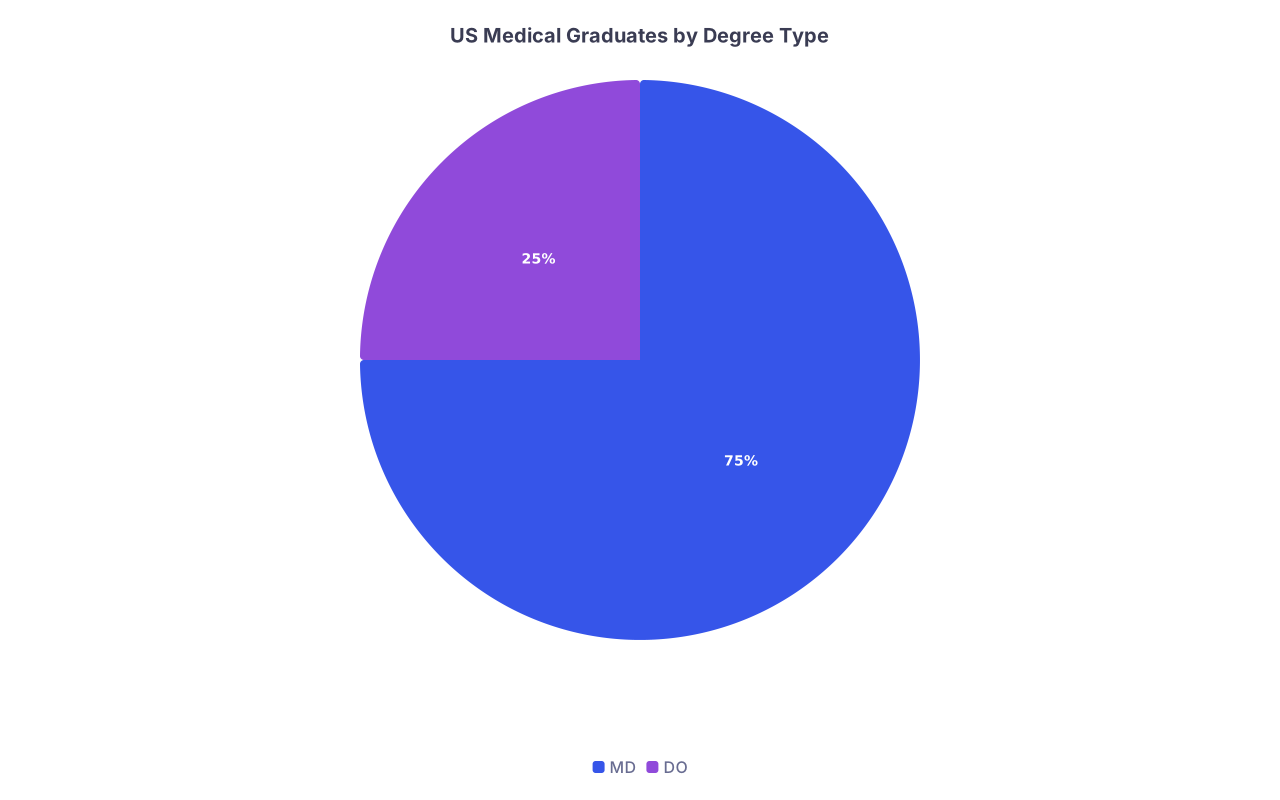
| Category | Value |
|---|---|
| MD | 75 |
| DO | 25 |
So yes, MD is more common. That doesn’t mean better. It means older and more well-known globally.
The actual meaningful differences (from a career point of view):
- Some ultra-competitive specialties (derm, plastic surgery, ortho at top academic centers) have historically favored MDs, especially from big-name schools. That’s a real thing. But plenty of DOs still match into competitive fields with strong scores, research, and networking.
- International recognition: MD is more straightforward abroad. If your entire plan is to move back to a country that doesn’t recognize DO at all, then yeah, you need to think strategically.
- Curriculum flavor: DO schools add osteopathic manipulative medicine (OMM). Some people love it, some tolerate it, some think, “Please don’t crack my back again.”
But in the U.S., for 90–95% of realistic career paths, DO vs. MD is not going to be the thing that makes or breaks your happiness. Your specialty choice, where you train, and who you are as a human physician will matter more.
Your family doesn’t know any of this. They just hear “different letters = less good.”
So we arm you with two things:
- The facts (for you)
- The script (for them)
Why Family Judgment Hurts So Much (And Why It’s Not Really About You)
Here’s the ugly truth:
A lot of family judgment isn’t actually about your future. It’s about their image and their fear.
They’re thinking:
- “What will I tell my friends?”
- “Is my child settling?”
- “Did we fail somehow if they didn’t get MD?”
- “I’ve only seen MD on TV—what is DO? Is it safe? Is it real?”
Some parents are blunt and hurtful:
- “Just apply again until you get into MD.”
- “But your cousin got into [Big Name] MD, why can’t you?”
- “Is this like a second-tier doctor thing?”
Others are quieter but do the tight-lipped smile, the “Oh… okay…” and that’s somehow worse because you feel the disappointment they’re not even saying.
Here’s what I need you to hear:
Their ignorance does not have to become your shame.
You can respect their feelings without letting them dictate your career. You can explain, educate, set boundaries. And if they still don’t get it?
That’s on them.
Not on you.
Scripts: What to Actually Say When They Question DO
Let’s be concrete because vague “communicate your feelings” advice is useless when you’re sitting at a table with relatives who talk over each other.
When they say: “Why not MD?”
You:
“MD and DO are both fully licensed physicians here. I applied to both routes. The DO school I’m considering has strong match rates and great clinical training, and it’s giving me the best shot at becoming the kind of doctor I actually want to be.”
Short. Calm. No apology.
When they say: “Is DO like… easier or lower level?”
You:
“DO schools are competitive too. I’ll still be taking the same board exams as MD students and going through the same residency match. The letters are different, but the responsibilities and training are real. I’ll be a physician, not ‘almost’ a physician.”
If you want to throw in a data point:
“Last year, DO grads matched into internal medicine, pediatrics, emergency medicine, anesthesia, and even some super competitive specialties. The Match doesn’t treat DOs like fake doctors.”
When they say: “In our country we don’t have DO. Will you be a real doctor there?”
You:
“That’s a fair question. Some countries automatically recognize DO, some need extra steps, and some don’t recognize it at all. Right now my plan is to practice in the U.S., where DO and MD have the same rights. If I seriously decide I want to move back long-term, I’ll look closely at the regulations there.”
If your long-term plan is to move abroad, you need to be brutally honest with yourself about whether DO will complicate that. That’s not about family ego. That’s about reality.
When they say: “Can’t you just reapply to MD next year?”
You:
“I could reapply, but that means losing another year of training, more money, and more uncertainty. This DO option gets me to the same endpoint—being a physician—just as effectively. I’m not interested in gambling my whole timeline just for two different letters when the actual work I’ll be doing is the same.”
Your Worst-Case Scenarios vs. What Actually Happens
Your brain right now:
- “If I go DO, they’ll never respect me.”
- “Every holiday for the rest of my life will be passive-aggressive comments.”
- “Future spouse’s family will judge too.”
- “Patients will see DO and think I’m lesser.”
Let’s be real about how this usually plays out.
At first? Yes, there might be confusion, judgment, tension. Especially in families where status and appearances matter a lot.
But once you:
- Put on a white coat
- Start talking about call nights and rotations
- Sign “Dr. [Your Name]”
- Actually help sick people
Most families shift faster than you’d expect. They brag. They say, “My kid is a doctor.” They conveniently forget they ever said, “Is that the same as a chiropractor?”
The people who don’t come around?
Those are usually the ones who would’ve found something else to pick at anyway.
And patients?
Half of them won’t even notice your letters. The other half ask “What’s DO?” once, you explain in 15 seconds, and then they just want their pain controlled and their questions answered. They care way more about you not rushing them out of the room.
When DO Is Actually the Better Move For You
Here’s a question nobody around you is asking, but you should:
“What’s more important to me: impressing people at family gatherings or actually becoming a physician in a reasonable timeframe?”
Because sometimes DO is not “settling.” It’s strategic.
Examples I’ve seen:
- Applicant with a 3.2 GPA, strong upward trend, 508 MCAT gets into solid DO programs, rejected from all MDs. They take the DO, work hard, match into EM, and love their life. If they’d waited “for MD only,” they might still be in application purgatory.
- Non-traditional applicant in their 30s with kids. Another 1–2 years reapplying would wreck their finances and family stability. They choose a DO acceptance, finish residency by 40 instead of chasing the idea of MD until 42–43.
- Student genuinely drawn to primary care, rural medicine, or patient-centered care styles. DO schools often lean into that mission. For them, DO aligns better with what they want to do.
But your family doesn’t understand timelines, loan interest, burnout, age, or match stats. They understand prestige.
You’re the one who has to live the life, not them.
How to Protect Your Mental Health While Everyone Has Opinions
You can’t stop people from having takes. You can control how much access they have to your mind.
A few things that help:
Limit the play-by-play updates.
You don’t need to tell 14 relatives every time you get an interview, waitlist, or rejection. The more they see this as a public contest, the more pressure you feel.
Pick 1–2 “gatekeepers.”
Maybe your mom and one sibling. You tell them the details. They can manage everyone else’s curiosity. You’re not a public news feed.
Create a one-sentence “status answer.”
When people ask, “So what’s happening with med school?” you say something like:
“I’ve been accepted to an osteopathic medical school here in the U.S.—I’ll be a fully licensed physician. I’m sorting out details now and I’m excited to move forward.”
Then you stop talking. Change the subject. You do not owe a TED Talk on DO vs. MD at every barbecue.
And privately, you need people who actually get it. Classmates, online communities, mentors who are DOs and MDs who respect DO training. Because trying to convince a stubborn relative can make you question your sanity.
What If You’re Still in the Application Phase and Terrified to Even Consider DO?
This is where a lot of people are stuck:
You haven’t applied yet, or you’re about to, and you’re thinking, “If I apply DO, it means I don’t believe in myself enough to get MD.”
No. It means you understand probability.
If your stats are borderline for MD but solid for DO, refusing to apply DO out of pride is basically saying, “I’d rather stay premed forever than be a doctor with DO on my name tag.”
You’re allowed to want MD. You’re allowed to try hard for it. But don’t confuse “MD or nothing” with “high standards.” Sometimes it’s just fear of what other people will say.
Here’s a framework:
- If you’d genuinely rather change careers than be a DO → fine, own that. Only apply MD.
- If your real dream is “I want to be a physician taking care of patients in X way” → then DO should absolutely be on the table, especially if it increases your chances of actually living that life.
And if your family throws a fit?
They’re not the ones taking Step 2 at 2 a.m. after call. You are.

| Stage | Activity | Score |
|---|---|---|
| Pre-Application | Fear of judgment | 4 |
| Pre-Application | Researching DO vs MD | 3 |
| Application Season | MD rejections arrive | 5 |
| Application Season | DO interview invite | 3 |
| Decision Point | Family questions DO | 4 |
| Decision Point | Choosing DO acceptance | 2 |
| Training | White coat ceremony | 5 |
| Training | Clinical rotations | 4 |
| Outcome | Match into residency | 5 |
FAQ (Exactly 4 Questions)
1. Will choosing DO instead of MD completely ruin my chances at competitive specialties?
Not “completely,” but it can make the path steeper for certain fields. Things like dermatology, plastics, neurosurgery, and some top-tier academic surgery programs historically leaned more MD, especially from big-name schools. But DOs do match into these with strong board scores, serious research, mentorship, and sometimes being willing to go to less famous programs or certain geographic areas. For fields like internal medicine, family med, peds, psych, EM, anesthesia, PM&R, etc., DOs match very consistently. So no, DO doesn’t “ruin” your chances, but if you’re dead set on one of those hyper-competitive specialties, you’ll have to be extremely intentional about performance and networking.
2. What if my parents say they won’t support me financially if I choose DO instead of reapplying to MD?
That’s brutal, but not unheard of. You have to get very sober, very fast: medical school is financed mostly by federal loans in the U.S., not by parents. You can do this without their money, though it may mean more financial stress and less cushion. The question becomes: is their conditional support enough to hijack your entire career path? Sometimes you can negotiate: “I hear your concerns. Let’s talk to an actual physician or advisor together.” Sometimes you’ll realize their “support” is really control. If they truly pull out, you’ll need to talk to financial aid offices, maybe work for a year, and get advice from students who’ve gone through med school without family backing. It’s not easy. But it’s possible.
3. How do I stop obsessively comparing myself to MD friends or siblings?
You probably won’t stop completely. But you can reduce the sting. First, curate your environment—mute social media accounts that constantly show off prestige stuff (white coat pics from “top 10” schools, etc.). Second, zoom in on your actual day-to-day: Are you learning? Growing? Moving toward residency? Comparison thrives in abstraction; it shrinks when you’re buried in real work. Also, remind yourself: by residency, everyone is just “interns” complaining about call. Nobody cares who took anatomy in which building. And if someone in your life keeps low-key flexing their MD over your DO? That’s a them problem. Mentally downgrade their opinion’s importance.
4. What’s one concrete step I can take today to feel less ashamed about considering DO?
Find and listen to one DO physician talk honestly about their career—preferably in the specialty you’re interested in. YouTube, podcasts, even program websites with resident bios. Notice how absolutely normal they sound. How patients, colleagues, and hospitals treat them. Write down three things from their story that you’d be proud to have in your own life: maybe their schedule, their patient population, their leadership roles. Then ask yourself: if you could have that life as a DO, would you really throw it away just to silence an uninformed relative? That exercise alone has snapped a lot of people out of the shame spiral.
Open your notes app right now and write a two-sentence answer to this:
“If I become a DO physician, my life will look like this day-to-day…”
Make it specific. Real patients, real work, real you. Then ask yourself honestly whether you’re willing to trade that actual life for the illusion of MD-only approval.