

The default advice about getting an MPH or MS before fellowship is wrong.
Most residents dramatically overestimate how much an extra degree will help their fellowship chances and underestimate the cost in time, money, and burnout. You do not “need” an additional degree before fellowship in almost every situation. In some narrow, well-defined cases, it helps a lot. Outside of those? It’s an expensive distraction.
Let’s cut through the noise.
The Short Answer: No, You Usually Do Not Need One
Here’s the blunt truth:
If your goal is simply: “Match into a competitive fellowship” (cards, GI, heme/onc, etc.), you usually do not need an MPH, MS, or other graduate degree.
Programs care about:
- Your residency performance (clinical reputation, in-training scores, evaluations)
- Your research output and letters
- Your perceived trajectory as a subspecialist
They do not care about extra letters after your name nearly as much as you think.
I’ve seen excellent residents with no additional degree match top GI and cards programs because they had strong mentorship and solid research. I’ve also watched residents with MPH/MPH/MS degrees not match where they wanted because their clinical performance or letters were lukewarm.
An additional degree is a tool. Not a golden ticket.
So the real question isn’t “Do I need an MPH/MS?”
The real question is: “Given my goals and current profile, will an additional degree move the needle more than other uses of that time?”
Let’s unpack that.
When an Additional Degree Actually Makes Sense
There are a few scenarios where an extra degree isn’t just optional—it’s legitimately useful, sometimes even strategically smart.
1. You Want an Academic or Research-Heavy Career
If you see yourself as:
- A clinical investigator
- Outcomes researcher
- Health services researcher
- Population health / disparities expert
- Implementation science person
…then a methodologically strong degree can be extremely valuable.
Think MPH with robust biostats / epidemiology, or an MS in Clinical Research / Epidemiology / Health Policy. Not a random “online healthcare leadership” degree.
What the right degree can do for you:
- Give you real statistical and study design skills so you’re not just the “token clinician” on a methods-heavy paper
- Plug you into a research network (mentors, statisticians, cores)
- Make you more credible when applying for T32s, K awards, or research-heavy fellowships
Important: this is about skills and networks, not just the credential.
2. You’re Serious About Public Health, Policy, or Global Health
If you want to build a career around:
- Health policy (state/federal level, think CMS, NIH, policy think tanks)
- Population health leadership in big systems
- Global health programs (WHO-affiliated NGOs, academic global health centers)
then a well-chosen MPH (or MPP/MPH, MS Global Health) can open actual doors.
In these cases, the degree isn’t just a fellowship booster—it’s part of your long-term identity. Fellowship directors in these spaces actually respect that.
But again, you should see a clear through-line:
Residency → Additional degree → Fellowship → Early career job where that degree is actively used.
If you can’t sketch that line on paper in 2–3 sentences, the degree may be more vanity than value.
3. You Need Formal Training in Something Your Field Cares About
Certain fellowships increasingly value specific expertise:
- Cardiology / critical care: Quality improvement, implementation science, biostats
- Heme/Onc: Clinical trials design, translational research methods
- Pulm/CCM: Outcomes research, health services, ICU epidemiology
A targeted MS in Clinical Investigation or Health Data Science can help if:
- You actually use it to produce work (abstracts, manuscripts, grants), and
- You pair it with real mentorship and projects at your institution.
An unused degree is like a Peloton gathering dust in the spare room. Technically impressive, functionally irrelevant.
4. You’re International Medical Graduate (IMG) With Gaps
This is delicate, but I’ll say it. Some IMGs use an MPH/MS as a bridge:
- To enter the US system
- To get US-based mentors and research
- To explain career timeline gaps
In this context, the degree is often more about access than education.
However, if you’re already in a US residency, doing another degree purely as a “signal” is rarely worth sacrificing clinical and research time—unless it comes packaged with powerful mentors and projects.
Now the other side of the coin.
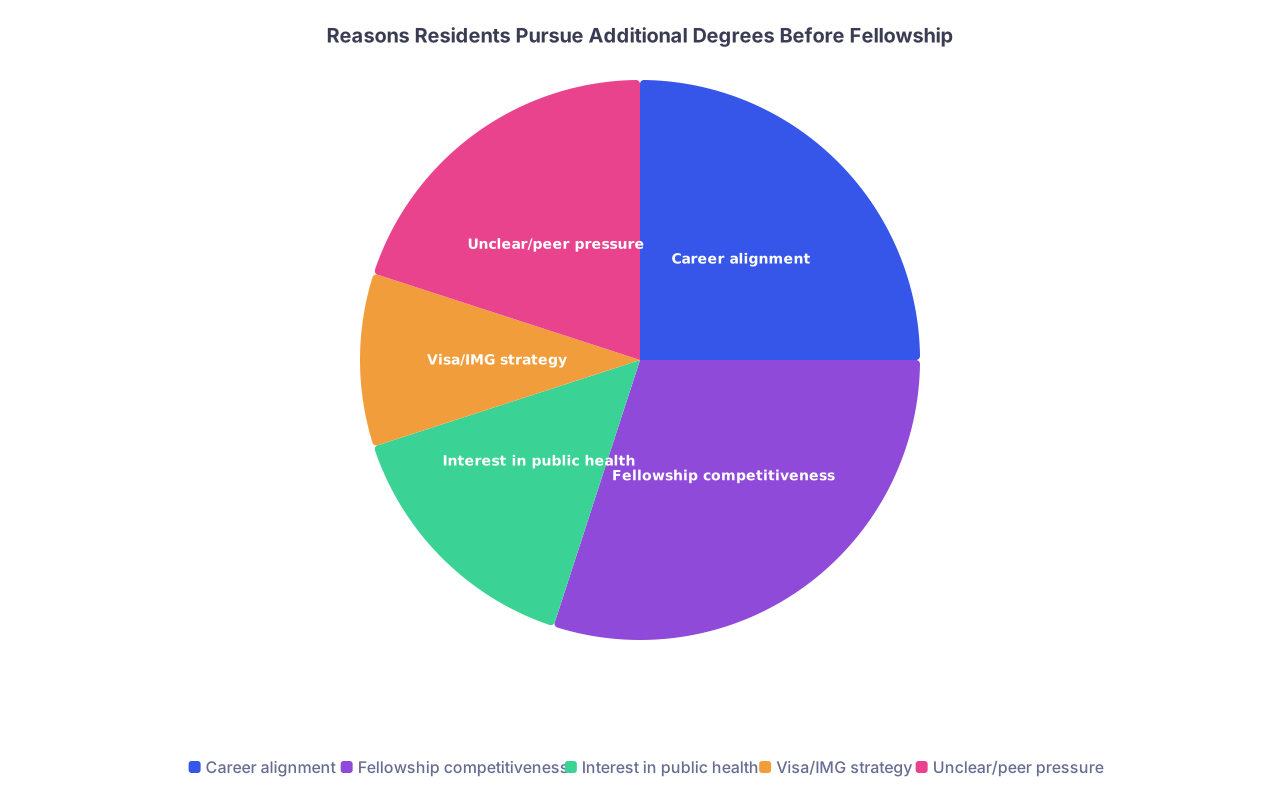
| Category | Value |
|---|---|
| Career alignment | 25 |
| Fellowship competitiveness | 30 |
| Interest in public health | 15 |
| Visa/IMG strategy | 10 |
| Unclear/peer pressure | 20 |
When an Additional Degree Is a Bad Idea
You’ll hear people say “It can’t hurt.” That’s wrong. It absolutely can.
Here’s where it usually backfires.
1. You’re Doing It Just to “Look Competitive”
Programs have seen this move a thousand times:
- Generic MPH with no substantial project
- Online MS in “Healthcare Management” with no leadership role
- Degree completed but zero publications, zero concrete skills, vague personal statement language like “I’m passionate about public health”
Fellowship directors are not impressed by unfocused degrees. They’re impressed by coherent stories.
“During my MPH, I trained in causal inference, then applied that to a multicenter project on heart failure readmissions that produced two first-author papers” actually means something.
“I did an MPH because my advisor said it would help” does not.
2. You’re Already Struggling With Burnout
Adding a graduate degree on top of residency is brutal. I’ve watched residents:
- Fall behind on clinical performance
- Miss research deadlines
- End up with a mediocre degree and a mediocre fellowship application
If you’re already scraping by—sleep-deprived, behind on charting, no bandwidth for research—a dual-track degree will usually worsen your overall competitiveness, not improve it.
Your best “fellowship prep” in that situation is stabilizing: protect sleep, get one or two manageable research projects, get standout clinical evals. Not more obligations.
3. You’re Taking on Massive Debt for It
A $50–80k MPH that you will barely use is a financial mistake, full stop. Plenty of residents sign up because “it’s only another loan” and regret it 3–5 years later when payments hit and the credential isn’t doing much.
If your program does not:
- Cover tuition
- Offer protected time
- Pair you with structured research mentors
you should think long and hard before paying out of pocket.
4. It Delays or Disrupts Your Core Training Progress
Fellowships want people who can function as excellent, reliable clinicians in their field.
If:
- You’re stepping out of residency for a full year and risking clinical skill decay
- Or you’re repeatedly compromising your clinical performance to meet degree deadlines
you’re trading the main thing programs care about (strong resident) for a shiny side credential.
That trade rarely pencils out.

| Step | Description |
|---|---|
| Step 1 | Considering extra degree |
| Step 2 | Do not pursue now |
| Step 3 | Reconsider or delay |
| Step 4 | Proceed with targeted plan |
| Step 5 | Clear career goal needs it? |
| Step 6 | Funding and protected time? |
| Step 7 | Will it enable real projects? |
How Fellowship Programs Actually View These Degrees
Here’s how most fellowship selection committees implicitly rank things:
| Factor | Typical Weight |
|---|---|
| Residency performance | Very high |
| Letters of recommendation | Very high |
| Research productivity | High |
| Personal statement / fit | Moderate |
| Additional degree (MPH/MS) | Low–moderate |
If the degree:
- Is tightly aligned with your stated career goals
- Led to concrete work (papers, posters, QI projects, policy briefs)
- Connects to your mentorship and the fellowship’s strengths
then it can bump you from “solid” to “compelling.”
If it’s:
- Unrelated
- Light on output
- Clearly done as window dressing
it sits in the “mildly interesting, not decisive” box.
I’ve been in rooms where someone says, “Oh, she has an MPH,” and the response is basically, “Okay, but how are her letters and publications?” That tells you how much it really weighs.
MPH vs MS vs “Other” – Which (If Any) Makes Sense?
Let’s break this down quickly.

MPH (Master of Public Health)
Best for you if:
- You want population health, health policy, global health, or health systems work
- Your fellowship goal overlaps (e.g., cardiology + population health, ID + global health)
- The program has serious methods training (not fluff electives only)
Avoid:
- Generic, superficial programs with weak biostats/epi teaching
- No clear project or practicum that yields real output
MS (Master of Science)
Best for you if:
- You want a research-heavy fellowship or early-career K award
- You need strong methods: biostats, clinical trials, epidemiology, data science
- Your institution has a reputable clinical research or epidemiology MS that integrates with ongoing studies
Avoid:
- Vague “medical science” programs that are glorified coursework with no real research pipeline
MBA, MHA, MEd, etc.
These are niche. They can be useful if you have:
- Clear leadership/admin aspirations (CMO, service line director, quality leadership)
- A specific role or track that actually values business or admin training
But an MBA won’t make you more desirable for a basic cardiology or GI fellowship. At best it’s neutral; sometimes it can confuse your narrative if your application screams “I want to be an administrator” but you’re applying for a research-heavy fellowship.
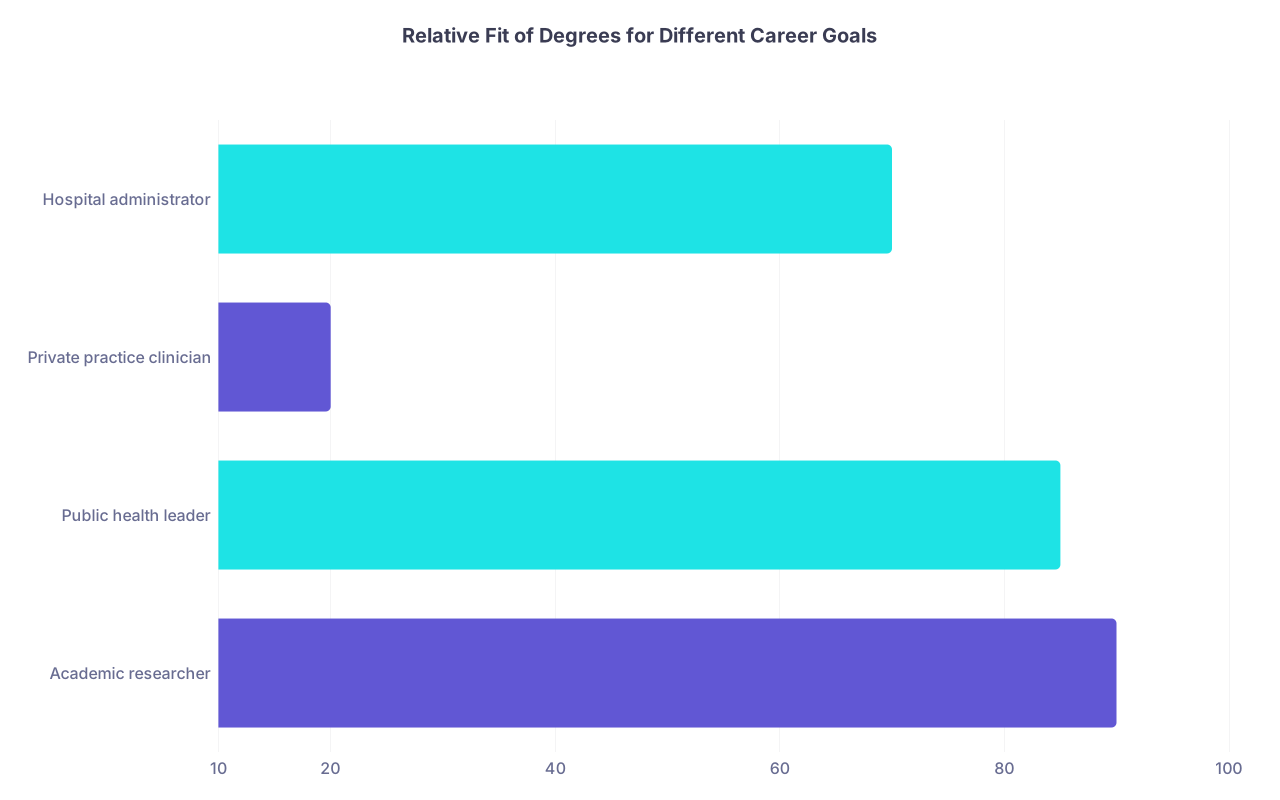
| Category | Value |
|---|---|
| Academic researcher | 90 |
| Public health leader | 85 |
| Private practice clinician | 20 |
| Hospital administrator | 70 |
How to Decide: A 5-Question Stress Test
If you’re on the fence, run your plan through this filter. If you cannot answer “yes” to at least 4/5, you probably should not do the degree right now.
- Can you state in one sentence how this degree directly advances your specific career goal?
- Is there a concrete opportunity attached (funding + protected time + mentor + likely project)?
- Will you realistically be able to maintain strong clinical performance while doing it?
- Can you point to 2–3 specific types of jobs or roles where this degree is either expected or clearly advantageous for you?
- Is the marginal benefit larger than what you’d get from spending the same time on research, mentorship, and clinical excellence?
If you’re answering, “Kind of, I guess” to most of these, the degree is probably more of a security blanket than a strategy.
Tactical Alternatives That Often Give More Return
Before you sign up for another two years of tuition and Zoom lectures, ask yourself if any of these would serve your fellowship application better:
- Join a serious research group in your department and get 1–3 first-author papers
- Do a chief resident year (for some fields/programs, this is a major signal)
- Pursue a focused research or QI fellowship year at your home institution
- Take structured short courses (e.g., clinical trials design, intro biostats) instead of a full degree
- Partner with your hospital’s quality or population health teams on a real, system-level project
I’ve seen residents do a one-year, non-degree clinical research year with mentored projects and come out far more competitive than peers who spent a year on a low-yield MPH.
How to Make It Worthwhile If You Do Commit
If you’ve gone through all this and still think, “Yes, this actually fits my trajectory,” then treat the degree like a launchpad, not a hobby.
Do this:
- Choose programs with hard skills: serious biostats, study design, data analysis
- Lock in a primary mentor before or immediately as you start
- Aim for 1–2 meaningful outputs (papers, grants, major QI projects) tied to your degree work
- Align your personal statement and fellowship interviews with a clear story: “Here’s what I studied, here’s what I built, here’s how it fits the career I’m aiming for.”
If your degree just results in a line on your CV, you left 80% of its potential value on the table.
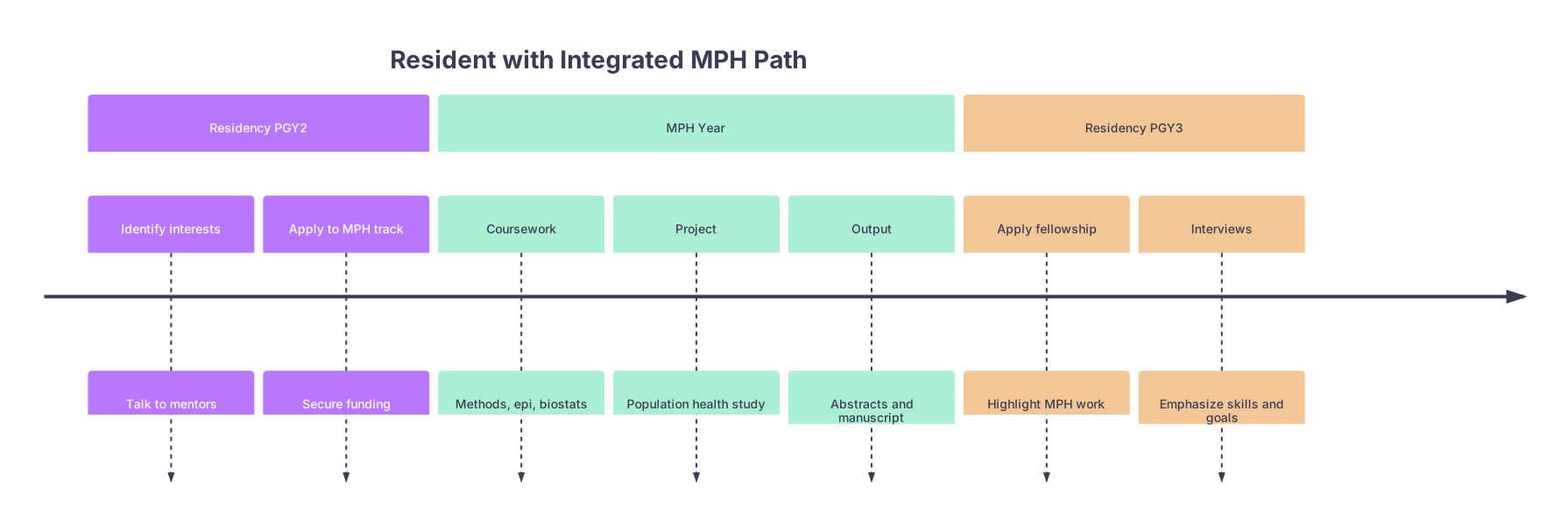
| Period | Event |
|---|---|
| Residency PGY2 - Identify interests | Talk to mentors |
| Residency PGY2 - Apply to MPH track | Secure funding |
| MPH Year - Coursework | Methods, epi, biostats |
| MPH Year - Project | Population health study |
| MPH Year - Output | Abstracts and manuscript |
| Residency PGY3 - Apply fellowship | Highlight MPH work |
| Residency PGY3 - Interviews | Emphasize skills and goals |
FAQ: Additional Degree Before Fellowship – 7 Common Questions
Will an MPH or MS make up for weak research during residency?
Not really. A degree can give you tools and time to do research, but the fellowship committee will still judge you on the actual output: abstracts, posters, publications, letters from research mentors. An MPH with no significant project is not a replacement for research productivity.Is it better to do the degree before residency, during residency, or after fellowship?
If you know you want a research or public health career and you can do a funded, reputable program integrated with training, that’s ideal. Doing it before residency can work if it leads directly into a strong research track, but many people forget a lot of the methods by the time they’re actually doing projects. After fellowship can be smart if your career path clearly demands it and you can get institutional support.Do competitive fellowships expect applicants to have additional degrees now?
No. Even in very competitive fields, the majority of fellows do not have extra degrees. What they have is a credible record of scholarship and strong letters. A minority will have MPH/MS degrees that are usually tied to serious research or public health work. Programs respect the work, not just the credential.Will an additional degree help me if my Step scores or residency program “brand” are weaker?
Marginally, at best. An MPH or MS will not erase a low Step score or completely overshadow the perceived tier of your residency. It can help you stand out if it leads to strong research or policy work, but it is not a magic equalizer. You’re usually better off maximizing research and clinical strength where you are.What if my program offers a “free” or heavily discounted degree during residency? Should I just take it?
“Free” is still expensive if it costs you time, energy, and attention you could have spent on higher-yield activities. If the program is high quality, offers protected time, and aligns with a clear career plan, great. If it’s just something everyone does “because it’s there,” think twice. You are not obligated to say yes.Does having an additional degree increase my attending salary later?
For most pure-clinical jobs, no. Private practice cardiology, GI, hospitalist, etc. won’t pay you more just because you have an MPH. It can matter if you move into admin, population health leadership, or specific research/industry roles, but for standard clinical practice, salary is driven by specialty, geography, and RVUs, not degrees.I’m already halfway through an MPH/MS and now I’m unsure. Did I make a mistake?
Not necessarily. The key now is to maximize what you’re getting out of it. Aggressively seek out mentors, attach yourself to 1–2 serious projects, and make sure your degree work feeds directly into your fellowship story and early-career plans. You cannot undo the time spent, but you absolutely can rescue the value.
Here’s your next step: take 10 minutes today, open a blank page, and write one brutally honest paragraph: “My ideal career in 10 years is…” Then add another: “How exactly would an MPH/MS help me get there faster or more effectively?” If you cannot answer that clearly and concretely, do not commit to a degree yet. Revisit the question after you’ve strengthened your clinical reputation and gotten involved in real projects where you are.


