
The PD changing mid‑fellowship season can wreck your plans—if you react emotionally instead of strategically.
You do not have time to panic. You have time to make a plan.
This is one of those “real residency life” moments no one tells you about on interview day. You’re lining up letters, finalizing your ERAS, timing your Step 3, and then: email from GME. “We are writing to inform you that Dr. X will be stepping down as Program Director, effective immediately…”
Your stomach drops. You think: “What does this do to my fellowship chances?”
Here’s how to handle it like someone who still matches, not someone who gets paralyzed.
Step 1: Diagnose What Kind of PD Change You Have
Not all PD changes are the same. Before you start rewriting your entire strategy, figure out which situation you’re actually in.
Common flavors I’ve seen:
Planned, orderly transition.
Old PD stepping down “after X years of leadership,” named successor already announced, timeline clear.Rapid but non‑scandal change.
New job, retirement, relocation, health reasons. Sudden, but not messy.Ugly or scandal‑adjacent exit.
Words like “leave of absence,” “while we conduct a search,” rumors of ACGME issues, hostile leadership changes, or faculty storming out with them.Vacuum situation.
Interim PD named, no clear permanent PD in sight, faculty factions forming in the background.
You probably know your PD and your department politics. Read between the lines of the email. Then get more data, quickly but quietly.
Who to ask (one‑on‑one, not group complaining in the workroom):
- A senior resident you trust who’s politically aware but not a gossip disaster
- A core faculty member who mentors residents
- The chief residents (they often hear things early)
- The program coordinator (for logistics, not gossip)
Your goal in these conversations is not to get the full drama download. It’s to answer three practical questions:
- Who is actually signing things (evaluations, rank lists, rec letters) over the next 3–6 months?
- Is there any ACGME or accreditation smoke here?
- Does the outgoing PD still want to help graduating residents, or are they fully checked out/gone?
Once you know those, you can move.
Step 2: Stabilize Your Letters of Recommendation—Fast
Your letters are the immediate risk.
You’re in one of three situations:
| Situation | Risk Level | Immediate Priority |
|---|---|---|
| PD letter already written & uploaded | Low | Confirm status only |
| PD promised a letter but has not written it | High | Replace or accelerate |
| You planned to ask PD but had not yet | Moderate-High | Pivot to alternatives |
If your PD letter is already uploaded or written
Get confirmation, do not assume.
Send a short, respectful email to the coordinator or PD (depending on the culture):
Dear [Coordinator/Dr. X],
I hope you are doing well. I wanted to confirm that my letter of recommendation for the [X] fellowship was completed and uploaded. I am very grateful for your support.
Best,
[Name], PGY‑[X]
If they confirm it’s done and in ERAS/VSLO/Interfolio, great. Do not poke the bear further. You have what you need.
If your PD promised a letter but hasn’t written it yet
This is where people get burned.
Two options:
Accelerate it immediately.
If the PD is still physically around and not in open conflict with the department:Dear Dr. [PD],
I heard about your transition and wanted to congratulate you on your next chapter. As you know, I am applying to [X] fellowships this cycle and was very grateful that you agreed to write a letter of recommendation.
Given the upcoming changes, I wanted to check whether you still have the opportunity to complete that letter, or if it would be more practical for me to seek an additional letter from another faculty member. I completely understand either way and appreciate your support throughout residency.
Best,
[Name]If they say yes, ask for a specific timeline: “Would it be possible to have it uploaded by [date]?” Then back it up with a CV, personal statement draft, and your rotation list.
Replace the letter.
If they’re gone, unresponsive, or the situation is political sludge—do not sit and hope. You need another strong institutional letter.Target options:
- Associate PD who knows you
- Division chief in your subspecialty of interest
- Chair/vice chair who is resident‑friendly
- Key research mentor with institutional stature
You are better off with a detailed, enthusiastic letter from a non‑PD than a rushed, generic PD letter written from an airport.
If you were planning to ask, but hadn’t yet
Honestly? In a messy PD transition, asking a departing PD for a new letter is often low yield unless:
- They love you and
- They’re clearly on decent terms with the department and
- They’ll still have institutional email/access
If those are not all true, pivot. Build your letter team around stable people whose names will still be on the website when fellowship PDs look you up.
Step 3: Decide What You Say in Your Fellowship Applications (If Anything)
The PD change feels massive to you. To most fellowship programs, it’s noise unless:
- Your program is under ACGME review
- There are widely known scandals
- Residents are fleeing mid‑year
You do not put “My PD left” in your personal statement. That reads defensive and messy.
Where it might come up:
- During interviews, when they ask: “Tell me about your residency program.”
- If your program’s reputation has recently dipped and people are curious.
- If there are obvious gaps (e.g., PD letter missing, unusual advisor structure).
Here’s how to frame it like an adult:
- Be factual, short, and non‑gossipy.
- Emphasize continuity of resident support.
- Turn it into a stability/resilience story, not a pity party.
Example for interviews:
“Our program had a leadership transition this year—the long‑time PD stepped down and we have an interim PD as the department recruits a permanent replacement. Day‑to‑day training has been very stable; the APDs and core faculty have maintained the educational structure and support. I worked closely with [X and Y faculty], who’ve been consistent mentors throughout the transition.”
If they push about why:
“My understanding is that it was a personal career move, and the details weren’t shared widely with residents. From our side, the focus has been on keeping rotations, conference, and fellowships on track, and that’s been my experience.”
Do not speculate. Do not repeat rumors. Do not roll your eyes or sigh dramatically.
Your goal: reassure them that you’re not bringing drama with you.
Step 4: Rebuild Your Internal Support System Quickly
The hidden damage of a PD change is not letters. It’s the feeling that your safety net disappeared.
You need a new micro‑team inside your department who:
- Know your fellowship goals
- Will advocate for you
- Can troubleshoot issues with schedules, letters, research
This is your informal committee. Pick 2–4 people:
- One APD or core faculty member in your specialty of interest
- One senior faculty member with institutional clout (chair, vice chair, division chief)
- Possibly your research mentor
- Sometimes a chief resident who is organized and plugged in
How to set this up without sounding needy:
Send short, focused emails:
Dear Dr. [X],
I’m a PGY‑[X] in our program, planning to apply to [Y] fellowship this cycle. With the recent leadership transition, I wanted to be proactive about making sure I have clear mentorship and support through the application process.
You’ve been someone I’ve really valued working with on [rotation/project], and I was wondering if you’d be willing to meet briefly so I can get your guidance on my application strategy and how best to represent our program this year.
Best,
[Name]
Then, during the meeting, be explicit:
“I’d love to have you as one of my main mentors through this process, if that’s something you’d be open to.”
You are not asking them to replace the PD. You are asking them to play a defined role: help you get into fellowship.
Step 5: Manage How Fellowship PDs Perceive Your Program Instability
Fellowship PDs talk. They know which residencies are bleeding faculty, which have ACGME citations, which have warring factions. Your job is to present yourself as someone who still got solid training.
There are three main levers you control:
Your letters’ tone and senders
Get at least one (ideally more) letter from someone whose name carries weight and who can write: “Despite leadership transition, clinical training and resident performance have remained excellent, and [Name] is an outstanding trainee.”Your application narrative
Personal statement = your voice.
CV = your work.
Neither should sound chaotic, reactive, or anchored to program drama.Your interview demeanor
They will subconsciously ask:
“Does this person seem like a casualty of a bad program, or someone who rose above noise and still performed?”
If your program’s PD change is known to be messy, they might directly ask: “How has that affected your training?”
Good answer structure:
- Acknowledge reality briefly
- Emphasize what’s stayed strong (case volume, teaching, faculty mentorship)
- Add one concrete example of you seeking out stability/progress (e.g., finding a new mentor, continuing research)
Example:
“There’s definitely been some uncertainty, but our core faculty have really stepped up. For example, when our PD stepped down, Dr. [Associate PD] and Dr. [Division Chief] reorganized advising so that every senior resident had a specific faculty mentor for fellowship. I’ve actually met with Dr. [X] several times about my research and career plans, and that’s been very steady.”
This tells them:
- You’re not in denial.
- You still have actual support.
- You take initiative.
Step 6: Adjust Your Timeline and Logistics
PD changes often slow down bureaucracy:
- Global letters and MSPE/summary letters might get delayed.
- Schedules can get shuffled as leadership reshuffles responsibilities.
- Committees approving conference time, electives, or away rotations might stall.
You can’t fix the system, but you can pre‑empt some delays.
Use a simple timeline map:
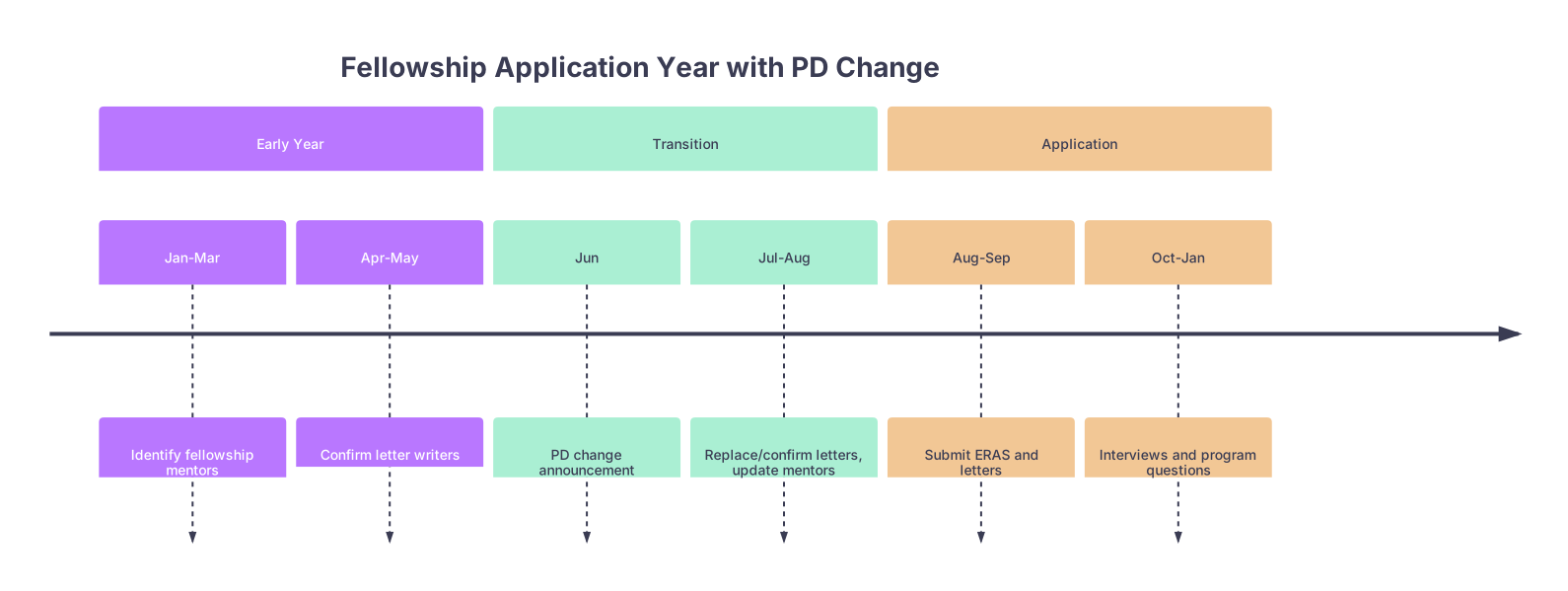
| Period | Event |
|---|---|
| Early Year - Jan-Mar | Identify fellowship mentors |
| Early Year - Apr-May | Confirm letter writers |
| Transition - Jun | PD change announcement |
| Transition - Jul-Aug | Replace/confirm letters, update mentors |
| Application - Aug-Sep | Submit ERAS and letters |
| Application - Oct-Jan | Interviews and program questions |
Practical moves:
Advance deadlines in your head. If ERAS letters “need” to be in by Sept 15, treat Sept 1 as your real deadline. Your system is less efficient now.
Double‑confirm administrative steps. Gently nudge the coordinator about:
- Finalizing your training verification
- Any institutional letter the PD used to sign
- Elective approvals crucial for your CV
Protect your strong rotations. If you’re scheduled for key subspecialty or prestige rotations in the coming months, watch for reassignments. If they try to move you, calmly but firmly explain these are central to your fellowship plans and ask for alternatives that still support your goals.
Short email for schedule issues:
Dear [Chief/Coordinator],
I saw the updated schedule and noticed my [X rotation] in [Month] might be changing. Since I am applying to [Y] fellowship this season, that rotation is particularly important for my experience and letters.
Is there a way to preserve that rotation, or, if a change is necessary, to substitute another experience that would support those fellowship goals?
Thank you,
[Name]
You are not whining. You’re advocating strategically.
Step 7: Decide Whether To Disclose Issues To Programs Privately
There are rare cases where things are bad enough that you consider emailing fellowship PDs to contextualize chaos at home:
- Mass exodus of faculty in your subspecialty
- Significant call schedule instability affecting your ability to get specific rotations
- ACGME citations that directly limit your training exposure
Do this only if:
- You have a clear, factual message.
- You can keep your tone professional and non‑vindictive.
- At least one senior mentor at your home institution agrees it’s a reasonable idea.
Often, this is best done via your letter writers, not by you.
Example: your mentor’s letter includes a line like:
“Despite a challenging period of leadership transition and some loss of faculty in our division, [Name] has proactively sought out experiences and research to ensure they meet and exceed the expectations for [Y] fellowship training.”
If you personally need to mention something in an interview (not email), anchor it in your actions, not the institution’s failures.
Bad:
“I couldn’t get enough [subspecialty] cases because the program fell apart after the PD left.”
Better:
“During a period of leadership and staffing transition, our access to [subspecialty] cases decreased, so I arranged an away elective at [X] and have also been working closely with [Y attending] to make sure I meet the expected volume and complexity.”
Programs care about what you did, not what went wrong around you.
Step 8: Protect Your Reputation Inside Your Own Department
One more risk: getting sucked into resident‑level venting that trickles back up. Then suddenly you’re “the negative one” when faculty are deciding who gets that prime phone call to their fellowship friend at [big‑name institution].
Avoid these traps:
- Group text chains shredding the PD and leadership that somehow leak screenshots.
- Loud complaining in conference rooms or the physician lounge with attendings in earshot.
- Social media posts about “toxic leadership” that anyone can screenshot.
You can be honest in safe spaces (close friends, therapist, partner). But in professional spaces, stay disciplined.
Among faculty, pick your lane:
- Calm
- Professional
- Focused on patients and education
This makes it much easier for people to back you strongly in letters and calls.
Step 9: If You’re a Junior Resident, Think About Your Longer Game
If you’re PGY‑1 or early PGY‑2 with a PD change now, the stress is less about this immediate fellowship season and more about: “Is this still the right place for me?”
Be cold‑eyed about it. Look at:
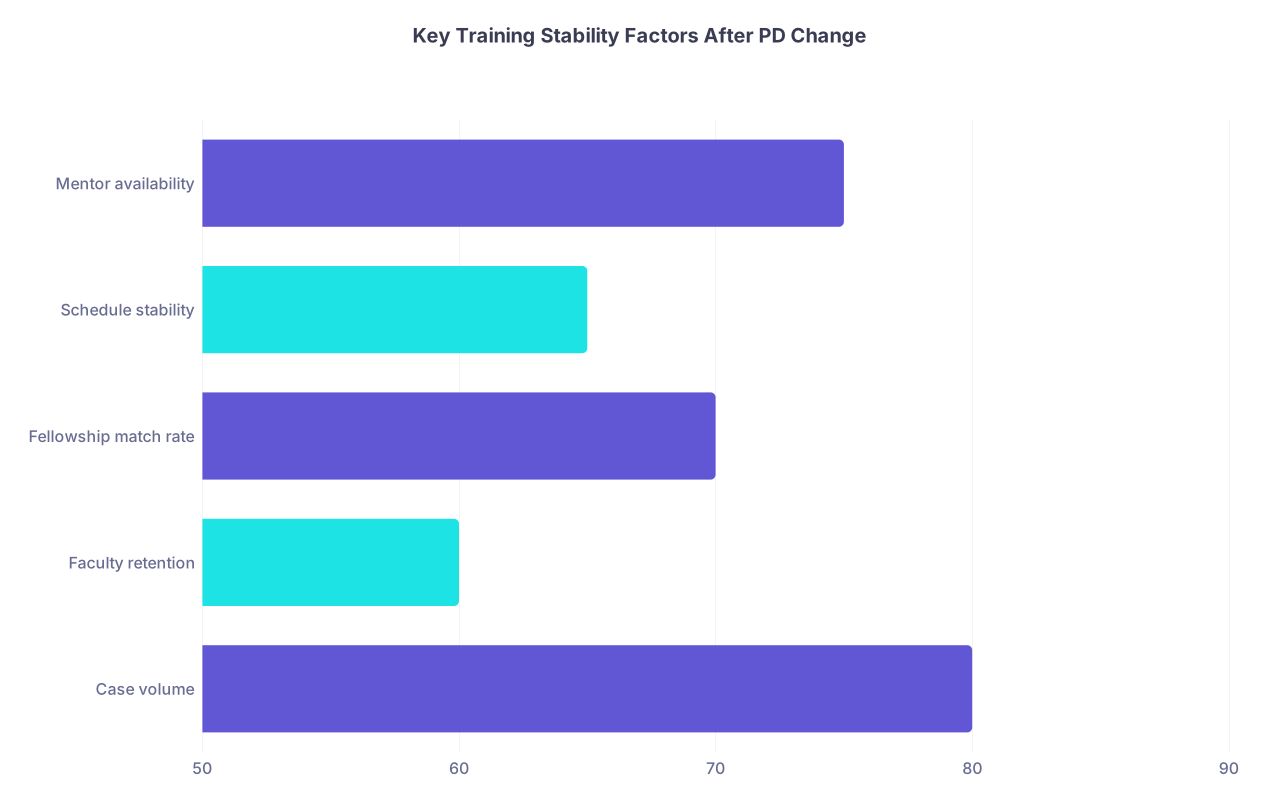
| Category | Value |
|---|---|
| Case volume | 80 |
| Faculty retention | 60 |
| Fellowship match rate | 70 |
| Schedule stability | 65 |
| Mentor availability | 75 |
Ask yourself:
- Are residents still matching decently, or has the match rate plummeted the last 2 years?
- Are key faculty in your target fellowship area staying or leaving?
- Has clinical volume or variety dropped to the point your training is compromised?
- Do you have at least 2–3 stable mentors who seem committed to seeing you through?
If the answers are mostly “yes, training is still solid,” then your move is to optimize within the chaos and ride it out.
If the answers are mostly “no, everything is eroding,” you quietly explore:
- External mentors (research, electives, away rotations)
- Dual‑application strategies (less competitive fellowship, hospitalist year then fellowship)
- In extreme cases, transferring programs…but that’s a last resort and a messy one.
Do not threaten to leave. Just gather data and build options.
Step 10: Reset Your Own Headspace So You Don’t Self‑Sabotage
The biggest damage from a PD change often happens in your own brain.
Common internal monologues I’ve heard:
- “Of course this happened right when I’m applying. My cycle is cursed.”
- “Programs will think I’m from a trash residency.”
- “Without my PD backing me, I’m screwed.”
That mindset shows up in your writing, your interviews, your body language. Fellowship PDs smell it.
Here’s the truth: Most programs have had PD changes. Many PDs sitting across from you on interview day were the new PD in a messy scenario at some point. They’re not shocked by the concept.
Your job is simple:
- Do your actual work well.
- Control what you can control: letters, mentors, rotations, narrative.
- Refuse to let your identity collapse into “person from the program with drama.”
If you need to, talk to:
- A trusted faculty mentor who is calm about this.
- A co‑resident who’s a year ahead and already matched.
- A counselor/therapist if the anxiety is bleeding into everything.
Not because you’re weak. Because your brain under prolonged uncertainty will start filling in worst‑case scenarios. You need a counterweight.
Your Move Today
Do not just “keep this in mind.” Do something concrete.
Today, pick three actions from this list and execute them:
- Email one potential new mentor to set up a 20‑minute meeting about fellowship.
- Confirm the status of your PD letter with the coordinator or PD.
- Make a short list of 3 alternate letter writers and draft your ask.
- Rewrite 2–3 sentences you’ll use in interviews to describe the PD transition calmly and professionally.
- Check your upcoming schedule for critical rotations and decide if you need to advocate for any changes.
Open your email right now and send one message—to a mentor, a potential letter writer, or your coordinator. One well‑written email today will do more for your fellowship outcome than three months of quiet frustration.