

What if every single thing you’ve said for the last two years points to one specialty… and now, suddenly, your heart (and brain) are screaming for a different fellowship?
Yeah. That.
First: Are You Actually Screwed?
Short answer: no.
Does it feel like you might have just set your career on fire? Absolutely.
The anxiety spiral usually goes like this:
- “My PD only knows me as ‘the cards person.’”
- “All my research is in the old field.”
- “My letters are from people in that other specialty.”
- “Programs are going to think I’m flaky and directionless.”
- “Everyone else has been ‘sure’ since PGY-1. I’m late. I missed the train.”
Let me be blunt: fellowship PDs don’t care that you changed your mind. They care whether your story makes sense now and whether you’ve actually done something to back it up.
Residency is literally the phase of training where you’re supposed to figure this out. People switch from heme-onc to cards. From pulm/crit to neph. From “I’m doing GI” to “Actually… hospitalist life might be it.” It happens every single year.
The real problem isn’t the change.
The problem is when the story is chaotic, unprepared, or looks like you’re chasing the shiniest thing.
How Programs Actually See a Late Change

Program directors aren’t dumb. They’ve seen:
- The person who suddenly “falls in love” with a hyper-competitive field 6 months before applications… with zero supporting evidence.
- The resident who realizes their supposed dream field is a disaster during a terrible rotation and pivots.
- The person who always had two interests and finally picked one late.
They can usually tell which story you’re in within 30 seconds of reading your application.
The late change by itself is not fatal. What hurts you is this combination:
- No clear explanation in your personal statement.
- No or minimal exposure to the new field.
- No letters from people in the new specialty.
- Vague, generic “I like physiology and procedures” type nonsense.
- Inconsistency: “I’ve always wanted X” when your CV screams Y.
They don’t need a childhood origin story. They need a coherent reason that lines up with what you’ve actually done and what people say about you.
The Three “Flavor” Scenarios of a Late Change
Most people fall into one of these buckets.
| Scenario Type | Risk Level | Fixable With Targeted Work? |
|---|---|---|
| Related fields (e.g. cards → ICU) | Low | Yes |
| Same department, different niche (e.g. GI → hepatology) | Very low | Yes |
| Completely different (e.g. GI → Rheum) | Moderate | Usually, but needs strategy |
1. Related Fields: You’re Probably Overpanicking
Example: You were “cards-bound” and now you want pulm/crit. Or you thought heme-onc but now you want solid oncology at an academic center.
Fellowship PD brain reading this: “Okay, so they like sick patients/ICU/rounding/longitudinal care. Sure.”
Your prior research and letters still help you here. The “narrative bridge” is easy:
- The physiology interest overlaps.
- The patient populations overlap.
- Your internal medicine skills translate perfectly.
You’re not in trouble here. You just need to:
- Get at least one strong letter from the new specialty.
- Do a focused rotation or elective in the new field, if you haven’t already.
- Write a personal statement that doesn’t pretend you always wanted this, but shows how you got here.
2. Same Department, Different Niche: This Barely Registers
Example: You thought you wanted advanced endoscopy but now you’re more into general GI. Or you always said “transplant nephrology” but now you’re not sure.
Most PDs shrug at this. Niche preferences shift all the time, even in fellowship. People go into fellowship thinking they’ll be interventional, and end up loving general clinic, or vice versa.
You don’t need to stress over this. Just don’t overpromise some hyper-specific career path in your application that you don’t actually want anymore.
3. Completely Different Field: This Needs Real Work, But It’s Not Hopeless
Example: For two years you were “GI or bust,” all your research is IBD, and now you want Rheumatology.
This is where the panic really hits. You start thinking:
- “My CV is a lie.”
- “Programs will think I’m just applying where I think I have a shot.”
- “They’re going to grill me on every prior decision.”
They might ask about it. But that’s not a death sentence.
Here’s how you don’t look flaky:
You have at least one substantial experience in the new field
Not just “I liked my PGY-1 rotation.” I mean: an away elective, extra clinic, a QI project, real mentorship.You can clearly explain why the old field stopped fitting
Not “I didn’t like it,” which sounds immature. More like:
“I realized I wanted more longitudinal, multisystem complexity instead of procedure-heavy focus” (for switching from GI to Rheum, for example).You show continuity of values and interests
The content changed, but the underlying “why” didn’t. For example:
“I’ve always been drawn to complex, multisystem problems. Initially I thought that meant GI because of my early research exposure, but during [rotation X], I realized what actually keeps me engaged is...”
If you can do that, a late switch can actually make you look reflective instead of lost.
But What About My Research? Did I Waste Years?
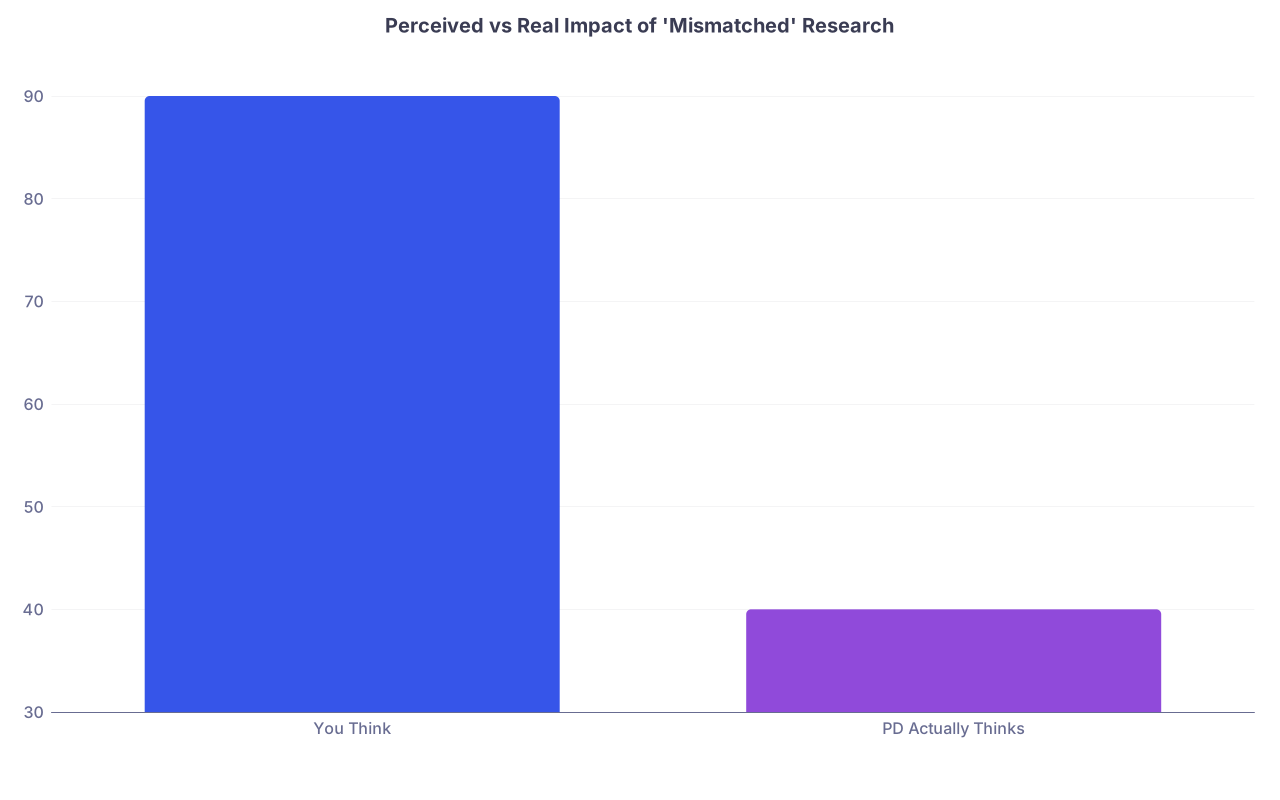
| Category | Value |
|---|---|
| You Think | 90 |
| PD Actually Thinks | 40 |
Probably the most common freak-out: “My research is all in the wrong field, so I’m done.”
No. You’re not.
Most fellowship programs do not require your research to be in that exact subspecialty, especially across internal medicine subspecialties. They care about whether you:
- Can complete projects.
- Understand basic research structure.
- Show follow-through.
- Can talk about what you did without sounding like you just put your name on it.
If you’re switching from GI to Rheum and all your posters are IBD, you frame it like this:
- “My research background taught me how to approach complex immune-mediated disease.”
- “It helped me appreciate the impact of chronic illness on quality of life, which I now see mirrored in rheumatology patients.”
- “Working with long-term IBD patients made me realize I’m drawn to chronic, relationship-based care.”
Is it perfect? No. But programs don’t need perfection. They need plausibility and honesty.
If you can add even a small project, case report, or QI thing in the new field before you apply, that helps a lot. Doesn’t have to be big. It just signals, “This isn’t a 2-week whim.”
The Letter Situation: How Bad Is It If My Letters Are From the “Old” Field?

This is where things can get messy.
Worst-case nightmare in your head:
“Every letter is from people in the wrong specialty, praising me for a field I no longer want. PDs will think I’m confused and uncommitted.”
Reality:
- It’s totally fine to have letters from your old field, as long as they speak to your work ethic, clinical judgment, team skills, and growth.
- What you really need is at least one strong letter from the new specialty saying, in effect, “Yes, this person fits here.”
So if you’re pivoting from cards to rheum or GI to pulm:
- Keep that amazing letter from the cardiologist who actually knows you well.
- Add a letter from someone in the new field who’s seen you recently and can say, “They are genuinely engaged in this work and would be a great fellow.”
If you’re truly stuck with no letter from the new field, then you need to fix that yesterday with:
- An elective in the new specialty.
- Extra clinics.
- Joining someone’s project.
- Asking directly: “I’m applying to X this cycle. Would you feel comfortable writing me a strong letter if we work closely during this block?”
If the answer is hesitant? Don’t force it. A lukewarm “To whom it may concern, they were fine” letter will hurt more than a strong letter from the wrong subspecialty.
How To Explain the Late Change Without Sounding Like a Disaster
This is the part everyone overthinks: “What do I say in my personal statement and interviews?”
Here’s the wrong way:
- “I’ve always wanted to be a rheumatologist.”
When your CV has 7 GI abstracts. They can read. Don’t insult them.
Here’s the right structure:
Acknowledge what you thought you wanted
“Early in residency, I was strongly considering GI. My initial research exposure and early mentors were in that field, and I explored it seriously.”Describe the turning point with specifics
“During my rheumatology rotation in PGY-2, I found myself staying late to discuss cases, read about disease mechanisms, and follow patients longitudinally. I realized I was most engaged when…”Connect your underlying interests
“Looking back, the common thread has always been complex, multisystem disease and long-term patient relationships. Rheumatology aligns more closely with those values than the procedure-focused aspects that initially drew me to GI.”Show you deliberately tested the decision
“After that rotation, I arranged additional rheumatology clinic time, joined a QI project on [X], and sought mentorship from Dr. Y to make sure this wasn’t a temporary reaction.”End in the present tense, not in apology mode
“Through these experiences, I’ve become confident that rheumatology is the field where I can contribute most, both clinically and academically.”
You’re not confessing a crime. You’re walking them through a thoughtful evolution.
What If I Changed Very Late… Like Right Before Applications?
This is where it gets uncomfortable.
If you pivot one or two months before ERAS opens, with:
- Minimal exposure in the new field.
- No mentorship.
- No projects.
- No letters.
Then yes, that’s a problem. Not because change is bad, but because you have no evidence that this isn’t impulsive.
You have three options in that case:
Apply anyway and accept the risk.
Scramble to get at least one rotation and one letter. You might still match, especially in less competitive fields or at your home institution.Strongly consider waiting a cycle.
Soul-crushing? Yes. But it can massively improve your chances if you use the time to build a real track record in the new field. I’ve seen people do this and end up at way better programs.Apply more broadly and be brutally realistic.
If you’re late, you cannot be precious about only “top tier” programs. Cast a wide net.
The worst move is denial—pretending your last-minute switch looks the same as someone who’s been showing sustained interest. PDs can tell.
Your PD / APD Conversation: Terrifying But Necessary

| Step | Description |
|---|---|
| Step 1 | Realize you want new field |
| Step 2 | Schedule meeting with PD |
| Step 3 | Explain change and reasons |
| Step 4 | Plan electives and letters |
| Step 5 | Seek additional mentor advice |
| Step 6 | Reassess timing or field |
| Step 7 | PD supportive? |
You’re probably afraid your PD will think you’re flaky. Honestly? Some are great. Some are rigid. Some just worry you’re harming your chances.
But hiding the switch is worse.
You need your PD and APDs for:
- Honest read on your competitiveness in the new field.
- Help arranging targeted rotations.
- Letter writers in the new specialty.
- Someone to vouch for you in those behind-the-scenes PD phone calls.
If you show up saying, “So I kind of changed my mind, but whatever,” you’ll get friction. If you show up with:
- A clear story.
- Real experiences in the new field.
- A plan for how to strengthen your application.
You’re much more likely to get support rather than side-eye.
What This Actually Looks Like Over Time
Here’s the part you cannot feel right now: three years from now, nobody will care that you pivoted late. They’ll just know you as “the rheum fellow” or “the pulm person.”
Right now you’re hyper-fixated on:
- Old emails where you said you were “100% GI.”
- That one attending who keeps introducing you as “our future cardiologist.”
- Your CV being a weird mix of old and new.
PDs see hundreds of applications. They are not doing a forensic investigation on your emotional consistency from PGY-1 to now. They’re scanning for:
- Can this person function as a fellow?
- Are they actually interested in this field?
- Do their experiences more or less match what they’re claiming?
- Do their letters support that?
You can check those boxes even with a late change.
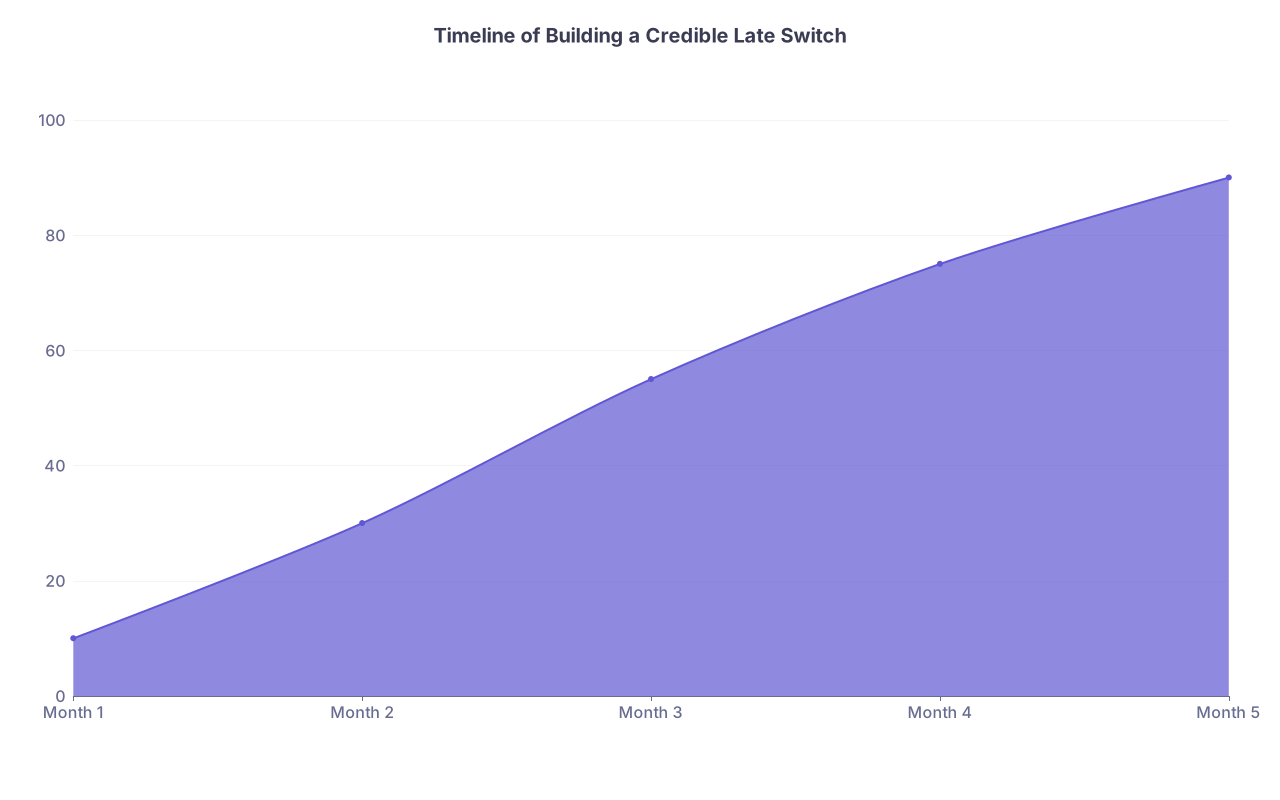
| Category | Value |
|---|---|
| Month 1 | 10 |
| Month 2 | 30 |
| Month 3 | 55 |
| Month 4 | 75 |
| Month 5 | 90 |
FAQ (Exactly 4 Questions)
1. Is it better to apply this cycle with a weak-but-real application to my new field, or wait a year?
If your switch is extreme and very recent—no rotations, no letters, no involvement—waiting a year often gives you a much better shot. You can get real exposure, strong mentorship, a project or two, and letters that actually say, “Yes, this person belongs here.” But if you already have some decent exposure and at least one letter, you might still be competitive enough this cycle, especially if you apply broadly and are flexible with program prestige and location.
2. Will programs think I’m just running from my old field because it was too hard?
Only if your explanation sounds like that. If you say, “Cards was too intense” or “I didn’t like the hours,” yeah, that lands badly. If instead you focus on fit—type of patients, style of thinking, long-term vs acute, procedural vs cognitive—they’re much more likely to see it as thoughtful, not avoidance. They don’t need you to worship suffering; they just need to believe you aren’t escaping, you’re choosing.
3. How many things in my application need to “match” my new field for it to be believable?
You don’t need everything to match. You need enough signal: one or two solid rotations in the new field, at least one strong letter from that specialty, and something—anything—on your CV that touches it (clinic, QI, case report, ongoing project). The rest can absolutely be “legacy” from your old interest. PDs are pattern-recognizers. If they see a clear, consistent current pattern toward your new field, they won’t obsess over the earlier stuff.
4. What if I change my mind again during fellowship?
Happens more than anyone admits. People start cards wanting advanced heart failure, then end up in interventional. Or start rheum and decide they love vasculitis clinics more than anything. Micro-shifts within a field are normal and expected. Huge changes (like switching out of the field entirely) are rarer but not impossible. The point is: this decision feels like a permanent tattoo right now, but in reality your career path will keep evolving. You just need to make the best, most honest choice with the data you have now.
Years from now, you won’t remember every tortured pro–con list or 2 a.m. panic about “wasting” your prior focus. You’ll remember the moment you finally stopped trying to force yourself into the wrong box and had the nerve to choose the field that actually fit.


