
Last winter, a PGY-2 medicine resident sat in my office, still in scrubs, car accident discharge papers folded in his pocket. “They say I’ll probably walk again, but not like before,” he said. “I was going to do cards. Is that over?”
If you developed a disability during residency and still want a fellowship, you’re not dealing with a theoretical question. You’re dealing with: Can I do this job safely, credibly, and sustainably—and will anyone train me?
Let’s walk straight into the hard parts and then map out a plan.
1. First reality check: Your current situation and what’s actually possible
Before you touch ERAS or start emailing PDs, you need a brutally honest snapshot of your functional reality. Not your worst day. Not the “maybe in a year” fantasy. What you can reliably do now, and what’s very likely by the time fellowship starts (12–24 months out).
Ask yourself (and your treating team):
- How does my disability affect:
- Standing/walking
- Fine motor skills/procedures
- Cognition (speed, concentration, fatigue, memory)
- Vision/hearing
- Sleep and stamina
- What’s stable vs still changing?
- What meds am I on and how do they affect performance?
- What restrictions has occupational medicine written down?
You need this for three things:
- To choose realistic specialties and subspecialties.
- To request appropriate accommodations.
- To explain your situation to PDs without sounding vague or evasive.
If you’re early after the injury/diagnosis (stroke, MS, spinal cord injury, new severe vision loss, psychiatric illness, etc.), build in some time to see what stabilizes. You do not need to lock in a fellowship path in the same month you get your diagnosis. In fact, that’s often a mistake.
Quick self-test: Clinical day categories
Look at your last month and sort your days mentally into three piles:
- “Green” days: You functioned close to baseline with your current strategies.
- “Yellow” days: You functioned, but with significant strain, pain, or near-miss errors.
- “Red” days: You should have called out or did, or you made real errors.
If your ratio is something like 3:2:0 (greens:yellow:reds), modifications and accommodations may be enough to make fellowship manageable. If it’s closer to 1:3:2, you’re not ready to assume you can handle a physically demanding procedural fellowship in 6–12 months.
And yes, that matters.
2. Choosing (or re-choosing) a fellowship field with a disability
You may not need to change your planned specialty. But you might need to pivot within it, or rethink entirely. I’ve seen all combinations:
- Ortho resident with hand injury move to PM&R, then do pain fellowship.
- Med resident with new MS still match into cardiology but focus on imaging/noninvasive.
- Surgery resident with mobility impairment transition to anesthesia and then critical care.
Let’s break it down by constraints, not by feelings.
Think in three buckets: Physical, cognitive, and schedule demands
Here’s a rough snapshot. This is not perfect, but it gives you a framework.
| Fellowship | Physical Demand | Procedures-Heavy | Shift/Call Intensity |
|---|---|---|---|
| Cardiology (Invasive) | High | Very High | High |
| Cardiology (Imaging) | Moderate | Low | Moderate |
| Pulm/CCM | High | High | High |
| Heme/Onc | Low-Moderate | Low | Moderate |
| Endocrinology | Low | Very Low | Low |
| Rheumatology | Low | Very Low | Low |
| GI (Endoscopy-heavy) | High | Very High | High |
| ID | Low-Moderate | Very Low | Moderate |
(You can mentally build a similar table for surgical subspecialties, anesthesiology, EM subspecialties, etc.)
Now layer your limitations on top:
- If standing/walking long distances is hard → round-heavy and OR-heavy fellowships become more challenging unless accommodations are robust.
- If fine motor or tremor is affected → procedures and endoscopy may be limited or impossible.
- If cognition, processing speed, or fatigue are significantly impacted → heavy ICU, high-acuity, or rapid multitask fields may not be safe.
This is not about whether programs “will take” you. It’s about what you can actually sustain for 20+ years without wrecking your body or making dangerous errors.
Concrete strategy: Build a shortlist of “green, yellow, red” fields
Do this on paper:
- Green (likely viable with current limitations): e.g., Endocrine, Rheum, ID, Hospice/Palliative, certain imaging-heavy tracks, research-heavy fellowships.
- Yellow (possible but would need significant accommodations and careful program selection): e.g., Noninvasive cards, Heme/Onc, outpatient GI/hep with limited procedures.
- Red (probably unsafe or not realistic now): e.g., Invasive EP, advanced endoscopy, trauma surgery, some high-volume surgical subspecialties.
That list becomes your starting map for conversations with:
- Your program director (PD)
- A trusted faculty mentor
- Occupational medicine / disability services
- Maybe a prior trainee or attending who practices with a disability (if you can find one—and yes, they’re out there)
3. Handling your current residency first (before chasing fellowship)
If your day-to-day residency life is barely functioning, you don’t have a fellowship problem. You have a current employment and safety problem.
You must secure three things first:
- Reasonable accommodations in residency
- A path to graduate in good standing
- Documentation that shows your ability to meet essential job functions with accommodations
Accommodations: What to actually ask for
You’re not begging for favors. You’re asserting legal rights under the ADA (or equivalent, if you’re outside the US) to reasonable accommodations that allow you to perform the essential functions of your role.
Concrete examples:
Schedule:
- No 24- or 28-hour calls; convert to night float with protected recovery time.
- Reduced consecutive days on heavy rotations.
- More clinic and consult months, fewer ICU/wards blocks if medically justified.
Physical:
- Reserved near parking or shuttle assistance.
- Voice-recognition software for notes if hand function is impaired.
- Ergonomic workstation (seated work, standing desks, etc.).
- Assistive devices allowed on the wards/OR.
Cognitive/fatigue:
- Protected break periods to manage fatigue.
- Limits on consecutive night shifts.
- Quiet workspace for documentation if sensory issues are present.
Work through occupational health and your institution’s disability office, not just a sympathetic chief resident. Verbal agreements disappear. You need things formalized.
Why this matters for fellowship
Programs will assess:
- Did you finish residency on time (or with a clear, reasonable extension)?
- Were there performance remediation issues?
- If there was time off or a leave, did you return and perform at a competent level?
- Are your current limitations stable and accommodated, or in crisis?
A strong narrative is: “I had X event/illness, we adjusted my schedule and duties, I completed all ACGME requirements with accommodations, my evaluations remained solid, and now I’m ready to train in Y field with similar support.”
A weak narrative is: “I’m still missing core rotations, I’ve barely been able to show up, I want you to take a chance on me.”
4. How to talk about your disability in fellowship applications
You don’t have to disclose every detail of your health, but trying to hide functional limitations is a terrible strategy. You’re going to show up in person eventually.
There are three main places this comes up:
- Personal statement
- ERAS “disruptions” / explanation sections
- Interviews
Personal statement: Address, don’t center
You’re not writing a trauma memoir. You’re explaining a professional pivot and demonstrating insight.
A clean structure:
- One short paragraph naming the event/diagnosis and very briefly what changed.
- “During my PGY-2 year, I sustained a spinal cord injury in a motor vehicle accident, resulting in partial lower extremity weakness and the need for a cane.”
- One paragraph on how you continued training and what accommodations made that possible.
- “With support from my program and occupational medicine, I completed all inpatient and ICU rotations with modified schedules and equipment. My evaluations remained strong, particularly in…”
- One to two paragraphs on your interest in the fellowship field and what you bring to it.
- Optional short closing on how your experience sharpened your clinical perspective (especially about chronic illness, accessibility, patient empathy), but don’t milk it.
Avoid:
- Overly inspirational language about “overcoming adversity.”
- Vague euphemisms (“health challenges”) that raise more questions than they answer.
- Making the entire essay about your disability.
Be concrete. Calm. Professional.
ERAS disruptions/leave sections
If you took a medical leave, say so plainly.
Example:
“I took a 4-month medical leave during PGY-2 following an MS diagnosis. I returned with formal accommodations in place and completed all ACGME requirements on an adjusted schedule.”
Programs mostly care: Did you resolve the leave? Can you meet their requirements?
5. Vetting and targeting programs: Not all fellowships are equal on this
Some programs will quietly see you as a burden. Some will bend over backwards to support you. Your job is not to convince the first group. It’s to find the second group as efficiently as possible.
Use your network aggressively
You want off-the-record intel. Things you typically will not see on official websites:
- Have they trained anyone with a visible or known disability before?
- How flexible are they with schedules and maternity leaves?
- How did they treat residents during illness, pregnancy, family crises?
Ask:
- Senior residents/fellows in your institution who rotated there
- Alumni from your residency
- Faculty who did fellowship there or know the PD personally
Questions to send someone you trust:
- “Are they humane about schedule changes for health issues?”
- “Have they supported any trainee through serious illness or disability?”
- “Would you send your own kid there if they needed accommodations?”
Reading between the lines
Look for:
- Programs that brag endlessly about “grit” and “warrior culture” → sometimes code for no flexibility.
- Places with long-standing issues with burnout and attrition → often terrible with disability.
- Versus programs that:
- Talk concretely about wellness resources.
- Publicly highlight part-time faculty, people returning from leave, etc.
No program will write “we’re great for disabled trainees” on their homepage. You have to infer.
6. Strategy for disclosure and timing with PDs
You’ll face the question: When do I disclose? On paper, post-interview, after matching?
Here’s the reality: If your disability is visible or functionally obvious (use a wheelchair, cane, significant tremor), hiding it is not an option. You need to get ahead of it.
A workable approach
On the application:
- Brief mention in personal statement if it materially affects your path / explains a gap / shapes your goals.
- Keep it succinct and factual.
After getting interview invites at especially promising programs:
If your limitations impact essential functions (call, ICU coverage, procedures), consider emailing the PD or coordinator before the interview:“I’m very excited to interview with your program. I want to make you aware that due to a spinal cord injury during residency, I use a cane and have certain physical limitations. I’ve successfully completed all internal medicine requirements with accommodations in place. I’d be glad to discuss how this has worked in practice and how I’d safely meet fellowship expectations.”
That sounds scary. But it flushes out programs that will never support you so you don’t waste time—and it allows supportive PDs to start thinking concretely about how they’d structure your training.
During the interview:
You want to hit three key messages:- You understand the demands of the field and are realistic about what you can and cannot do.
- You’ve already successfully functioned as a resident with accommodations.
- You’ve thought about how to meet the essential fellowship requirements safely.
Be ready with specific examples:
- “On our MICU, I handled X number of patients with this call structure…”
- “For procedures, I can/cannot do ___; in residency we handled this by ___.”
If your disability is invisible (psychiatric condition, seizure disorder now controlled, mild MS with no obvious deficits), you have more flexibility. You can choose to disclose only if it affects schedule or call. But understand: if accommodations will be needed, springing it on them on July 1 is not a power move; it’s a mess.
7. Matching your disability to fellowship tasks: Get granular
You need to go beyond “cards might be hard.” Look at daily tasks.
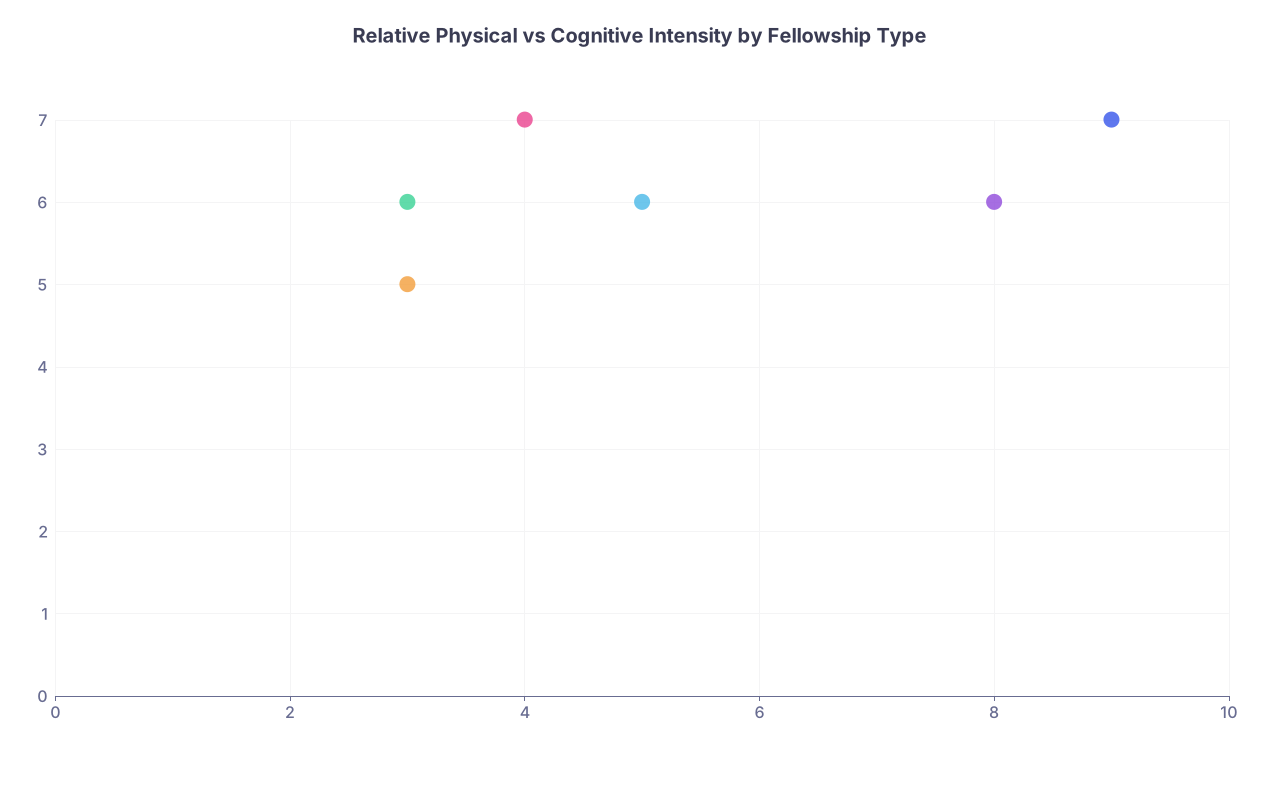
| Category | Value |
|---|---|
| ICU/CCM | 9,7 |
| Invasive Cardiology | 8,6 |
| Endocrinology | 3,6 |
| Rheumatology | 3,5 |
| Heme/Onc | 4,7 |
| ID | 5,6 |
(Each point is [physical intensity, cognitive intensity] on a 1–10 scale, approximate.)
Now tie that to your situation:
Mobility impairment:
- Rounding-heavy, multi-site programs are tougher. Look for:
- Strong hospital transport systems, compact campuses.
- More clinic-based fellowships (endo, rheum, allergy, some heme/onc tracks).
- Programs willing to adjust call room location, provide closer parking, etc.
- Rounding-heavy, multi-site programs are tougher. Look for:
Manual dexterity problems:
- Highly procedural (EP, GI, IR, some pulm) may be off the table—or you may need to specialize within the fellowship (e.g., advanced imaging rather than cath).
- Outpatient consult-based fields are friendlier.
Cognitive/fatigue limitations:
- High-acuity, constant-multitask areas (ICU, ED-based fellowships) are risky.
- Specialty clinics, longitudinal care fields, and consult-based fellowships may be more sustainable.
You’re trying to design a path where you are not the constant limit case of the system. That’s how you burn out fast.
8. Money, time, and backup plans
Nobody talks about this enough.
If matching is uncertain, protect yourself
You may be in a situation where:
- Your specialty is moderately competitive.
- You’re limiting yourself to disability-friendly programs.
- Your application has a medical leave or changed path.
You need parallel tracks:
- Primary track: Fellowship applications in realistic, well-chosen fields.
- Backup track: A post-residency job you can do even if you don’t match this year.
That might look like:
- Hospitalist work with tailored schedule (no nights, partial FTE).
- Outpatient clinic position within your core specialty.
- Research-heavy or QI-heavy job with some clinical component.
Do not gamble your entire financial stability on a specialty where you have multiple red flags and only 5–10 programs nationwide that might work.
9. Psychological reality: Identity, shame, and letting go
The hardest part for most residents is not the logistics. It’s the identity loss.
You trained for years imagining yourself as a proceduralist, surgeon, “intense ICU doc,” or whatever story you built. Then your body or brain changes, and that story collapses.
Let me be blunt: clinging to a fantasy of what you “were supposed” to do can wreck the actual good life you can still have.
I’ve watched:
- A resident with significant neuropathy push into a high-procedure field, only to flame out mid-fellowship and leave medicine entirely, bitter and broke.
- Another with similar limitations pivot to endocrine, carve out a phenomenal academic career, and be happier than he ever imagined.
The difference wasn’t talent. It was willingness to update the story.
You’re allowed to grieve. You’re allowed to be furious. But you also have to decide if you’d rather be “what you imagined at 24” or employed, competent, and not destroying your health by 40.
10. Concrete action plan (next 3–6 months)
Let’s distill this into moves you can make now.

| Step | Description |
|---|---|
| Step 1 | Assess Functional Status |
| Step 2 | Secure Residency Accommodations |
| Step 3 | Confirm Graduation Path |
| Step 4 | Map Fellowship Options - Green Yellow Red |
| Step 5 | Discuss With PD and Mentor |
| Step 6 | Target Programs and Update CV |
| Step 7 | Strategic Disclosure in Apps |
| Step 8 | Interview and Clarify Expectations |
| Step 9 | Primary and Backup Plans |
Step-by-step:
- Sit down with your treating team and occupational medicine. Get clear, written functional assessments.
- Formalize and, if needed, adjust your residency accommodations. Make sure you are actually functioning at a sustainable level.
- Meet with your PD:
- Clarify your expected graduation date.
- Ask directly: “Based on my performance since the injury/diagnosis, do you feel comfortable supporting me for fellowship in ___ area?”
- Build your “green/yellow/red” fellowship list.
- Find one or two trusted faculty mentors in fields that are realistic for you to pursue. Not the trauma surgeon who still thinks you’ll be doing overnight call with a walker at 55.
- Draft your personal statement with a brief, factual explanation of your disability and pivot, if relevant.
- Start quietly querying your network about program cultures at places on your realistic list.
- Outline your backup job plan if you don’t match.
You don’t need to do all of this in a week. But you do need to start.
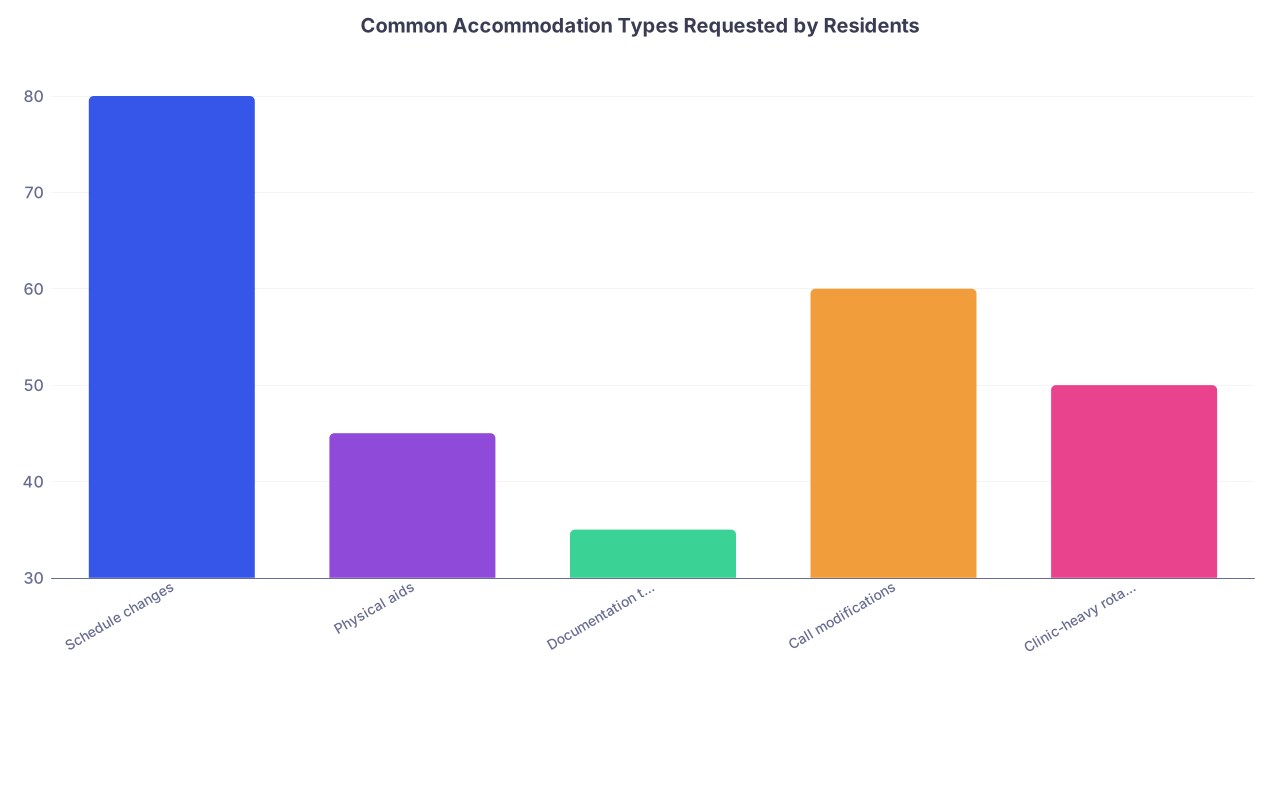
| Category | Value |
|---|---|
| Schedule changes | 80 |
| Physical aids | 45 |
| Documentation tools | 35 |
| Call modifications | 60 |
| Clinic-heavy rotations | 50 |

FAQs
1. Should I delay applying for fellowship to “prove” I can function post-disability?
If you’re within 3–6 months of a major event (stroke, spinal cord injury, new MS diagnosis, severe psychiatric episode), delaying a cycle is usually smart. It lets you stabilize, finish residency cleanly, and apply with real data about your capacity rather than guesses. But if you’re already a year or more out and functioning well with accommodations, you do not need to wait just to “prove” something abstract.
2. Will disclosing my disability automatically hurt my chances?
Not automatically. At good programs, clear, mature disclosure paired with evidence of solid performance can actually help by signaling insight and reliability. At bad programs, yes, it will hurt you—but those are the same places that would have been a nightmare to train in with a disability. Your goal is not to trick everyone; it’s to filter for the ones worth training with.
3. Can a program legally refuse to accommodate me in fellowship?
Programs are required to provide reasonable accommodations that don’t fundamentally alter essential job functions or create undue hardship. They do not have to waive core skills (e.g., procedural volume in a procedural fellowship) or eliminate essential call responsibilities entirely. This is where picking the right field and right program matters—asking endocrine to provide a quieter clinic room is reasonable; asking a trauma surgery fellowship to exempt you from the OR is not.
4. What if my PD is unsupportive or subtly discouraging me from applying?
Document everything. Keep emails. If they refuse to write a strong letter, you may need to shift strategy toward programs where other faculty can vouch for you, or build more time and experience post-residency before applying. Sometimes an unsupportive PD is a sign your current performance really isn’t where it needs to be; sometimes it’s bias. You need a second opinion from a mentor who’s seen your actual work since the disability.
5. Is it better to choose a “less competitive” fellowship just to increase my odds?
Choosing a field solely because it’s less competitive but wildly mismatched to your interests and limitations is a bad play. You’ll be miserable and maybe unsafe. However, within the set of physically and cognitively realistic options, leaning toward less competitive subspecialties or tracks (e.g., research-leaning, community-based programs) can absolutely be part of a smart risk-reduction strategy.
Key points to walk away with:
- Start with reality: understand your actual functional limits and stabilize residency with proper accommodations before chasing fellowship.
- Choose fields and programs where your disability and the job demands are aligned, then disclose strategically and concretely.
- Protect yourself with a credible backup plan, and be willing to update your career story rather than forcing your body into a role it cannot safely sustain.