

It’s 10:30 p.m. You finished clinic hours ago, but you’re still in your office, scrolling fellowship program websites with your door half closed so your partners don’t walk by and see. You’ve got a panel of patients who trust you, bills that expect your current income, maybe kids who now finally sleep through the night—and you’re seriously considering going back into training.
You’re not crazy. You’re just at a crossroads.
I’m going to treat you like what you are: a trained physician with limited patience for fluff. You already know what fellowship is. You already survived residency. What you need is:
- Is this pivot even realistic?
- What are the landmines?
- How do you actually execute this without burning your life down?
Let’s go step by step.
1. First: Reality Check – Are You Doing This for the Right Reasons?
If you’re already in private practice, you’ve seen enough to know: the grass is not automatically greener anywhere. Before you chase a fellowship spot, get brutally clear on your why.
Here are the good reasons I’ve seen work out:
- You discovered a niche you actually love (e.g., you’re an internist who really lives for cards consults and feels dead inside doing chronic pain and vague fatigue visits).
- Your current practice model is a bad fit and just changing jobs won’t fix it (toxic group, punishing RVU culture, no room for subspecialty work).
- You’ve always known you wanted an academic or highly specialized career, but you went straight into practice for geographic/financial/family reasons.
- Market reality: in your region, generalists are being squeezed and subspecialists in X field are in huge demand, and you want to be on the right side of that.
And the bad reasons that tend to blow up:
- You hate your partners and think fellowship will magically make you happier (you might just be changing what kind of pain you have).
- You’re burned out and think “more training” is easier than fixing boundaries, workload, or location.
- You feel behind compared to your co-residents who did fellowships and now post fancy cases on Twitter.
- You’re trying to avoid dealing with personal life issues by staying “in training” forever.
Be harsh with yourself. If you strip away ego and fear and what everyone else is doing, do you still want this?
Quick gut test
Answer these in your head, quickly, no overthinking:
- If fellowship paid exactly what you make now, would you be excited to start next July?
- Would you still want to subspecialize if you had to move states and reset your network?
- If you could change practices (but stay general) and be reasonably happy, would you still feel pulled toward fellowship?
If you answered “yes” to 1 and 2 and “no” to 3, you’re probably in genuine pivot territory.
2. Understand the Structural Challenges You’re Up Against
Programs do not see you as “standard” applicant. That’s both good and bad.
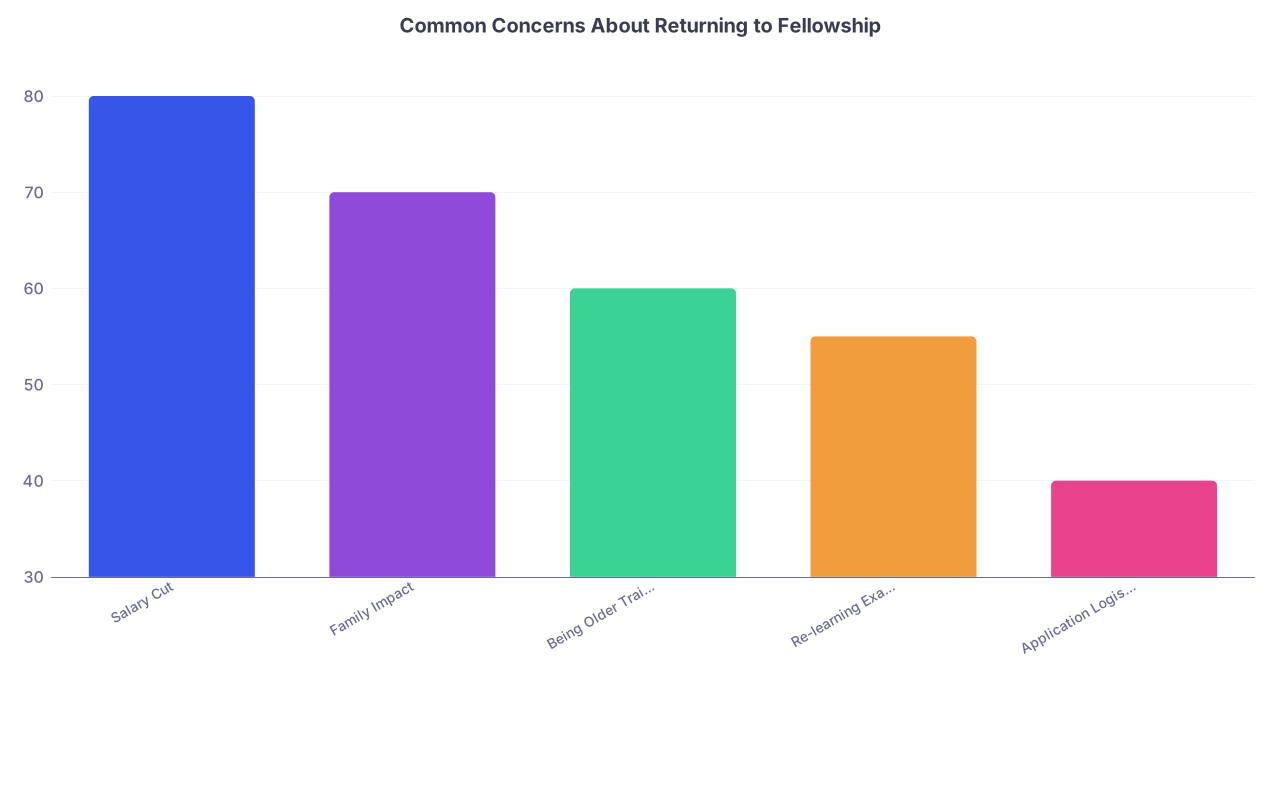
| Category | Value |
|---|---|
| Salary Cut | 80 |
| Family Impact | 70 |
| Being Older Trainee | 60 |
| Re-learning Exams | 55 |
| Application Logistics | 40 |
Here’s how programs will quietly categorize you:
- Non-traditional / out-of-training candidate
- Potentially “rusty” on in-training style medicine
- Possibly excellent maturity and work ethic
- Possibly difficult to schedule (kids, mortgage, dual-career spouse)
- Potential visa/logistics questions if you’re IMG
None of this is fatal. But pretending it is not an issue is how your application dies.
The big friction points
Timeline gap
You’ve been out of residency for 1–10+ years. Committees will ask:- Are your skills current?
- Are you going to struggle with the fellowship workload?
- Why now?
Letters of recommendation
Your best advocates are probably no longer faculty; they’re partners or community docs. Some programs value that; some do not.Exam performance & recency
You may not have a recent in-training exam, Step 3 might be old, and you may or may not have board certification already.Financial and lifestyle hit
You will drop income. Likely hard. And your family will feel it.Perception risk
Some PDs quietly worry you’ll bail if the pay cut/lifestyle shock hits mid-year, or that you’ll be harder to “mold.”
None of this is insurmountable, but you need a plan for each.
3. Picking the Right Fellowship and the Right Programs (Not All Are Candidate-Friendly)
You’re not 27 and mobile and free anymore. You can’t spray 60 applications and “see what happens.” Be strategic.
Step 1: Choose your field like it will stick for 20 years
If you’re pivoting from practice, you do not want to do this twice. Make sure your target fellowship:
- Has real job openings near where you could live
- Aligns with work you already know you enjoy (not just “sounds cool”)
- Has training that is compatible with your physical stamina and life stage (e.g., late-30s/40s doing a super-malignant surgical fellowship with night cases every other day—that’s a question)
Step 2: Target programs that historically accept non-traditional applicants
You need data. Not vibes.
Ask current fellows and recent grads (cold email is fine if done respectfully):
- “Do you have any fellows who came from private practice or with a gap after residency?”
- “How do faculty view applicants who’ve been out of training for a few years?”
Look at program websites and fellow lists. If all you see is straight-through PGY-whatever with no prior practice, that’s a sign. Not a hard no, but a caution flag.
Step 3: Prioritize geographic and support realities
For you, geography is not just preference. It’s logistics: spouse job, childcare, aging parents, mortgage.
Rank programs by:
- Distance from current support network
- Cost of living vs fellowship salary
- Call schedule and average hours
- Culture around families and outside life
| Factor | Considerations for Pivoters |
|---|---|
| Location | Spouse job, childcare, support system |
| Call Intensity | Night float vs home call, weekend frequency |
| Program Culture | History with non-traditional fellows |
| Research Demands | Required projects vs optional involvement |
| Job Placement | Alumni jobs in your desired region |
4. Fixing the Paper Trail: CV, Personal Statement, and Letters
This is where mid-career applicants either stand out beautifully or look like a mess.
CV: Convert private practice to something academic programs understand
Your CV cannot look like your credentialing form. Translate.
Key sections you should have:
- Training and certification (keep this clean and simple)
- Current practice details (group size, clinical focus, any leadership roles)
- Teaching (residents, students, nurse practitioners, CME talks)
- Quality improvement, committees, or leadership
- Any research, posters, or publications (even old ones matter now)
- Community involvement that’s actually relevant (free clinic, outreach, etc.)
If you’ve done nothing that looks remotely academic since residency, that’s not fatal, but it means you need the next thing.
Personal statement: Tell the pivot story in a straight line
Your personal statement is not a therapy session. It is a professional narrative that answers three questions clearly:
- What do you do now?
- Why are you leaving it?
- Why is this specific fellowship the logical next step?
If your current practice is fine but “not enough,” say so like an adult. Example:
“For the past four years I’ve practiced as a general internist in a busy suburban group. I’ve enjoyed the relationships and continuity, but I’ve consistently found my most meaningful work in managing complex heart failure, arrhythmia management, and pre-operative cardiac risk evaluation. Over time, I’ve shaped my practice to include more of this, but there are clear limits to what I can offer without formal cardiology training.”
That’s straightforward. No melodrama, no trashing your job.
Avoid:
- Blaming your partners, hospital, or system for everything
- Long rants about RVUs or prior authorization
- Vague language like “I just feel called” with no concrete examples
Back it up with specific episodes where you were doing quasi-subspecialty work and loved it.
Letters: You need at least one strong academic voice
Programs will want to hear from:
- Someone who knows you as a trainee (former PD, APD, or senior faculty)
- Someone who knows you in practice (partner, department chair, hospital CMO, etc.)
Reach out early. Like months early. A former PD getting an email in April for letters due in June is fine; in September, less fine.
When you ask, be blunt:
- “I’m applying for [fellowship name]. I’ve been in practice at [place] since [year]. I’m hoping you can comment on my performance during residency and whether you’d recommend me strongly for advanced training now.”
If your old PD has no idea what you’ve been doing since graduation, give them a one-page summary of:
- Current role
- Procedures or complex cases you routinely handle
- Teaching, leadership, or projects
- Why you’re applying now
For practice letters, coach them gently:
- Ask them to comment on your clinical judgment, reliability, collegiality, and capacity to function in a training environment.
- Ask them to give concrete examples: “handled complex X case,” “volunteered to train new hire,” “took the lead on QI project.”
Vague “great doc, patients love them” letters do nothing for you.
5. The Money and Life Side: Do Not Hand-Wave This
This is the part people like to gloss over. You cannot.
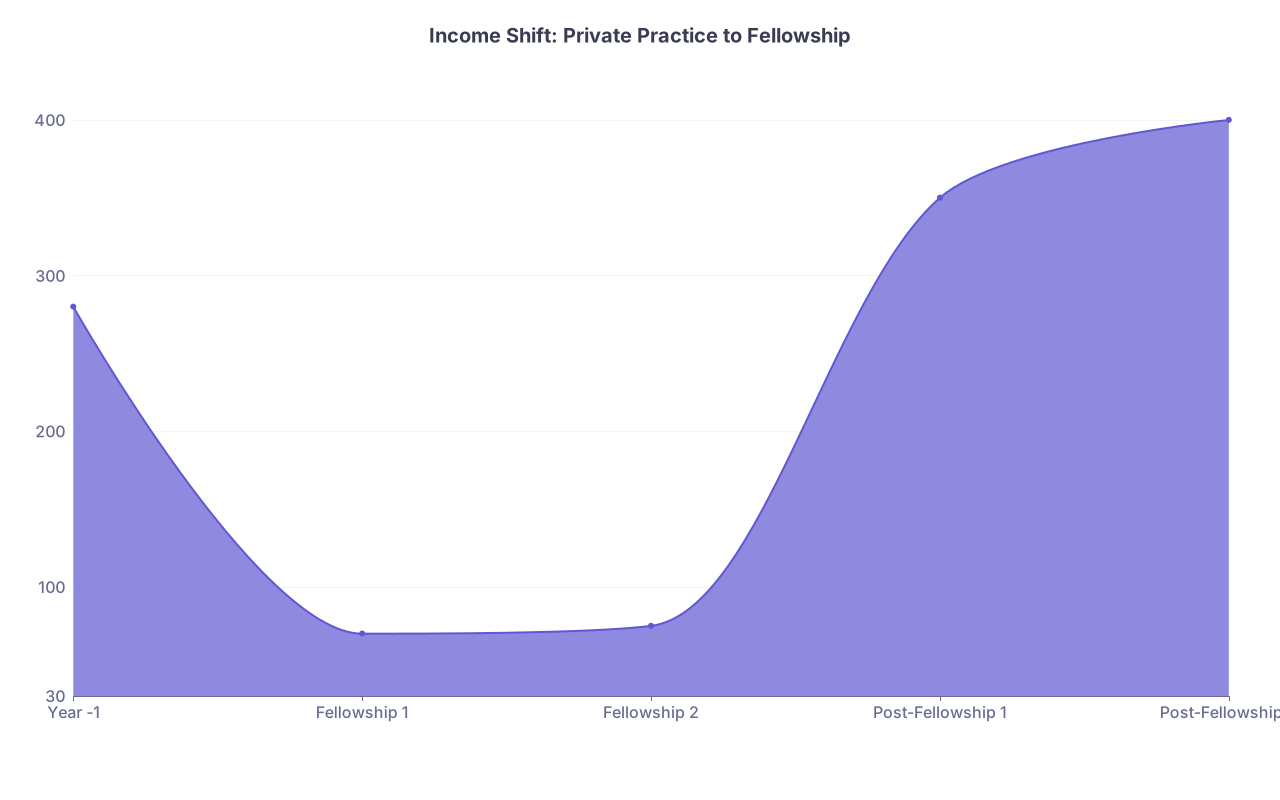
| Category | Value |
|---|---|
| Year -1 | 280 |
| Fellowship 1 | 70 |
| Fellowship 2 | 75 |
| Post-Fellowship 1 | 350 |
| Post-Fellowship 3 | 400 |
(Units could be approximate annual income in thousands; the point is the dip.)
Do some actual math:
- Current take-home vs projected fellowship take-home
- Housing, childcare, loan payments, spousal income, etc.
If you do not already live like a resident, you will feel this hard.
Minimum financial prep before you commit
- Build a 6–12 month real emergency fund, not fantasy numbers.
- Cut or renegotiate major fixed costs before Match (car leases, daycare options, housing if you may have to move).
- Look at PSLF or loan repayment options if you’ll be at a qualifying institution.
- Talk to your partner (if you have one) about division of labor and expectations. Do not spring “by the way, I’ll be working 70 hours again” on them after you match.
Family and lifestyle conversation
You’re not the only one going back into training. Your family is, too.
You owe them straight talk:
- On-call nights are coming back.
- Salary is dropping.
- Vacation flexibility will be limited.
Decide upfront:
- Where will kids be in school?
- Will spouse/partner work more, less, or the same?
- Are you okay living apart temporarily (some couples do this for 1–3 years; it is not easy)?
If your family is half-hearted, address it now. Resentment at month 3 of fellowship is brutal.
6. Re-Tuning Your Clinical and Exam Brain
If you’ve been in community practice, your brain has adapted. Fast. Efficient. But maybe not formatted for board-style questions or complex zebras.
Programs worry about this. Solve it before they ask.
Before interviews
- Do a light but real review of core content in your field. Not like Step 1 grind, but enough you can talk cases without saying “I’d have to look that up” every three minutes.
- Read 1–2 major guidelines in your future subspecialty and a few landmark trials. You do not need all of them; you need to sound like someone who has not been asleep for 5 years.
- If there’s an in-service or specialty ITE you can sit in on (through your hospital or society), consider it.

If you end up matched, then:
- Plan 2–3 months of stepped-up reading before fellowship starts.
- Reach out to your future program for recommended texts or online modules. Many will happily point you to their standard intern/fellow reading list.
You do not need to be the smartest person on day 1. You do need to show you are not clinically stale.
7. Interview Season: How to Talk About Your Pivot Without Sounding Confused
This is where your whole pivot is either convincing or not.
How PDs and faculty will test you
They will probe three angles:
- Motivation – Are you serious or dabbling?
- Stability – Will you handle the pay cut and schedule?
- Fit – Will you fit into a cohort of younger trainees and the existing program culture?
Prepare clear, honest answers to:
- “Why now?”
- “What made you decide to step away from practice?”
- “How will your prior experience help you as a fellow?”
- “What challenges do you anticipate going back into training?”
You want to sound like this:
“I’ve had five years of general practice. I’m proud of the work I’ve done, but over time, I found that the cases I kept wanting to spend extra time on were [subspecialty cases]. I shaped my schedule to see more of those, took on X QI project, and joined Y hospital committee. There’s a ceiling to how far I can go without formal training, so this isn’t about escaping my current job. It’s about going deeper into the kind of work I already know I like.”
Not like this:
“Primary care is a mess, I’m burned out, so I decided to try fellowship.”
You can acknowledge systemic problems—everyone in that room knows them—but do not sound like you’re just running away from something.
Use your practice experience as an asset
You are bringing things most straight-through applicants don’t have:
- You know how to run a clinic.
- You can handle patient and family conversations calmly.
- You’ve seen the downstream effects of subspecialty decisions.
- You understand RVUs, length of stay, and real-world constraints.
Explicitly connect that:
“As someone who’s managed complex [disease] without immediate subspecialty backup, I have a strong sense of what information referring providers actually need and what they struggle with. I think that perspective will make me a better consultant and teacher.”

| Step | Description |
|---|---|
| Step 1 | Unhappy or limited in current practice |
| Step 2 | Change practice or role |
| Step 3 | Clarify long term goals |
| Step 4 | Stay in practice and redesign career |
| Step 5 | Commit to fellowship path |
| Step 6 | Prepare finances and family |
| Step 7 | Apply strategically to programs |
| Step 8 | Can practice change fix it |
| Step 9 | Need subspecialty training |
8. Planning Your Exit from Practice Without Nuking Relationships
You still have to leave your current job. Do not torch that bridge.
Step 1: Timing
Fellowships usually start July 1. You’ll know if you matched months earlier.
Work backwards:
- Contract notice periods (often 60–180 days)
- Malpractice tail coverage details
- Patient panel handoff
If you’re in a small group, tell leadership early—before the rumor mill. Ideally right after you’ve matched, once it’s real but while there’s time to recruit or rearrange.
Step 2: Frame it like a professional pivot, not a judgment
To partners, say something like:
“This isn’t about the group. I’ve realized over the past few years that I want to subspecialize in X. I know it has real implications for the practice, so I want to give as much notice as I can and help with the transition.”
Then actually help. That means:
- Clean handoffs, clear notes, and transitional messages to key patients
- Avoiding dramatic exits (“I’m out of here Friday, good luck”)
- Offering to be reachable for a limited period for questions on complex cases you’re leaving behind (within reason)
Future you may want a job with these people or their network. Keep things clean.

9. Mental Shift: From Attending Back to Trainee
This is the ego part. No way around it.
You’ve had your own patients. Maybe your own MA, your name on the door, your own billing number. Now you’re going to:
- Take orders again
- Ask for signatures
- Follow someone else’s rounding style
- Do night float like it’s 2012
You need to decide in advance that you’re okay with that.
Faculty and co-fellows will notice if:
- You constantly say “Well, in my practice, we did it this way”
- You resist feedback because “I’ve been an attending for years”
- You treat residents like subordinates rather than colleagues
You can and should bring your experience, but pick your moments. Being the former-attending who quietly nails the consult, helps the intern, and listens in conference is far more impressive than the one who starts every sentence with, “Back when I was in practice…”
10. Concrete 6–12 Month Timeline If You’re Serious
Let’s make this real. If you want to start fellowship July two years from now (standard lead time), here’s a skeleton timeline.
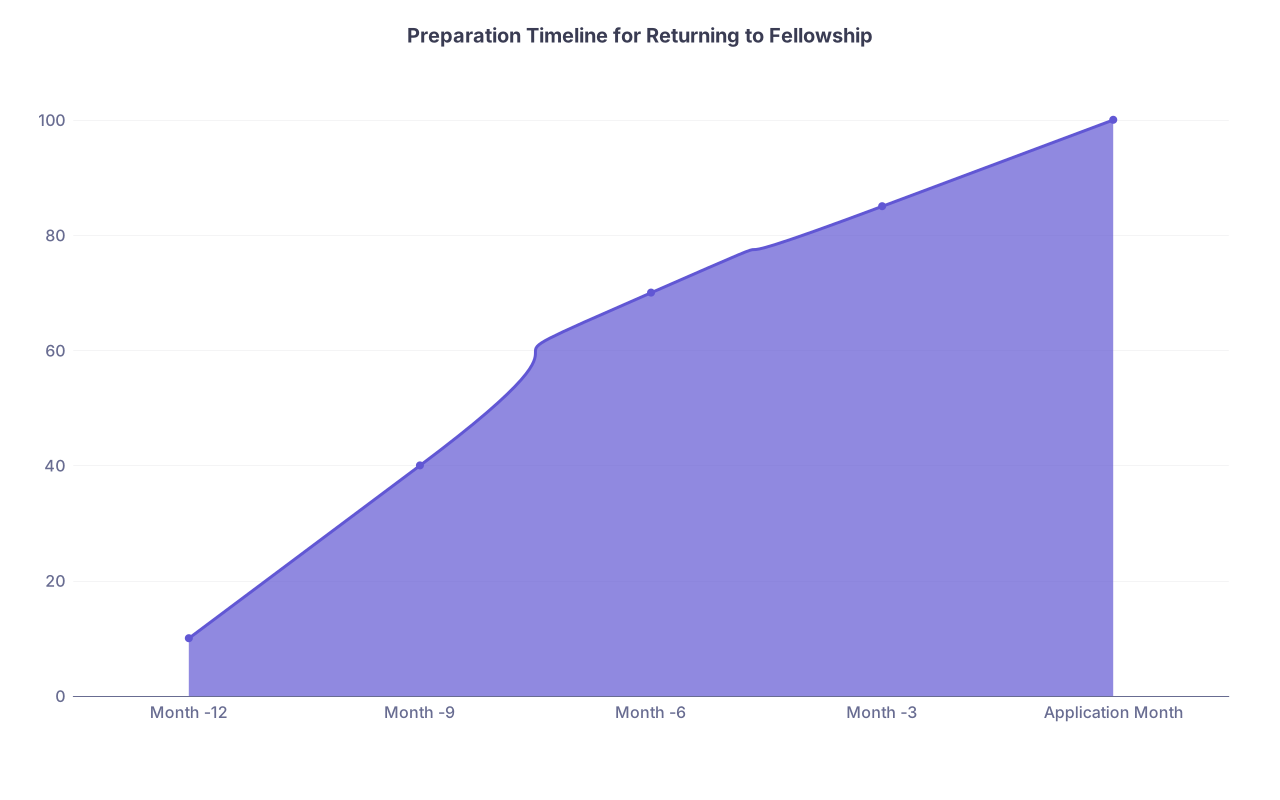
| Category | Value |
|---|---|
| Month -12 | 10 |
| Month -9 | 40 |
| Month -6 | 70 |
| Month -3 | 85 |
| Application Month | 100 |
(Value = percent readiness; the idea is to ramp up.)
12–9 months before applications open:
- Decide definitively on specialty.
- Have initial conversations with family.
- Contact former PD/mentors to float the idea and gauge support.
- Start rough financial planning.
9–6 months before:
- Identify target programs and make a long list.
- Update CV; draft personal statement.
- Line up letter writers; confirm they’ll support you.
- Start light content review so you don’t sound rusty.
6–3 months before:
- Finalize program list (long but realistic).
- Polish personal statement with someone who knows the field.
- Ask letter writers for final letters with clear deadlines.
- Make real financial moves: budgeting, savings, maybe selling a house if needed.
3 months before to submission:
- Complete application, triple-check gaps and dates.
- Reach out to a couple of programs with specific interest (if appropriate in your specialty).
- Plan work schedule around likely interview season if you can.

FAQ (Exactly 3 Questions)
1. I’ve been out of residency for 7–10+ years. Is it too late to go back for fellowship?
No, it’s not automatically too late, but the longer the gap, the more intentional you need to be. You’ll need stronger explanations, stronger letters, and probably some recent academically flavored activity (teaching, QI, maybe a small project or course) to show you’re not clinically or intellectually stale. Some programs are open to seasoned applicants and even prefer them; others want straight-through trainees only. Your job is to target the former, not waste time on the latter, and be very clear about why now and how you’ll adjust to trainee life again.
2. Do I need new research before applying, or can I rely on what I did in residency?
You don’t absolutely need new research, especially in clinically heavy fields, but you need something that signals you’re still engaged beyond pure volume practice. Old residency research is fine to list; it still shows you can think and write. If you’ve been out for years, consider doing at least one small, achievable thing: a QI project with a poster, a local talk, helping with a chart review at your hospital. Do not try to build an entire research career in six months. Just create a recent point of contact with academic or scholarly work.
3. What if my current partners or employer get angry when I tell them I’m leaving for fellowship?
Some will. Especially if you’re busy and hard to replace. That does not mean you are wrong to go. Your responsibility is to give reasonable notice, help transition your patients, and honor your contract. You are not required to sacrifice the next 20 years of your career because they built a schedule around you. Stay calm, be professional, and do not get baited into defensiveness. Document key conversations, clarify tail coverage and final pay, and keep your reputation clean. They’ll be annoyed for a while; they’ll survive. So will you.
Today’s actionable step:
Open a blank document and write one clear paragraph answering this question: “Why am I leaving my current practice for fellowship now, and why this specific field?” No buzzwords. No excuses. Just the truth. If that paragraph still feels solid when you re-read it tomorrow, you’re ready to take the next step.


