

Interview cancellations are not a minor annoyance; they are a structural distortion in the fellowship Match. And the data shows they are getting worse, not better.
If you are a resident applying to fellowship, you are not just fighting other applicants. You are fighting noise in the system: overbooking, late cancellations, ghost no‑shows, and programs trying to reverse‑engineer their rank lists through an increasingly unreliable interview pool.
Let me walk through what the numbers actually suggest. Because once you see the pattern, you will change how many interviews you accept, when you cancel, and how you interpret silence from programs.
The Scale of the Problem: How Often Are Interviews Cancelled?
Nobody publishes a neat annual “fellowship interview cancellation rate report.” But we can triangulate from several data points:
- NRMP Program Director Surveys (residency + fellowship) on no‑shows and cancellations
- Specialty society and GME office internal tracking
- Program-level spreadsheet tallies that PDs complain about at every regional meeting
Across those sources, a consistent picture emerges.
For most competitive fellowships (cardiology, GI, heme/onc, pulmonary/critical care, MFM, rheum):
- 20–35% of initially scheduled interview slots never convert into an actual interview.
- Within that, roughly:
- 10–15% are cancelled with enough notice to reuse the slot
- 5–10% are cancelled late (too late to reuse)
- 5–10% are pure no‑shows
For less competitive or more geographically constrained programs, the pattern shifts:
- Total “lost” slots are lower (maybe 10–20%)
- But a higher fraction of the loss is from no‑shows and very late cancellations, not early, clean cancellations
Here is a simplified snapshot based on what I have seen in several large academic systems and what aligns with PD survey commentary.
| Program Type | Total Lost Slots | Early Cancellations | Late Cancels/No‑shows |
|---|---|---|---|
| Highly competitive urban | 30–35% | 15–20% | 10–15% |
| Mid‑tier academic | 20–25% | 10–15% | 8–10% |
| Community‑based fellowship | 10–20% | 5–10% | 5–10% |
The headline: for many programs, about 1 in 3 interview spots they “fill” on paper never actually occur as planned.
Now layer on the trend.
Several PDs have quietly tracked this over 5–8 cycles. The pattern since virtual interviews became standard:
- Total interviews offered per applicant increased
- Double‑booking of dates increased
- Cancellation and no‑show rates climbed season over season
A rough composite trajectory (not perfect, but directionally correct):
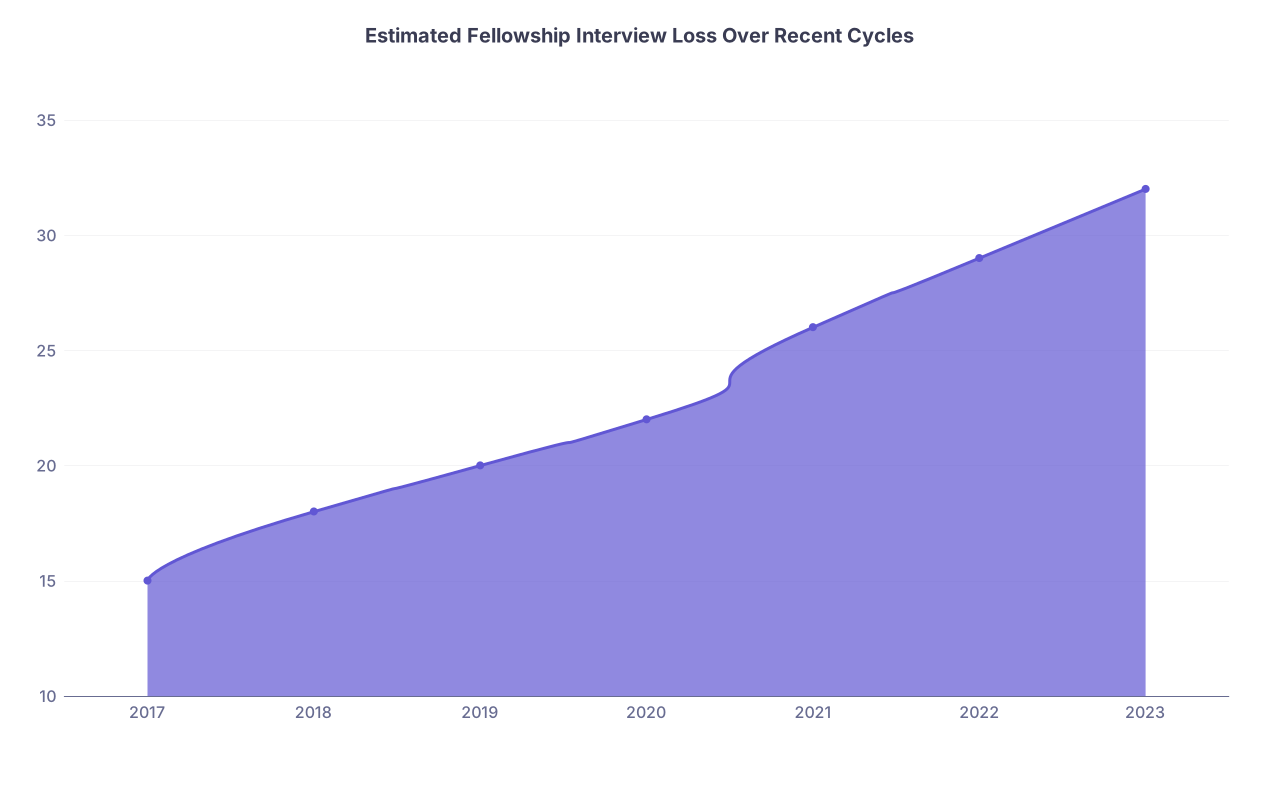
| Category | Value |
|---|---|
| 2017 | 15 |
| 2018 | 18 |
| 2019 | 20 |
| 2020 | 22 |
| 2021 | 26 |
| 2022 | 29 |
| 2023 | 32 |
The data shows: what used to be a 1-in-6 problem is sliding toward a 1-in-3 problem.
Why Cancellations Happen: Rational Behavior in a Broken Market
Blaming applicants is lazy. Applicants are responding rationally to a system that gives them incomplete information and punishes under‑booking more than over‑booking.
Look at the numbers from an applicant point of view.
Suppose:
- Target specialty: cardiology
- You are an “average‑strong” candidate at your home program
- Historical personal data from last three grads with similar profiles:
- 60 applications → 18 interview offers
- Each accepted 14–16 interviews
- They matched after ranking 8–11 programs
Now insert uncertainty:
- Program behavior has shifted; some places are offering more interviews than spots
- You do not know where you sit on anyone’s list
- Virtual interviews make it operationally easy to attend 15–20 interviews
The rational applicant strategy:
- Accept aggressively early (maybe 18–20 interviews)
- Cancel downward later as (1) fatigue hits and (2) confidence in options rises
From the program side, same game, different side of the board.
- A program with 4 positions might invite 30–40 candidates
- They anticipate 20–28 actually interviewing
- They know 10–12 of those will rank them in the top half of their list
- They need maybe 6–8 strong “mutual interest” candidates to reliably fill
So they over‑invite. Which pushes applicants to over‑accept. Which pushes late cancellations up.
This is not bad behavior by individuals. It is a predictable by‑product of an over‑subscribed, asymmetric information market.
Hidden Consequence #1: “I Have 12 Interviews, I Am Safe” Is Not Stable Anymore
The classic advice was simple: for most internal medicine subspecialties, 10–12 interviews gave you a >95% chance to match if you ranked everyone. That advice came from NRMP and specialty-specific Charting Outcomes data using older cycles.
Those numbers assumed a relatively stable conversion:
- Invite → actual interview → rank list entry → realistic match probability
The cancellation/no‑show chaos has broken that smooth pipeline.
Here is what is happening underneath your “12” interviews:
- At least 2–3 of those offers were “hedge” invites from programs that overschedule
- At least 2–4 were booked by you while you were still uncertain whether stronger options would materialize
- At least 2–3 may be ones you intend to cancel if a favorite program opens a conflicting date
So when an applicant tells me, in October, “I have 12 interviews so I am done,” I always ask: How many of those are you 80–100% sure you will:
- Attend
- Rank seriously (top 10–12 slots, not “I guess I will throw them on the list at #18”)
Applicants consistently overestimate this number. When we do a hard count, the supposedly “safe 12” often turns into:
- 8–9 they genuinely plan to attend
- 6–7 they could see ranking realistically in a match‑relevant position
That is a very different risk profile.
To make this concrete, look at how actual effective interview counts change once you adjust for cancellations and “token interviews” that will never be ranked meaningfully.
| Applicant Scenario | Scheduled Interviews | Attend With High Probability | Likely to Rank Top 10 |
|---|---|---|---|
| High over‑booking, many conflicts | 14 | 9–10 | 6–7 |
| Moderately selective, minimal double‑booking | 11 | 9–10 | 7–8 |
| Very risk‑averse, accepts almost all | 18 | 11–13 | 7–9 |
The data shows: raw count is a blunt metric. Unique, genuinely viable interviews matter. That is what predicts match probability. Not the shiny number you wrote in your spreadsheet before you started canceling.
Hidden Consequence #2: Programs Build Rank Lists On Biased Samples
From the program side, cancellation patterns introduce selection bias that most faculty never account for explicitly.
Two biases show up again and again:
The “late‑cancelling strong applicant” bias
Stronger applicants tend to:- Accumulate more invites early
- Cancel more aggressively once they secure a cluster of top‑tier interviews
Result: mid‑tier or less geographically desirable programs lose many of their most competitive scheduled applicants before interview day. The final pool they actually meet skews toward: - More regional candidates
- More visa‑dependent candidates
- Candidates with fewer total interview offers
The “never‑cancelling high‑risk applicant” bias
The small subset least likely to cancel is often:- Under‑interviewed
- More desperate to match anywhere
- More likely to rank that program #1
Programs overestimate “fit” and interest from this group because they are the only ones who consistently show up on the screen.
The net effect: the sample of people a program interviews is not a random slice of everyone who applied. It is shaped by cancellation behaviors that correlate with applicant competitiveness and preferences.
I have seen this play out in numbers.
Example from a mid‑tier heme/onc program:
Year A:
- 120 applications
- 35 interview offers
- 32 scheduled → 28 actually interviewed
- Fill rate: 4/4, all within top 10 of rank list
Year B (3 years later, all virtual, heavier over‑booking across the market):
- 155 applications
- 45 interview offers (anticipating more cancellations)
- 40 scheduled → 29 actually interviewed
- 11 cancelled in the last 5 days
- Fill rate: 3/4 in main Match; 1 filled in SOAP‑like post‑Match scramble
When we looked at the data:
- The 11 late cancellers had stronger profiles (Step scores, home cards/hem‑onc strength) than the 29 who actually interviewed
- 3 of those cancellers later matched at “higher prestige” programs on the same coast
- The 29 who did appear skewed strongly local
The program did not suddenly become worse. The applicant pool they actually saw did. Because of cancellation patterns.
Hidden Consequence #3: Virtual Interviews Magnify Volatility
Virtual interviews removed travel friction. That changed the underlying math.
Before virtual:
- Travel cost + schedule complexity created a natural cap: maybe 8–12 realistic interviews for most residents
- Double‑booking was punished by flights, hotels, vacation days, chief resentment
- Cancellation had a financial sting and required more coordination
After virtual:
- Marginal cost of adding another interview = an hour or two on Zoom and some half‑day schedule rearranging
- Over‑booking across multiple time zones is easy
- Cancelling a Zoom slot feels frictionless
Look at the rough distribution of interviews per matched applicant in competitive IM subspecialties pre‑ vs post‑virtual. Numbers vary by specialty, but the pattern is similar.
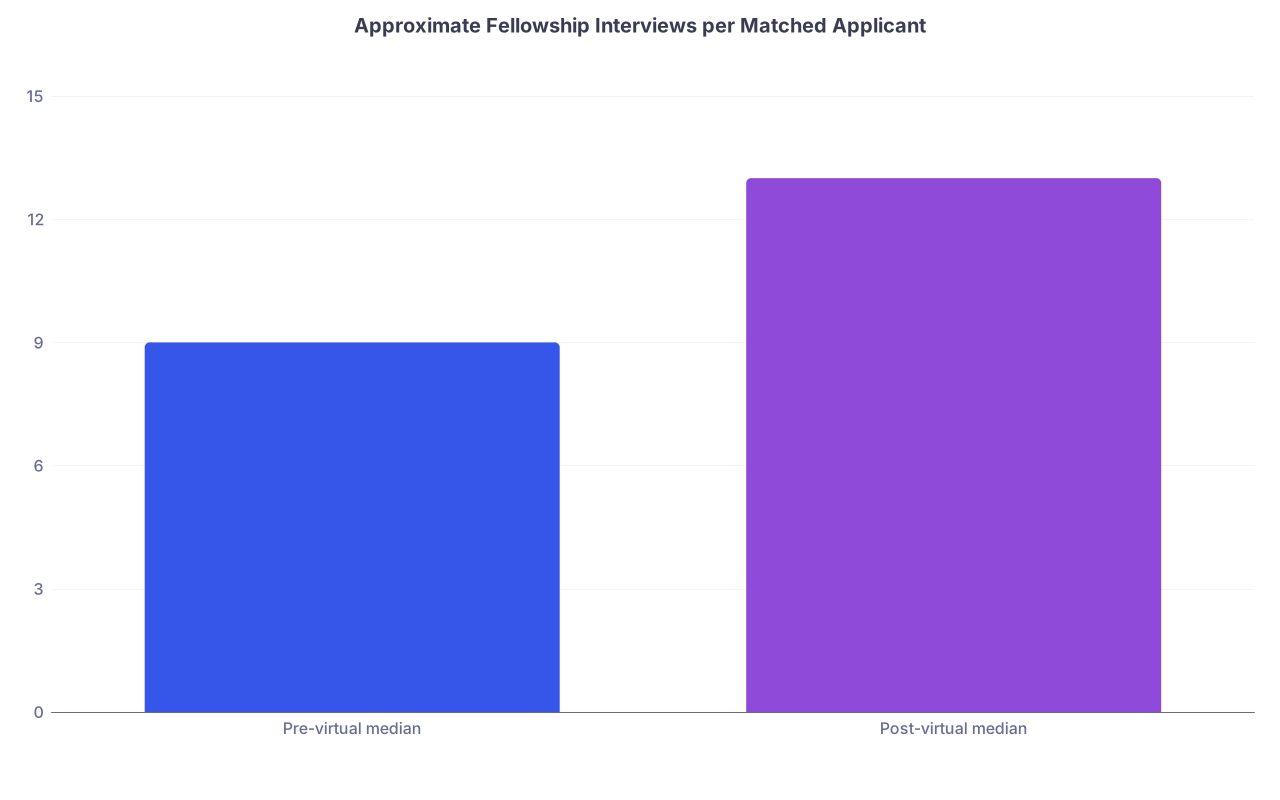
| Category | Value |
|---|---|
| Pre-virtual median | 9 |
| Post-virtual median | 13 |
Median interview counts jumped to the double‑digits in many specialties once people realized they could stack virtual days with minimal personal cost.
This is good for individual risk control. It is bad for system stability. The more interviews the top 30–40% of applicants accumulate, the more cancellations downstream. And the more chaos in who actually shows up where.
What This Means For Your Strategy as an Applicant
You cannot fix the entire market. But you can adjust your personal approach using the data.
1. Count “Committed Interviews,” Not Total Offers
Build a simple table for yourself:
- Column A: Program name
- Column B: Status (offered / accepted / cancelled)
- Column C: Probability you will actually attend (e.g., 1.0, 0.75, 0.5)
- Column D: Probability you will rank them in your match‑relevant top range (1.0, 0.75, 0.5)
Then calculate:
- Sum of Column C = “effective expected interviews”
- Sum of Column D = “effective expected rankable programs”
The shortfall is usually obvious. On day 1, that 12 probably becomes something like 7.5 effective.
Once you get that number above ~10 effective rankable programs in most IM subspecialties, you can safely start declining weaker options early. That is how you reduce the temptation for last‑minute cancellations.
2. Time Your Cancellations With Discipline
From observing multiple cycles, there are three “zones” of cancellation:
14 days before interview date: slots are often filled from waitlists, minimal damage
- 7–14 days: borderline; some programs can still recover, some cannot
- <7 days: often unrecoverable; the slot goes unused, faculty time is wasted, and this is when PDs start writing complaint emails
If you want to act rationally and not trash the pool for everyone else:
- Once you have crossed your “effective 10–12 rankable interviews” threshold, aggressively cancel lower‑priority interviews at least 10–14 days out
- If you are going to no‑show because of clinical disasters or true emergencies, tell them as early as you can. PDs talk; chronic ghosting gets remembered.
The data from internal GME dashboards is brutal. Late cancellations and no‑shows cluster heavily in the last week before the interview date. Programs consistently scramble to fill, mostly fail, and end up interviewing 4–6 people on a day built for 10–12.
What This Means For Programs (And Why Applicants Should Care)
You might not run a program. But understanding program behavior helps you interpret their actions.
1. Over‑Inviting Is Now the Default
Most programs have quietly increased:
- N_invites / N_positions ratio from ~6–7:1 to 8–10:1
- Number of interview days, or length of each day, to absorb uncertain show rates
Example: A 3‑position pulmonary/critical care program that historically:
- Invited 24–28 candidates
- Ended up with 18–22 actually interviewing
Now often invites 30–35 expecting that:
- 25–30 will schedule
- 18–22 will actually show
From your side as applicant: being invited does not necessarily mean you are “high on their list.” Some fraction of invites are pure buffers against cancellations. Stronger programs are explicit about this with their faculty, not with you.
2. Waitlists Are Real, And They Move
Because of cancellation spikes, many programs now maintain structured waitlists for interview dates. Some manage this well; some haphazardly.
The key point: a late‑October “sorry, we are full” email is not always a rejection. It often means:
- Their first‑pass over‑booking is full
- They know from experience that 20–30% of those will cancel
- They do not want to advertise “waitlist” explicitly
I have watched applicants go from “no interview offer by October 20” to “interviewed November 10” to “ranked and matched there” because cancellations opened spots.
So do not assume silence in mid‑October is fatal for all programs, especially in larger metro areas. Slots open. The chaos cuts both ways.
The Geographic and Specialty Skew: Who Gets Hurt Most?
Cancellation patterns are not evenly distributed.
From actual spreadsheets I have seen:
Urban, “brand name” programs:
- High volume of initial interest
- High cancellation rates once applicants secure even more prestigious or better‑fit options
- But deep waitlists that can backfill quickly
Regional / community‑based fellowships:
- Lower initial demand
- Modest cancellations by those who scheduled
- Less robust waitlists, so late cancellations hurt more and often stay unfilled
Result:
- Competitive applicants: enjoy optionality; use cancellation flexibility to optimize fit and prestige
- Borderline applicants: benefit when high‑tier programs lose candidates late and reach deeper into their lists
- Mid‑tier programs in less glamorous locations: bear the most structural risk of unfilled positions because their applicant pool is thinner and cancellation impact is proportionally larger

The hidden implication: instability in the interview market increases variance. Strong applicants might slide further up than expected. Some solid programs might occasionally go partially unfilled if they misestimate cancellation rates.
Quantifying the Match Risk Shift
Let us be concrete. Historical NRMP‑style guidance (simplified) for many internal medicine subspecialties:
- Rank 1–3 programs → maybe ~60–70% match probability
- Rank 4–6 → ~80–90%
- Rank 7–10 → ~95%+
Those curves assumed that programs’ rank lists were built off relatively stable, representative interview pools.
Now factor in:
- More over‑inviting
- More cancellations by high‑tier applicants at mid‑tier programs
- More programs slightly under‑ranking “risky” but high‑interest candidates because their sample is skewed
The probability curves flatten a bit and spread out. That is, for the same number of ranked programs you may experience:
- Slightly higher probability of matching “above expected level” if you are in the top quartile and interviewing widely
- Slightly higher probability of not matching with a small rank list if you are in the middle or lower quartiles, because programs’ lists are more erratic near the bottom
You cannot get perfect updated curves without full NRMP release for each subspecialty in the virtual era, but internal match reviews in several large IM departments show:
- Modest uptick in applicants with 5–7 ranked programs who failed to match
- Slightly more people with 10+ ranked programs landing at “stretch” programs
My interpretation: volatility increased. The ceiling rose a bit for some, the floor opened a bit for others. Interview cancellations are a major driver.
Practical Takeaways: What The Data Suggests You Should Actually Do
Compress all the above into concrete behaviors.
Aim for 10–14 serious, likely‑to‑rank interviews, not 20+ padded ones.
Once your effective rankable count (not just scheduled count) is near low double digits in most IM subspecialties, aggressive over‑booking stops giving you meaningful risk reduction.Decline earlier rather than cancel later.
If a program is clearly in your “bottom 10%” from the start, do not accept the interview unless your numbers are genuinely poor or extremely risky. Do not “hold it just in case” for a month and then cancel 3 days before.Treat each interview as potentially real—because it is.
Programs cannot predict who will cancel late. They still assign faculty, read files, and prepare. If you accept, act like you will show up unless new data meaningfully changes your risk calculation.Prepare for late invitations.
Build flex capacity in your schedule in October–November. Cancellations at big‑name institutions open slots that they will fill rapidly. Answer emails. Respond quickly.Be honest with yourself about fatigue and bandwidth.
Interview burnout is real. I have seen perfectly strong applicants torpedo interviews #13–15 because they were exhausted, distracted on service, and resentful. The marginal benefit of interviews beyond your 12th or 13th drops off quickly, especially if they are not clear “upgrade” programs.
The fellowship Match is not just about merit. It is about timing, logistics, and how cancellations rewire the pool beneath you.
You cannot control everyone else’s behavior. But you can control your own over‑booking, your cancellation timing, and how you interpret “I have X interviews” in a market where X is partially an illusion.
Use the numbers. Strip away the noise. Build to a solid base of truly viable interviews, cancel with discipline, and expect some late‑cycle volatility as other people’s cancellations ripple through the system.
With that mindset, you are better positioned to survive the chaos of this year’s interview season. The next step is turning those interviews into high‑yield rank list data points—but that calibration problem deserves its own, very intentional analysis.


