

Should I Delay Boards to Focus on Fellowship Interviews and Apps?
It’s late September. Your fellowship ERAS is in, interview invites are trickling (or flooding) in, and your in‑training exam or board date is circled on the calendar like a threat. You’re post‑call, your inbox is a mess, and your brain is running one question on loop:
“Should I push back boards so I can focus on fellowship interviews and applications?”
Here’s the answer you’re looking for: sometimes yes, often no — and you need a structured way to decide.
I’ll walk you through that decision like I would with a senior resident in my office, not like some vague Reddit thread full of “it depends” and no commitment.
Step 1: Get Clear on What’s Actually at Stake
You’re not choosing between “boards” and “fellowship” in the abstract. You’re choosing between:
- A fixed high‑stakes exam with financial and career consequences
vs. - A short, intense interview/application season that determines your subspecialty future.
Let’s make it concrete.
| Factor | Boards | Fellowship Interviews/Apps |
|---|---|---|
| Timeline Flexibility | Moderate | Low |
| Direct Career Impact | Certification, job eligibility | Subspecialty path, prestige, geography |
| Financial Cost of Failure | High (retake fees, lost income) | Moderate (missed match, reapp cycle) |
| Time Window | Can often reschedule within months | Fixed season, 1x per year |
Here’s my baseline view:
- If you are at real risk of failing boards, you favor boards.
- If you are solid for boards but at risk of tanking interviews, you favor fellowship season.
- The trick is being brutally honest about which bucket you’re actually in.
Step 2: Classify Yourself Into One of 3 Buckets
Be honest. No fantasy version of yourself.
Bucket 1 – “Board Risk Is Real”
You’re here if:
- You barely passed (or failed) an in‑service, Step/Level 2, or a prior board.
- Your last 4–6 weeks of practice questions are consistently below passing.
- Faculty you trust have said some version of, “You really need to lock in for boards.”
If that’s you, I’m blunt about this:
Do not sacrifice board prep for a “stronger” fellowship season.
Passing boards is a gatekeeper for almost everything you want later, including most fellowships and jobs.
In this bucket, delaying boards to after interview season is often the safer choice, as long as:
- Your specialty board allows a reasonable delay.
- Your program is on board with the new date.
- You make a real, scheduled plan for the new study block, not fantasy “future me will be less busy.”
Bucket 2 – “Borderline But Passable”
You’re not doomed, but you’re not cruising.
Typical signs:
- Question banks in the low‑to‑mid 60s and trending up.
- You’re on track but underprepared if interviews devour your time.
- You can pass if you protect 2–3 focused hours per day, most days.
Here, the decision is trickier. You have two legitimate options:
Keep your board date and ruthlessly structure your life.
- Limited number of interviews (you choose quality over volume).
- Protected study time daily, even on interview days.
- No heroic all‑nighters “catching up.”
Delay boards if your interview schedule is insane.
- 15–20+ interviews across multiple time zones.
- Heavy home call or ICU/ED rotations during that same window.
- A track record of underperforming when overextended.
In this bucket, I look at numbers: how many interviews, how many heavy weeks, and your current practice scores.
Bucket 3 – “Board Secure, Fellowship at Risk”
You’re here if:
- Historically strong test taker, high Step/Level scores, solid in‑service performance.
- Current question bank scores are comfortably above passing with a clear upward trajectory.
- You can likely pass even with a suboptimal last‑minute push.
For you, the answer is usually:
Do not delay boards. Instead, adjust interviews and expectations.
Your boards are not the real threat. Burnout, logistics, and a chaotic schedule are.
You:
- Trim low‑priority interviews.
- Schedule your exam at a sane time in the season (not peak week).
- Keep a lighter clinical rotation if possible in the 4 weeks around the test.
Step 3: Look at the Logistics (They Matter More Than You Think)
Everyone acts like this is purely academic. It’s not. The calendar rules your life here.
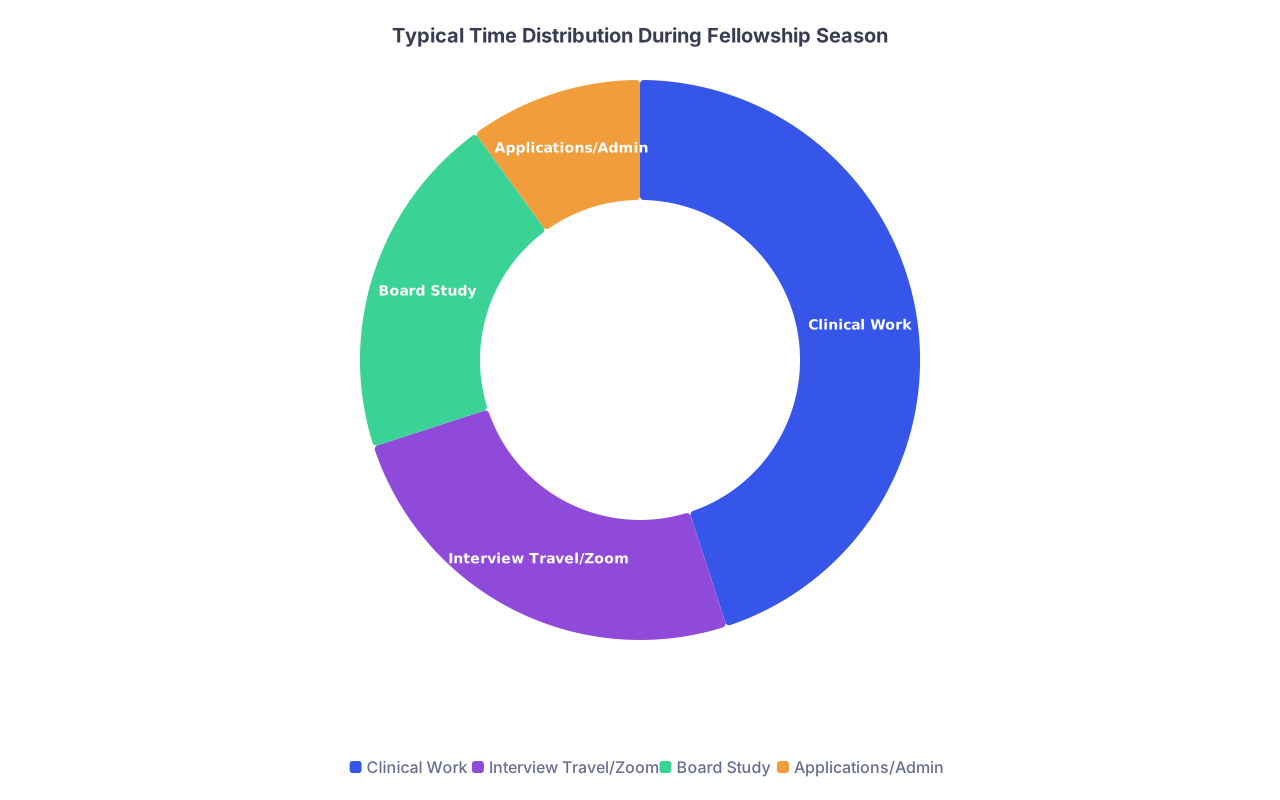
| Category | Value |
|---|---|
| Clinical Work | 45 |
| Interview Travel/Zoom | 25 |
| Board Study | 20 |
| Applications/Admin | 10 |
Ask these concrete questions:
What rotation are you on?
- ICU/Night float/ED + boards + interviews = bad plan.
- Elective/clinic/jeopardy = much more doable.
How many interviews do you realistically expect?
- For competitive fellowships (cards, GI, hem/onc), 10–15 interviews is common.
- If you’re tracking to 5–7, that’s very different from 18.
Are you traveling or mostly on Zoom?
- Zoom season is way easier to pair with board prep than 4 am airport runs and post‑red‑eye clinic.
What does your board window look like?
- Is there an exam date after the heaviest part of interview season and before your board eligibility expires?
- Can you move from October to January without messing up credentialing or graduation?
If the logistics scream “this is insane,” listen to them. That’s not weakness. That’s pattern recognition.
Step 4: Understand Program and Fellowship Perspectives
Programs care about two things here:
- That you pass boards on time.
- That you don’t embarrass them in the fellowship match.
Fellowships care that:
- You’re board eligible/certified on their timeline.
- You’re not an obvious burnout case by the time you arrive.
So how do they see delays?
- Reasonable delay with a plan: usually fine if communicated.
- Last‑minute panic reschedule after you’ve clearly not been studying: looks worse.
- Failing boards because you tried to do everything simultaneously and bombed the exam: that’s the nightmare scenario.
If you’re considering a delay, talk to:
- Your PD or APD
- A trusted faculty mentor in your target fellowship
Phrase it like this:
“I’m juggling boards and a busy interview season. My practice tests are at X–Y%. I’m considering moving my exam from [original date] to [new date] to lower the risk of failing. Does that sound reasonable from the program’s perspective?”
You’re showing judgment, not weakness.
Step 5: A Simple Decision Framework
Here’s the decision tree I’d actually use.

| Step | Description |
|---|---|
| Step 1 | Assess Board Risk |
| Step 2 | High board risk |
| Step 3 | Moderate or low risk |
| Step 4 | Delay boards to post interviews |
| Step 5 | Cut interviews, focus on boards |
| Step 6 | Trim interviews, keep exam or minor delay |
| Step 7 | Keep exam, maintain steady study |
| Step 8 | Practice scores near passing? |
| Step 9 | Can you delay exam? |
| Step 10 | Interview schedule heavy? |
Stripped down:
- High board risk + ability to delay → Delay boards, protect exam.
- High board risk + no ability to delay → Ruthless about interviews, boards come first.
- Low–moderate board risk + insane interview schedule → Trim interviews, possibly minor delay.
- Low board risk + manageable interviews → Keep exam as planned, structure your time.
Step 6: What “Focusing on Fellowship” Actually Means
Saying “I’ll delay boards to focus on fellowship” only makes sense if you actually do something with that reclaimed time.
Here’s what I mean by truly focusing on fellowship:
- Research your programs beyond the website blurbs. Actual notes.
- Prepare specific stories for behavioral questions (“Tell me about a time you…”).
- Practice tight, clear answers about:
- Your career goals
- Why this subspecialty
- Why this program specifically
- Keep up minimal clinical reading so you don’t sound rusty when cases come up casually.
Too many residents “delay boards” and then just…let the time evaporate into random charting, doom‑scrolling, and half‑baked prep. If you delay, the time must have a job.
Step 7: Scenarios and What I’d Actually Advise
Let’s run a few real‑world style scenarios.
Scenario 1 – IM Resident, Cards Fellowship, October Boards
- 62–65% on UWorld, trending slowly up.
- 14 interview invites across the country, most in October/November.
- You’re on wards in October, ICU in November.
What I’d tell you:
- Move boards out of the ICU month at minimum.
- If your board window allows January, I’d seriously consider delaying there.
- If it doesn’t, cut 3–5 lower‑tier interviews, protect 2 hours/day during October, and push to the latest possible October/early November exam date.
Scenario 2 – Peds Resident, Heme‑Onc Fellowship, Solid Tester
- Historically strong scores, 70%+ on question banks.
- 8–10 Zoom interviews, mostly half‑days.
- You’re on elective in the 3 weeks before boards.
What I’d tell you:
- Don’t delay boards.
- Treat each interview day like a light day, and study 1–2 hours before or after.
- Use elective weeks as a mini‑boot camp: 3–4 hours of questions per day.
Scenario 3 – Anesthesia Resident, Pain Fellowship, Bare Minimum Scores
- You failed your in‑training once.
- Current practice exams near or slightly below passing.
- 6–7 interviews, mostly local.
What I’d tell you:
- Boards first. Full stop.
- If possible, move exam after interviews to get a 4–6 week pure board block.
- If you can’t move it, you may need to cancel some interviews and aim to match next cycle rather than risk failing your boards.
Step 8: If You Decide to Delay — Do It Correctly
If you’re leaning toward delaying boards, do not half‑commit.
Do this:
- Confirm with your board and PD that the new date keeps you in good standing.
- Put the new exam date in writing and treat it like a contract, not a suggestion.
- Build a written weekly schedule for the months between now and that new date.
- Tell at least one co‑resident or mentor your plan so someone can call you out if you start drifting.
And for your own sanity: use some of that mental bandwidth to make your fellowship season excellent — not just “less frantic.”
Step 9: If You Decide Not to Delay — Protect Yourself
If you keep your original board date, you can’t wing it.
Non‑negotiables:
- Cap your interviews. You do not need 20.
- Lock in daily question time (even 60–90 minutes is powerful if consistent).
- Put “no‑study” days on the calendar (post‑call, brutal travel days) so you don’t feel constant guilt and burnout.
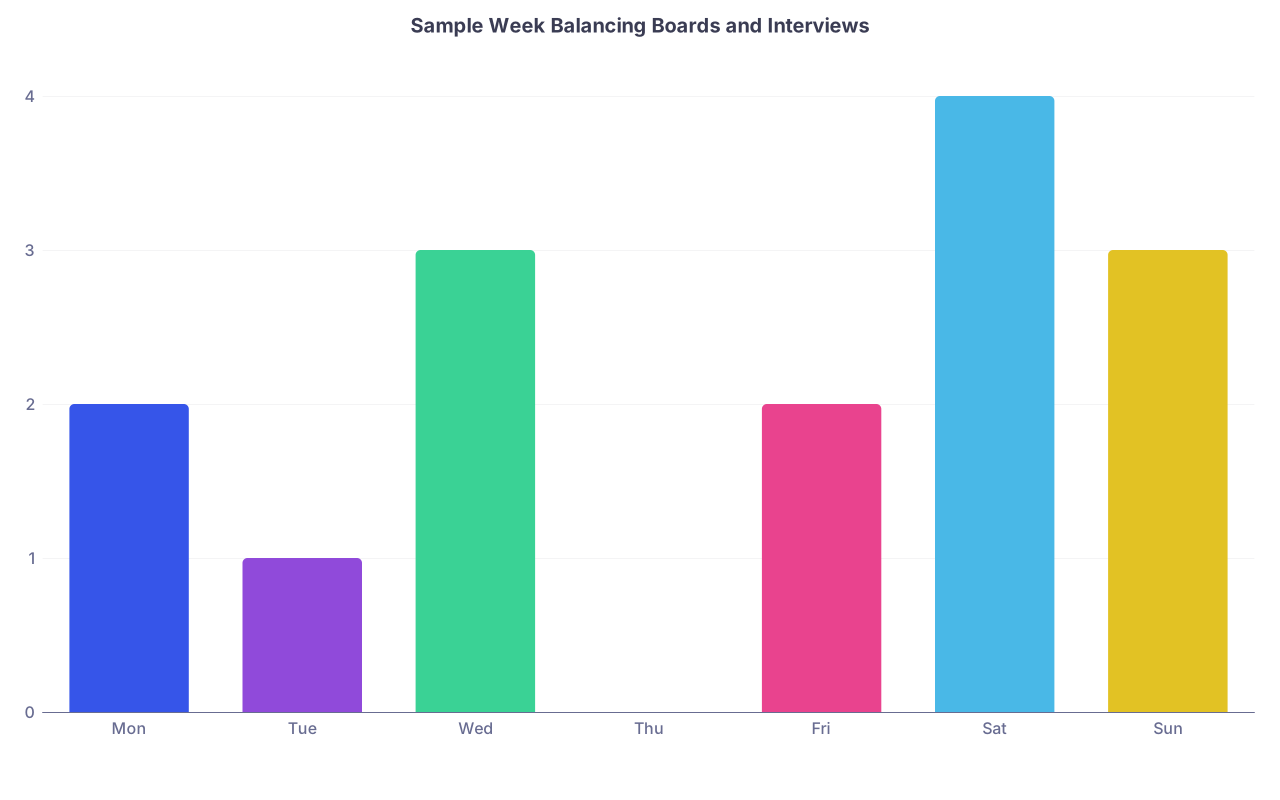
| Category | Value |
|---|---|
| Mon | 2 |
| Tue | 1 |
| Wed | 3 |
| Thu | 0 |
| Fri | 2 |
| Sat | 4 |
| Sun | 3 |
That kind of pattern — variable, realistic study hours — works far better than the fantasy of “5 hours every day” that never happens.
FAQ: Should I Delay Boards for Fellowship Season?
Will delaying boards hurt my fellowship chances?
No, not usually, as long as you remain board eligible on their start date timeline and you pass on the first attempt. Failing boards is far more damaging than a reasonable, explained delay. If asked, you frame it as a planned, thoughtful decision to maximize success, not as panic.What’s worse: failing boards once or matching a year later?
Failing boards once is worse, in my opinion, for long‑term credibility and stress. A delayed match is painful but recoverable and often forgotten. A board failure sits on your record and in your own head for years. If you must choose, protect the exam.How many fellowship interviews are “enough” so I can safely cut some to protect boards?
Depends on specialty and your competitiveness, but a common pattern: for most internal medicine subspecialties, 10–12 solid interviews give a very high chance of matching. For less competitive fields or very strong applicants, 6–8 can be enough. Talk to recent grads from your program; their numbers are more accurate than anonymous forums.Does a strong board score actually help my fellowship chances?
At the application stage, yes, a strong score can help, mainly as another signal of competence. But once interviews are offered, how you interview, your letters, and your fit matter far more than the difference between a “good” and “great” board score. Passing cleanly is more important than squeezing out an extra few percentile points.Should I do interview prep or board prep on post‑call days?
Neither, if you’re truly wrecked. Post‑call “studying” is usually low‑yield and reinforces burnout. Better move your serious cognitive work to non‑post‑call days and use post‑call for rest, light review (flashcards, skimming), or nothing at all. Protecting your brain’s bandwidth is part of actually passing the exam and interviewing well.How early should I bring this up with my program director if I’m considering delaying boards?
As soon as you’re seriously considering it — ideally 2–3 months before your exam window. Programs hate last‑minute chaos. If you walk in with practice scores, a proposed new exam date, and a clear plan, most PDs will respect that and work with you. Do not wait until you’re two weeks out and melting down.
Here’s your actionable next step:
Open your most recent board practice score report and your interview calendar side by side. Circle the 4–6 weeks around your planned exam date. Then answer, in writing, one question: “Am I more likely to fail this exam or to underperform on a few interviews?” Your honest answer should drive whether you move the test, cut interviews, or keep the plan and double down on structure.


