
You absolutely can ask additional questions in your thank‑you email—what’s annoying is doing it the wrong way.
Let me be blunt: Programs do not get irritated because you asked a thoughtful, brief follow‑up question. They get irritated because you sent a wall of text, tried to re‑interview yourself over email, or pushed them for information they legally cannot give you.
If you learn the difference, you’ll stop overthinking this and start writing thank‑yous that actually help you.
The Core Answer: Yes, But With Rules
Here’s the direct answer you’re looking for:
You can ask 1–2 concise, genuine questions in a thank‑you email after a residency interview. It is not annoying if:
- The email is short (think 5–10 sentences total).
- The questions are specific and clearly relevant.
- You’re not asking about stuff they already covered or that’s easily found online.
- You’re not asking them to break NRMP rules or give you a commitment.
Programs see hundreds of thank‑you emails. The ones that quietly irritate them fall into a few predictable buckets: too long, too demanding, too needy, or clearly copy‑pasted.
Your goal: short, appreciative, and one clear, purposeful question if you truly need the answer.
When It’s Smart to Ask Additional Questions
Follow‑up questions in a thank‑you make sense when they:
- Clarify something directly discussed in your interview.
- Help you make a realistic decision about how to rank a program.
- Ask for specific resources or contacts, not special favors.
Examples of good reasons to ask:
- You forgot to ask about a track/subspecialty you’re seriously considering (e.g., a clinician‑educator track, global health, research pathway).
- You want clarification on call schedule, off‑service experiences, or location logistics that were mentioned but not fully explained.
- You were told, “Reach out if you want to connect with a resident who did X,” and you’re following through.
This is where a single, well‑aimed question actually makes you look engaged and thoughtful.
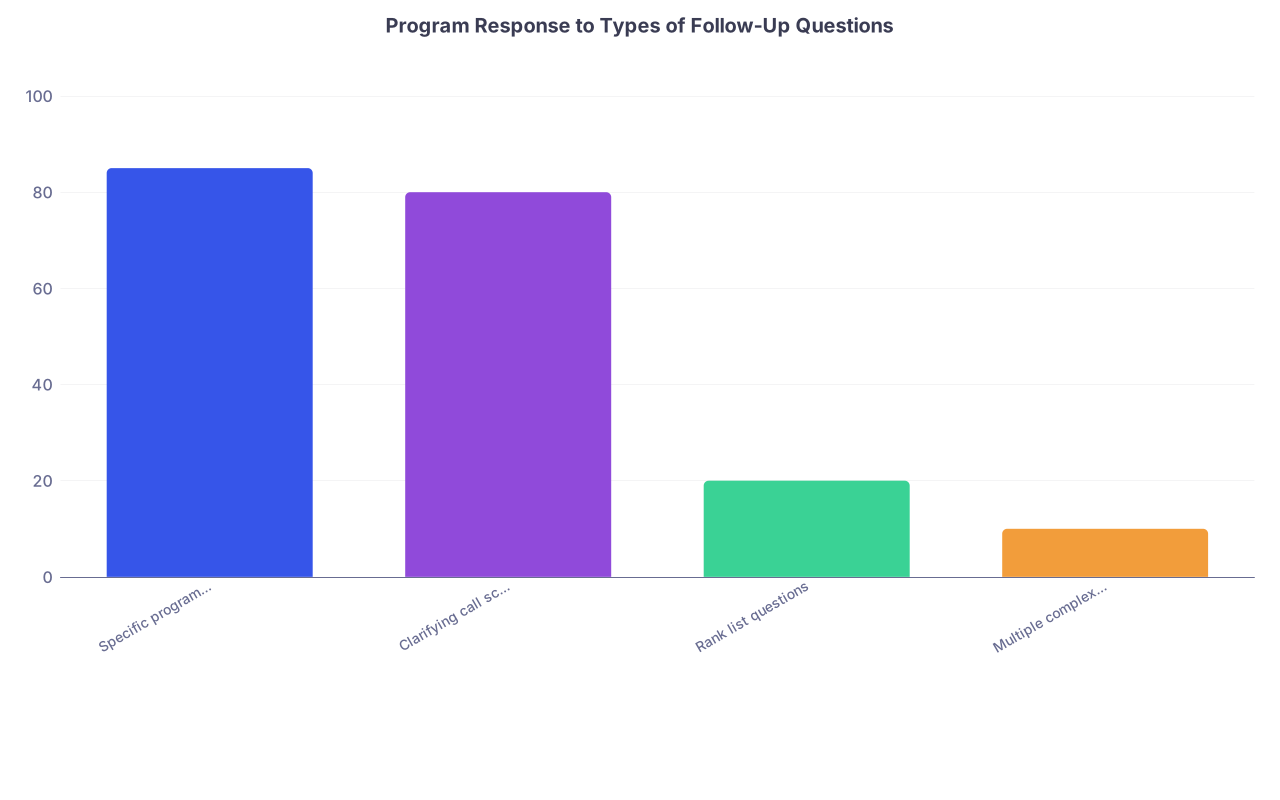
| Category | Value |
|---|---|
| Specific program detail | 85 |
| Clarifying call schedule | 80 |
| Rank list questions | 20 |
| Multiple complex questions | 10 |
- “Specific program detail” → Often seen as good engagement.
- “Clarifying call schedule” → Normal and acceptable.
- “Rank list / ‘Where do I stand?’” → Mostly unwelcome.
- “Multiple complex questions” → Where you slide into annoying.
When Your Question Crosses the Line
What is annoying? Three main things.
1. Turning a thank‑you into a second interview
If your email looks like this:
Thank you so much…
I had a few quick questions:
- How many residents match into cards vs GI each year?
- What percentage of residents present posters?
- How is moonlighting handled?
- How do rotations change between PGY‑1 and PGY‑2?
- How much one‑on‑one time do residents have with faculty?
You did too much. That belongs in:
- A follow‑up message to the coordinator asking to connect with a chief/resident, or
- A pre‑interview Q&A or second look, not a “thank‑you” email.
Rule: Your thank‑you is not a survey.
2. Fishing for rank‑list information or commitments
Programs hate this one, and it puts them in an awkward spot.
Examples of bad questions:
- “Will I be ranked to match if I rank you highly?”
- “Where do I stand compared to other applicants?”
- “Do you think I’m a competitive candidate for your program?”
- “If I rank you #1, can you tell me if I’m likely to match?”
These are either NRMP‑sensitive or just uncomfortable. They won’t answer, and you’ll come across as naive at best.
3. Asking for easily available information
If the answer is on:
- Their website
- Their FREIDA listing
- The slide deck they emailed
- Or covered in the Q&A session
…do not ask it again in a faculty thank‑you email.
That’s the stuff where I’ve heard PDs say, “They clearly weren’t paying attention,” or “They didn’t bother reading what we sent.”
If you genuinely missed it, ask the coordinator or a resident, not the PD or faculty you’re thanking.
How to Structure a Thank‑You Email With a Question (Templates)
Here’s the basic structure that works 99% of the time:
- Short thank‑you.
- One specific thing you appreciated or learned.
- One clearly stated question (if you have one).
- Brief closing line.
Template for a PD or faculty thank‑you with one question
Subject: Thank you – [Your Name], [Specialty] interview on [Date]
Dear Dr. [Last Name],
Thank you again for taking the time to speak with me during my interview at [Program] on [Day]. I appreciated our discussion about [specific topic—teaching culture, patient population, research, etc.].
I did have one brief follow‑up question: [1–2 sentence question, max].
I remain very interested in [Program] and am grateful for the opportunity to interview.
Sincerely,
[Your Name]
[Medical School]
Examples of clean, non‑annoying questions you could drop into this:
- “You mentioned a clinician‑educator track for interested residents. Is that something residents usually enter during PGY‑2, and is there a set application process?”
- “You briefly referenced a global health elective your residents do in PGY‑3. Is that built into the schedule or something residents apply for separately?”
- “You noted that interns get some time in the ICU. Is that a full rotation or a partial month, and does it happen early in the year?”
Short. Specific. Answerable in one or two sentences.
Who To Ask Which Kind of Question
Part of not being annoying is sending the question to the right person.
Here’s how to think about it:
| Question Type | Best Person to Email |
|---|---|
| Schedule / logistics | Program coordinator |
| Call schedule / workload feel | Current resident / chief |
| Research specifics / mentorship | PD or research director |
| Fellowship match outcomes | PD or chief resident |
| “Where do I stand?” / ranking | Ask no one |
If your question is more “What’s it actually like?” than “What’s officially required?”, aim it at residents, not attendings.
You can do that in a thank‑you by asking for a connection rather than peppering the PD:
“If possible, I’d appreciate being connected with a current resident who’s involved in [X], as I’m strongly interested in that during residency.”
That is not annoying. That’s actually very normal.
Timing and Volume: How Much Is Too Much?
A few simple rules keep you on the safe side.
Timing
- Send thank‑you emails within 24–72 hours of your interview.
- Asking a question in that window is fine; it’s still “fresh.”
- If a new, important question comes up weeks later, skip the thank‑you format and email the coordinator or a resident instead.
Volume
- One email per interviewer.
- One question max per person.
- If you have multiple questions, you:
- Ask the most critical one in the PD email, and
- Ask the coordinator to connect you with a current resident for the rest.
If you’re writing to the PD, the APD, three faculty, and two residents, every single one with “a couple of quick questions”… yes, that’s annoying.
Examples: Good vs. Annoying Thank‑You Questions
Let me show you the difference clearly.
Internal medicine example
Good:
“During our conversation, you mentioned that interns get early autonomy in managing their own patient lists. Could you share roughly how many patients an intern typically carries on the wards at the start of the year versus later on?”
Annoying:
“Could you describe the exact cap for interns and seniors on each rotation and how that’s evolved over the last few years, and how it compares to other programs in the region?”
The first is an easy, high‑yield answer.
The second is a mini‑project.
Surgery example
Good:
“You spoke about the high operative volume for juniors. Is there a dedicated skills lab curriculum that accompanies that experience, or is most teaching intraoperative?”
Annoying:
“Can you send me a breakdown of average case numbers per resident by PGY year across the main categories (lap chole, hernia, colectomy, etc.)?”
Again, one is a quick reply; the other is a data request that belongs in a recruitment packet, not in a thank‑you.
How Programs Actually Perceive Follow‑Up Emails
Here’s what I’ve heard, sitting with PDs and chiefs after interview days:
- “Short and specific is fine. I reply when I can.”
- “I answer genuine questions; I ignore 3‑paragraph essays.”
- “The people who send mass, identical emails to every faculty… we can tell.”
- “Thank‑yous don’t move you from ‘maybe’ to ‘yes,’ but they can nudge you from ‘we liked them’ to ‘we remember them.’”
Your thank‑you will almost never rescue a terrible interview. But a clean follow‑up with one good question can:
- Reinforce your interest.
- Clarify something that actually affects your rank list.
- Make you stand out slightly in a good way.
That’s enough. You’re not writing a legal brief.

| Step | Description |
|---|---|
| Step 1 | Had interview |
| Step 2 | Do nothing |
| Step 3 | Draft short email |
| Step 4 | Send simple thank-you only |
| Step 5 | Add 1 concise question |
| Step 6 | Send email |
| Step 7 | Want to send thank-you? |
| Step 8 | Have 1 real question? |
Quick Decision Rules You Can Actually Use
If you’re staring at your draft wondering whether the question is “too much,” run it through this checklist:
- Can they answer this in 1–2 sentences?
- Is it directly relevant to my decision to rank them?
- Did we touch on this topic during interview day?
- Is this information not already public or in their materials?
- Am I asking only one question in this email?
If you can honestly say yes to 3–4 of those, you’re probably fine.
If your question is about:
- Your competitiveness
- Where you stand
- Whether you’ll match if you rank them highly
- Or anything that smells like a “deal”
Delete it. That’s what gets silently judged.
FAQ: Asking Questions in Thank‑You Emails After Residency Interviews
1. Will asking a question in my thank‑you hurt my chances?
No, not if it’s brief, relevant, and professional. Programs are not docking you for one thoughtful question. They roll their eyes at needy or high‑maintenance behavior, which usually shows up as long, demanding emails or constant follow‑ups—not one clean question.
2. What if I genuinely have several important questions?
Do not dump them all into one faculty thank‑you. Ask one key question in your PD email if needed, then email the coordinator asking to be connected with a current resident for a more in‑depth conversation. Residents expect and handle those longer, “what’s it really like?” questions.
3. Is it better to send a thank‑you with no question at all?
If you’re forcing a question just to sound engaged, skip it. A simple, specific thank‑you (“I appreciated our discussion about X and Y”) is perfectly fine. The worst version is a fake‑sounding, generic question that could have been answered by Google.
4. Should I send different questions to each interviewer or the same one?
Different. Copy‑pasting the same question to every faculty member looks lazy and transparent. Tailor each thank‑you to something you actually discussed with that person. If you don’t have a natural question for them, do not invent one—just thank them and move on.
5. What if they never respond to my question?
That’s normal. PDs and faculty are busy, and email replies are inconsistent. Their silence does not mean they disliked you. If it’s genuinely important, you can follow up once with the coordinator or ask a resident instead. Do not send multiple nudges to the same faculty member.
Key takeaways:
You can absolutely include one thoughtful, concise question in a residency thank‑you email. Keep the email short, the question specific and answerable, and avoid anything about your rank status or competitiveness. When in doubt, thank them sincerely, ask nothing, and protect your energy for the rank list that actually matters.