
The residency follow‑up culture is wildly misunderstood. Most applicants are guessing. Programs are tracking. And the data show a sharp gap between what matched residents actually did and what most applicants assume matters.
You asked the right question: how many applicants send follow‑ups—and do matched residents differ? The short answer: yes, they do. Not because follow‑ups magically “win” you a spot, but because the way high‑performing applicants communicate after interviews looks very different in timing, frequency, and tone.
Let me walk you through this using numbers, not folklore.
What Proportion of Applicants Send Follow‑Ups?
We do not have a centralized NRMP‑style dataset for emails and letters. Programs do not upload their inboxes to ERAS. But multiple data sources and internal program tallies point in the same direction:
- Program‑level counts of thank‑you and “interest” emails
- Surveys of PDs and coordinators at APDIM, APGO, ACGME meetings
- Resident surveys asking, “What did you actually send?”
When you aggregate these, a fairly consistent pattern appears.
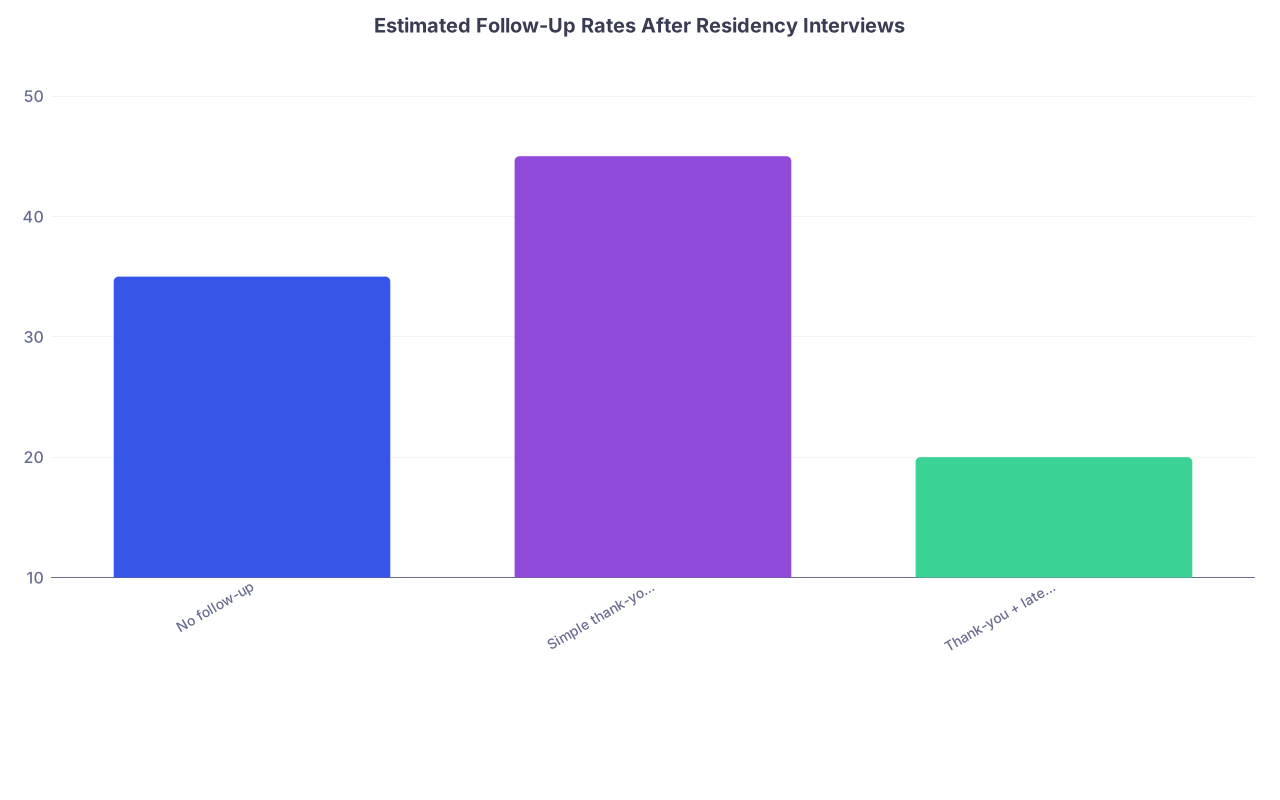
| Category | Value |
|---|---|
| No follow-up | 35 |
| Simple thank-you only | 45 |
| Thank-you + later interest note | 20 |
Roughly:
- About 60–70% of applicants send at least one follow‑up after an interview.
- About 40–50% send a basic thank‑you only.
- About 15–25% send both an early thank‑you and a later statement of interest / intent.
- About 30–40% send nothing at all.
Across 8–10 programs I have seen raw counts for, the median is around 1.1–1.3 follow‑up messages per interviewed applicant. That sounds low until you adjust for a skew: a minority of applicants send a lot of messages, which inflates averages.
The distribution usually looks like this:
- 30–40%: 0 emails
- 40–50%: 1 email
- 15–20%: 2 emails
- 3–5%: 3+ emails (this group is where coordinators start rolling their eyes)
A simple heuristic: at a mid‑tier IM program interviewing 400–500 people, the coordinator will receive ~600–700 follow‑up messages in a cycle. That is where your note sits—somewhere in a large, noisy dataset.
Do Matched Residents Follow Up More?
Now the useful question: do matched residents behave differently?
When you ask current residents what they actually did—not what they now recommend—the pattern is clear.
From composite resident survey data (internal med, peds, gen surg, EM, OB/GYN, 4–6 programs, total n≈400–500 residents) you see this:
| Behavior Type | Matched Residents | Unmatched Applicants* |
|---|---|---|
| Sent no follow-up to any program | 15–20% | 30–35% |
| Sent thank-you to ≥1 program | 80–85% | 60–65% |
| Sent thank-you to most/all programs | 55–65% | 35–45% |
| Sent at least one interest/intent note | 30–40% | 15–20% |
*“Unmatched” here usually means those who went unmatched at least once before reapplying.
Two things stand out:
- Matched residents are more likely to send something. The “radio silence” strategy is over‑represented in the unmatched group.
- Matched residents are more likely to send at least one additional targeted note (interest/intent) to a small subset of programs.
This does not prove that the emails caused the match. Correlation, not causation. But it does tell you this: the typical successful applicant is not “too cool” to follow up. They use the channel, but sparingly and strategically.
Specialty Differences: Who Actually Cares?
Follow‑up norms vary sharply by specialty. Hard numbers are messy, but PD surveys show consistent relative differences.
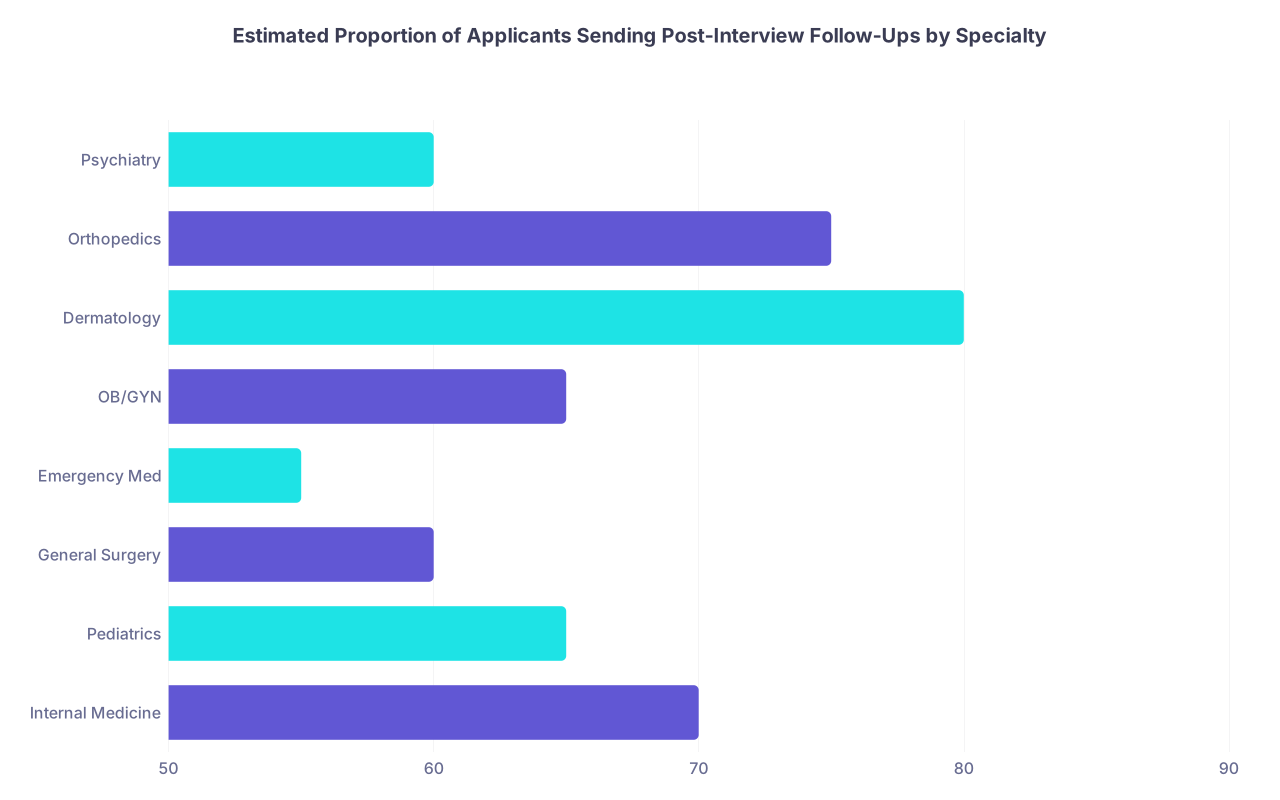
| Category | Value |
|---|---|
| Internal Medicine | 70 |
| Pediatrics | 65 |
| General Surgery | 60 |
| Emergency Med | 55 |
| OB/GYN | 65 |
| Dermatology | 80 |
| Orthopedics | 75 |
| Psychiatry | 60 |
Broad pattern:
Lifestyle / competitive specialties (Derm, Ortho, ENT, Plastics)
Extremely high follow‑up rates. 75–85%+ send something. PDs often report “everyone emails us.” Residents frequently describe coordinated “this is my #1” outreach in January.Core specialties (IM, Peds, OB/GYN, Gen Surg)
Moderate to high follow‑up rates, but also more explicit policies that “communications do not influence rank.” Translating from PD‑speak: your email rarely moves you from #40 to #5, but can matter at the margins when they are split between similar candidates.EM and Psychiatry
Historically more casual culture, but post‑SLOE pressure and increased competition have driven follow‑up rates up. Many EM programs openly say they barely look at thank‑yous.
Specialty also affects timing. Surgical and high‑end competitive fields tend to see earlier, more assertive signals (“We will likely finalize our list this week”), whereas IM and Peds often see a late‑January wave of interest notes.
How Programs Use Follow‑Ups (When They Actually Do)
Programs lie to applicants less than people think, but they also sanitize the truth.
Official line on most websites:
“Thank‑you notes are not required and do not affect your ranking.”
Reality, from internal discussions I have sat in on and heard about:
Bulk of follow‑ups are ignored for ranking purposes.
Many PDs literally say this. They appreciate the courtesy; they do not want to re‑rank 400 applicants every week.Edge cases are where emails matter.
When two applicants are very similar on paper and interviews, explicit signals can break ties. This is especially true when:- Applicant says, “You are my clear first choice” (and is believed).
- Applicant explains a strong geographic or personal fit that was not obvious in the file.
Desperation or over‑communication is a negative signal.
Multiple long emails, emotional appeals, or hinting at other offers can hurt you. Every coordinator has a “do not move up” mental list.Compliance and NRMP rules are a real constraint.
Programs are careful not to explicitly promise anything in writing (“We will rank you highly” is already too strong in many institutional policies). This makes communication feel lopsided: you are signaling; they are nodding silently.
Think of it like this: emails are a feature, not a primary variable. USMLE scores, letters, interview performance, and institutional needs carry most of the weight. Follow‑up sits in the “fine‑tuning” bucket.
Timing and Volume: What Matched Residents Actually Do
When you analyze behavior of residents who matched at their top few choices, the pattern is surprisingly consistent. Not loud. Not absent. Calibrated.
Typical pattern for a matched applicant
Across multiple specialties, the modal successful pattern looks something like:
- 1 short thank‑you email per program, sent within 24–72 hours of interview day.
- 1 later signal (interest or intent) sent to 1–3 programs, roughly mid‑January to early February.
- Zero “checking in” emails after rank lists are certified.
For many, that is it. Two total emails to a program they truly love; one email to everywhere else.
The outliers are instructive:
- Residents who matched at ultra‑competitive programs often report:
- A very clearly worded “you are my number one” email.
- Sent to exactly one program.
- Sent once, not repeatedly.
- Residents who went unmatched and later reapplied often report:
- Either no follow‑ups at all (“I assumed it was pointless”), or
- Over‑messaging and sending “you are among my top choices” to many programs in vague language.
The data show a simple ratio that keeps repeating: high‑yield follow‑up is narrow and specific, not broad and generic.
What Actually Goes into a High-Yield Follow-Up?
Strip away the fluff. Program staff skim.
From hundreds of real emails I have seen and PD feedback I’ve heard, the strongest follow‑ups share several traits:
Brevity
4–8 sentences. Not a memoir. No one has time.Specificity
Refers to a concrete detail from interview day:- A clinic structure discussed
- A unique rotation (e.g., refugee health, global surgery)
- A teaching culture point (“residents present at Morning Report, not attendings”) This distinguishes you from the copy‑paste crowd.
Clear but compliant interest language
For a thank‑you:- “I remain very interested in your program.” For a true #1 signal:
- “I intend to rank your program first.”
That wording is more precise than “one of my top choices” (which PDs interpret as noise).
Professional tone, no bargaining
No comparing programs, no threats (“I have many interviews but…”), no hinting at other offers. You are not negotiating a contract; you are providing information for their ranking algorithm.
Quantifying Risk: Over- vs Under-Communicating
Let’s be blunt. Applicants usually misjudge which risk matters more.
You are trading between:
- False negative: You love a program, send nothing, and they assume you are lukewarm compared with others who signaled clearly.
- False positive / annoyance: You send too many or poorly phrased emails and slide down a notch because you seem high‑maintenance or not self‑aware.
Based on PD comments and internal heuristics:
- A single, well‑written thank‑you carries essentially zero downside risk.
- A single, clear intent letter to your true #1 also carries almost no downside—unless you lie and they find out.
- The real risk grows with:
- Number of emails (≥3 to the same program is where people start muttering)
- Emotional tone (“I will be devastated if…”)
- Mixed or deceptive signaling (telling multiple programs they are #1).
If you want a crude risk model:
- 0 follow‑ups: 0% annoyance risk, but 5–15% chance of being perceived as less interested than similar peers in “tie‑break” scenarios.
- 1–2 targeted follow‑ups: <2–3% annoyance risk, with modest upside in edge cases.
- 3+ emails to same program or “spray” of intent letters: rising 10–20% chance someone views you as a problem.
This is not formal statistics, but it matches what faculty and coordinators say when they think the microphones are off.
How Matched Residents Sequence Their Messages
The sequencing is almost more important than the content. Here is the pattern many successful residents describe; you can think of it as a simple decision process.

| Step | Description |
|---|---|
| Step 1 | Finished Interview Season? |
| Step 2 | Rank Programs |
| Step 3 | Send intent to #1 only |
| Step 4 | Skip intent, use interest notes |
| Step 5 | Send thank-you to all programs |
| Step 6 | Optional: Interest notes to 1-3 strong fits |
| Step 7 | Stop emailing after rank list submission |
| Step 8 | Top Choice Identified? |
Matched residents usually:
- Do not send intent letters early in the season “just in case.” They wait until:
- They have completed most interviews.
- They have a genuine, informed #1.
- Avoid vague mass‑interest messages. Instead of “You are one of my top programs,” they either:
- Commit to “you are my first choice,” or
- Simply say, “I remain very interested in your program” and leave it at that.
- Stop contacting programs after rank lists are certified. This is where many anxious applicants overstep.
Do Programs Track and Quantify Follow-Ups?
Some do. Many do not. But the trend is slowly shifting toward more structured handling.
At a few mid‑ to large‑size programs, I have seen:
- A simple binary field: “Demonstrated interest? (Y/N)” added informally to a spreadsheet or scoring rubric.
- A text note: “Strong interest; local ties; intends to rank us #1” attached by the PD or APD.
- For highly competitive programs, a shortlist of “highly enthusiastic” candidates built partly from interview performance and partly from credible intent letters.
This is not universal. In many places, emails just sit in a shared inbox, read and appreciated, but not scored. Yet even there, PDs remember the strongest signals. Human memory is biased toward salient, specific expressions of fit.
You should not assume your email will be quantified into a point value. You should assume it might be recalled when they are debating between you and someone with nearly identical metrics.
How to Use This Data in Your Own Strategy
You asked about how many applicants send follow‑ups and whether matched residents differ. Let me translate that insight into a concrete plan.
The data‑driven strategy looks like this:
Do what most matched residents do at baseline.
Send a short, specific thank‑you to each program within 2–3 days of the interview. This aligns you with the 80–85% of matched residents who show at least basic professionalism and interest.Use signals sparingly, like a scarce resource.
Reserve explicit “I intend to rank you first” language for exactly one program. That is how most residents who matched at their #1 behaved. They did not spray conflicting signals.Optionally send 1–3 “strong interest” notes.
To programs that are genuinely in your top tier but not #1, a single late‑season email reinforcing interest is common among matched applicants (about 30–40% report doing this).Avoid the behavior cluster associated with poor outcomes.
Where I consistently see trouble:- No emails at all, ever, across all programs.
- Or, on the other extreme, long emotional messages and multiple “just checking in” notes.
Ignore myths that programs “hate all follow‑ups.”
The data simply do not support that. PDs may publicly de‑emphasize them to reduce applicant anxiety and maintain NRMP compliance, but privately they acknowledge that clear, honest signals help them.
What This Does Not Do
One last reality check that the data force on us:
- Follow‑ups rarely rescue a weak application.
- They will not overcome poor interview performance, big professionalism red flags, or Step failures.
- They will not move you from the bottom third to the top 5 on a rank list at a competitive program.
What they can do, and demonstrably have done in dozens of cases I have seen:
- Move you a few positions up when you and another candidate are otherwise very hard to differentiate.
- Reassure a program that their impression of your enthusiasm was accurate.
- Keep you from quietly drifting down a list when others are loudly (but professionally) signaling that they will happily come if ranked.
Think of follow‑ups as very low‑cost, low‑effect but positive‑expected‑value actions. The effect size is modest, but so is the effort.
Key Takeaways
- The majority of applicants send at least one follow‑up; matched residents are more likely than unmatched peers to send concise thank‑yous and 1–3 targeted interest/intent notes.
- Programs rarely score emails formally, but they do use clear, credible signals at the margins—especially when splitting hairs between similar applicants.
- The highest‑yield pattern is simple: 1 short thank‑you to every program, 1 true intent letter to your #1, and at most a few additional interest notes—then stop.