
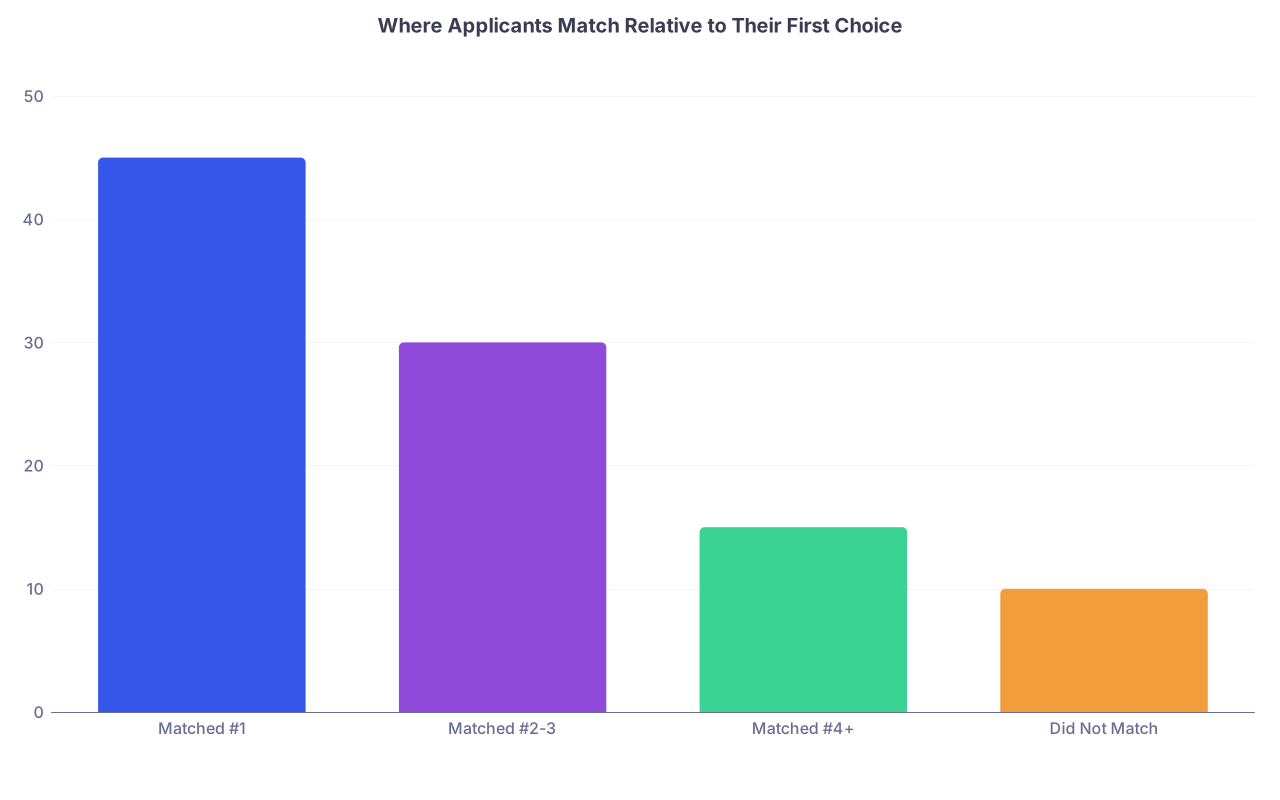
Only 11% of applicants actually match at the single program they “love the most” on their rank list.
Let that sink in before you agonize over whether it’s “unethical” to tell more than one program you’re very interested.
The culture around residency “love letters,” post-interview emails, and signaling interest is a mess of half-truths, folklore, and fear. You’re told one minute that programs do not care what you write; the next minute, that one wrongly worded email could get you reported to the NRMP police.
Here is the blunt version: done correctly, it is not unethical to signal strong interest in more than one program. What’s unethical is lying about your rank list or making explicitly conflicting promises. Everything else is strategy, psychology, and noise.
Let’s strip this down to what the rules, the data, and actual program behavior show.
What the NRMP Actually Cares About (Not Your Feelings)
The NRMP cares about one thing in this space: coercion and fraud around rank lists.
Their Match Participation Agreement is surprisingly narrow. The key ethical boundaries are:
- You cannot promise to rank a program first if you are not actually doing that.
- A program cannot demand a commitment (verbal or written) in exchange for ranking you a certain way.
- You cannot coordinate with other applicants or programs to rig outcomes.
That’s the line. Not “you can only be in love with one program.” Not “you must never say you’re very interested in more than one place.” The NRMP is not the feelings police.
What is explicitly prohibited is saying, “You are my #1 and I will rank you first,” and then ranking someone else first. That’s a misrepresentation tied to the formal process.
On the other hand, saying “I remain very interested in your program and I could see myself training here” to five different programs? That’s not a violation. That’s Tuesday.
The NRMP’s own statements back this up. They repeatedly emphasize:
- You may express interest to programs.
- You are not required to tell any program how you will rank them.
- If you do choose to tell a program they’ll be ranked first, it should be true.
Everything else is moral panic and rumor.
Where Applicants Get Twisted: Words vs. Implications
The ethical mistake is not “showing interest in multiple programs.” It’s using language that implies an exclusive promise when you don’t intend one.
I’ve seen this play out every year:
- Applicant A writes: “You are my top choice and I will rank you #1.”
- Applicant B writes: “I remain extremely interested in your program and think it is an excellent fit for my goals.”
Applicant A then panics a week later after a great second-look elsewhere and flips their rank list. Now you’ve walked into the only real ethical landmine: you misrepresented your final rank order to a program in writing.
Applicant B? Completely fine. They told the truth. They’re extremely interested in several places. That’s normal. That’s how the Match works.
The obsession with being “ethical” gets weaponized into this weird purity test where people think they must:
- Pick a “soulmate” program in January.
- Pledge eternal loyalty in an email.
- Feel guilty for liking more than one option.
That’s romantic nonsense, not ethics.
You are allowed to genuinely like multiple programs. You are allowed to say so. You are allowed to rank them however you want later.
What Programs Actually Pay Attention To
Here’s the part nobody likes to admit: most programs are not sitting around in February dissecting the adjectives in your thank-you email.
Post-interview contact tends to fall into three categories from the program side:
Completely ignored
Many PDs and coordinators barely skim these messages. There’s too much volume, too little signal.Mildly noticed, rarely decisive
A sincere, specific note may nudge the “tie-breaker” conversation. But it’s not moving someone from the bottom third to the top of the rank list.Red-flagged if obviously manipulative
This is where people get burned. Over-the-top praise, obvious copy-paste, or clearly conflicting promises (yes, they sometimes talk) can make you look disingenuous.
The NRMP data is clear on one major point: applicants overestimate how much post-interview communication changes rank lists. Programs care far more about:
- Interview performance
- Letters of recommendation
- Clinical performance
- Fit with the program’s needs (and yes, that includes vibes)
Post-interview emails are, at best, seasoning. Not the main dish.
So no, signaling strong interest in more than one place does not make you unethical. It makes you realistic. Because statistically, you are not matching at “the one true love” most of the time.
| Category | Value |
|---|---|
| Matched #1 | 45 |
| Matched #2-3 | 30 |
| Matched #4+ | 15 |
| Did Not Match | 10 |
Look at that distribution and tell me with a straight face that it’s “unethical” to keep doors open.
The Real Question: What’s Honest vs. What’s Dumb?
Skip the fake moral dilemma. Here’s the real breakdown.
Honest and ethical:
- “Your program is one of my top choices.”
- “I remain very interested in training at your institution.”
- “I was particularly impressed by X and feel I’d be a strong fit here.”
Still honest, but more specific — and now you’re committing:
- “I plan to rank your program very highly.”
- “Your program will be at the top of my list.” (Ambiguous but suggestive)
Ethically dangerous if untrue:
- “I will rank your program first.”
- “You are my #1 choice.”
If that last category is true, fine. Say it once, to one program, late enough that you’re not going to change your mind. But if you’re still genuinely torn? Do not lock yourself into language that implies exclusivity.
And that’s the entire “is it unethical?” puzzle.
It’s not about how many programs you signal interest to. It’s about how precise and truthful you are with your words.
You want your communication to meet three conditions:
- Factually accurate
- Not misleading
- Consistent with your eventual rank list
Do that, you’re fine.
“But Won’t Programs Be Mad If They Find Out I Told Others I’m Interested?”
Short answer: no. Long answer: they assume you did.
Program directors are not naïve. Many are former applicants from the “handwritten letter” era when you had to physically mail your flattery. They know:
- You interviewed at multiple programs.
- You probably liked several of them.
- You may have sent polite, appreciative notes to multiple places.
The only time they actually get annoyed is when they feel lied to. There’s a difference between:
- “We know this applicant likely sent a similar ‘very interested’ email to other places.”
vs. - “This applicant told us we were their #1, then openly told another program the same thing, and now they matched somewhere else.”
One is normal. The other is dishonest. PDs talk. Not constantly, but enough that they compare notes in tight specialty circles, especially for odd situations.
So yes, if you spam half the country with “you are my top choice” emails, you look unserious at best and unethical at worst.
But sending four programs some version of, “I really enjoyed my interview and remain very interested in training here” is not a scandal. It’s standard.
How to Signal Strong Interest Without Lying
You want concrete language that:
- Signals serious interest
- Does not commit to rank order
- Can be sent to more than one place without contradiction
Example structure that actually works:
Short reminder of who you are: “Thank you again for the opportunity to interview with [Program Name] on [date]. I really enjoyed speaking with Dr. X about Y.”
Specific detail that proves you were paying attention: “Our discussion about your resident-run clinic and the support for global health electives really stood out to me.”
Clear statement of strong interest, but not exclusivity: “I remain very interested in your program and could see myself thriving in your training environment.”
You can send that template — with program-specific details — to multiple places. No ethical violation. No false promises. No problem.
If you truly decide on a #1 and want to say that explicitly, you do it once, late in the game, with simple, clear language:
“I wanted to let you know that after completing all of my interviews, I have decided to rank [Program] first.”
And then you actually rank them first.
Do not send that sentence — or any rephrased version of it — to more than one program. That’s the line.
Where Applicants Self-Sabotage
The more interesting question isn’t “is it unethical?” It’s “is it smart?”
I’ve watched applicants pull the following moves every year:
- Freezing and sending no follow-up at all because they’re terrified of “breaking rules.”
- Overcompensating and sending grand, emotional letters to five different places.
- Writing “you’re my top choice” when what they meant emotionally was “I liked you a lot.”
None of that helps.
What helps is very boring:
- Polite, concise, specific follow-ups.
- Avoiding anything you’d be embarrassed to have read aloud at a PD meeting.
- Keeping your wording honest and non-absolute while you’re still uncertain.
This is the Match, not dating. You don’t get extra points for pretending you only interviewed at one place and “knew it was the one.”

| Step | Description |
|---|---|
| Step 1 | Finish Interviews |
| Step 2 | Send strong interest notes to programs you liked |
| Step 3 | Send strong interest to favorites |
| Step 4 | Optionally tell true #1 theyll be ranked first |
| Step 5 | Finalize rank list |
| Step 6 | Have clear #1? |
The rational way to handle this:
- While undecided: use strong but non-exclusive language with multiple programs.
- Once decided: if you want, send a single, honest “you’re my #1” to that one program. Or send nothing. Both are allowed.
Nothing in that sequence is unethical.
The Psychological Trap: Guilt Where It Doesn’t Belong
A lot of this “is it unethical?” anxiety is displaced guilt.
You’re in a rigged-feeling system. Programs can ghost you, send misleading “you’re ranked highly” vibes, or over-interview far more people than they can rank deeply. But you’re the one worrying that saying “I’m very interested” to three places is sin-level behavior?
No.
Save your moral outrage for real abuses of power — like programs pushing you to reveal your rank list, or promising top-5 ranking in a way that feels coercive. That is a problem.
You respectfully expressing genuine interest to multiple institutions that you would happily train at? That’s not unethical. That’s self-preservation.

Where I Draw the Line (And You Should Too)
Let me be totally clear about my position:
- It is ethical to tell multiple programs you are “very interested,” “strongly considering,” or “could see yourself training there.”
- It is ethical (though not required) to tell one program they will be ranked first — if that is actually true and remains true when you certify your list.
- It is unethical to tell more than one program they’re your #1.
- It is unethical to mislead a program about your rank order in a way that would reasonably alter their expectations.
And very little else in this arena rises to the level of “ethical issue.” Most of it is just strategy and personal style.
| Category | Value |
|---|---|
| General appreciation | 5 |
| Strong interest | 15 |
| Top choice-ish | 40 |
| Explicit #1 promise | 90 |
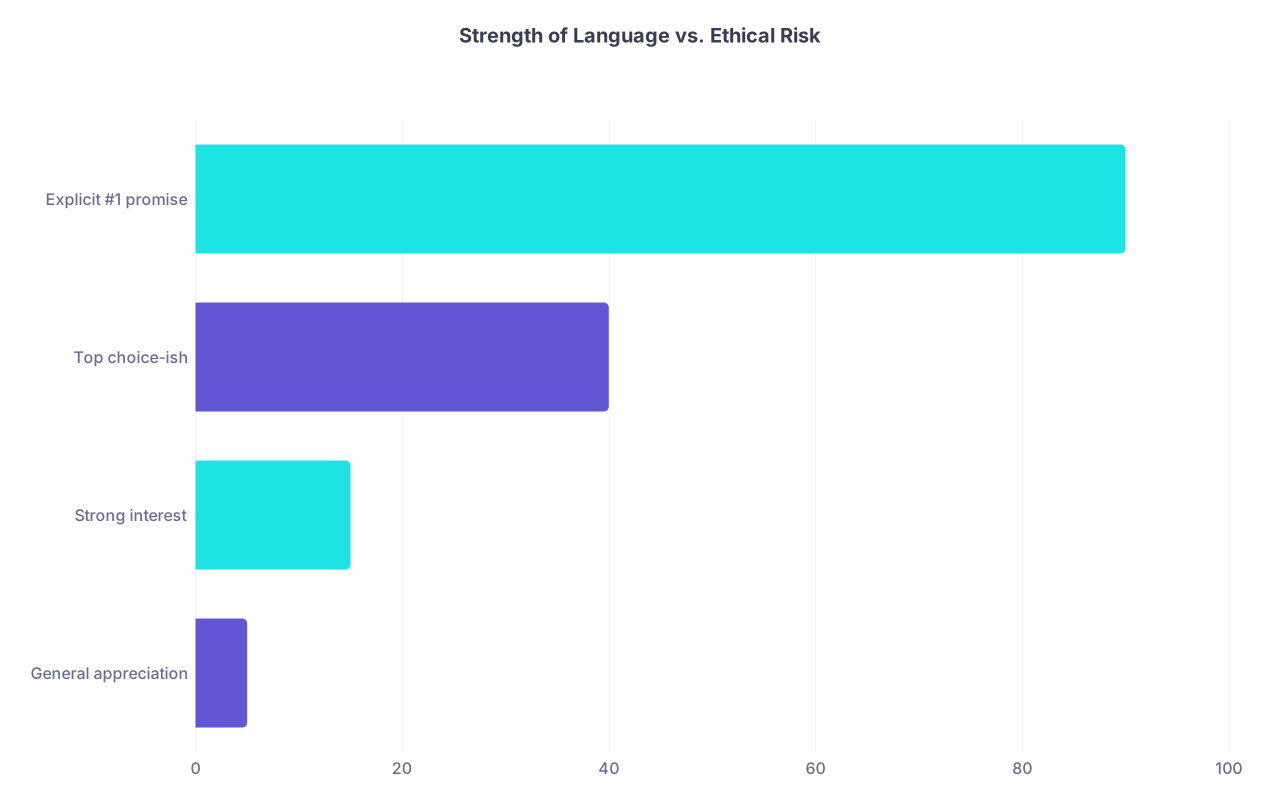
Higher value here = higher risk of creating ethical problems if used loosely. You can safely live in the first two categories with multiple programs.
The Bottom Line
Three things to carry with you:
- The NRMP cares about honesty about your rank list, not about you only liking one program. Lying about who is #1 is unethical; liking multiple programs and saying so is not.
- Strong, non-exclusive interest language is fair game with more than one program. Avoid absolute “you’re my #1” statements unless you mean it and only say it once.
- Programs expect you to signal interest to more than one place. What they remember is not that you liked others; it’s if you were obviously manipulative or dishonest.
Be honest. Be specific. Don’t overpromise. That’s ethics in the Match — not self-imposed martyrdom about only “loving” one program.