
You’re sitting at your laptop, inbox open, heart rate slightly elevated.
You see it clearly now: you double-booked. Two interviews. Same day, overlapping times. You already asked Program A to move once. They accommodated. Then you bailed again for Program B. Now you’ve switched, rescheduled, maybe even canceled and re-asked. And you’re wondering:
Did I just tank this program?
Do I follow up? Apologize? Pretend nothing happened?
You’re in the “I-might-have-burned-a-bridge” zone. I’ve seen people handle this well and walk away with an offer. I’ve also seen people make it worse with clumsy follow-ups.
Let’s clean up your situation.
Step 1: Get brutally clear on what actually happened
Before you send a single email, you need a precise story. No vague “I had a conflict.” Spell it out for yourself first.
What did you actually do?
Common versions:
You accepted two interview offers for the same day/time, then:
- Canceled one late to attend the other
- Asked one program to move you, then later switched back
- No-showed one (this is the worst case; we’ll handle it)
You:
- Initially scheduled Program A
- Later got a “dream” invite from Program B for the same day
- Moved or canceled A to take B
- Then realized B isn’t actually better / logistics fell apart / guilt kicked in
- Tried to go back to A
Write down:
- Timeline (dates of invites, your responses, reschedules)
- Exactly what you told each program
- What, if anything, they replied with
That clarity matters. Your follow-up has to be consistent with their email trail and your previous explanations. Programs do read their own threads. And occasionally they forward them to the PD or coordinator.
Step 2: Understand what programs actually care about
Programs are not sitting there thinking, “How dare they pick another program over us.”
The real concerns:
- Reliability: Will this person show up to work? Or will they bail last minute?
- Professionalism: Do they communicate clearly? Respect people’s time?
- Integrity: Are they honest about conflicts? Or obviously making stuff up?
You can absolutely recover from a double-booked switch if you hit those three well in your follow-up.
What they really hate:
- Silence after a messy reschedule or late cancel
- Obvious lying (“unexpected family emergency” that keeps mutating)
- Repeated changes with no acknowledgment of the inconvenience
Your job is not to make them “feel loved.” Your job is to show them:
I’m accountable. I respect your time. This won’t reflect how I function as a resident.
Step 3: Triage your exact scenario
Let’s sort you into a bucket. Different scenario → different follow-up.
| Scenario Code | Situation | Priority to Fix |
|---|---|---|
| A | Rescheduled once, professionally | Low |
| B | Rescheduled twice but with notice | Medium |
| C | Late cancel (<48 hours) for another interview | High |
| D | No-showed an interview | Very High |
| E | Canceled, then tried to rebook same program | High |
Scenario A: You rescheduled once, cleanly
Example: You emailed 1–2 weeks in advance, “I have a scheduling conflict that day; is there another date available?” They moved you. You attended. No drama.
In that case:
You probably do not need a special follow-up about the reschedule itself. Just a normal post-interview thank you is enough.
If you feel weird about it, you can add one line in your thank you:
“Thank you again for accommodating my earlier scheduling conflict; I truly appreciated the flexibility.”
Then drop it. Do not re-apologize three times. That starts to look insecure.
Scenario B: You rescheduled twice, but with reasonable notice
This is more borderline. Coordinators remember the people they had to move around more than once.
You need to show:
- You’re aware you created extra work
- You’re not flaky, just caught in a bad scheduling pileup
Here’s how you follow up after the interview with Program A (the one you bounced around):
Subject: Thank you and appreciation for your flexibility
Body:
Dear [Program Coordinator Name] and [Program Director Name],
Thank you again for the opportunity to interview with [Program Name] on [date]. I enjoyed meeting the residents and faculty and learning more about your program.
I also want to acknowledge and thank you for accommodating my schedule changes. I recognize this created extra work on your end, and I’m grateful for your patience and flexibility during a very compressed interview season.
After speaking with your team, I’m even more interested in [specific aspect you liked – e.g., your categorical curriculum, the global health track, or the resident camaraderie].
Sincerely,
[Your Name], [AAMC ID]
That’s it. You take responsibility, you show appreciation, you move on.
Do not:
- Explain in detail which other program caused the conflict
- Complain about the ERAS scheduling madness
- Over-apologize (“I feel terrible, I’m so ashamed…”)
You’re not writing a confession. You’re restoring professionalism.
Scenario C: You late-canceled (<48 hours) for another interview
Now we’re in damage control territory.
If you canceled on short notice because you chose another program instead, they probably know. Coordinators compare notes. Applicants talk. It’s not invisible.
Your goals:
- Own the late notice
- Avoid adding lies
- Leave the door cracked open without expecting magic
Email structure:
- Subject line
- Brief apology + acknowledgment of inconvenience
- Honest but concise reason category
- Humble close
Subject: Apology for late cancellation – [Your Name]
Body:
Dear [Program Coordinator Name] and [Program Director Name],
I wanted to follow up regarding my late cancellation of the interview scheduled on [date] for [Program Name].
I recognize that canceling so close to the interview date was unprofessional and likely caused inconvenience for your team and faculty. I’m genuinely sorry for the disruption this created in your schedule.
I made a poor decision trying to manage overlapping interview commitments and did not communicate early enough. That’s on me, and I will handle any future scheduling conflicts with more foresight and respect for everyone’s time.
Thank you again for considering my application. I appreciate the opportunity, and I’m sorry I did not handle this situation as well as I should have.
Sincerely,
[Your Name], [AAMC ID]
Notice what I did not do:
- I didn’t say “family emergency” or “unexpected illness” unless that was actually true.
- I didn’t ask for another chance in the same email. That’s usually too much.
If you truly, honestly want to ask if there’s any path to reschedule, you can add one line:
“If there is ever an opportunity to re-interview or be reconsidered in the future, I would be very grateful, but I understand completely if that is not possible this season.”
That’s as far as you push. Then you leave it.
Scenario D: You no-showed. No email, no call.
This is the worst from a program’s perspective. I’ve watched PDs literally say, “No-shows = auto-reject.” Not all of them. But enough.
You still follow up. Because:
- It’s the minimum professional thing to do.
- You won’t always know who knows whom. This can echo into fellowship or job applications.
Your email needs two things: clear ownership and a real explanation. “I forgot” is terrible but still better than lying.
Subject: Sincere apology for missed interview – [Your Name]
Body:
Dear Dr. [PD Last Name] and [Coordinator Name],
I am writing to offer a sincere apology for failing to appear for my scheduled interview with [Program Name] on [date].
I did not communicate appropriately beforehand, and I recognize that this was unprofessional and disrespectful of the time your faculty and staff reserved for me. There is no excuse for my lack of communication.
[One honest sentence of explanation, if you have one that isn’t fabricated. For example: “I mismanaged my interview schedule and mistakenly recorded the wrong date,” or “I was dealing with a personal issue and froze instead of reaching out as I should have.”]
I understand if my application is no longer under consideration. Regardless, I wanted to take responsibility for my actions and acknowledge the impact they had on your team. I will not make this mistake again.
Sincerely,
[Your Name], [AAMC ID]
Do not expect recovery. Sometimes they’ll reply politely; sometimes you’ll get silence. The goal here is not “save the interview.” It’s: don’t be the person who vanished without a word.
Scenario E: You canceled, then tried to go back to the same program
This is the classic “I picked Program B over A, then realized B isn’t that great / B canceled / logistics changed” situation.
You already canceled Program A. Then your situation changed. Now you want to interview at A again.
This is delicate. It can work if:
- Your initial cancellation wasn’t insulting (“I’ve decided to focus on more competitive programs…” — yes, people actually write that)
- You approach them humbly and with a plausible reason
Here’s the move.
Subject: Inquiry about interview availability – [Your Name]
Body:
Dear [Program Coordinator Name] and Dr. [PD Last Name],
I previously canceled my interview at [Program Name] that was scheduled for [original date]. Since then, my schedule and priorities for this season have changed, and I realized I made that decision too quickly.
After speaking with colleagues and learning more about your program’s [e.g., strong teaching culture, community-focused patient population, specific track], I remain very interested in [Program Name].
I understand completely if the interview spot cannot be reopened or if your schedule is already full. However, if there is any possibility of being reconsidered for an interview, I would be grateful.
Thank you for your time and for the initial offer to interview.
Sincerely,
[Your Name], [AAMC ID]
You do three things:
- Admit you changed your mind.
- Show specific interest, not generic flattery.
- Explicitly give them an easy out.
If they say no or ignore it, you drop it. No second ask. No guilt-tripping.
How much to reveal about the other program?
Short answer: almost nothing.
Do not write:
“I canceled your interview because I got an invite from [Fancy University] but then realized I’m not competitive and now I’d like to come back.”
That just makes you look insecure and transactional.
Instead, keep explanations high-level:
- “overlapping interview commitments”
- “compressed schedule and poor planning on my part”
- “I made a poor decision trying to juggle multiple interviews”
Programs don’t need the whole drama. They just need to see you’re not lying and you’re taking responsibility.
Timing: When to send the follow-up
Use this logic:
- If you messed up before the interview (late cancel / no-show) → send the apology within 24–48 hours.
- If you completed the interview but double-booking caused extra rescheduling → fold the acknowledgment into your post-interview thank you, sent within 24–72 hours.
- If you canceled and now want to re-open an interview → reach out as soon as your situation changes. Waiting weeks makes it weirder; it signals they were clearly your backup’s backup.
How much does this really hurt your chances?
Programs vary. I’ve seen all of these:
- PD who doesn’t care at all: “As long as they showed up and weren’t a jerk, I don’t care how many times they rescheduled.”
- Coordinator who is quietly annoyed but doesn’t torpedo you: “I remember them, but the faculty really liked them.”
- PD who is strict: “Late cancel for another interview = no rank.”
What actually protects you:
- Your behavior during the actual interview day (if you get there)
- How strong your application is otherwise
- Whether they believe your follow-up reflects your true baseline professionalism or just an off day under pressure
You can’t control their personality, but you can absolutely control whether you look like a decent adult cleaning up a mistake or a flaky person who ghosts when stressed.
How to not make this worse going forward
You’re in a stressful season. People do dumb stuff when they’re stretched. You don’t want to repeat this.
Quick guardrails:
Use a single master calendar.
Not mental notes. Not three different apps. One calendar with:- All interview dates and times
- Time zones clearly labeled
- Travel / commute buffers
Hold dates before responding.
When you get a new invite that overlaps, do not immediately start canceling old ones. Email the new program:“Thank you for the invitation to interview. I am very interested in [Program Name]. I am currently scheduled for another interview on [date] at [time]. Do you happen to have availability on [alternate dates]? I’d be grateful for any flexibility.”
Let them say no before you blow up another commitment.
If you must prioritize, decide fast and cancel early.
A clean, early cancel (“I’ve adjusted my interview schedule and need to withdraw from this interview, but I’m grateful for the opportunity”) is much more forgivable than a last-minute scramble.
A quick visual: when follow-ups are most critical
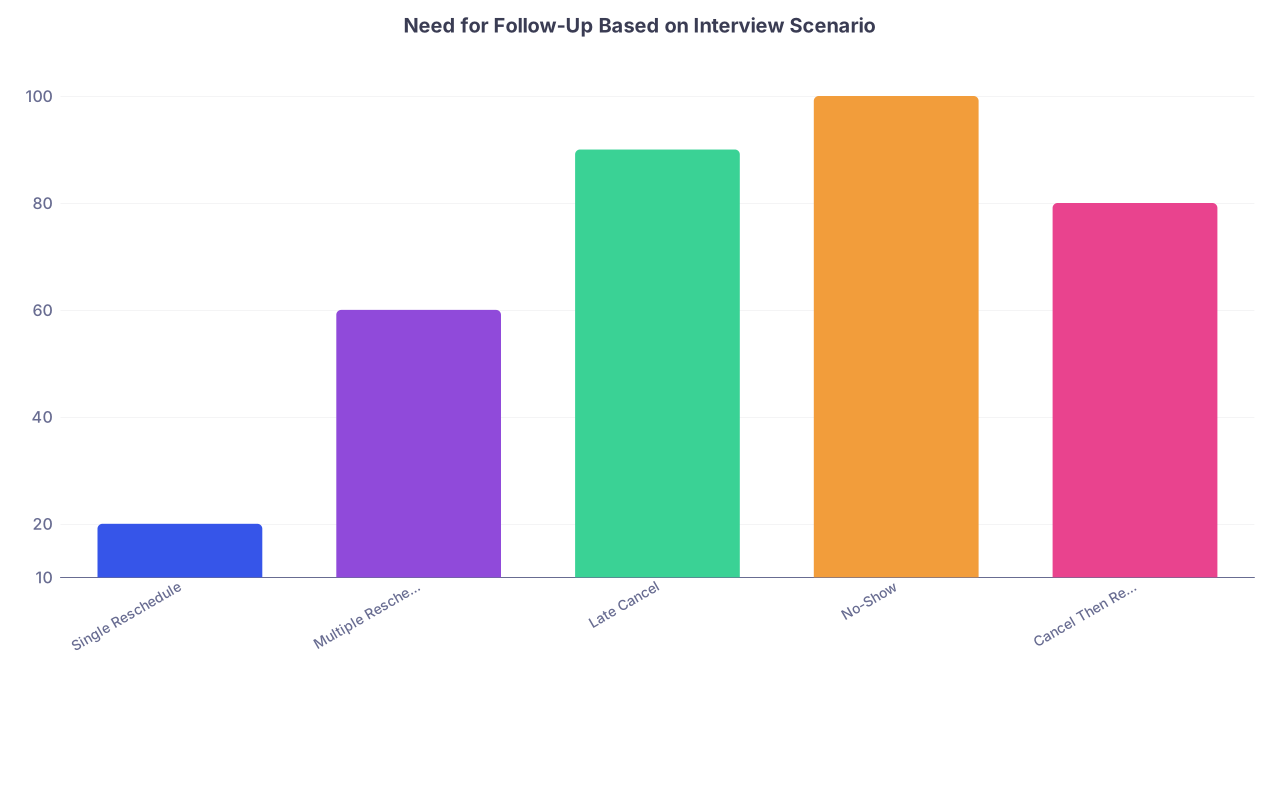
| Category | Value |
|---|---|
| Single Reschedule | 20 |
| Multiple Reschedules | 60 |
| Late Cancel | 90 |
| No-Show | 100 |
| Cancel Then Re-Ask | 80 |
Think of it this way: the closer you get to interview day before changing plans, the more you owe them a careful, explicit follow-up.
What if you feel like being fully honest will hurt you?
The temptation is always there: “I’ll just say ‘family emergency.’ They can’t question that.”
Here’s my take after watching this for years: fake emergencies are overused and often obvious. Programs see patterns. When a coordinator says, “We had five applicants this week with last-minute ‘emergencies’ that magically cleared up for a different program’s interview,” that’s not good.
Better:
- Admit poor planning.
- Admit overbooking.
- Admit you got overwhelmed.
You will not be the first applicant who struggled with an insane interview schedule. You might be the first who actually owned it cleanly.
How to emotionally move on after you’ve done your part
You can’t ruminate your way into a better outcome.
Once you:
- Send a clean, honest follow-up
- Thank them appropriately after any interview you do attend
- Tighten up your scheduling system
You’re done. Let their committee do what it will do.
Do not:
- Send multiple apology emails
- Ask if your mistake will hurt your rank position (they won’t tell you, and it’s awkward)
- Have your dean or advisor email them to “advocate” about this specific scheduling issue (that usually amplifies it)
If a trusted advisor or faculty mentor wants to send a generic letter of support for you as an applicant, fine. But dragging this specific incident into more inboxes rarely helps.
Bottom line
You double-booked. You switched interviews. You created friction. It happens.
Handle it like this:
- Be specific and honest about what actually happened, at least with yourself, so your story is consistent.
- Send one clear, accountable follow-up: apologize when you should, thank them for flexibility when they gave it, and then stop rehashing it.
- Fix your system going forward so you are never again the applicant who no-shows or panics into bad decisions.
You cannot guarantee forgiveness. You can absolutely control whether this looks like a one-time stumble under pressure or a red flag about how you’ll behave as a resident.