
You are a third‑year IM resident. It is 9:30 p.m., you are finishing notes on your cirrhosis admissions, and your attending casually mentions: “Our advanced GI guy came in for an ERCP this afternoon and just billed more for a 90‑minute case than I will for my entire call shift.”
You look up.
This is the moment you start wondering how much of GI’s financial upside is actually about advanced endoscopy—and whether ERCP and EUS are the gatekeepers to top‑tier GI income.
Let me break this down specifically.
1. The Core Reality: General GI vs Advanced Endoscopy
People lump “GI” together, but from an income and lifestyle standpoint there are at least three different jobs hiding inside:
- Clinic-heavy general GI (IBS, GERD, chronic liver disease).
- Procedure-heavy “bread and butter” GI (screening/diagnostic scopes, colon cancer screening mills).
- Advanced interventional endoscopy (ERCP, EUS, complex EMR/ESD, third-space).
ERCP and EUS sit in bucket 3. They are not “extra skills.” They fundamentally change your:
- Revenue per hour.
- Negotiation power with groups and hospitals.
- Call structure and schedule control.
A non‑advanced GI can do extremely well financially, especially in a high‑volume colonoscopy‑focused practice. But the upper tail of GI income—mid‑$700k into seven figures—is disproportionately populated by physicians who:
- Perform high volumes of ERCP and/or EUS.
- Anchor pancreaticobiliary / complex endoscopy services at hospitals.
- Leverage those procedures into high‑value contracts and downstream revenue capture.
So let me show you how that works in actual numbers—not vague “you’ll be paid more” nonsense.
2. Why ERCP and EUS Are Income Multipliers (Not Just Extra Codes)
2.1 Procedure Characteristics That Pay
ERCP (Endoscopic Retrograde Cholangiopancreatography) and EUS (Endoscopic Ultrasound) have three key economic properties:
- High professional fees per case.
- High facility revenue for the hospital/ASC.
- Critical, time‑sensitive indications (you become indispensable).
They are not screening colonoscopies. They are:
- Obstructive jaundice.
- Ascending cholangitis.
- Pancreatic head masses.
- Complex biliary strictures.
- Pancreatic fluid collections.
You are the person who either fixes this now or calls surgery/interventional radiology. In most hospitals, you are the only one who can do it endoscopically. That changes your value.
2.2 Numbers: Relative Value and Time
I will stay conceptual, but the ratios are accurate.
Approximate professional work RVU ranges (ballpark, highly dependent on exact coding and modifiers):
| Procedure | Typical wRVU Range |
|---|---|
| Screening colonoscopy | 3–4 |
| Colonoscopy with polypectomy | 4–6 |
| EGD with biopsy | 2–3 |
| EUS (diagnostic + FNA) | 6–10 |
| ERCP (diagnostic + therapy) | 8–14+ |
Now match that to time:
- Screening colonoscopy: 20–30 minutes in high‑throughput settings.
- EUS: 30–60 minutes.
- ERCP: 45–90+ minutes (varies massively by complexity).
So per hour, a commonly seen pattern in well‑run practices:
- High‑volume screening colonoscopy: 2–3 colonoscopies/hour → maybe 8–15 wRVU/hour.
- EUS-heavy block: 1–2 procedures/hour → often 10–18 wRVU/hour.
- ERCP-heavy block: 1 case/hour → 10–15+ wRVU/hour, sometimes more with add‑ons.
Then layer on the hospital’s perspective: a single ERCP/EUS often triggers tens of thousands of dollars in facility and downstream imaging/surgery/oncology revenue.
That is why hospitals will compete for you if you can do advanced procedures that retain those patients locally.
3. How ERCP/EUS Training Changes Your Career Trajectory
3.1 Training Path: Where This Fits In
Here is the practical training sequence:

| Step | Description |
|---|---|
| Step 1 | IM Residency 3y |
| Step 2 | GI Fellowship 3y |
| Step 3 | General GI Practice |
| Step 4 | Advanced Endoscopy Fellowship 4th year |
| Step 5 | Advanced GI Practice with ERCP EUS |
| Step 6 | Advanced Endoscopy? |
Advanced endoscopy is normally a 4th year after standard 3‑year GI fellowship (U.S. model).
Typical volume targets in a solid advanced fellowship:
- ERCP: 200–300+ cases.
- EUS: 250–350+ cases.
- EMR, complex polypectomy, maybe POEM/ESD depending on program.
And here is the harsh truth:
- If you graduate GI fellowship with <50 ERCPs and <50 EUS, nobody rational should credential you for independent advanced work.
- You can “dabble” with EUS or ERCP if you have structured mentorship in practice, but this is increasingly frowned upon from quality and medico‑legal standpoints.
So if you want your income to be meaningfully ERCP/EUS‑driven, do the 4th year. The market still rewards that heavily.
4. The Income Mechanics: How ERCP/EUS Actually Boosts Compensation
4.1 Three Main Income Channels
Advanced endoscopy changes earnings through:
- Direct professional fees: higher RVUs per procedure.
- Leverage in employment contracts: stipends, higher base, productivity rates.
- Strategic positioning: ability to negotiate ownership in ASCs, service line leadership, or carved‑out call pay.
Let us walk these concretely.
4.1.1 Direct RVU‑Based Income
Most hospital employment and many group contracts for GI are RVU‑based.
You will see things such as:
- Base salary: say $450k–550k for a new GI.
- RVU target: 8,000–10,000 wRVU/year.
- RVU overage compensation: $40–$60 per wRVU over target (varies a lot by region and setting).
Now take two early‑career GI physicians in the same system:
Dr. A – general GI, minimal advanced:
- Heavy colonoscopy list, clinic, some inpatient consults.
- Total: say 9,000 wRVU/year.
Dr. B – advanced endoscopist:
- Lower clinic load, more block time in advanced room.
- Total: 12,000+ wRVU/year (not rare when ERCP/EUS volumes are built out).
At $50 per wRVU over target with a 9,000 RVU baseline:
- Dr. A hits target → maybe collects base + small bonus.
- Dr. B overshoots by 3,000 RVU → 3,000 × $50 = $150k incremental.
That is just RVU overage, not counting any stipends or premiums negotiated specifically for advanced call coverage or service building.
You see the pattern. The more of your schedule you convert into high‑complexity, high‑RVU advanced work, the less you need to grind endless clinic visits or low‑reimbursing follow ups.
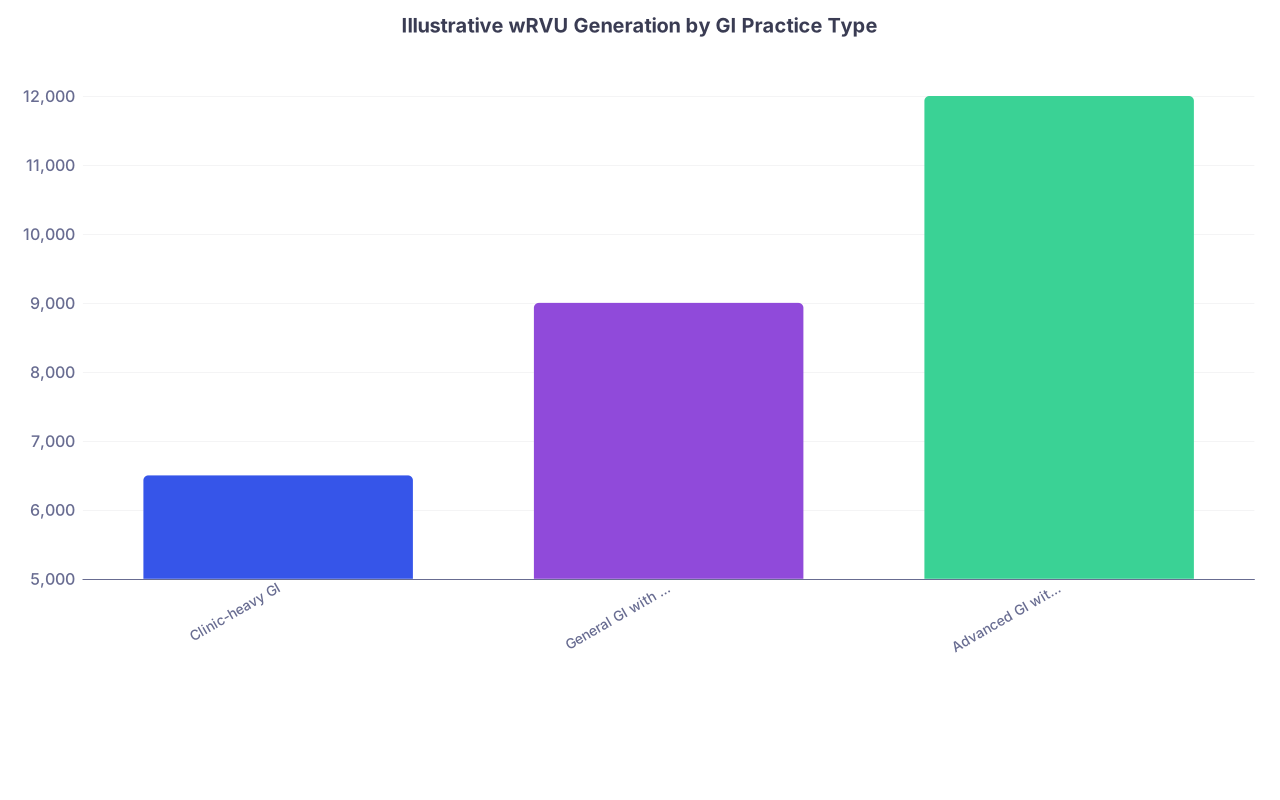
| Category | Value |
|---|---|
| Clinic-heavy GI | 6500 |
| General GI with scopes | 9000 |
| Advanced GI with ERCP/EUS | 12000 |
4.2 Hospital Value and Negotiation Power
Hospitals do not care about your colonoscopy revenue as much as you think. Colonoscopies can be commoditized and moved to ASCs.
They care a lot about:
- Keeping biliary/pancreatic cases in‑house.
- Avoiding transfers to tertiary centers.
- Supporting oncology programs with local EUS staging and biliary drainage.
- Maintaining in‑house solutions for cholangitis at 2 a.m.
An advanced endoscopist directly influences:
- ICU length of stay in cholangitis.
- Referral patterns for complex neoplasia.
- Ability to recruit hepatobiliary surgery and oncology.
That is real money for them.
So hospitals use several mechanisms to attract/retain advanced endoscopists:
- Higher starting salaries than general GI in the same market.
- GI service‑line director or “Director of Advanced Endoscopy” stipends.
- Dedicated block time with priority access to fluoroscopy rooms.
- Funded support: advanced techs, newer scopes, anesthesia coverage.
- Call differentials or specific “advanced call” compensation.
The punchline: you become less replaceable. And less replaceable specialists write better contracts.
5. Lifestyle and Call: The Tradeoff Behind the Money
Let me be explicit: ERCP/EUS income is not free money. There are tradeoffs.
5.1 Call Structure: Who Gets the 2 a.m. Cholangitis?
In a mid‑size hospital with:
- 4 general GIs.
- 1 advanced GI.
How does call work?
Typical patterns I see:
- General GIs do the routine GI bleed/EGD/colonoscopy call.
- All true ERCP/EUS needs funnel to the advanced endoscopist, either:
- As home call with emergent ERCP, or
- As early‑AM add‑ons the following day if stable enough.
If you are the only advanced endoscopist in a region, you can end up effectively on continuous “soft call” for advanced cases—even if officially on a rotating schedule. That can chew into evenings, weekends, and vacation plans.
Some groups do this smarter:
- Two advanced GIs sharing advanced call.
- Tiered call: general GI covers first call; advanced only gets called for clearly ERCP‑level issues.
- Explicit limits on nighttime ERCP except life‑threatening cholangitis.
But you need this in writing. Hope is not a system.
5.2 Procedural Risk and Stress
ERCP and EUS carry higher complication rates than diagnostic scopes:
- Post‑ERCP pancreatitis.
- Perforation.
- Bleeding.
- Sedation‑related issues in sicker patients.
You will be doing more procedures on:
- Older, sicker, coagulopathic patients.
- ICU patients with pressors.
- Oncology patients with complicated anatomy.
The malpractice exposure and cognitive load are not the same as doing three ASA 2 colonoscopies before lunch. Some people thrive on that; some burn out fast.
6. Practice Setting: Where ERCP/EUS Income Peaks (and Where It Does Not)
You cannot ignore practice environment. Same skill set, wildly different outcomes.
| Setting | ERCP/EUS Volume | Income Ceiling | Independence | Typical Tradeoffs |
|---|---|---|---|---|
| Academic center | High | Moderate–High | Low–Medium | Teaching, research, admin |
| Large private group + ASC | Moderate–High | Very High | High | Business risk, long hours |
| Hospital employed | Variable | Moderate–High | Low | Stability, bureaucracy |
| Small community practice | Low–Moderate | Moderate | Medium | On‑call burden, solo coverage |
6.1 Academic Advanced Endoscopy
Reality: Academic advanced endoscopy has:
- High volume of complex cases.
- Lower average personal income than private‑practice counterparts.
- Compensation “ceilinged” by institutional salary scales.
But you get:
- Complex, interesting pathology.
- Trainees doing part of the scut and some of the procedures.
- Research, innovation, ESD/POEM, clinical trials.
- Reputation and referrals statewide.
If your primary goal is to maximize annual income, pure academic is usually not the top of the curve. But it can still be very good, especially in systems with RVU‑based bonuses layered on base salary.
6.2 Private Practice with ASC Ownership + Hospital Contracts
This is where advanced GI can explode financially, when done right.
Key mechanisms:
- Professional fees for ERCP/EUS (billed by you or your group).
- Equity in an ASC that does high volumes of colonoscopy/EGD, plus selected advanced cases.
- Potential medical directorship stipends from hospitals for the advanced program.
- Negotiated hospital support for capital-intensive equipment (EUS processor, fluoroscopy, duodenoscopes).
You can design a week like this:
- 2 days advanced block at hospital (ERCP/EUS, complex EMR).
- 2 days high‑volume colonoscopy/EGD at ASC.
- 1 day clinic / admin.
You are touching revenue streams from:
- High‑margin outpatient colonoscopy.
- Advanced inpatient referrals.
- Facility fee sharing through ASC equity.
This is how real‑world advanced GIs end up in the $800k–$1.2M+ bracket in some markets. Not instantly; usually after a few years of sweat equity and building referrals.
6.3 Hospital‑Employed Advanced GI
This is becoming more common: hospitals directly employing a “Director of Advanced Endoscopy” or similar.
Upsides:
- Straight salary + RVU bonus. No billing headache.
- Very predictable benefits, retirement, malpractice coverage.
- Guaranteed base that is often higher than general GI colleagues to offset advanced call and case complexity.
Downsides:
- Less upside from ASC ownership.
- You are locked into hospital RVU rates and productivity targets.
- Admin control over your schedule; less autonomy to say, “no, I will not book three advanced ERCPs back‑to‑back on Friday at 3 p.m.”
You trade some upside for stability. For many people that is acceptable, especially with family or lifestyle priorities.
7. What ERCP and EUS Actually Add to Your Day‑to‑Day Work
Let us make this concrete. A week in the life of an advanced GI in a solid community setting:
- Monday:
- AM: 3 ERCPs (stones, malignant stricture stent, benign stricture dilation).
- PM: 4 EUS (two pancreatic masses, two subepithelial gastric lesions).
- Tuesday:
- ASC day: 12 colonoscopies, 3 EGDs.
- Wednesday:
- Clinic: 18–20 patients (post‑ERCP follow ups, complex biliary disease, general GI mix).
- Thursday:
- Mixed: 2 EUS for staging, 1 ERCP, then some add‑on inpatient scopes.
- Friday:
- ASC or hospital “overflow” block + admin/meetings.
Your average colonoscopy‑only colleague might:
- Do more total scopes but fewer complex procedures.
- Spend more time in clinic.
- Have less disruptive call (no middle‑of‑the‑night cholangitis).
But per hour of procedural time, your advanced cases are driving higher RVU and making the hospital a lot more money. Which, again, is why they will pay you more and tolerate more demands from you than from the third straight‑out‑of‑fellowship general GI applicant.
8. Risks, Burnout, and When Advanced Endoscopy Is a Bad Idea
I have seen residents chase advanced endoscopy for the wrong reasons and regret it.
Bad reasons to do advanced endoscopy:
- “I heard they make a million dollars.”
- “I hate clinic; I just want to do cool cases.”
- “It will guarantee me a job anywhere.” (No, in some saturated cities you will still struggle.)
Better reasons:
- You genuinely like sick patients and complex procedures.
- You are comfortable being the final decision‑maker at 2 a.m. for high‑risk interventions.
- You want to build or lead programs, not just join existing ones.
Burnout drivers in advanced GI:
- Solo advanced coverage in a region → perpetual soft call.
- Administrations that push volume with no limits on complexity.
- Understaffed endoscopy units with poor tech and anesthesia support.
- Unrealistic expectations that every choledocholithiasis gets cleared endoscopically right now regardless of patient stability.
The money is not worth hating your life. You need to evaluate:
- How many advanced endoscopists are in the group/region?
- How is ERCP/EUS call distributed and compensated?
- Are there written guidelines for what is truly emergent vs. urgent add‑on?
- Who backs you up surgically and radiologically if things go wrong?
9. How to Position Yourself in Residency/Fellowship If You Want This Path
If you are still in IM or early GI fellowship, you can actually steer toward this.
9.1 As an Internal Medicine Resident
Focus on:
Matching a GI fellowship that has:
- Strong endoscopy volume.
- Access to an in‑house advanced endoscopist.
- A known track record of grads going into advanced fellowships.
Building general strengths:
- ICU comfort.
- Complex hepatology and pancreatobiliary disease knowledge.
- Research or QI focusing on GI procedural outcomes or pancreatobiliary topics.
You do not need to publish in EUS right now. But show you care about procedural fields and complex GI.
9.2 As a GI Fellow
This is where you separate the “maybe advanced” from the “definitely advanced” track.
Do this:
Get maximum exposure to ERCP/EUS early:
- Observe, then assist, then drive parts of the case.
- Understand fluoroscopic anatomy intimately.
Work with your advanced attendings:
- Ask them bluntly about their lifestyle and income.
- Ask which advanced fellowships they respect.
Build a concrete fellowship application:
- A couple of pancreatobiliary/EUS/ERCP‑adjacent abstracts or case series.
- Strong letters from your advanced mentors.
- Clear statement of purpose: clinical advanced endoscopy, not fluffy.
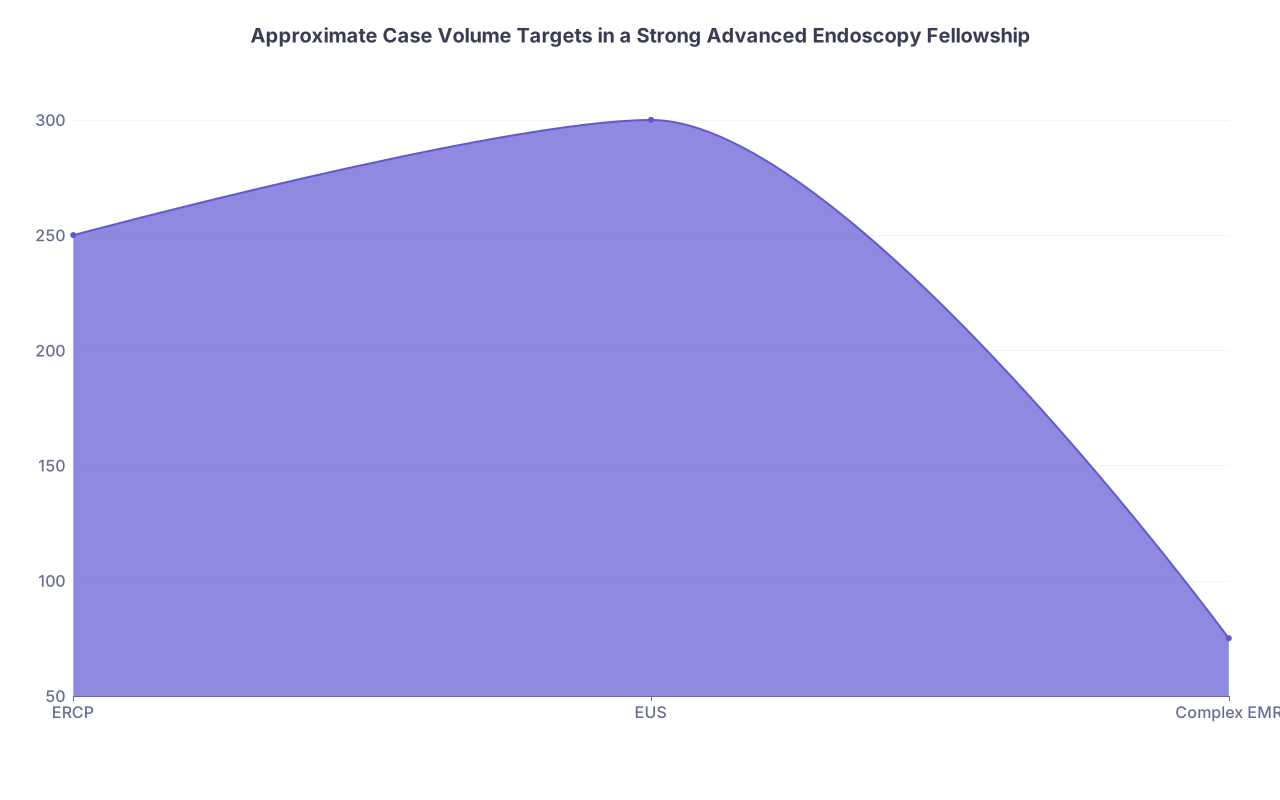
| Category | Value |
|---|---|
| ERCP | 250 |
| EUS | 300 |
| Complex EMR | 75 |
If your own GI fellowship is weak on advanced exposure, you will need to:
- Do electives at outside centers.
- Attend advanced endoscopy courses.
- Network more aggressively.
The advanced fellowship world is small. People know each other.
10. Strategic Mistakes to Avoid With Advanced GI Income
A few patterns I have watched unfold badly:
Accepting “advanced” roles without volume guarantees
Job ad: “Seeking GI with ERCP/EUS interest.”
Reality: You end up doing 95% general GI, 5% advanced, because the older partner keeps all the complex cases. Your skills decay, and the income bump never materializes.Under‑negotiating call compensation
If you are the only ERCP provider for multiple hospitals and getting no additional pay or schedule adjustment, you are being used, not valued.
Ignoring ASC equity discussions
Some groups will happily let you crank out high‑RVU work in their ASC without offering you a realistic path to ownership. If they keep all the facility profit and you just get RVUs, you are leaving money on the table long term.
Overcommitting early
New advanced endoscopist, eager to please, takes on everything. Before you realize it, your 50‑hour week becomes 70, and the admin’s answer to “we need another advanced person” is “you are managing fine.”
Say yes strategically. Not reflexively.
11. Quick Reality Check: Is Advanced Endoscopy Actually Necessary to Earn Top GI Money?
No. You can make serious money in GI without ever touching an ERCP scope.
High‑throughput, ASC‑based colonoscopy practices with:
- Ownership stake.
- Efficient throughput.
- Strong referral streams.
can yield extremely high incomes.
The difference is this:
- Without ERCP/EUS, you are more easily replaced. There are many general GIs.
- With ERCP/EUS, especially in under‑served regions, you become the anchor of a service line.
The top percentile of GI earners frequently combine:
- High‑volume colonoscopy/EGD.
- Some degree of advanced endoscopy (ERCP/EUS ± EMR/ESD).
- Business leverage through ownership or leadership positions.
So no, it is not mandatory. But it is one of the cleanest ways to supercharge the financial and strategic side of a GI career—if you can handle the tradeoffs.
FAQ (Exactly 6 Questions)
1. How much more can an advanced endoscopist make compared with a general gastroenterologist?
In many U.S. settings, early‑career advanced endoscopists can earn $100k–$250k+ more than peers doing only general GI, once their practice matures. Top‑end private practice or group/ASC models can push that difference even higher. The spread comes from:
- Higher RVU generation (ERCP/EUS vs only standard scopes).
- Service‑line stipends and leadership roles.
- ASC ownership and better contract leverage with hospitals.
The gap is smaller in rigid academic salary structures, but still present via productivity bonuses.
2. Do I absolutely need a dedicated advanced endoscopy fellowship to do ERCP and EUS?
If you want full‑spectrum advanced practice and long‑term credibility, yes, you should plan on a 4th‑year advanced fellowship. Minimal exposure during a standard GI fellowship does not safely prepare you for independent ERCP/EUS volume. Credentialing committees and malpractice carriers are less and less tolerant of “I learned on the job” advanced endoscopy. A formal fellowship also signals to employers and hospitals that you are serious and properly trained, which strengthens both job prospects and negotiating power.
3. Which is more valuable for income: ERCP or EUS?
From a pure income and hospital leverage standpoint, ERCP usually wins. It is more frequently emergent or urgent (cholangitis, obstructive jaundice), drives more downstream care, and has higher typical RVU values. EUS is crucial—especially for pancreaticobiliary and oncologic workups—and is often paired with ERCP in the same patient population. In reality, the market wants both. A “ERCP‑only” or “EUS‑only” advanced endoscopist is less attractive than someone competent in both modalities.
4. Is advanced endoscopy compatible with a good lifestyle and family life?
It can be, but only with deliberate job selection and boundaries. If you are the sole ERCP/EUS provider in a region and the hospital expects 24/7 availability without backup, your lifestyle will suffer. Good setups share advanced call among multiple specialists, define what is truly emergent, and compensate you appropriately. You also want robust anesthesia, endoscopy nursing, and tech support to prevent every day from turning into a chaotic slog. You can absolutely have a stable family life as an advanced endoscopist, but you must filter jobs aggressively.
5. How early in training do I need to decide on advanced endoscopy?
You do not need to commit during IM residency, but by early PGY‑4/first year of GI fellowship you should be leaning one way or the other. Advanced fellowship applications typically go in during the second year of GI fellowship. Use your first fellowship year to:
- Maximize exposure to ERCP/EUS.
- Work with advanced attendings.
- Start one or two targeted research or QI projects in pancreatobiliary/advanced endoscopy.
Waiting until late in fellowship to decide makes your application weaker and limits your fellowship options.
6. If I hate clinic, is advanced GI the answer?
Not necessarily. If your primary motivation is “less clinic,” you might be disappointed. Advanced endoscopists still need clinic time to:
- See new complex referrals.
- Manage post‑procedure complications and follow up.
- Run multi‑disciplinary cases with oncology, surgery, and hepatology.
What advanced GI actually gives you is a higher procedural density in your schedule and more control over what kind of clinic you run. If you fundamentally dislike high‑stakes procedures, complication discussions, and middle‑of‑the‑night decisions on very sick patients, advanced endoscopy will feel worse, not better.
Key takeaways:
- ERCP and EUS do not just add procedures; they fundamentally shift your RVU generation, hospital value, and long‑term income ceiling in GI.
- The tradeoffs are real—higher risk, more complex call, and the potential for burnout if you are the only advanced person covering a large region.
- If you genuinely like complex procedures and are willing to train an extra year, advanced endoscopy is one of the clearest paths into the top income brackets of gastroenterology.