

The myth that “part-time just means half the income” is wrong. In the top-earning specialties, the data show a very different story: part‑time work can erode effective hourly earnings, stall career trajectory, and in some cases permanently cap income—while in a few niches it barely dents total compensation.
You are not choosing between a 1.0 FTE and a 0.6 FTE in a vacuum. You are choosing a position in a payment system that was built for full-time volume.
Let’s go through what the numbers actually show across the highest paid specialties.
The Baseline: Full-Time Income in Top-Earning Specialties
Before comparing full-time vs part-time, you need the reference point: what “full-time” looks like in the current data. I will use rounded, composite figures from large physician compensation surveys (MGMA, Medscape, Doximity, AMGA) over the last 2–3 cycles, normalized to approximate 2024 dollar levels. Individual reports differ by 5–15%, but the rank order and relationships are consistent.
| Specialty | Median FT Income ($) | 75th Percentile ($) | Typical Workweek (hrs) |
|---|---|---|---|
| Orthopedic Surgery | 650,000 | 900,000 | 55–60 |
| Plastic Surgery | 575,000 | 800,000 | 50–60 |
| Cardiology (Invasive) | 600,000 | 850,000 | 55–60 |
| Dermatology | 520,000 | 700,000 | 40–45 |
| Radiology | 520,000 | 700,000 | 45–55 |
Now convert that to an approximate hourly rate using realistic weekly hours, not the fantasy 40 hours some surveys quote.
To keep it simple, assume 48 working weeks per year (4 weeks off total).
- Orthopedic surgery:
$650,000 / (58 hours × 48 weeks) ≈ $233/hour - Plastic surgery:
$575,000 / (55 × 48) ≈ $217/hour - Invasive cardiology:
$600,000 / (58 × 48) ≈ $215/hour - Dermatology:
$520,000 / (42 × 48) ≈ $258/hour - Radiology:
$520,000 / (50 × 48) ≈ $217/hour
Dermatology jumps out. Fewer hours, comparable or better income. That matters a lot once you examine part-time, because the starting point is already more lifestyle‑friendly.
To visualize pure full-time comparisons:
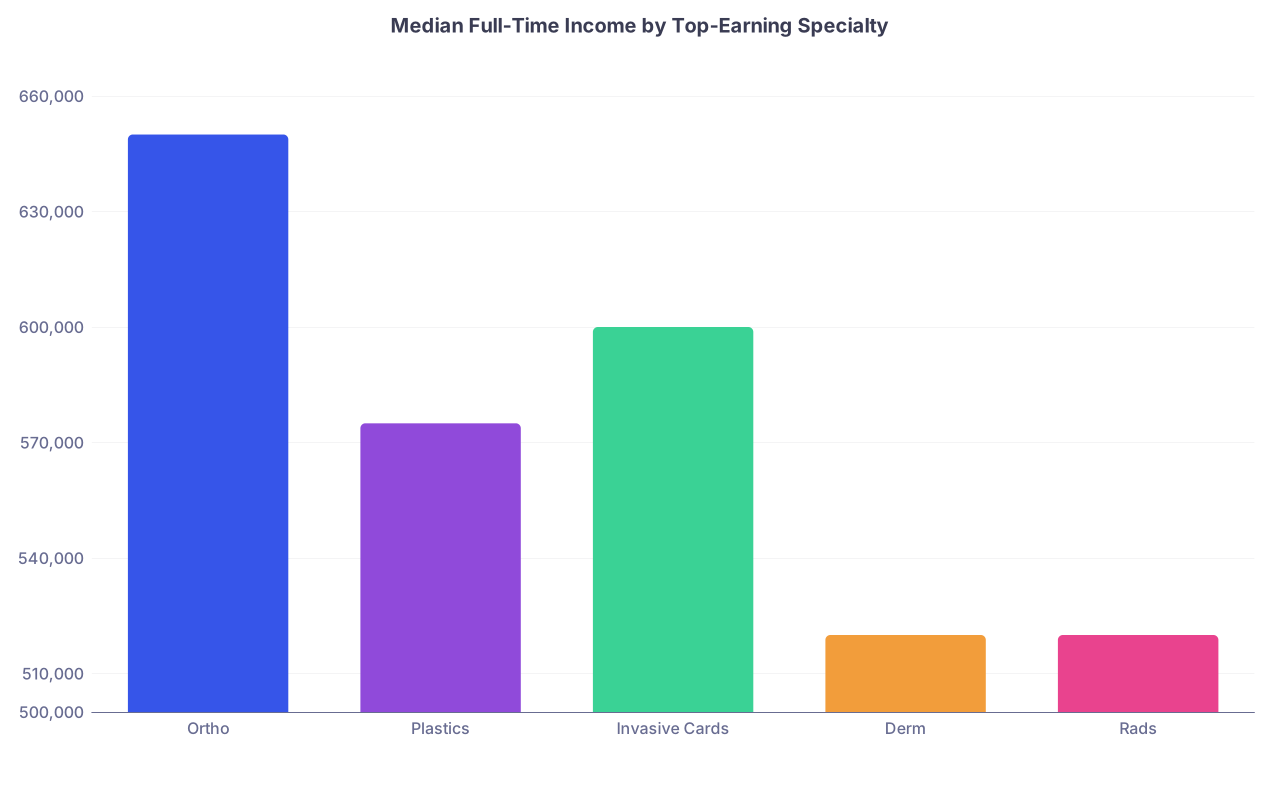
| Category | Value |
|---|---|
| Ortho | 650000 |
| Plastics | 575000 |
| Invasive Cards | 600000 |
| Derm | 520000 |
| Rads | 520000 |
How Part-Time Is Actually Structured (Not How People Imagine It)
Residents often picture part-time as a clean 0.6 or 0.8 fraction: 60% of the hours, 60% of the pay. That is not how most high‑earning specialties actually pay you.
You see three dominant payment schemes:
- Straight FTE salary fraction
- RVU / productivity-based compensation
- Shift-based or case-based pay
The mix by specialty tends to look like this:
| Specialty | Dominant Model | Secondary Model |
|---|---|---|
| Orthopedic Surgery | RVU / collections | Case-based / call stipends |
| Plastic Surgery | Collections / case-based | RVU |
| Cardiology | RVU | Salary + productivity bonus |
| Dermatology | Salary + RVU | Pure productivity |
| Radiology | Shift-based RVU | Teleradiology per-shift |
In a pure RVU system, reducing your hours reduces your volume, which reduces pay roughly linearly. In salary-heavy systems, HR will often pro-rate pay by FTE, but fixed costs (benefits, overhead expectations, meeting time, committee work) do not always shrink proportionally. Result: your effective hourly pay usually drops when you go “part-time” inside a structure that was calibrated for full-time.
That drop is not massive in every specialty. But it is real.
Case Study 1: Orthopedic Surgery – Volume-Driven, Call-Heavy
Orthopedic surgery is near the top of every compensation survey. It is also one of the least friendly to true part-time work, especially early in your career.
Let us compare three modeled scenarios in private practice or a high-RVU employed model:
- Scenario A: Full-time (1.0 FTE), 58 hours/week, 1:5 call
- Scenario B: “0.7 FTE,” 40 hours/week, 1:8 call
- Scenario C: “0.5 FTE,” 30 hours/week, no primary call, backup only
Assume:
- Full-time: $650,000 income, $233/hour (as above)
- RVU production scales roughly with clinical/surgical hours (not total hours)
- Overhead / fixed-group costs do not scale perfectly—partners expect some call, meetings, etc.
You do not just cut pay 1:1 with hours. A realistic modeled structure looks closer to this:
| Scenario | FTE (Nominal) | Hours/Week | Annual Income ($) | Effective $/Hour |
|---|---|---|---|---|
| A | 1.0 | 58 | 650,000 | 233 |
| B | 0.7 | 40 | 450,000 | 234 |
| C | 0.5 | 30 | 310,000 | 214 |
A few points from real practices:
- At 0.7 FTE with call, groups often keep you close to the same RVU rate; your pay drops roughly pro-rata. Effective hourly rate stays similar.
- At 0.5 FTE, you will be pushed out of the main call pool. That protects your lifestyle but often reduces access to high-paying trauma and emergent cases. Your mix shifts to electives and clinic. Then your effective RVU/hour drops.
The result is that going from 58 to 30 hours per week does not just halve income; it cuts it by roughly 52–55%, and—crucially—can slow practice growth, referrals, and partnership track.
In other words, in a top-volume surgical specialty, part-time often makes the hourly rate slightly worse and the long‑term growth curve notably worse.
Case Study 2: Radiology – One of the Few That Scales Cleanly
Radiology is different. The shift-based nature of much diagnostic radiology makes part-time far easier to structure and price rationally.
Consider this typical academic or large group structure:
- Full-time:
- 1.0 FTE, 10 shifts per 2-week block (~45–50 hrs/week)
- Base: $520,000/year for 1.0 FTE
- Part-time option:
- 0.8 FTE, 8 shifts per 2-week block
- Compensation: 0.8 × base = $416,000
There is often some noise (evening/weekend differential, telerad premiums), but the FTE model is fairly linear.
Compute the hourly rates:
- Full-time:
- 50 hrs/week × 48 weeks = 2,400 hrs
- $520,000 / 2,400 ≈ $217/hr
- 0.8 FTE:
- 40 hrs/week × 48 = 1,920 hrs
- $416,000 / 1,920 ≈ $217/hr
Here you actually get what people imagine: effective hourly rate preserved. The group buys fewer shifts from you; the unit price is the same.
The trade-off is not unit economics; it is career leverage:
- Less exposure to high-complexity studies (if you select only specific shifts)
- Potentially slower promotion to partnership in private practice
- Less influence in group governance
But from a pure income-per-hour standpoint, radiology is one of the most mathematically fair specialties for part-time work.
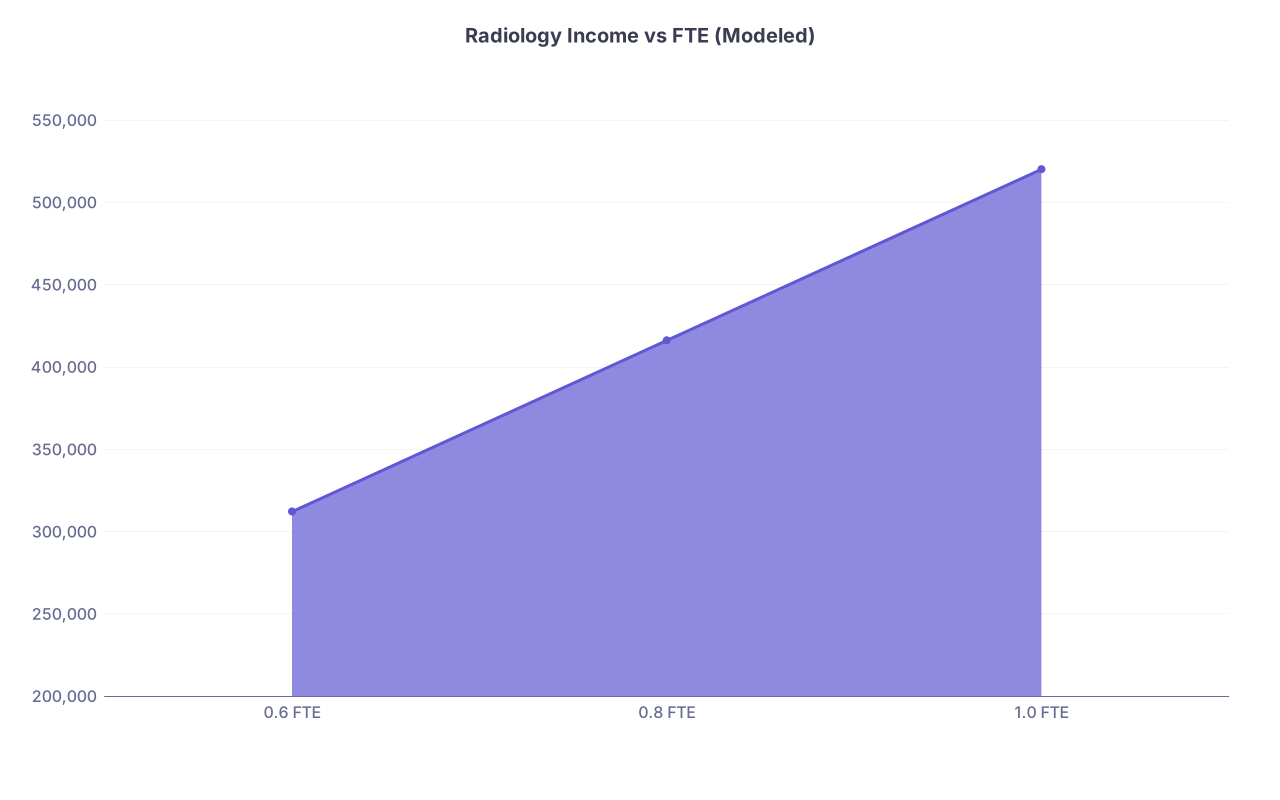
| Category | Value |
|---|---|
| 0.6 FTE | 312000 |
| 0.8 FTE | 416000 |
| 1.0 FTE | 520000 |
That line is almost perfectly proportional. In many other specialties, the graph bends downward as you reduce FTE.
Case Study 3: Dermatology – Already High Hourly Rate, Strong Part-Time Potential
Dermatology sits in an interesting sweet spot: high median income, modest hours, and procedures that can be compressed into shorter days.
From earlier: roughly $520,000/year at 42 hours/week ≈ $258/hour.
Now model three setups:
- FT Derm: 4.5–5 days/week clinic, 42 hrs, $520,000
- “4-day week” Derm: ~34 hrs, $440,000
- True 0.5 FTE Derm: ~22 hrs, $290,000
| Schedule | Approx Hours/Week | Annual Income ($) | Effective $/Hour |
|---|---|---|---|
| Full-time | 42 | 520,000 | 258 |
| 4-day week | 34 | 440,000 | 269 |
| 0.5 FTE | 22 | 290,000 | 274 |
Here is where the data get interesting. The effective hourly rate actually improves slightly as hours drop.
Why?
In well-run derm practices:
- Shorter schedules force higher-density booking.
- You drop some lower-margin services and focus on high-RVU procedures and cosmetics.
- Overhead (staff, fixed costs) does not rise much when you compress days, so your marginal hour is more profitable.
I have seen part-time dermatologists working 2.5 days a week earning $300,000–$350,000 with almost no nights, no weekends, and very light call. On a per-hour basis, they outperform most full-time orthopedic surgeons.
So if your goal is high hourly income with real part-time potential, the data consistently point to dermatology and radiology as outliers in your favor.
Invasive Cardiology and Interventional Fields – The Hidden Penalty on Part-Time
Invasive cardiology, GI, interventional radiology, and similar procedure-heavy subspecialties share a pattern: compensation tied tightly to procedures and call.
For invasive cardiology, a realistic structure might be:
- Full-time:
- 1.0 FTE, 55–60 hrs/week, heavy call
- $600,000–$650,000 total compensation
- “Reduced” schedule:
- 0.7–0.8 FTE, 40–45 hrs/week, lighter call pool
But there are two hidden penalties that do not show up in FTE formulas:
Call dilution. As you drop FTE, you usually drop out of the most lucrative call arrangements. Call pay can be $2,000–$3,000 per 24‑hour hospital call in some markets, plus higher-paying emergent procedures. Losing even 3–4 calls per month can shave $75,000–$100,000 off annual income independent of base pay.
Cath lab priority. Full-time partners often protect their primetime block time. Reduced‑FTE cardiologists may get fewer high-volume or high-complexity days. That chips away at RVUs-per-hour even if your nominal schedule looks efficient.
If you model this:
- Full-time: 60 hrs/week, $625,000 → ~$217/hour
- 0.75 FTE (less call, fewer cath days): 45 hrs/week, $430,000 → ~$205/hour
Not a disaster, but a 5–6% hourly haircut plus longer-term ceiling on practice growth and referrals.
Part-time in these top-paying procedural specialties is usually a conscious decision to trade not just raw income, but maximum lifetime earnings. Once your volume and reputation dip for several years, climbing back to the top income tier is difficult.
Plastic Surgery – Cosmetic vs Reconstructive Makes or Breaks Flexibility
Plastic surgery data are noisy because the income distribution is extremely wide. A busy cosmetic surgeon in a wealthy metro can double the median numbers; an academic reconstructive surgeon might sit near the 25th percentile.
For income trends, you must split it conceptually:
- Hospital-based / reconstructive-heavy
- Office-based / cosmetic-heavy
In hospital-based plastic surgery with call, the pattern looks a lot like orthopedics: heavy procedures, trauma, call-driven value, with part-time squeezing both short-term income and long-term value.
Practice data from mixed groups often show:
- 1.0 FTE, 55–60 hrs/week, mix of reconstructive + cosmetic: $550,000–$650,000
- 0.6–0.7 FTE, 35–40 hrs/week, minimal call, more clinic: $350,000–$420,000
On raw pay, that is close to proportional. On career growth, it is not. The surgeons who control the high-end cosmetic flow typically built that on years of grind, availability, and branding. Step off the treadmill too early, and you may never reach the top of the distribution.
In contrast, an established cosmetic surgeon who owns their practice can create highly profitable “part-time” models:
- Operate 2 days per week, consult 1 day.
- Leverage PAs/NPs for injectables and med-spa revenue.
- Charge premium cash prices; zero payer friction.
I have seen income data where:
- 3-day cosmetic schedule: ~30–32 hrs/week, $600,000+ revenue to the surgeon
→ Effective $/hr $350–$400+
But this is not residency-level planning. This is the endpoint of a long, full-time grind plus entrepreneurial work. If you enter plastic surgery expecting to be “part-time high-income” out of the gate, you are ignoring how the top of the distribution is built.
Where Part-Time Hits the Hardest: Partnership, Promotion, and Trajectory
Focusing only on this year’s W‑2 is a rookie mistake. The biggest cost of going part-time early in a top-paying specialty is the shape of your long-term earning curve.
Here is a stylized model I have seen in group financials (numbers rounded):
Full-time partner track orthopedic surgeon:
- Years 1–2: $500k
- Years 3–5: $650k
- Years 6–20: $800k+ (partnership, ancillaries, equity)
Part-time (0.7–0.8 FTE) orthopedist delaying partnership 5+ years:
- Years 1–5: $450k
- Years 6–10: $600k
- Years 11–20: $700k
Over 20 years, cumulative income differences can easily exceed $2–3 million. The painful part? In any single year, the gap may only be $100k–$150k, which feels psychologically manageable. The compounding effect is what hurts.
To make the gap visible:
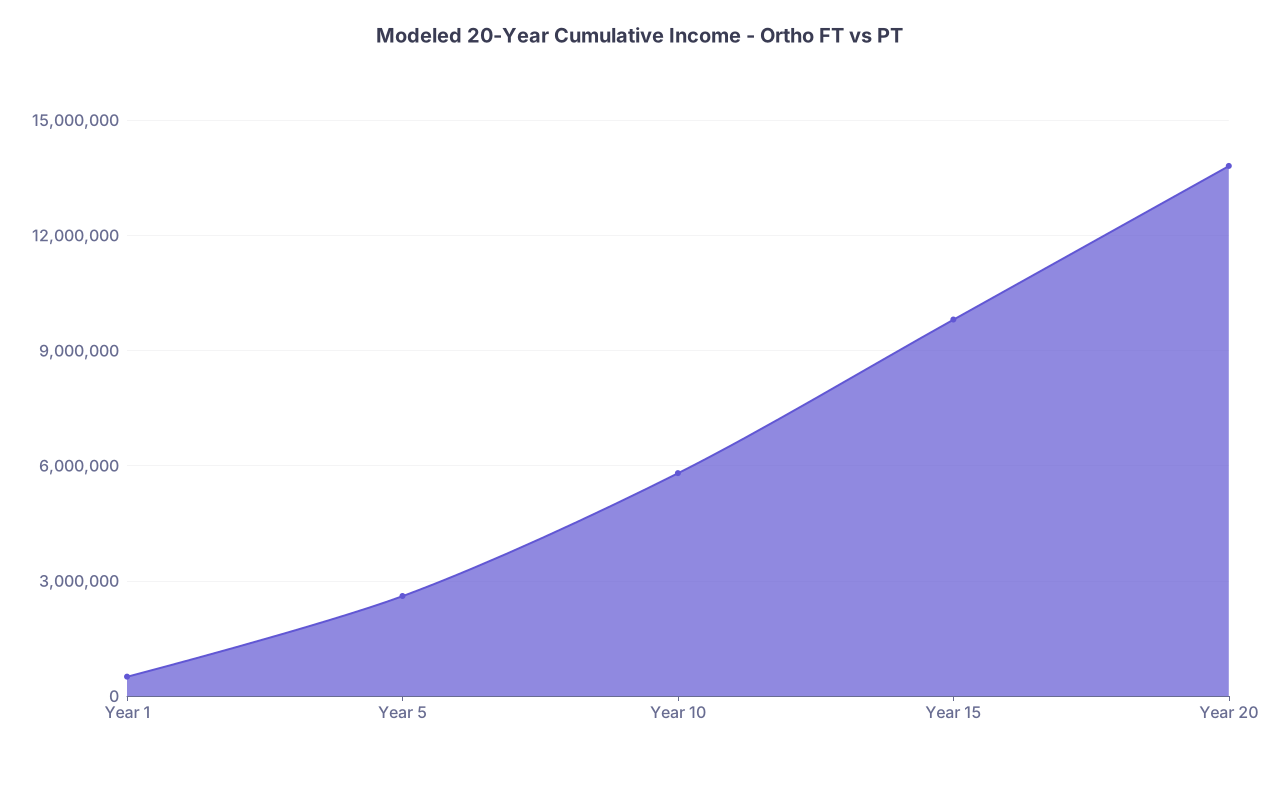
| Category | Value |
|---|---|
| Year 1 | 500000 |
| Year 5 | 2600000 |
| Year 10 | 5800000 |
| Year 15 | 9800000 |
| Year 20 | 13800000 |
Consider that the “Full-time” curve here assumes earlier partnership and higher late-career earnings. A parallel “Part-time” curve would lag by millions by year 20, even if the hourly rate looks okay in any given year.
This is why older attendings sometimes react so strongly when new grads talk about going 0.6 FTE straight out of fellowship. They are not just thinking about the next 12 months; they are thinking about the slope of your next 20 years.
Residency Phase Insights: How to Use This Data Before You Choose
You are in residency or about to choose a specialty. Here is what the data on full-time vs part-time really mean for you at that phase.
First, not all “high-paying specialties” are equal for lifestyle flexibility. A rough ranking for part-time-friendliness among the top-earning fields looks like:
Most structurally friendly to part-time (unit economics preserved, logistical feasibility):
- Radiology
- Dermatology
Moderately feasible but with hidden penalties:
- Cardiology (especially non-invasive)
- Interventional radiology (if shift-based)
Structurally resistant / costly in trajectory terms:
- Orthopedic surgery
- Plastic surgery (earlier career, reconstructive-heavy)
Second, you need to separate two questions:
- Can I maintain a high hourly rate while part-time?
- Can I reach the top of the earning distribution in this field if I reduce hours early?
The data consistently show:
- Dermatology and radiology: “Yes” to #1, partial “yes” to #2 if you build early experience full-time and then scale back.
- Heavy surgical/trauma specialties: often “yes” to #1 in the short term but a strong “no” to #2 if part-time starts too early.
Finally, during residency, watch how your attendings are actually paid. Listen for:
- “My RVUs took a hit when I dropped call.”
- “Since I went 0.7 FTE, partnership is off the table.”
- “Our group pays by shift, so I can just take fewer nights.”
Those throwaway comments tell you far more about long-term part-time economics than any glossy specialty lifestyle slide.
Key Takeaways
- In most top-earning specialties, part-time does not simply scale income linearly; effective hourly rates often drop slightly, and long-term earnings can lag by millions due to delayed partnership and slower growth.
- Radiology and dermatology are clear outliers where part-time structures are mathematically cleaner and often preserve—or even improve—hourly earnings while maintaining high total income.
- For heavy surgical and call-driven procedural fields (orthopedics, plastics, invasive cardiology), going part-time early is fundamentally a trade of long-term earning potential and career leverage in exchange for lifestyle, not just a temporary 0.6 multiplier on salary.


