
Mohs Surgery vs General Derm: Revenue Streams and Practice Models
Most dermatologists are quietly underpaid compared with what their schedules and waiting lists could justify. The people who escape that gravity tend to fall into one of two groups: high‑efficiency general dermatologists or well‑positioned Mohs surgeons. Everyone else is just trading time for RVUs and wondering why the math feels off.
Let me break this down specifically: “Mohs vs general derm” is not just a question of which procedures you like. It is a question of how you want to generate revenue, how you want to structure your day, and how exposed you want to be to hospitals, insurers, and referral patterns.
You are not choosing between “clinic” and “surgery.” You are choosing a practice and income architecture.
1. Core Economic Difference: What You’re Actually Selling
At a high level, both Mohs and general derm sell time. The trick is what you pack into each unit of time, and how reliably it converts into billable work.
General Dermatology: High-Throughput, High-Variability
General derm is a volume game. Short visits, broad payer mix, and a mix of:
- Evaluation and management (E/M) codes
- Office procedures (shaves, punch biopsies, cryo, ED&C)
- Chronic disease management (acne, psoriasis, atopic, etc.)
- Cosmetic “bolt‑ons” if you are smart about it
A full day of general derm might be:
- 30–45+ patients
- 10–20+ procedures (biopsies, cryo, excisions)
- 60–80% insurance-based, 0–40% cosmetic depending on practice
Your revenue per hour depends on:
- Payer mix (commercial vs Medicare vs Medicaid vs self-pay)
- How many procedures you cram into each clinic block
- Whether you own ancillaries (phototherapy, patch testing, cosmetics, products)
When done badly, general derm is “23 acne rechecks and three biopsies” and you walk out mildly resentful. Done well, it is tightly structured, procedure‑dense, and financially very strong.
Mohs Surgery: Narrow Scope, Higher Unit Value
Mohs is different. You are mono‑focused on:
- Skin cancer treatment (Mohs, complex repairs, flaps, grafts)
- Some reconstructive work
- Possibly cosmetics layered in (especially in private practice)
You see fewer patients per day, but each one may generate:
- Mohs surgery (first stage + additional stages)
- Complex repair, flap, graft codes
- Pathology (if you own/are associated with the lab, depending on state and Stark rules)
The per‑patient and per‑hour revenue potential is high, especially in commercial‑heavy, high skin‑cancer‑incidence markets. But it is also highly dependent on:
- Referral volume
- Local competition (number of existing Mohs surgeons)
- How your contracts pay for Mohs vs excisions
For dermatology residents: Mohs is not automatically more lucrative. A busy, procedure‑heavy general derm clinic can absolutely rival (or surpass) the income of a moderately busy Mohs surgeon. The difference is that Mohs revenue is more concentrated and more tightly tied to a narrow set of codes.
2. Revenue Streams: What Actually Brings Money In
Let’s dissect the specific revenue streams you are playing with.
General Dermatology Revenue Streams
Think of general derm as a diversified portfolio.
Office Visits (E/M)
- New patient and established patient codes (9920x / 9921x)
- Telederm in some models
- Chronic disease follow‑up is the “annuity” part of your practice
Minor Procedures
- Shave biopsies, punch biopsies
- Cryotherapy for actinic keratoses, warts, benign lesions (when justified)
- ED&C for non‑melanoma skin cancer
- Simple excisions and intermediate repairs
This is the backbone. High procedure density drastically changes your revenue per hour. A day of “E/M only” general derm is financially underperforming compared to what is possible.
- Advanced Medical Services
- Biologics management for psoriasis, atopic dermatitis, HS
- Patch testing
- Phototherapy (if you own the booths, this is a real ancillary)
These do not always pay spectacularly per unit of time, but they deepen patient dependence on your practice and generate repeat visits and related procedures.
Cosmetics (optional, but powerful in the right setting)
- Neurotoxin, fillers, laser work
- Microneedling, peels, sclerotherapy
- Cash‑only, no payer headaches, but marketing‑dependent
Product Sales
- Skincare lines, sunscreens, cosmeceuticals
- Margins can be decent but you need staff buy‑in and logistics
Mohs Surgeon Revenue Streams
Mohs has a narrower but potent set of streams.
Mohs Surgery Itself
- CPT codes for the first stage + additional stages
- Site‑dependent reimbursements (nose vs trunk, etc.)
- Multiple stages and multiple sections can stack rapidly on a busy day
Repairs and Reconstruction
- Simple, intermediate, and complex repairs
- Local flaps and full‑thickness skin grafts
- These codes often represent a significant portion of total case reimbursement
Pathology Revenue
- If you have an in‑office lab and can legally bill the technical and/or professional component, that is meaningful
- Hospital‑employed or integrated health systems may swallow this, leaving you with RVUs only
Cosmetics (selectively)
- Many Mohs surgeons develop periocular rejuvenation, scar revision, resurfacing, or cosmetic reconstruction sidelines
- This varies widely; some Mohs surgeons essentially double as facial plastics‑lite
Consulting and Tumor Boards
- Typically more relevant in academic centers
- Indirect financial value (protected time, promotion, reputation) more than direct billing
| Aspect | General Dermatology | Mohs Surgery |
|---|---|---|
| Core Revenue | E/M + minor procedures | Mohs stages + complex repairs |
| Procedure Volume | High, lower unit value | Moderate, high unit value |
| Cosmetics Role | Optional, can be major | Optional, usually adjunct |
| Pathology Income | Limited, usually external | Possible if owning/partnering with lab |
| Dependence on Referrals | Moderate | High |
3. Practice Models: How Your Day and Income Are Structured
Let us talk actual practice models you will see on the ground.
General Dermatology Practice Models
High-Volume, Insurance-Based Private Practice
This is the stereotypical “40 patients/day, 10‑minute slots” model.- Revenue comes from high visit counts and a brisk flow of biopsies and minor procedures.
- Compensation often tied to collections or RVUs.
- Burnout risk is real if the schedule is badly designed, but financially strong if payer mix is good.
In this model, cosmetic work is often tacked on in separate blocks or with separate patient flow.
Mixed Medical + Cosmetic Practice
Common in affluent suburbs or urban centers.- 60–80% medical, 20–40% cosmetic is a fairly typical balance for a profitable hybrid.
- Cosmetic blocks are cash‑rich and can substantially increase take‑home pay.
- Requires branding, marketing, and careful appointment design so you do not destroy your medical flow.
Concierge or Boutique Dermatology
Still niche, but growing.- Patients pay membership fees or higher cash rates; volume per day is lower.
- Income shifts from visit‑based to relationship‑based plus selected cosmetics.
- Works best if you are in a wealthy area and have strong patient loyalty and differentiation.
Employed / Hospital-Integrated General Derm
- Often paid on salary + RVU bonus.
- Less upside if RVU thresholds are aggressive or RVU values are low.
- Non‑clinical time, benefits, and support can be good, but you are rarely maximizing your earning potential compared to aggressive private practice.
Mohs Surgeon Practice Models
Referral-Based Mohs in Private Practice
This is the classic model: local derms and PCPs send you skin cancers.- Your schedule is mostly Mohs cases, maybe with some post‑ops and a sprinkle of general derm or cosmetics.
- Income depends heavily on keeping the referral base happy and avoiding turf wars.
- Owning the facility and lab (if compliant with regulations) amplifies revenue significantly.
Integrated Mohs in a Derm Group
- You are the in‑house Mohs person for a multispecialty derm group.
- Group derms feed you cases; you may also see outside referrals.
- Income often tied to collections from your Mohs work, possibly shared ancillaries.
- Excellent if the group is busy and the region has strong skin‑cancer incidence (sun‑belt states, older populations).
Hospital or Health System Employed Mohs
- You receive a salary plus potential RVU or productivity bonus.
- Path revenue often goes to the institution.
- Stability is high; upside is limited.
- You may also be pulled into complex recon and multidisciplinary tumor boards.
Academic Mohs
- Salary is usually lower compared with private practice, sometimes substantially so.
- You gain program building, research, teaching, and prestige benefits that may compensate you in non‑financial ways.
- Case complexity is often higher, but case volume and payer mix may not favor maximum income.
4. Throughput, RVUs, and Realistic Income Ranges
Let us talk ugly numbers. No one in residency gives you these cleanly. Attendings talk in vague terms: “You will be fine.” That is not helpful.
These are rough, ballpark, post‑residency estimates. Region, payer mix, and business setup can swing these by 30–50%.
Typical Productivity Patterns
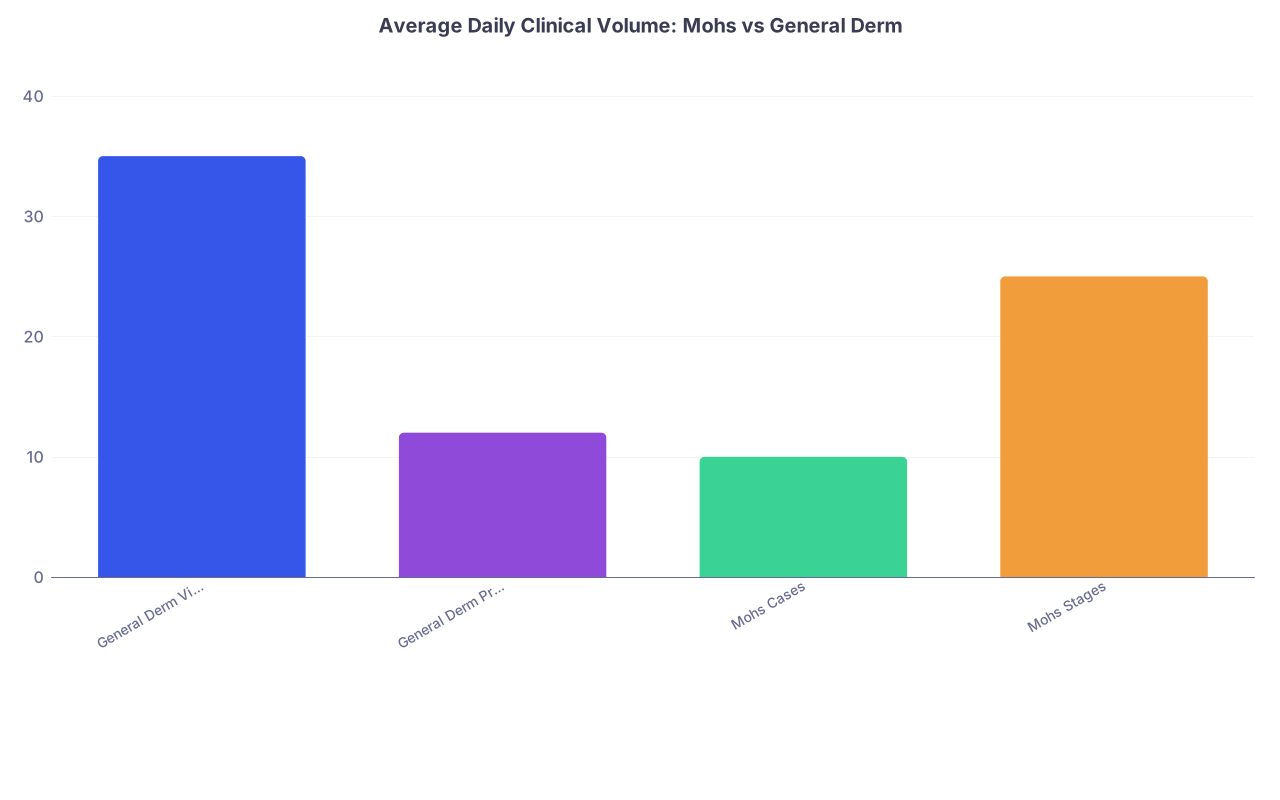
| Category | Value |
|---|---|
| General Derm Visits | 35 |
| General Derm Procedures | 12 |
| Mohs Cases | 10 |
| Mohs Stages | 25 |
For a busy general dermatologist in private practice:
- 30–45 patients per day
- 10–20 billable procedures per day
- RVUs per day vary widely, but 25–40 is a believable range in efficient practices
For a busy Mohs surgeon:
- 6–15 patients per day (Mohs cases)
- Each case may generate multiple stages and a repair
- RVUs per day can be very high if the schedule is optimized and case mix is complex
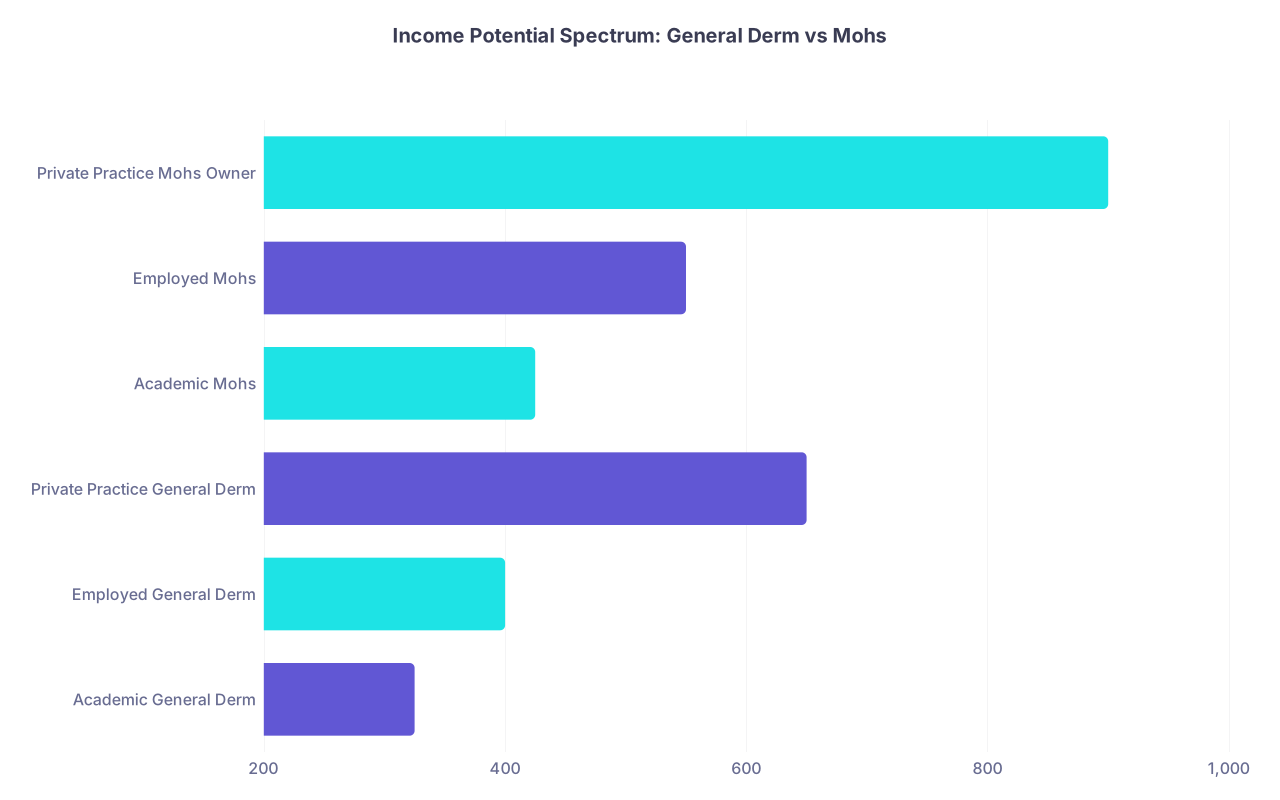
Ballpark Income Ranges (Attending Level)
Again, these are broad U.S. figures. Exceptional people and unusual markets land outside these.
General Dermatology:
- Employed / hospital: ~ $300–450k commonly
- Private practice associate: ~$350–600k, sometimes more with strong cosmetics and ancillaries
- Owner partner in high‑volume, procedure‑dense, good‑payer practice: often $600k+ possible
Mohs Surgery:
- Academic / hospital employed: often ~$350–500k
- Private practice associate with good referral base: ~$500–800k
- Practice owner with strong referral network, own lab, optimized scheduling: mid‑6 figures to low 7 figures is not fantasy; several Mohs surgeons quietly clear $1M+ in the right markets
But here is the critical nuance: a ruthlessly efficient general dermatologist with robust cosmetics in a strong market can match or outperform a middling Mohs surgeon who is under‑referred or hospital‑hamstrung. Mohs is not an automatic golden ticket. It is a multiplier only if the environment cooperates.
5. Overhead and Risk: Who Pays for the Toys and People?
Revenue alone is misleading if you ignore overhead.
General Derm Overhead Profile
General derm overhead often includes:
- Clinical staff (MAs, nurses)
- Front desk, billing, practice manager
- Lease for office space
- Equipment: cryo units, exam tables, dermatoscopes, minor surgery instruments
- Optional: phototherapy booths, patch testing kits, cosmetic devices
- Malpractice (relatively modest compared with surgery specialties)
Overhead in dermatology private practice frequently sits in the 45–60% range of collections. Add major cosmetic devices and heavy marketing and the number can climb.
But general derm can be run fairly lean. A couple of MAs, a shared front desk, and a straightforward EHR can carry a very profitable single‑doc practice if volume is solid.
Mohs Overhead Profile
Mohs overhead is more complex.
- Multiple rooms per case (one patient cycling through surgical, waiting, and reconstruction)
- Dedicated histotech and lab space for frozen sections
- Cryostats, staining equipment, QA protocols
- Higher staffing (scrub techs, histotechs, more MAs)
- More involved regulatory and accreditation burdens if you run your own lab
- Malpractice a bit higher but still not neurosurgery‑level
The upside: when running at proper capacity, the fixed cost of the Mohs lab and staff is diluted over high‑value cases. When under‑utilized, the overhead crushes you.
So, financially, Mohs is more “high fixed, high potential.” General derm is “moderate fixed, highly scalable with volume.”
6. Referral Dynamics and Market Risk
The big weakness of Mohs is simple: dependence.
Mohs: You Live and Die by Referrals
Mohs surgeons in private practice generally need:
- General derms, PCPs, and others to send them cancers
- Stable relationships built on access, communication, and trust
- Freedom from aggressive competing Mohs practices siphoning off referrals
What I have seen blow up careers:
- A hospital system hires its own Mohs surgeons and stops sending out
- A large derm group in town decides to bring Mohs in‑house
- A breakdown in relationships over billing practices, patient poaching, or scheduling delays
If your practice model is “one or two big referral sources give me most of my cases,” you are fragile. Lose one, you feel it immediately.
You can mitigate this by:
- Spreading referrals across many smaller practices
- Providing excellent access and communication (easy scheduling, fast notes, reachable by phone / text)
- Avoiding any behavior that looks like you are stealing general derm patients
General Derm: More Direct Patient Loyalty
General derm is less dependent on referral pipelines and more on:
- Direct patient loyalty and word of mouth
- Local brand, online reviews, and access (how fast can a new patient be seen)
- Contracts with payers
If a big PCP group stops referring, you feel it—but many patients show up self‑referred, through family/friends, or because “you are the dermatologist in my network.” That is a more stable base.
In other words: general derm income is buffered by the sheer breadth of reasons people need a dermatologist. Mohs income is narrower, focused on a subset of those who develop skin cancer and whose doctors choose you.
7. Lifestyle, Call, and Burnout Patterns
Everyone likes to ask “which one makes more money.” The quieter but equally important question: “which one makes me hate my life less at 15 years out.”
General Derm Lifestyle
- Clinic-based, mostly weekday, 8–5 type work
- Call tends to be light and mostly handled by phone; emergencies are rare
- Emotional load varies by how much complex disease you see (e.g., advanced HS, cutaneous lymphoma)
- Burnout tends to come from volume pressure, EHR grind, and repetitive complaints, not trauma or death
General derm also gives you more flexibility to insert variety: cosmetics, specialty clinics (psoriasis, hair, contact derm), research, or teaching.
Mohs Surgeon Lifestyle
- Also mostly weekday clinic/procedure days
- Cases can be longer and more cognitively focused, but narrower scope
- Your schedule is less flexible: you cannot “squeeze in a full facial skin cancer” quite the way you squeeze in a wart
- Emotional stress spikes when doing complex reconstructions on cosmetically and functionally crucial areas (nose, eyelids, lips)
Many Mohs surgeons love the puzzle and the craftsmanship. Some feel boxed into “cancer factory days” when the schedule is stacked.
From a burnout perspective, the path is different. Mohs is narrower but potentially more satisfying day‑to‑day for those who like tangible procedures and seeing the result immediately. General derm is broader but can feel like a treadmill unless you control your panel and schedule.
8. Training Bottleneck and Career Flexibility
Fellowship Bottleneck
Mohs fellowships are limited. Highly coveted. Competitive.
Residents aiming for Mohs often:
- Stack up derm surg rotations, case logs, and research
- Angle for programs with high case volume and strong faculty connections
- Accept that a mediocre application will not land a top fellowship easily
If you get the fellowship and succeed, you have a relatively rare skillset. That has value. But you are also more pigeonholed.
Flexibility After Training
A general dermatologist can:
- Stay 100% medical
- Add cosmetics
- Add procedural focus (surgical derm, simple excisions)
- Move between private practice, academic, and employed models more fluidly
A Mohs surgeon can:
- Practice pure Mohs
- Become “Mohs + derm + cosmetic hybrid” in some models
- Move into leadership roles in derm surgery, multidisciplinary oncology, etc.
But pure general derm jobs pay perfectly fine and exist almost everywhere. High‑volume Mohs jobs require specific regional demand and referral ecosystems.
9. Hybrid Models: Where the Real Money Often Lives
The most financially successful dermatologists I have seen fall into one of three hybrid patterns:
- General derm with heavy procedures and well‑run cosmetics.
- Mohs surgeon with a strong reconstructive and cosmetic side business.
- Large derm group owners who combine both under one roof and capture internal referrals, cosmetics, and ancillaries.
These models capture:
- High‑value procedures
- Cash pay services (cosmetics)
- Some degree of vertical integration (path, phototherapy, products, surgery, medical derm)
Here is how that looks structurally:

| Step | Description |
|---|---|
| Step 1 | General Derm Visit |
| Step 2 | Biopsy or Procedure |
| Step 3 | Chronic Disease Follow up |
| Step 4 | Pathology |
| Step 5 | Mohs Referral |
| Step 6 | Mohs Surgery |
| Step 7 | Repair or Flap |
| Step 8 | Post op Visit |
| Step 9 | Cosmetic or Scar Revision |
| Step 10 | Biologic Management |
| Step 11 | Long term Follow up |
The lesson: do not think in silos. The best practices architect flows, not just visits.
10. Strategic Advice for Residents and Early Attendings
You are trying to decide: chase Mohs, stick with general derm, or attempt some hybrid. Some blunt guidance.
Choose Mohs if:
- You genuinely enjoy surgery, reconstruction, and the repetitive focus of skin cancer work.
- You are prepared to hustle for fellowship and later for referrals.
- You are comfortable with the idea that your business can be disrupted if local referral patterns change.
Choose general derm if:
- You like variety and long‑term patient relationships.
- You want geographic flexibility and easier job mobility.
- You are willing to learn efficiency and potentially some cosmetics to hit the top income tiers.
Stop believing any of these myths:
- “Mohs is always the highest paid.” False. Environment and practice model matter more than fellowship letters.
- “General derm is capped financially.” False. Poorly run general derm is capped. Well‑run general derm is not.
- “Cosmetics are frivolous.” Also false. They are often the most controllable and profitable revenue stream if you know your market.
To make an intelligent decision, you should be looking at actual numbers. Case logs. RVU sheets. Overhead percentages. Collection reports. Not just what someone in the work room “heard.”
If you are on rotation now, ask specific questions:
- How many patients per day?
- Roughly how many procedures per day?
- How are you paid—salary, RVUs, percent of collections?
- What is overhead as a percentage of collections in this practice?
- How many Mohs cases per day, and how many stages on average?
You will learn more from one candid lunch with a private practice Mohs surgeon or high‑volume general dermatologist than from a month of vague academic chatter.
| Category | Value |
|---|---|
| Academic General Derm | 325 |
| Employed General Derm | 400 |
| Private Practice General Derm | 650 |
| Academic Mohs | 425 |
| Employed Mohs | 550 |
| Private Practice Mohs Owner | 900 |

11. The Bottom Line: Mohs vs General Derm, Financially and Structurally
Here is the distilled truth.
Mohs surgery is a high‑leverage, high‑dependency revenue engine. When fed a steady supply of appropriately indicated cancers in a favorable payer mix, it prints money—especially if you capture pathology and reconstruction. But the engine sputters without referrals and can be cramped by institutional control of ancillaries.
General dermatology is a diversified platform. Less spectacular per unit, more robust across time and geography. Add procedures and cosmetics, tighten your clinic efficiency, and you have a very lucrative, stable career without ever cutting a flap.
The smartest dermatologists stop thinking in terms of “which is better” and start asking, “Which model fits my skills, risk tolerance, and local market—and how can I architect multiple revenue streams around that choice?”
That is the real game.

Key Takeaways
- Mohs is not automatically richer; environment, referrals, and practice structure determine whether its higher unit value translates into higher income.
- General derm, when run with high procedure density and smart use of cosmetics and ancillaries, can match or exceed Mohs income with more flexibility and less dependency.
- Your real decision is not just Mohs vs general derm—it is which practice model and revenue architecture you want to build your career around.