
It’s August. You and your partner are staring at a shared spreadsheet.
There’s a tab for your programs. A tab for theirs. A messy third tab labeled “overlap???”
You both keep hearing the same vague advice:
- “Apply broadly.”
- “Couples need more programs.”
- “You’ll be fine.”
None of that helps you answer the only question that actually matters:
How many programs do we each need to rank so that we have a high probability of matching together, without lighting an extra $3,000 on fire?
Let me walk you through the logistics and the math. Step-by-step. No hand-waving.
1. Ground Rules: What Changes When You Couples Match
First, you need to understand what actually changes when you couples match. Most people hand-wave this and then wonder why their list is a mess.
What stays the same
Individually:
- You each still:
- Apply to programs in ERAS.
- Interview separately.
- Are evaluated separately.
- Programs:
- Rank you as if you are NOT coupled.
- Do not see your partner’s score or rank position.
Your individual competitiveness still matters. A lot.
What changes with couples matching
NRMP couples match lets you:
- Link rank lists so that:
- You rank pairs of programs instead of single programs.
- The algorithm tries to match you to the best pair on your joint list.
That means your rank list becomes something like:
- Row 1: You – Program A, Partner – Program X
- Row 2: You – Program A, Partner – Program Y
- Row 3: You – Program B, Partner – Program X
- Row 4: You – Program C, Partner – Program Z
…and so on.
Here is the key mental shift:
The unit of matching is now a pair of positions, not a single one.
So the whole game becomes: how many pairs can you reasonably construct?
2. The Core Problem: Overlap vs Total Programs
The biggest mistake couples make is confusing:
- “Total programs we each applied to”
- With “Number of realistic pair options”
They are not the same.
Example I see constantly:
- Partner 1 (P1): 80 Internal Medicine programs
- Partner 2 (P2): 70 Pediatrics programs
- Overlap in same city/commutable area: 18 program pairs
On paper they “applied to 150 programs.”
In reality, they have 18 useful pairs for the couples algorithm. That’s it.
So your goal isn’t “X programs each.”
Your goal is:
Enough joint pairs across your rank list to give the algorithm room to find you both a seat.
3. The Basic Math: Turning Programs Into Pairs
Time to get mechanical.
Step 1: Build your raw lists
Make two simple lists:
- List A – your programs
- List B – your partner’s programs
For each program, assign:
- City / metro area (or region if you’re open to 45–60 min commutes)
- Program type (academic vs community, categorical vs prelim)
- Rough tier (reach / target / safety)
Do not skip the “tier” step. You will need it later.
Step 2: Define “acceptable pairs”
Not every combination is realistic. You must define your constraints:
- Are you willing to:
- Do long distance (LD) if one of you has no match otherwise?
- Accept a prelim + advanced combo for one or both?
- Have one partner in a weaker program if the other is in a strong one?
You need three levels:
- Ideal pairs
- Same city, both categorical, both in target-or-better programs.
- Acceptable pairs
- Same region (commutable or realistic weekend travel).
- One or both slightly below ideal (tier-wise).
- Last-resort pairs
- Long distance.
- One unmatched, one matched.
- Prelim-only situation.
You might not end up ranking level 3. But you must at least decide whether you are willing to. That changes the math dramatically.
Step 3: Map potential pairs
Now you map:
- For each of your programs, list every partner program that:
- Is in the same city / region (per your definition).
- Or in an LD bucket if you are willing to rank LD.
You are building a bipartite grid in your head:
- Rows = your programs
- Columns = partner’s programs
- Each cell = possible pair
You do not need to rank them yet. Just count how many cells (pairs) could be realistically rankable.
4. A Concrete Example: How the Numbers Blow Up
Let’s run a realistic scenario.
- P1: Applying IM
- 60 programs
- P2: Applying Peds
- 50 programs
After filtering for same metro area:
- In NYC region:
- P1: 10 IM programs
- P2: 7 Peds programs
- Potential pairs: 10 × 7 = 70
- In Chicago region:
- P1: 5 IM
- P2: 4 Peds
- Pairs: 5 × 4 = 20
- In smaller city:
- P1: 2 IM
- P2: 1 Peds
- Pairs: 2 × 1 = 2
Total same-city pairs: 70 + 20 + 2 = 92
Right away, you see the structure:
- The overlap distribution matters more than total programs.
- 15 programs each in NYC gives you 225 potential pairs.
- 60 random programs each scattered across the country might give you <20 pairs.
This is why couples who “apply broadly” but not strategically still crash.
5. Target Pair Counts: What Is “Enough”?
You want numbers? Here are numbers. Assume:
- Both relatively average applicants (no major red flags).
- Non-ultra-competitive specialties (IM, FM, Peds, Psych, EM, etc.).
- Willing to rank some non-ideal pairs.
In that situation, I like these minimum target ranges:
| Couple Risk Tolerance | Same-City Pairs | Total Pairs (incl. LD/safety) |
|---|---|---|
| Very Risk Averse | 60–80 | 100–150 |
| Moderate | 40–60 | 80–120 |
| Willing to Risk More | 25–40 | 60–90 |
Why these numbers?
Because the couples algorithm is less flexible than two independent matches. You are asking it to align two rank orders, not one. That needs volume.
If one or both of you have weaker applications (low Step, fails, no US clinical experience, IMG status), push hard toward the upper end or beyond these ranges.
6. How Many Programs Should Each of You Apply To?
Here is how to actually back-calculate from “pairs” to “programs each.”
Step 1: Pick your risk category
Be honest. If you “must match together this year” for visas, finances, or life reasons, you are very risk averse. Say so.
Step 2: Set a pair target
Example: You choose “moderate risk” → goal of ~50 same-city pairs and ~100 total pairs.
Step 3: Look at your overlap pattern
You need to decide how many programs per city/region. Use the multiplication effect:
- If in a key city:
- You apply to ~10 programs, partner applies to ~10 programs
- That is up to 100 potential pairs just from that city (assuming different programs, not duplicates of the same institution).
Real world: It is not always 10 × 10 because:
- Your specialty may only have 6 programs in that city.
- Their specialty may only have 4.
- You might not like all of them.
But the principle holds:
The fastest way to increase pair count is to concentrate applications in overlapping cities, not just add random locations.
Step 4: Assign realistic city targets
Let’s do a concrete build-out.
Say you want:
- 3 major overlap cities
- 3–4 mid-size overlap regions
You decide:
- For each major city:
- You: 8–12 programs
- Partner: 8–12 programs
- For each mid-size region:
- You: 4–6 programs
- Partner: 4–6 programs
Rough math:
- Large city A: 10 × 10 ≈ up to 100 pairs
- Large city B: 8 × 8 ≈ up to 64 pairs
- Large city C: 8 × 8 ≈ up to 64 pairs
- Region D: 5 × 5 ≈ up to 25 pairs
- Region E: 4 × 4 ≈ up to 16 pairs
- Region F: 4 × 4 ≈ up to 16 pairs
You will not use every possible pair (some combinations will be nonsense). Even if you only use ~40–50% of those, you easily hit your 100+ pair target.
Step 5: Add some non-overlap “insurance” programs
Personally, I like to see:
- 10–20 programs each that:
- You still apply to.
- You rank alone or in LD backup pairs.
These may show up in your couples list as:
- You – Program StrongCity, Partner – “No match”
- You – Program StrongCity, Partner – FarAway Hospital
They are unromantic. They are also the difference between:
- Matching separately but at least finishing residency on time
versus - Both going unmatched because you refused to consider safety nets.
7. Visualizing Your Couples Match Strategy
Let’s map the whole thing as a process. This helps keep you from spiraling or missing steps.

| Step | Description |
|---|---|
| Step 1 | Start Couples Match Planning |
| Step 2 | List All Programs Each |
| Step 3 | Tag City Region and Tier |
| Step 4 | Define Acceptable Pair Rules |
| Step 5 | Calculate Overlap by City |
| Step 6 | Increase Overlap Cities or Programs |
| Step 7 | Set Pair Target Numbers |
| Step 8 | Build Joint Rank List Skeleton |
| Step 9 | Add Safety and LD Pairs |
| Step 10 | Review Risk vs Pair Count |
| Step 11 | Finalize Application Numbers |
| Step 12 | Monitor Interview Invites and Adjust |
| Step 13 | Enough Same City Pairs |
Pin that flow in your head. If you feel lost, you are usually stuck between E and G or K and L.
8. Specialty-Specific Adjustments
Not all couples are created equal. Some combinations are structurally harder.
A. Two competitive specialties (e.g., Derm + Ortho, Ortho + ENT)
Here, the limiter is not pair count. It is interview count.
You must assume:
- Each of you might only get:
- 10–15 interviews if you are mid-tier candidates.
- Many cities will have:
- 0–2 programs in your field.
Implications:
- You will need:
- On the order of 60–80+ applications each, minimum.
- Sometimes 100+ for the more competitive partner, depending on stats.
- You must:
- Be open to:
- Prelim + advanced combos.
- Long distance as a serious backup.
- Be open to:
- You strongly consider:
- Adding a parallel “less competitive” specialty for one partner, if matching together this year is non-negotiable.
B. One competitive + one less competitive (e.g., Ortho + FM, Radiology + IM)
Here, the competitive partner sets the ceiling.
- They might get 12 interviews despite 80 apps.
- The less competitive partner might get 30 interviews off 40 apps.
The strategy:
- The less competitive partner must:
- Aggressively cluster applications around the competitive partner’s realistic interview locations.
- Be willing to:
- Attend more mid-tier and community programs in those cities.
- You accept that:
- One list will look “over-applied” compared to normal advice. That is fine.
C. Two non-competitive specialties (e.g., IM + Peds, FM + Psych)
This is where you have the most control. You can lean more heavily on structured math and less on praying for miracles.
For average US MD/DO couples:
- 40–60 applications each is usually enough if:
- You have strong city overlap.
- You are not red-flag-heavy (no failures, no big professionalism issues).
- 60–80 each if:
- You are IMGs.
- Lower Step scores.
- Few US letters.
Focus less on “how many” and more on:
- Are we getting:
- At least 10–12 overlapping interview locations?
- Enough same-city interviews to build 40–60+ realistic pairs?
9. Tracking Reality: Interviews vs Pairs
Theoretical pairs do not matter if interviews don’t materialize.
You must track two levels of numbers:
- Interviews per person
- Overlapping interview cities
Use something like this:
| City / Region | Your Invites (Count) | Partner Invites (Count) | Estimated Pairs Possible |
|---|---|---|---|
| NYC | 5 | 4 | 10–15 |
| Chicago | 3 | 3 | 6–9 |
| Boston | 2 | 1 | 2–3 |
| No Overlap | 4 | 6 | 0 |
Update this every time a new invite or rejection hits.
Then:
- If by late October you see:
- Lots of solo-invite cities
- Very few overlap cities
→ you may need: - Extra applications in cities where one of you is already getting love.
Yes, you can apply late to fill gaps. It is not ideal, but it is better than silently hoping.
10. How to Build the Actual Couples Rank List (Math + Triage)
Let’s talk about the part everyone underestimates: constructing the joint rank list.
Step 1: Rank programs individually first
Individually:
- You build your personal program rank list.
- Your partner builds theirs.
Ignore the couple status for a moment. Just answer: “If I were solo, what is my order?”
Step 2: Create a joint grid
Make a grid (spreadsheet):
- Rows: your programs in your solo rank order.
- Columns: partner’s programs in their solo rank order.
Now you fill in cells that meet your “acceptable pair” definitions:
- Color code:
- Green = Ideal
- Yellow = Acceptable
- Red = No-go
Step 3: Walk down the joint desirability, not just individual
You now simulate:
- “Which pair, on this grid, represents the highest combined happiness that is still acceptable for both of us?”
You do not just sort by “my #1 with their #1, my #1 with their #2, etc.” That ignores reality. You must respect both of your preferences and logistic constraints.
This is where people freeze. Use a simple heuristic:
- Start with:
- Cells where both are top 10–15 individually.
- Then include:
- Cells where one is top 10 and the other is top 20–25.
- Then downshift:
- Add lower-ranked combos gradually until you have:
- 60–100 meaningful pairs (depending on your risk appetite).
- Add lower-ranked combos gradually until you have:
Step 4: Add safety and “unbalanced” pairs at the end
Near the bottom of the list, append:
- Long-distance but both matched.
- One matched, other “No match.”
- Prelim + advanced combos.
Rank them in true order of combined acceptability, not ego.
11. Costs: What This Will Actually Run You
All this sounds expensive. It is. But you can at least be deliberate about where the money goes.
Key cost drivers:
- Application fees scale non-linearly:
- Programs 1–10: cheap.
- Programs 41–60: more painful.
- Beyond 60: increasingly expensive.
- Interviews:
- Still often have:
- Travel costs (for in-person)
- Time off from rotations
- Still often have:
You minimize wasted cost by:
- Prioritizing overlap regions.
- Cutting low-yield solo programs early if:
- They create no realistic pair options.
- They are not dream solo destinations you would accept without your partner.
Here is the idea:
- It is not inherently “bad” to apply to 80+ programs each as a couple.
- It is bad to pay for 80+ if you only have 30 joint pairs and no long-distance backups.
12. A Quick Visual: How Interview Overlap Drives Pair Count
Just to make this intuitive, here is a simple chart to show why overlap matters more than total numbers.
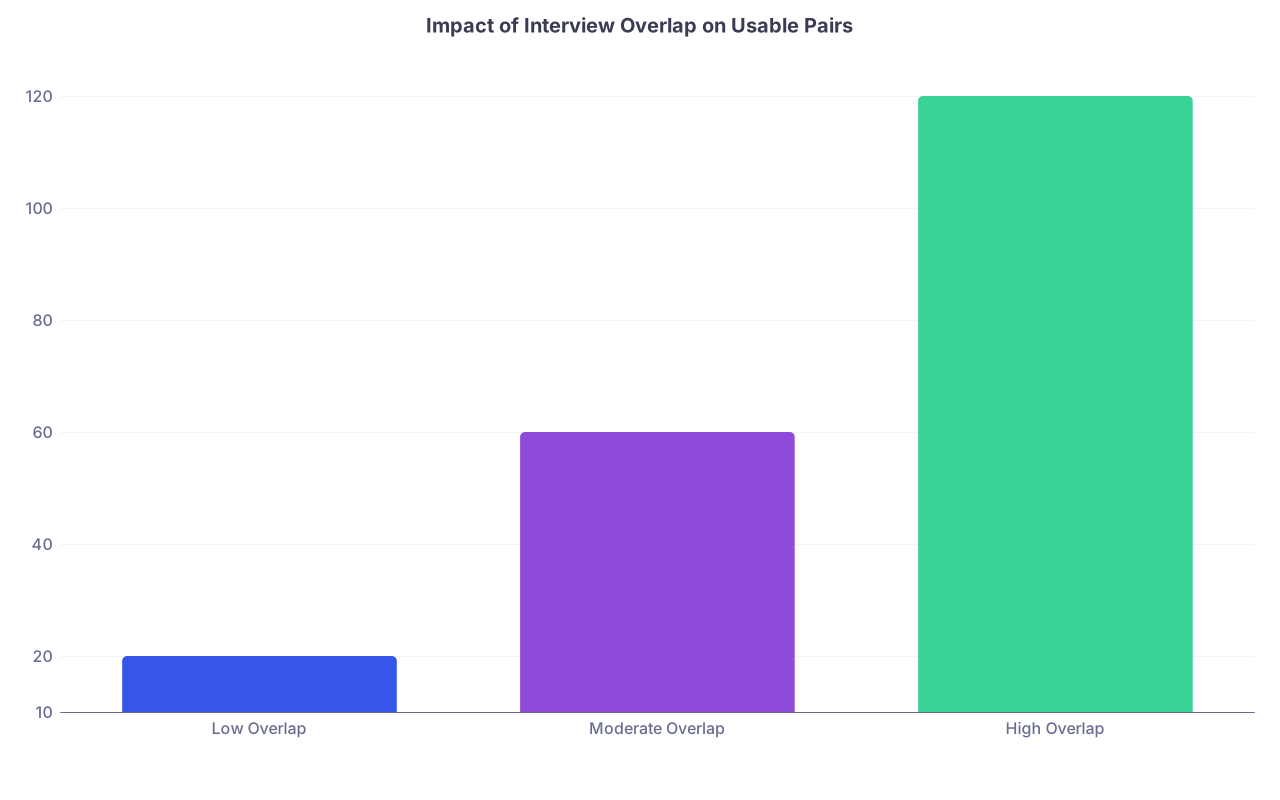
| Category | Value |
|---|---|
| Low Overlap | 20 |
| Moderate Overlap | 60 |
| High Overlap | 120 |
Same two fictional couples:
- Both applied to ~70 programs each.
- The only difference is how many interviews occurred in the same city.
The couple with high overlap ends up with 120+ pairs to rank.
The couple with low overlap has 20. One of those pairs will match. The other couple might not.
13. Common Dumb Moves That Break the Math
I have seen these over and over:
Independent application strategies
- Each partner builds their list in isolation.
- They only “see what overlap we get” afterward.
- Translation: You are trusting random chance to handle the single most important variable.
Pretending you are not risk averse
- Saying, “We’d be ok with long distance,” but then refusing to rank LD pairs.
- If you would truly rather go unmatched than do LD, admit that. Then increase your same-city pair count.
Overvaluing prestige for one partner
- One person refuses to consider mid-tier programs in cities where the other has strong options.
- Then both complain they "had no pairs."
No late-course correction
- You see early that interviews are geographically lopsided.
- You do nothing.
- You had time to add a few key applications where your partner is strong. You chose not to.
14. Step-by-Step Checklist You Can Actually Use
Let’s pull this into a direct protocol.
Before ERAS submission
- Decide:
- Must you match together this year?
- Or is “match separately vs not at all” acceptable?
- Pick risk level:
- Very risk averse / Moderate / Risk-tolerant.
- Set target:
- Same-city pairs: ___
- Total pairs (incl. safety/LD): ___
- Identify 3–6 priority metro areas/regions.
- Plan applications:
- For each region:
- You: ___ programs
- Partner: ___ programs
- For each region:
After interview season starts (by mid-October)
- Build a shared interview tracking sheet by city.
- Count current and projected potential pairs by region.
- If overlap is low:
- Add targeted applications to:
- Cities where one already has interviews.
- Nearby programs that may still send late invites.
- Add targeted applications to:
Before rank list certification
- Rank individually first.
- Build the joint grid with acceptability coloring.
- Construct joint list:
- Top: ideal same-city pairs.
- Middle: acceptable compromises.
- Bottom: LD and safety options (if you are willing).
- Count how many actual pairs are on the final list.
- Compare to your target.
- If far below and risk-averse, reevaluate where you can safely add “less perfect” but acceptable pairs.
15. Final Tight Summary
Three things I want you to remember:
- You are not trying to maximize “programs applied to.” You are trying to maximize usable pairs. Overlap by city is the engine.
- Decide your true risk tolerance and build a numerical target for same-city and total pairs. Then work backwards to how many programs each of you needs.
- Track your interview patterns in real time and adjust. The couples match punishes inertia. You do not get points for blind optimism.
If you build this deliberately instead of guessing, you stop being two people “hoping the algorithm is kind” and start acting like a joint project with a real plan. That is how you stack the odds in your favor.