
You just opened your ERAS token email. Your cursor hovers over “Enter USMLE/ECFMG Information.”
And your stomach drops.
Because you know what is coming:
- Step 1 – failed, then passed.
- Step 2 CK – two attempts.
- Maybe Step 3 – not first try either.
You are an IMG. Everyone already told you the exams had to be perfect. One attempt. High scores. Clean record.
That did not happen.
Now you are staring at a very real question:
“Is this over for me, or is there a way to build an application that programs will still take seriously?”
Let me be blunt:
No, it is not automatically over. But you do not get to apply like everyone else. You cannot pretend your application is standard. You need a different strategy, a different level of discipline, and a much tighter story.
This article is that strategy.
Step 1: Face the Problem Like a Program Director Would
Before you “reframe” anything, you need to see your file the way a PD or screening resident sees it. Not the way you wish they would.
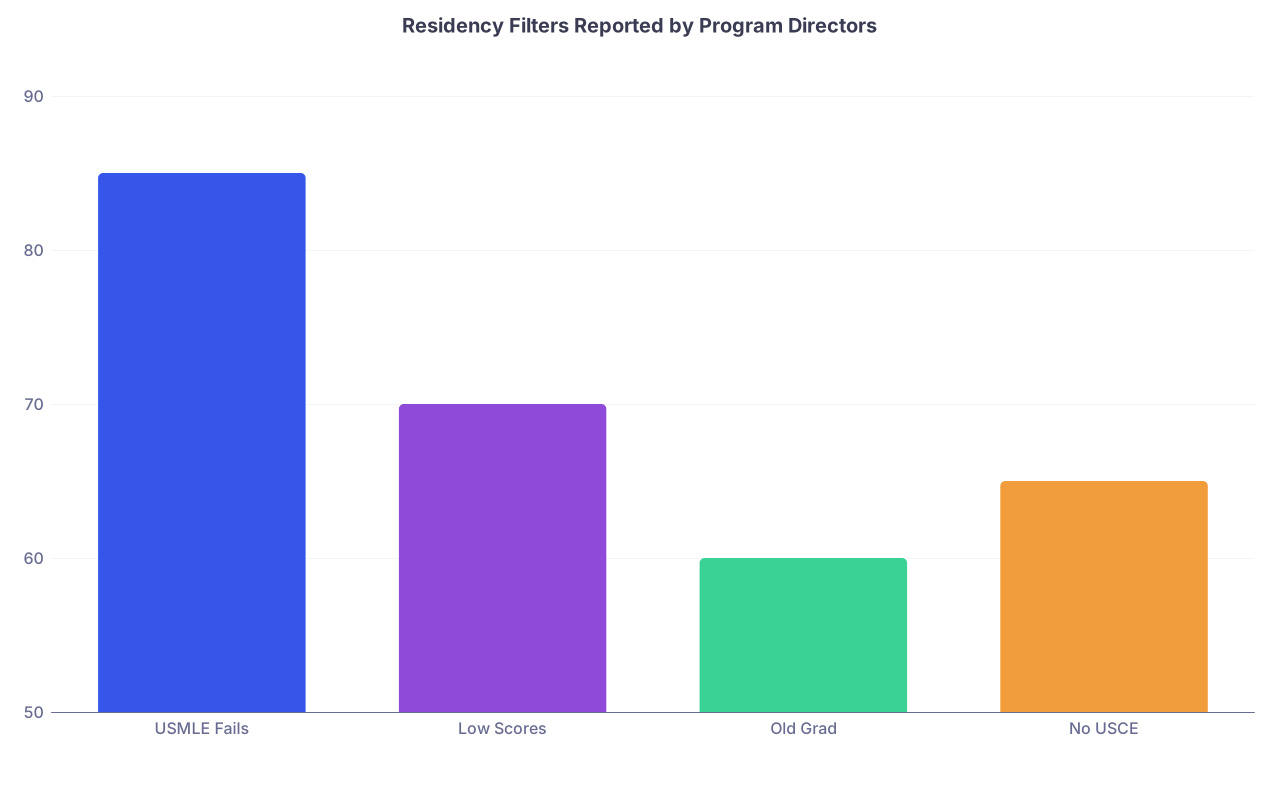
| Category | Value |
|---|---|
| USMLE Fails | 85 |
| Low Scores | 70 |
| Old Grad | 60 |
| No USCE | 65 |
How your multiple attempts look on their screen
Most programs have one of three reactions when they see multiple attempts:
Hard stop filter.
Some places auto-screen out:- Any Step 1 fail
- Any Step 2 CK fail
- More than 2 total attempts
You will not see these rejections. You will just never get an invite.
Conditional interest.
Others will look closer if:- Your most recent score is much stronger
- You have a compelling story (health issue, major life event, genuine improvement)
- You bring something they care about: research, strong US clinical experience, prior residency, unique skills
Contextual evaluation.
A small subset—often community or IMG-friendly programs—will actually read your whole file and ask:- Did this applicant recover?
- Are they reliable now?
- Are there clear signs they can pass boards on the first try from here on out?
Your job is to build an application that performs well with groups 2 and 3. Group 1 is gone; do not waste energy fantasizing about them.
You are not trying to win every program. You are trying to be a “yes” for a specific slice of the market.
Step 2: Clean Diagnosis – Why Did You Need Multiple Attempts?
You cannot reframe what you do not understand. Vague excuses will destroy you. So will silence.
You need a specific diagnosis of what went wrong and what you changed.
Common real causes I see:
- Language barrier and slow reading → timed exams killed you
- Poor study strategy → too many resources, not enough deep practice
- Unrealistic scheduling while working full-time
- Personal crisis (family illness, visa mess, financial disaster)
- Untreated health issues (depression, anxiety, ADHD, medical illness)
Write this down honestly, then force yourself to turn it into a brief, professional explanation.
Bad version:
“I struggled with test-taking and some personal issues and unfortunately needed multiple attempts.”
Good version:
“My first attempt at Step 1 coincided with a major family health crisis. I underestimated the impact on my focus and preparation and failed by a narrow margin. I took responsibility, stepped back to rebuild my study structure, and passed on my second attempt with a 21-point improvement from my NBME baseline.”
Notice:
- Direct.
- Concrete.
- Shows growth.
- No drama.
You will use this explanation in:
- Personal statement (1–2 sentences max)
- Possibly in ERAS “Additional Information”
- Interviews, when asked
If you cannot state your story clearly in 3–4 sentences, you are not ready to apply.
Step 3: Build a “Redemption Arc” – Show an Upward Trajectory
Programs do not just care that you failed. They care what happened after you failed.
You must show a clear upward trajectory that is impossible to ignore.
Areas where you need visible improvement
Later exams
- Higher Step 2 CK (if your Step 1 was weak)
- Step 3 passed on first attempt with decent score
- Any in-training exams (if you have them) showing improvement
Recent performance
- Strong letters commenting on reliability, knowledge, and clinical reasoning
- Recent USCE with good evaluations
- If in another country’s residency: solid performance, promotions, chief roles
-
- Research with accepted abstracts, posters, or publications
- Teaching roles, tutoring, curriculum work
You are trying to send a loud message:
“I am not the person who failed that exam three years ago. Here is the evidence.”
Step 4: Fix Your Exam Profile (If You Still Can)
If you still have any exams left (Step 2 CK or Step 3), you cannot afford another stumble. Your margin is gone.
You must treat the next test as your last chance to prove academic reliability.
Minimum standard you should aim for now
You want your next score to look like this:
| Situation | Target for Next Exam |
|---|---|
| Fail on Step 1, pass Step 2 CK | At or above specialty's average |
| Multiple Step 2 attempts | Solid Step 3 pass, no drama |
| Old grad with attempts | Clear recent exam success |
You do not need a 260. You need:
- One clean, well-prepared, first-attempt pass
- A score that suggests “this person will probably pass boards”
Non-negotiables for your next exam
Dedicated period
Stop trying to “fit” prep around chaotic full-time work if that is why you failed. Negotiate:- Reduced hours
- Different shift pattern
- Short unpaid leave if necessary
Another fail costs more than lost salary.
Limited resources, deep practice Use:
- One primary Qbank (UWorld or Amboss)
- Two NBME self-assessments minimum
- One main content source (Boards & Beyond / OnlineMedEd / similar)
No bouncing between six different textbooks. That is how people fail repeatedly.
Score thresholds before test day
Set hard rules before you test:- At least two NBME scores comfortably above your desired passing margin
- Qbank percent correct: ideally >60–65% on first pass (depending on baseline)
If you are not meeting these numbers, postpone. A later pass is better than another attempt.
Step 5: Reposition Your Specialty Targets
You cannot ignore specialty competitiveness. Multiple attempts push you down several rungs.
Here is the reality:
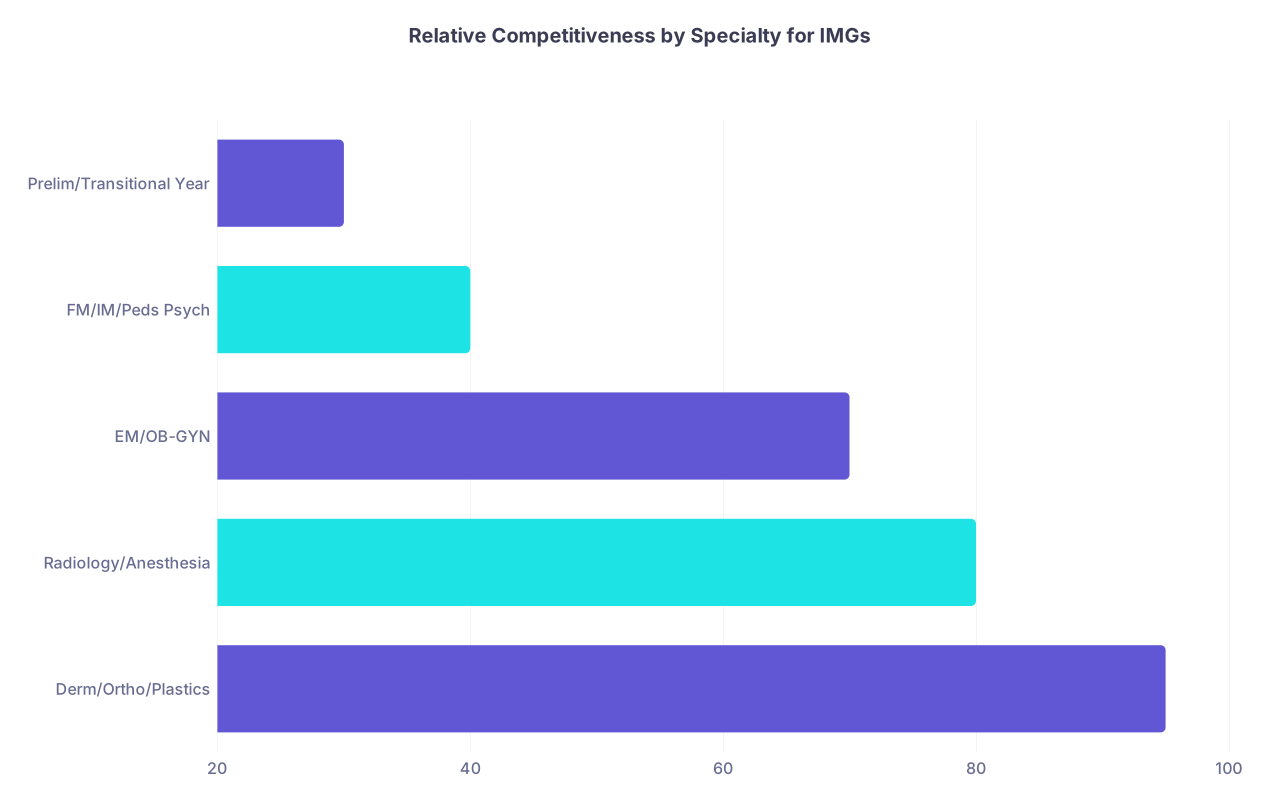
| Category | Value |
|---|---|
| Derm/Ortho/Plastics | 95 |
| Radiology/Anesthesia | 80 |
| EM/OB-GYN | 70 |
| FM/IM/Peds Psych | 40 |
| Prelim/Transitional Year | 30 |
With multiple attempts, chasing radiology, dermatology, or ortho is usually fantasy. I have seen exceptions, but they are outliers with:
- US MD or DO degree plus IMG background
- Extreme research pedigree (top 10 institution, multiple first-author papers)
- Strong connections
If you are a typical IMG with attempts, think in terms of probability, not ego.
More realistic primary targets
- Internal Medicine (especially community, non-university)
- Family Medicine
- Psychiatry
- Pediatrics (some programs still IMG-friendly)
- Transitional or prelim spots as a foot in the door
Then add a tiny number of “reach” programs only if you have strong compensating strengths.
You are not surrendering. You are choosing a winnable war.
Step 6: Rebuild the Application Around Your Strengths
You cannot build your story around your exam record. That is your liability. You build it around what you do well and where you add value.
Core pillars you need to strengthen
US Clinical Experience (USCE)
Not just any observership. The quality and recency matter.- Aim for: 3–6 months of meaningful USCE in your chosen specialty
- Prefer: hands-on externships or sub-intern level rotations if possible
- Minimum: observerships where you are actually seen and evaluated, not shadowing 10 feet behind someone
You want attendings who will say:
“This candidate functioned at the level of an intern on our service. Reliable. Hard working. Good fund of knowledge.”
That line in a letter can overpower a lot of doubt.
Letters of recommendation
Set a high bar. Weak or generic letters hurt you more than no letter.You want:
- At least 2 strong letters from US physicians in your chosen specialty
- 1 letter from someone senior (program director, clerkship director, department chair) if you can earn it
How to earn a good letter:
- Show up early, leave late
- Know your patients cold
- Offer to present, to teach med students, to help with research or QI
- Ask: “Is there anything I can do to be more helpful to the team?”
Research and academic work Not everyone needs this. With multiple attempts, it helps.
Reasonable goals:
- 1–3 abstracts accepted at conferences (even regional)
- 1–2 publications (case reports count, but try to add at least one original project or review)
- QI project in a US hospital with measurable outcome
Tell the story: “Once I realized exam scores might limit me, I invested in research and QI to contribute academically and improve patient care.”
Step 7: Reframe the Narrative – How You Talk About Your Attempts
This is where most applicants fail. They either:
- Over-explain and sound defensive
- Under-explain and look evasive
You need a controlled, disciplined narrative.
Where to address attempts
- Personal statement – one short paragraph, not the star of the show
- ERAS experiences – show actions: tutoring, mentorship, research, QI, leadership roles
- Interview answers – clear, practiced, not robotic
Template for your “exam story”
Build it in four parts:
Context (brief, no drama)
“During my preparation for Step 1, I was balancing full-time clinical work in my home country with exam study and a significant family health issue.”
What went wrong (own it)
“I overestimated my ability to manage everything and under-prepared. I failed my first attempt.”
What you changed (this is critical)
“I took this seriously. I adjusted my schedule, reduced outside commitments, structured my study using a single resource and daily questions, and met regularly with a mentor to review my progress.”
Evidence of improvement
“With this approach, I passed on my second attempt and later passed Step 2 CK and Step 3 on the first attempt. The same structured methods now guide how I prepare for patients and stay up to date clinically.”
Deliver this calmly. No self-pity. No blaming.
Then pivot to your strengths:
“Since then, my focus has been on proving reliability in my clinical work, which is reflected in my recent US evaluations and letters.”
Step 8: Target Programs Intelligently (Not Desperately)
Spray-and-pray is how you burn money and ego. Strategy beats volume.
Know your real competitiveness tier
If you have:
- Multiple attempts
- Older year of graduation
- Limited USCE
You are not competing in the same space as:
- Fresh grads with 250+ scores
- US MDs with honors everywhere
You need to find the programs that match your profile.
Use data and signals
Look for programs that:
- Explicitly accept multiple attempts (website or NRMP/ERAS data)
- Have high IMG percentages in current residents
- Are community-based or lower-tier university affiliates
- Are located away from the “hot” cities (New York, California, major coastal hubs)

Do not romanticize prestige. You want a place that will train you, sponsor your visa if needed, and get you board certified.
Step 9: Clean Up the Rest of Your File – No More Red Flags
Multiple attempts are already one red flag. You do not get to have three more.
Go through your application looking for anything else that screams “risk”:
- Large unexplained gaps → briefly explain with something constructive (family, research, USCE, health)
- Repeated failures in medical school → explain pattern and subsequent improvement
- Unfinished degrees or jobs with no reason for leaving → add a short, neutral explanation
You want the reviewer to think:
“Yes, there is a history. But the last 2–3 years look solid, consistent, and professional.”
Step 10: Use the Interview to Close the Loop
If you get an interview, understand what that means:
They already know about your attempts and invited you anyway.
So at that point, they are testing three things:
- Are you honest and self-aware?
- Are you going to struggle with in-training exams and boards?
- Are you someone they can trust at 3 a.m. on call?
How to handle the exam question in interviews
You will likely hear:
“I see you had multiple attempts on your exams. Can you tell me about that?”
Your answer should be:
- 60–90 seconds
- Same 4-part structure as before (context → issue → change → results)
- Calm, matter-of-fact tone
Then pivot:
“Since then I have focused on strengthening my clinical performance. On my recent US rotations, I consistently took on intern-level responsibilities, and my supervisors commented on my reliability and growth. That is how I plan to approach in-training exams as well: structured preparation, early start, and accountability with my seniors.”
You want them thinking:
“Okay. They had a rough start, but they are stable now.”
Step 11: Consider a Two-Step Path if Necessary
Some of you are too far behind for a direct categorical spot right away. Harsh, but true.
That does not mean game over. It means you may need an intermediate stage:
Options that can significantly help
Prelim or transitional year
- One-year contract
- Chance to prove yourself in the US system
- Strong in-house advocates for next match cycle
Works best if:
- You are willing to reapply aggressively after PGY-1
- You perform extremely well during that year
Research year in the US
- Real position in a department related to your target specialty
- Aim for output: abstracts, posters, manuscripts
- Build deep relationships with faculty who can vouch for you
Home-country residency first, then US move
- Complete or partially complete residency at home
- Apply later with a strong track record and clear subspecialty interest

| Step | Description |
|---|---|
| Step 1 | Current IMG with multiple attempts |
| Step 2 | Apply broadly to IMG friendly programs |
| Step 3 | Consider two step pathway |
| Step 4 | Prelim year in IM or FM |
| Step 5 | US research position |
| Step 6 | Residency in home country |
| Step 7 | Stronger profile for future match |
| Step 8 | Competitive for direct categorical? |
Choosing a two-step path is not failure. It is strategy.
Step 12: Psychological Reset – You Cannot Apply From a Place of Shame
Here is the part almost nobody talks about: the mental load.
If you walk into this process carrying shame and embarrassment like a backpack full of rocks, it shows:
- In how you write
- In how you speak
- In how you answer questions
You need a different internal script.
Not “I am the one who failed exams.”
More like “I am the one who learned the hard way, changed, and kept going.”
That does not mean denial. It means you integrate your failures into a coherent story of growth instead of letting them define you.
What You Need to Do This Week
Do not just read this and go back to scrolling forums.
Here is a concrete plan for the next seven days:
Day 1–2: Write your exam story
- 3–4 sentences: what happened, what you changed, how you improved
- One version for personal statement, one shorter version for interviews
Day 3: Audit your current profile
- Exams: list all scores, attempts, dates
- USCE: months, type, location
- Research: projects, output
- Gaps: any unexplained period >3 months
Day 4: Pick your primary specialty and backup
- Based on reality: attempts + scores + year of graduation
- Make a list of 30–50 IMG-friendly programs for that specialty
Day 5–6: Reach out for higher-yield opportunities
- Email 5–10 US physicians about potential observerships, externships, or research roles
- Ask old supervisors for updated letters with specific strengths mentioned
Day 7: Rewrite your personal statement start
- Delete any abstract “why I love medicine” fluff
- Open with a clinical moment that shows who you are now, not your exam history
- Insert your exam explanation as one controlled, professional paragraph
Do that this week. Then you can worry about the rest.
Open a blank document right now and write your 3–4 sentence “exam story” exactly as you would want to say it in an interview. No more than 150 words. That is the core you will build your entire reframed application around.