Most IMGs do not fail the Match because they are “not good enough.” They fail because they waste a tiny budget on the wrong programs, at the wrong time, with the wrong message.
You cannot out-spend U.S. grads or wealthy applicants. You must out-strategize them.
This guide gives you a concrete, step-by-step system to:
- Decide how many programs you can afford
- Prioritize programs like a sniper, not a sprinkler
- Use a tight communication script (emails, ERAS messages, calls) that actually moves your application instead of annoying coordinators
If your budget is limited and your instinct is “apply everywhere and pray,” stop. That is how you burn money and still end up unmatched.
Let us build a real plan.
1. Know Your Numbers First (Brutal but Necessary)
You cannot build a prioritization strategy without hard numbers. Guessing is for people with unlimited funds.
Step 1: Define your total realistic match budget
Include everything:
- ERAS application fees
- NRMP registration
- USMLE transcript fees
- OET / ECFMG-related fees (if applicable this season)
- Extra documents (certifications, translations, notarizations)
- Interview expenses: travel OR remote setup upgrade (decent webcam, mic, clothes)
Now, pull actual numbers.
| Item | Typical Cost (USD) |
|---|---|
| NRMP Registration | 85–100 |
| ERAS Token + First 10 Programs | ~700–750 |
| Additional Programs (each, 11–20) | 19 |
| Additional Programs (each, 21–30) | 23 |
| Additional Programs (each, 31+) | 27 |
| USMLE Transcript (one-time to ERAS) | 80 |
Check current-year fees; they change. But you need a working budget today.
Example:
You have $1500 total available for the entire cycle.
- Subtract fixed costs:
- NRMP: $100
- ERAS token + first 10: ~$750
- USMLE transcript: $80
Remaining: $1500 − (100 + 750 + 80) = $570 for extra programs + interviews.
You are not “broke.” You just need surgical precision.
Step 2: Decide your maximum number of programs
Use your remaining ERAS budget and a rough per-program cost.
For simplicity, assume your average cost per additional program will sit between the tiers, say around $23.
$570 / $23 ≈ 24 additional programs.
So:
- 10 programs (included in base ERAS)
- +24 extra programs
Max total: ~34 programs.
That is your hard ceiling. Not “hope number.” Hard ceiling. You will not exceed it.
If your budget is even smaller (for example total $1000), that ceiling might be 20–25 programs. Then strategy becomes even more critical.
2. Classify Yourself Honestly Before You Pick Programs
Where you apply depends heavily on how competitive you are. You must label yourself correctly. Delusion is expensive.
Let us define three broad IMG profiles for core specialties (Internal Medicine, Family Medicine, Pediatrics, Psychiatry, Neurology). Surgery and highly competitive specialties are a different game; if you want those on a tight budget with weak scores, you are gambling.
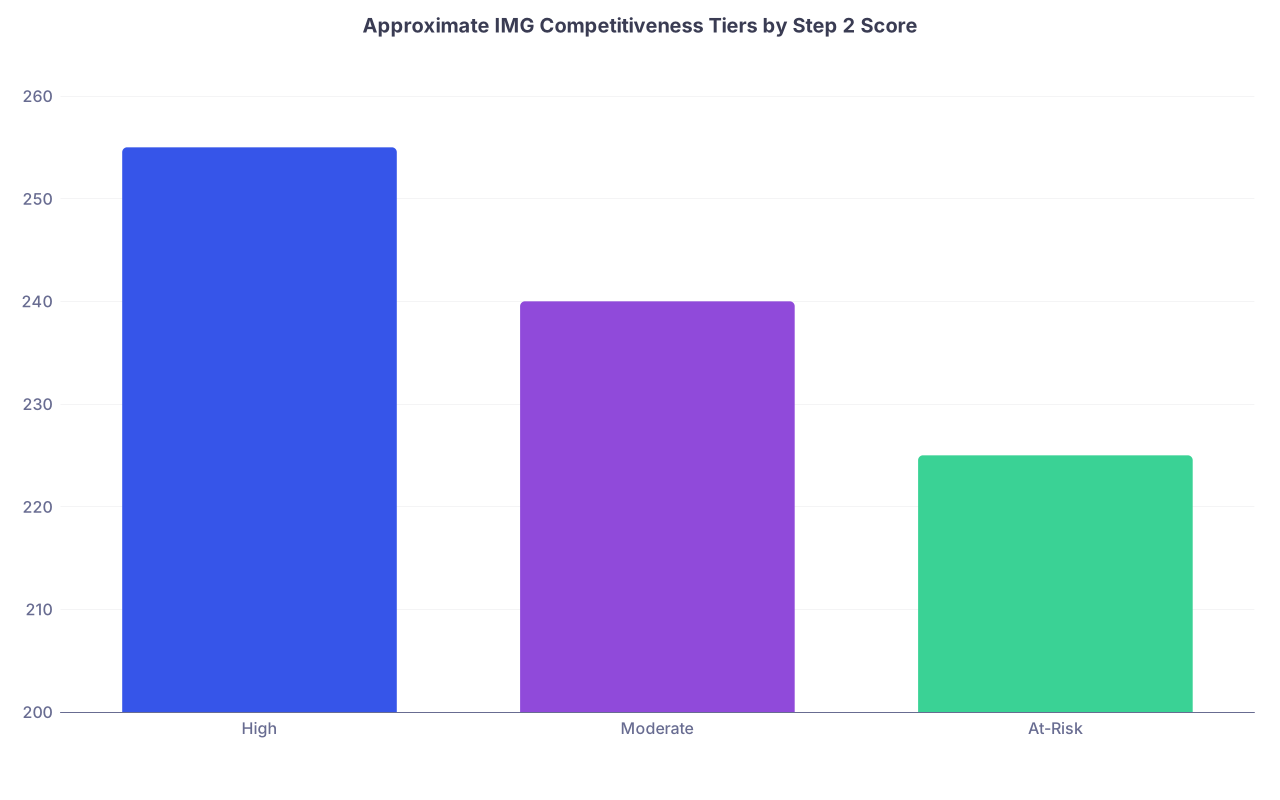
| Category | Value |
|---|---|
| High | 255 |
| Moderate | 240 |
| At-Risk | 225 |
Tier A: Strong IMG
- Step 2 CK: ≥ 250
- Recent YOG (≤ 3–4 years)
- Multiple U.S. clinical experiences (hands-on preferred)
- Strong letters from U.S. faculty
- No exam failures
Tier B: Moderate IMG
- Step 2 CK: 235–249
- YOG up to ~6–8 years
- At least 1–2 U.S. clinical experiences (observerships okay)
- Maybe one weaker spot (older YOG, average letters, borderline English)
- No or single marginal red flag (e.g., one attempt but many years ago + strong recent work)
Tier C: At-Risk IMG
- Step 2 CK: < 235 or any exam failure
- Older YOG (> 8–10 years)
- Little or no U.S. clinical experience
- Mixed portfolio: some research, some home-country experience, but not aligned to U.S. programs
- Visa required
You know where you fit. Stop pretending you belong in another tier; you are designing a budgeted strategy, not a fantasy.
3. Program List Strategy: How to Build a Targeted List on a Small Budget
You cannot browse casually. You need a filtering pipeline.
We will build your list in three passes:
- Hard filters – immediate disqualifiers
- Priority scoring – ranking realistic programs
- Budget fitting – trimming to your exact number
Step 1: Set hard filters
Non-negotiables. If a program fails any of these, you do not apply. Period.
Hard filters for most IMGs should include:
- Visa:
- If you need sponsorship, only programs that sponsor your visa type (usual: J‑1; sometimes H‑1B).
- USMLE failures:
- If a program explicitly states “no attempts” and you have a failure → out.
- YOG limit:
- If program states “YOG ≤ 5 years” and you are 10 years out → out.
- IMG friendliness (history):
- Programs with 0–5% IMGs in the last years are almost always a waste for most IMGs, especially with low budgets.
Make a simple spreadsheet (Google Sheets is fine):
Columns:
- Program name
- Specialty
- State
- Visa (Y/N, which)
- YOG limit
- IMG % (approximate from FREIDA / website / forums)
- Minimum scores / attempt policy
- Notes
If any hard filter is failed, mark that row RED – EXCLUDE.
This alone can cut 40–60% of programs and save you hundreds of dollars.
Step 2: Build a simple priority score
Now, for remaining programs, score them from 1–5 in these areas:
IMG Friendliness (IF)
- 5 = Many IMGs, historically welcoming
- 3 = Some IMGs, mixed
- 1 = Rare IMGs but not banned
Fit to Your Profile (FP)
- Score based on how close your Step 2, YOG, visa needs, and experiences are to what they state or typically show.
- 5 = You meet or exceed all typical criteria
- 3 = You are slightly below somewhere but still plausible
- 1 = You just barely scrape their minimums
Location and Practicality (LP)
- You cannot afford 10 in-person interviews scattered across the U.S. if you are on a tight budget.
- 5 = Region where you have family/friends / cheap stay / easy travel / multiple programs nearby (clusters)
- 3 = Neutral location, some travel flexibility
- 1 = Remote, isolated, expensive to reach
Define your total priority score:
Total Score (TS) = IF + FP + LP (range: 3 to 15)
Then rank programs from highest to lowest TS.
Patterns you will see:
- Some “famous” university programs will have low IMG Friendliness and Fit but high prestige. Those are poisonous for your budget.
- Some small community hospitals in less-popular states will have high IF and FP and neutral LP. Those are your gold mines.
Step 3: Divide into tiers: Core, Stretch, Long-Shot
Use your TS and your own judgment.
As a guideline:
- Core programs: TS 11–15
- Stretch programs: TS 8–10
- Long-shot programs: TS ≤ 7 but have something you like (location, research, specific interest)
How many in each depends on your competitiveness:
| IMG Tier | Core (%) | Stretch (%) | Long-shot (%) |
|---|---|---|---|
| Strong | 60 | 30 | 10 |
| Moderate | 70 | 25 | 5 |
| At-Risk | 80 | 20 | 0 |
If your ceiling is 34 programs and you are a Moderate IMG:
- ~24 Core
- ~8 Stretch
- ~2 Long-shot
If your spreadsheet has 60–70 “possible” programs, ruthless cutting will be uncomfortable. Do it anyway. Your wallet demands it.
4. State and Region Strategy: Cluster to Save Money
You are not just paying to apply. You are paying to interview. On a limited match budget, you must think about geography.
Rule: Apply in clusters, not randomly
Pick 2–4 key states or regions based on:
- High IMG friendliness
- Visa sponsorship
- Affordable travel and lodging for you
- Programs packed within reasonable radius (same metro / neighboring cities)
Typical high-IMG states:
- New York
- New Jersey
- Michigan
- Illinois
- Florida
- Texas (but visa and competition may be tough in some areas)
Are there exceptions? Of course. But if you apply to 5 states in all far directions and get 3 interviews, you can blow half your budget on 3 flights and 3 sets of hotels.
Instead, imagine this cluster approach:
- Northeast cluster: New York / New Jersey / Pennsylvania
- Midwest cluster: Michigan / Ohio / Illinois
Interviews in each cluster can often be grouped into a single trip or even done remotely in same time zones if virtual remains common.
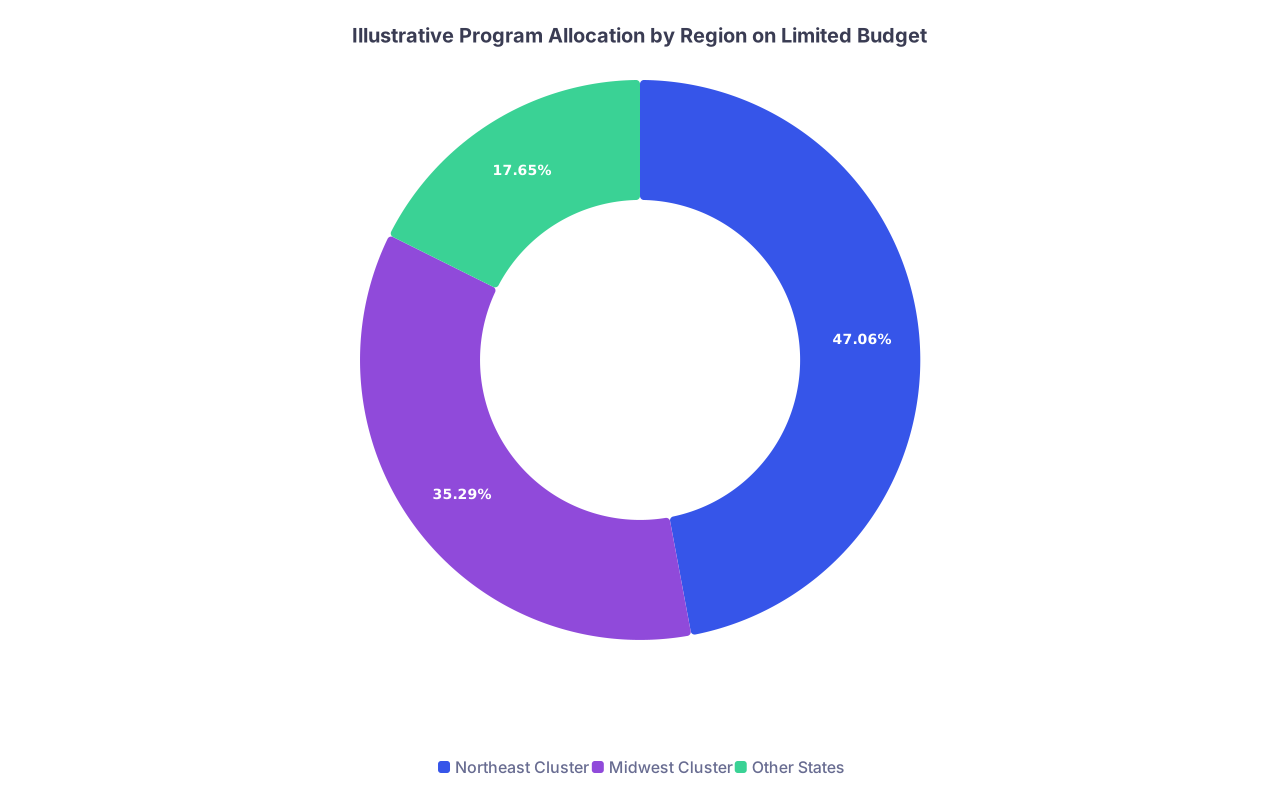
| Category | Value |
|---|---|
| Northeast Cluster | 16 |
| Midwest Cluster | 12 |
| Other States | 6 |
You are fighting for efficiency. Every cluster is a potential multi-interview trip instead of one flight per interview.
5. Timing Strategy: When to Apply with Limited Money
Another quiet killer: late applications.
With a small budget, you simply cannot afford to waste even one application on a program that is already closing doors.
Your protocol:
Have your entire list ready before ERAS opens for submission.
No last-minute scrambling that leads you to add random programs at 2 am.Apply on the first possible submission day with your carefully chosen list.
Early visibility boosts your chances, especially at IMG-friendly community programs that fill interview spots quickly.Do not “save money” by waiting to see if interviews come before applying more.
With a small budget, you must get maximum return from early targeted applications, not late scattered ones.
If you are very tight on cash and truly cannot submit your full planned list at once, then:
- Submit your highest TS “Core” programs on day 1 (e.g., 20–25).
- Hold back a smaller secondary list (say 8–10 programs) that you will apply to in 2–3 weeks only if your interview response is terrible.
- But understand: this is second-best. You pay a penalty for late apps.
6. Communication Script: How to Reach Out Without Sounding Desperate
Most IMGs either never email programs or they spam them with embarrassing messages.
You are not doing either. You will send lean, targeted, respectful messages that:
- Show you did your homework
- Emphasize fit
- Do not beg
Use different scripts for:
- Before interview invites
- After interview invite
- After interview, when ranked or hoping to be ranked
6.1 Pre-interview interest email (before invites)
Use sparingly. Focus on your top 10–15 core programs where you are a very good fit.
Subject line options:
- “Inquiry from IMG applicant – [Your Name], [Specialty] Applicant”
- “Interest in [Program Name] – [Your Name], IMG Applicant”
Template:
Dear Dr. [Last Name] / Program Coordinator,
My name is [Full Name], an international medical graduate from [Country] applying to [Specialty] this season. I recently submitted my application to [Program Name] and wanted to briefly express my specific interest in your program.
[1–2 sentences about alignment]
Example:
During my clinical experience at [U.S. institution], I worked extensively with underserved communities and saw the impact of continuity primary care. Your program’s emphasis on [clinic type / community hospital / underserved population] and longitudinal clinic at [site] strongly aligns with my goals.I completed Step 2 CK with a score of [Score], am ECFMG certified (or will be by [month/year]), and require [J‑1 / H‑1B] visa sponsorship.
If there is any additional information I can provide to assist in the review of my application, I would be happy to send it.
Thank you for your time and consideration.
Sincerely,
[Full Name]
AAMC ID: [ID]
Key points:
- Short. No life story.
- Direct about visa.
- A specific reason, not “I love your program so much.”
Do not send this to 100 programs. Focus on ones where you already look good on paper and where a nudge could help.
6.2 Response to interview invitation (budget-aware)
You must accept or decline quickly and smartly.
If it is a program in your priority cluster:
Dear [Coordinator Name],
Thank you very much for the invitation to interview for the [Specialty] residency position at [Program Name]. I am honored and excited for the opportunity.
I confirm my availability for the interview on [Date/Time]. Please let me know if there are any additional steps or documents required beforehand.
Sincerely,
[Name]
If it is outside your clusters, and your budget is extremely tight, you must make a hard choice. Do not automatically say yes.
Ask yourself:
- Is this program more valuable than a cluster program I might still get?
- Can I realistically afford travel (if in-person)?
- Would attending this interview force me to decline others later because of money?
Sometimes the correct move is to decline a distant, expensive interview to save funds for multiple cluster interviews. Painful, but rational.
If you must ask about virtual option:
Dear [Coordinator Name],
Thank you for the invitation to interview at [Program Name]. I am very interested in your program.
I am currently based in [Country/State] and, due to financial constraints this season, I am trying to minimize long-distance travel. I wanted to kindly ask if there might be a possibility for a virtual interview, if the program offers this option.
I completely understand if all interviews are in-person only and will respect the program’s policy.
Thank you again for considering my application.
Sincerely,
[Name]
Do not push. Ask once. Accept their policy.
6.3 Post-interview thank-you email
Skip long emotional essays. Short, professional notes are enough.
Send to:
- Program director
- One or two key faculty interviewers
Template:
Dear Dr. [Last Name],
Thank you for taking the time to speak with me during my interview at [Program Name] on [date]. I appreciated learning more about your program’s [specific item: curriculum structure / patient population / mentorship approach].
Our discussion about [specific topic you discussed] reinforced my interest in training at [Program Name].
Thank you again for your time and consideration.
Sincerely,
[Name]
No promises. No “I will rank you #1” yet.
6.4 Post-interview “strong interest” or “rank” email
If you are going to send a “I will rank you highly” or “I will rank you #1” message, do it late in the season (after your interviews are mostly done) and be honest. Do not send “You are my #1” to five programs. Programs talk.
A simple “strong interest” version:
Dear Dr. [Last Name],
I wanted to again thank you and your team for the opportunity to interview at [Program Name]. After completing my interviews this season and reflecting on what I am looking for in a training program, [Program Name] stands out as one of my top choices.
The combination of [specific detail 1] and [detail 2] strongly matches my goals in [career interest]. I would be honored to train at your program.
Thank you for your consideration.
Sincerely,
[Name]
If you choose to send a true “you are my #1” email, send to exactly one program. Not mandatory, but if you do it, mean it.
7. Decision Rules: How to Adjust Mid-Season Without Blowing the Budget
You need a simple decision tree. Otherwise, fear will make you throw more money at the problem in November.
Here is a compact flow idea:

| Step | Description |
|---|---|
| Step 1 | Applications Submitted |
| Step 2 | Wait 3-4 Weeks |
| Step 3 | Stay with Current List |
| Step 4 | Send Targeted Interest Emails |
| Step 5 | Apply to Backup Programs |
| Step 6 | Use Remaining Budget on High-TS IMG-Friendly Programs |
| Step 7 | Reassess After 2 Weeks |
| Step 8 | Consider Off-cycle Plans or Research Year |
| Step 9 | Any Interview Invites? |
| Step 10 | Total Invites >=5? |
Concrete rules:
- If by 3–4 weeks after application release you have:
- 0 invites → Use remaining budget to apply to a second small batch of very IMG-friendly programs only (preferably you pre-identified them).
- 1–2 invites → Send targeted pre-interview emails to top 10–15 programs where you are strong. Then wait another 2 weeks before spending more.
- 3–5+ invites → Do not panic-apply to another 30 programs. Focus on doing well in these interviews.
If by late December you have zero interviews and no budget left, your problem is not the program list anymore. It is your profile. Then the solution is not “more random applications.” It is:
- U.S. clinical experience
- Research year
- Score improvement (if still possible)
- Better letters and networking
8. Common Money-Wasting Mistakes IMGs Make (That You Will Avoid)
Let me be direct. I have seen these destroy cycles:
Applying to 150+ programs with a weak profile “just in case.”
It empties accounts and gives 1–2 low-yield interviews, if any.Ignoring stated filters.
If a program explicitly says “No visa sponsorship” and you need a visa, your $27 went straight to the trash.Chasing big-name university programs with no IMG history.
Prestige does not override their institutional bias.Random geographic scatter.
One program in California, one in Florida, one in Maine. Weekly flights at $600 each. Not sustainable.Being late.
Submitting in October or November because of money issues. That just means you pay almost full price for one-third the chances.Sending long, desperate emails.
No one reads three-page personal stories in a cold email. You waste time and hurt your image.
You avoid all of this by following the system above.
9. Putting It All Together: A Sample Lean Strategy
Let me sketch what a smart limited-budget season could look like for a Moderate IMG with $1500 total.
- Step 1: Confirm total budget and calculate max programs (~34).
- Step 2: Hard-filter all programs by:
- Visa: J‑1 sponsorship only
- No ban on attempts (you have 1 CS failure)
- YOG accepted up to 10 years
- Step 3: Score remaining programs on IMG friendliness, fit, and location practicality.
- Step 4: Choose 2 main clusters:
- Northeast (NY/NJ/PA) – 18 programs
- Midwest (MI/IL/OH) – 12 programs
- Plus 4 “wild card” programs in states with good IMG history
- Step 5: Mark:
- 24 Core
- 8 Stretch
- 2 Long-shot
- Step 6: Apply to all 34 on day 1.
- Step 7: Two weeks later:
- 2 interview invites (MI, NY) → good sign but still light.
- Send concise pre-interview emails to top 12 Core programs without invites yet.
- Step 8: By mid-November:
- 6 total interview invites (4 in clusters, 2 scattered).
- Decline 1 very remote, expensive in-person interview outside clusters.
- Focus on 5 interviews: all virtual or in 2 groups of travel.
- Step 9: Prepare thoroughly for each interview, send clean thank-you emails, one “strong interest” message to your top program in December.
This approach respects the budget, maximizes return on each dollar, and gives a realistic chance to match—much better than spraying 120 random applications.
10. Your Next Action Today
Do not just “think about” this strategy. Open a blank spreadsheet right now and do three things:
- Set your hard financial ceiling in dollars and translate it into a maximum number of programs.
- Write your three hard filters (visa, YOG, IMG history or score policies).
- List 10 programs you are considering and mark which fail your hard filters.
If you actually do that, you will feel something important: control. And from control, you can build a deliberate match plan, even on a limited budget.