
The way most interns prioritize tasks on call is backwards—and that’s why they feel constantly behind.
You do not need more hustle. You need a ruthless, simple system for deciding what happens next when everything feels urgent.
Here’s that system.
The Core Rule: Sickest First, Unstable Before Inconvenient
On a busy call night, you’re not prioritizing “what’s fastest” or “who paged first.” You’re prioritizing based on clinical risk.
Strip it down to this:
- Unstable or potentially unstable patients
- New or unclear problems that could become unstable
- Time-sensitive but not life-threatening tasks
- Routine/administrative work
That’s the backbone. Now let’s make it practical so you can actually use it at 2 a.m. when five pages hit at once.
Step 1: Build a Mental Triage Grid for Every Page
When your pager explodes, you need a mental habit, not a panic response.
For every new task or page, ask yourself three questions in under 10 seconds:
- Could this kill or significantly harm the patient in the next 30–60 minutes?
- Is this a new, unexplained change or a concerning trend?
- Is there a clock on this task (med timing, OR, transfusion, lab draw, admission clock)?
Your answers drop into a simple priority bucket:
| Priority Level | Examples |
|---|---|
| Level 1: Emergent | Hypotension, chest pain, acute neuro change |
| Level 2: Urgent | New hypoxia, rising lactate, uncontrolled pain |
| Level 3: Time-Sensitive | Antibiotic due, admission orders, pre-op labs |
| Level 4: Routine | Diet changes, bowel reg, discharge paperwork |
You don’t need to announce this grid. Just run it silently in your head.
If the answer to question 1 is “yes” or even “maybe,” that task jumps to the front. Everything else waits.
Step 2: Learn What Actually Counts as “Emergent”
Interns often under-react to truly dangerous changes and over-react to noise. Here’s the blunt version.
Things that usually go to the top of the list immediately:
- Hypotension or MAP < 65 (especially if new)
- New O2 requirement or sat drop (e.g., 100% → 88% on room air)
- Acute chest pain, shortness of breath, or new arrhythmia
- Any acute mental status change (confusion, agitation, unresponsiveness)
- Focal neurologic deficits (facial droop, weakness, word-finding issues)
- Uncontrolled bleeding or suspected GI bleed (melena, hematemesis, large bloody stool)
- Sepsis flags: high fever + hypotension or tachycardia + altered mental status
- Post-op patient with concerning vitals or severe pain out of proportion
These are drop-what-you’re-doing items. You either go see them now, or—if you’re truly tied up in a code-level situation—you:
- Call a senior or rapid response
- Give a clear, brief handoff: “I’m in a code. Can someone see Room 14 with new O2 requirement to 6L and sats 88%?”
If you're not sure whether something is emergent, default to treating it like it is until you’ve laid eyes on the patient or have enough data to safely downgrade.
Step 3: Script How You Triage When 3–4 Pages Hit at Once
You’ll get this scenario a lot:
- Page 1: “FYI, BP 82/48, patient looks a little pale.”
- Page 2: “Patient wants sleep meds.”
- Page 3: “New temp 38.9, soft BPs, more confused than this morning.”
- Page 4: “Family wants to talk about code status.”
Here’s how I’d rank that:
- Page 1 and 3: Both may be septic/unstable – go see one, then the other
- If one sounds clearly sicker (e.g., MAP in the 50s, now 6L NC), see that one first.
- On the way, call the nurse for the other room: “Draw lactate, repeat vitals; I’m coming as soon as I see my other unstable patient.”
- Page 4: Can wait 30–60 minutes unless there’s an active end-of-life issue.
- Page 2: Lowest priority. Answer later or bundle with your bedside pass-through.
The point: order isn’t about “who paged first.” It’s about who can crash fastest.
Step 4: Have a Default Order for Common Night Tasks
Once the true emergencies are stabilized (or at least in motion), you still have a pile of work:
- New admissions
- Cross-cover issues
- Med reconciliations
- Pain and nausea control
- Order clarifications
- Discharge summaries for tomorrow
- Notes you haven’t finished
You need a default order of operations so you’re not deciding from scratch every time.
Here’s a reasonable baseline on a typical floor call night:
- Active clinical problems that are getting worse
- Rising creatinine with no fluids ordered
- Recurrent fevers with no cultures/antibiotics
- Pain 8–10/10 despite PRNs
- Time-locked items
- Stat or now meds
- Antibiotic first dose
- Insulin around meals/bedtime
- Pre-op labs or imaging needed by a certain hour
- New admissions
- Especially if ED is calling repeatedly; you do not want boarding with no orders
- “FYI” pages that you’ve triaged as stable
- Mild tachycardia in an anxious, otherwise stable patient
- Slightly low electrolyte that can be replaced with routine orders
- Paperwork and notes
- Finish notes when your pager quiets down or in between calls
- Discharge summaries can wait unless attending explicitly said otherwise
This is not rigid. If your ED admission is septic and on pressors, they jump right to category 1.
Step 5: Use Bundling—Stop Doing One-Off Trips
A hidden time killer: running to the same pod three different times in 40 minutes because you handled every page in strict time order.
Instead, once you’ve triaged emergent stuff, bundle:
- If you’re going to see Room 12 for new hypoxia, check your pager:
- Any other issues in that hallway? Room 10 wants pain meds; Room 14 has a bladder scan question.
- You can reassure the nurse: “I’m heading to that pod. I’ll see 12 first, then 10 and 14.”
At the computer, bundle orders and documentation:
- Admit order set for your new patient
- While labs are populating, sign pending routine orders
- Then move on to the next admission or sick call
You will not always be able to bundle perfectly. But even small bundling wins (3 tasks in 1 trip instead of 3 trips) keep you sane at 4 a.m.
Step 6: Learn When to Interrupt Yourself
You’re writing admit orders when a new page comes: “Room 5, chest pain.”
You do not finish your beautiful H&P first. You stop, triage, and possibly walk away from what you’re doing.
Use this rule:
- Any potential Level 1 problem? Stop your current non-urgent task and assess.
- Level 2 urgent issue? Pause after you complete a natural breakpoint (e.g., finish ordering antibiotics, then go).
- Level 3–4? Jot them on your list and keep working until you hit a gap.
If your brain screams “this could be bad,” you listen to that more than your desire to check a box off the to-do list.
Step 7: Run a Simple “What Next?” Check Every 30–60 Minutes
You need to keep reordering the deck. Situations change. Labs come back. Patients decompensate out of nowhere.
Every 30–60 minutes (or after you finish a big chunk of work), take 60–90 seconds and:
- Glance at:
- Vitals dashboard
- New labs
- Pages you haven’t answered
- Ask:
- Has anyone newly crossed into “could crash in the next hour” territory?
- What is the single most important thing I can impact in the next 10–15 minutes?
Write the next 3 tasks on a sticky note or index card. Then do them in that order. Don’t re-triage every 2 minutes unless something major changes.
This reduces that spinning, “I’m doing a million small things and nothing important is done” feeling.
Step 8: Decide When to Call for Help (Sooner Than You Think)
A lot of interns wait too long to escalate, either because they’re afraid of “bothering” their senior or they don’t want to look clueless.
Here are clear triggers to call a senior or attending:
- You have two or more Level 1 issues at once and physically cannot be in both places
- You’re in a room with a patient who looks bad and you’re thinking, “I’m out of my depth”
- You’re considering ICU transfer, rapid response, or code status change
- You’ve seen a patient for the same issue 2–3 times and they’re not improving
- The ED is pushing admissions and you’re already drowning in unstable floor patients
What you say matters. Keep it tight:
“I’ve got three sick problems at once. One hypotensive on 4L, another with new neuro deficit, and a septic ED admit still in triage. I can’t safely handle this alone. Can you help prioritize or see one of these with me?”
That’s not weakness. That’s good triage judgment.
Step 9: Use a Quick Visual System to Track Tasks
If you try to keep everything in your head on a busy night, you will forget something real and important. Everyone does.
I like a simple 3-column scratch pad (paper or a text file):
- Left: Emergent/Urgent (Levels 1–2)
- Middle: Time-Sensitive (Level 3)
- Right: Routine/To Close the Loop (Level 4)
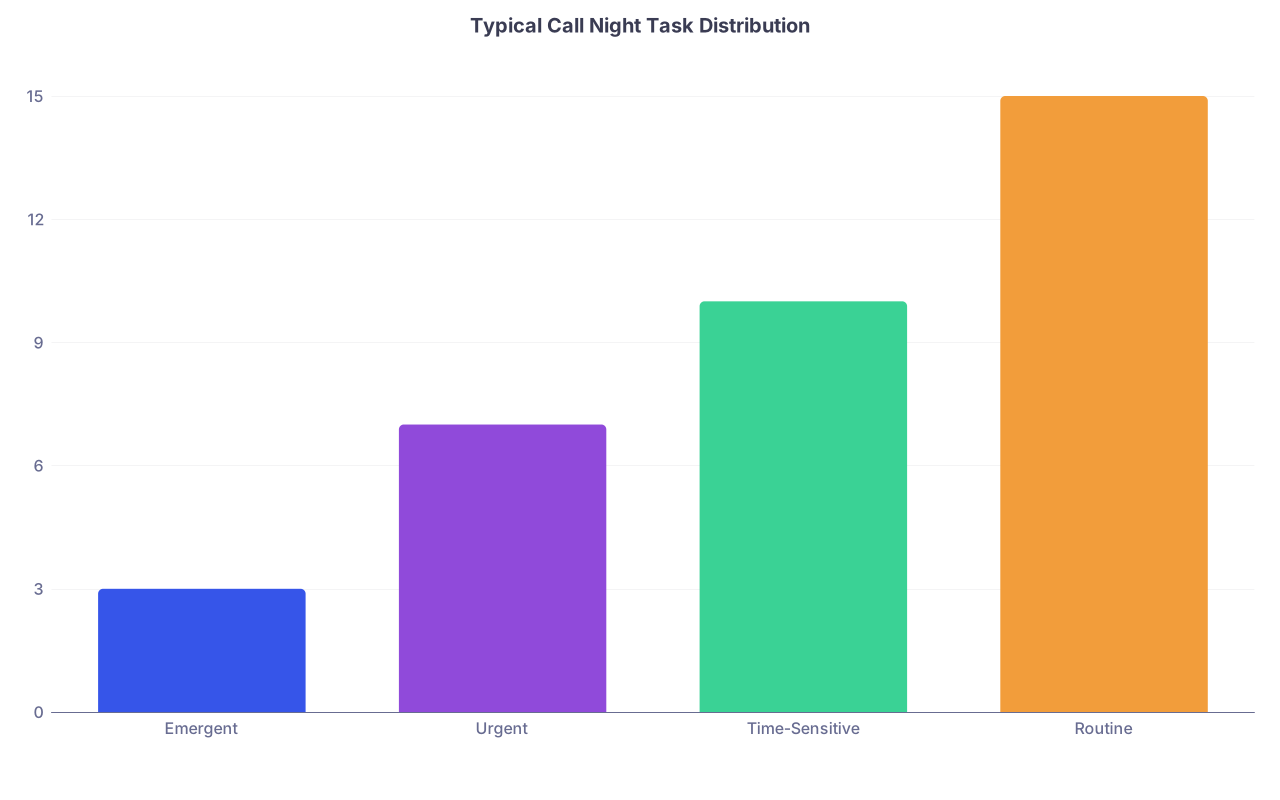
| Category | Value |
|---|---|
| Emergent | 3 |
| Urgent | 7 |
| Time-Sensitive | 10 |
| Routine | 15 |
When a page comes in:
- Triaged as Level 1–2? Left column, star it.
- Antibiotic due in 30 minutes? Middle column.
- Diet change request? Right column.
Cross things off aggressively. If the left column is empty for a stretch, you attack the middle. When left and middle are quiet, you finally work on the right (notes, discharges, cleanup).
Step 10: Common Intern Mistakes in Prioritizing—and How to Avoid Them
I’ve seen the same errors over and over.
Mistake 1: Treating every page as equally urgent
You end up sprinting to rooms for “Tylenol for headache” while someone else gets progressively more hypotensive.
Fix: Use the 4-level system. Force yourself to mentally label each page before you move.
Mistake 2: Getting stuck in the EMR while patients worsen
You’re buried clicking boxes for an admission while a cross-cover patient slowly spirals.
Fix: Any concerning vitals or symptoms → see the patient or put eyes on the data before finishing that non-urgent charting.
Mistake 3: Saying “I’ll go after I finish X” too often
You convince yourself you’ll just complete this note/order set, which turns into 15–20 minutes.
Fix: If you suspect Level 1–2 urgency, give yourself a 60–120 second max to close your current action, then walk.
Mistake 4: Not using the nursing staff as allies
You ignore their sense of urgency, or assume “if it were bad, they’d have called rapid.”
Fix: If a nurse sounds worried, bump the priority up. Ask: “On a scale of 1–10, how concerned are you?” A “7–10” gets prompt attention.
A Simple Flow You Can Memorize
Here’s the whole thing in one picture:

| Step | Description |
|---|---|
| Step 1 | New Page or Task |
| Step 2 | Go see now or call rapid |
| Step 3 | Assess soon - Level 2 |
| Step 4 | Plan timing - Level 3 |
| Step 5 | Routine - Level 4 |
| Step 6 | Reassess task list |
| Step 7 | Life or limb risk in 30-60 min? |
| Step 8 | New or worsening clinical problem? |
| Step 9 | Time sensitive deadline? |
This is what your brain should be doing automatically by the end of your first few months.
One Last Piece: Protect Your Future Self
On call, it’s tempting to do only what’s on fire. That’s how you end up at 6 a.m. with three unfinished admissions and no notes.
So when the truly urgent work is handled and your pager quiets even a little:
- Close loops that will cause pain later:
- Put in admit order sets
- Place obvious overnight PRNs (pain, nausea, sleep for appropriate patients)
- Write the skeletal HPI/assessment now, refine later
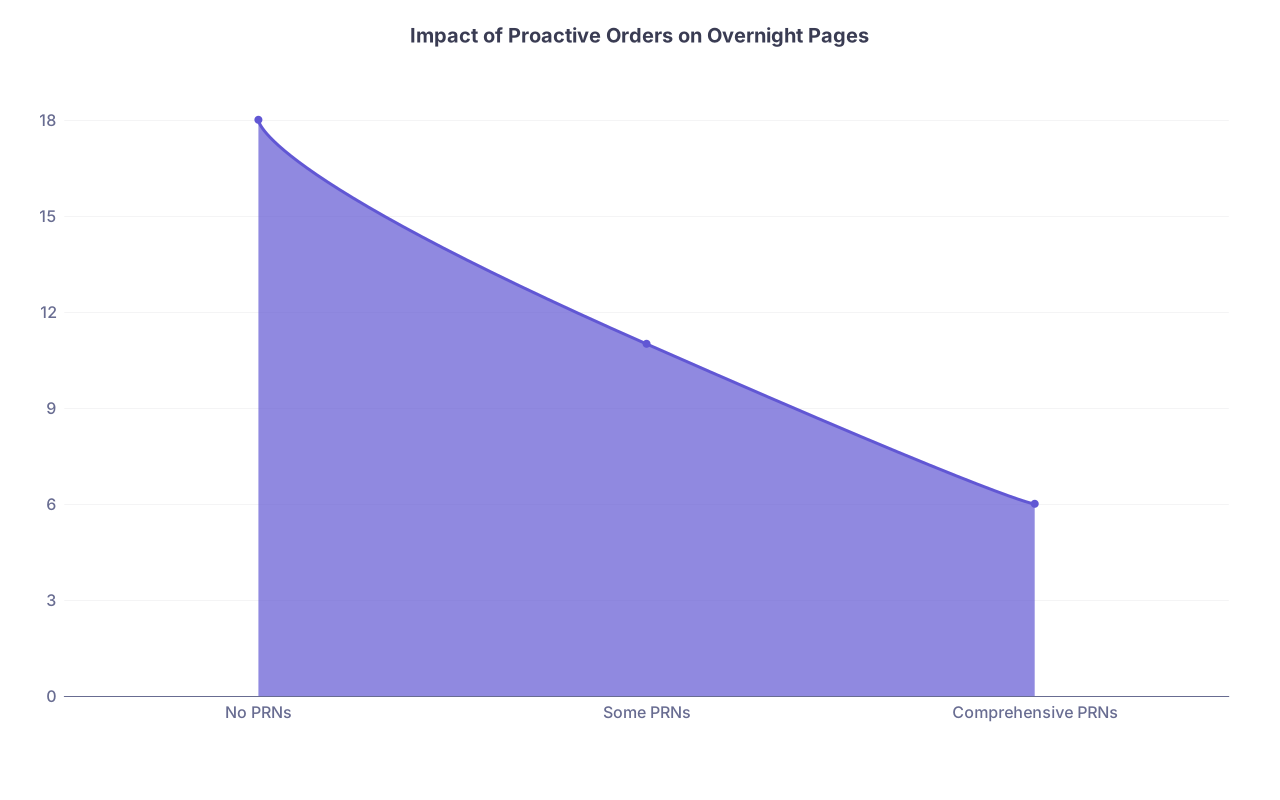
| Category | Value |
|---|---|
| No PRNs | 18 |
| Some PRNs | 11 |
| Comprehensive PRNs | 6 |
A few smart orders early can cut your overnight pages dramatically.
The Bottom Line
Three key points to walk away with:
- Prioritize by risk, not by who paged first. Sickest and potentially unstable patients always move to the top.
- Use a simple, consistent triage system. Classify each task (emergent, urgent, time-sensitive, routine), bundle when possible, and re-check priorities every 30–60 minutes.
- Ask for help when your plate is unsafe, not when it’s empty. Two+ truly sick patients at once, or that bad feeling you’re in over your head, is a sign to involve your senior—immediately, not later.