
You’re on call. It’s 7:45 p.m., you’ve barely eaten, your pager hasn’t stopped, and you’re staring at your list wondering how you’re supposed to see three new admissions, follow up four critical labs, and call two angry families… all before sign-out.
You know you need help. You also really do not want your senior thinking, “This intern can’t handle it.”
Here’s exactly how to tell a senior you’re overwhelmed with patients—without sounding helpless, disorganized, or unsafe.
The Core Rule: Safety > Image
Let me start bluntly: hiding that you’re drowning is worse than admitting it.
Every good senior would rather hear “I’m at capacity” than find out three hours later that:
- A septic patient never got antibiotics
- A troponin of 20 sat in the chart
- A discharge didn’t happen because no one followed up on a simple task
Programs do not fire people for asking for help appropriately. They do get very unhappy when patient care suffers because someone was too proud or scared to speak up.
So your goal isn’t to “not need help.”
Your goal is to:
- Recognize when you’re beyond safe capacity
- Communicate that clearly and concretely
- Propose what you can do and ask for targeted help
Do that consistently and you come across as safe, self-aware, and reliable—not weak.
When Are You Actually “Overwhelmed”?
You’re not “overwhelmed” every time you’re busy. Residency is busy by design. You are overwhelmed when your workload is starting to threaten safety or basic functioning.
A few clear red flags:
- You have new unstable patients you have not seen yet.
- You are more than 1–2 hours behind on critical labs, vitals, or imaging follow-up.
- You’re getting pages you literally cannot triage because you haven’t seen the patient.
- You can’t remember what you agreed to do for which patient.
- You’re making small, sloppy errors (ordering meds on the wrong patient, mis-clicks, etc.).
- You feel panicky and frozen rather than just stressed and focused.
If you’re in one of those zones, it’s time to talk to your senior. Not in an hour—now.
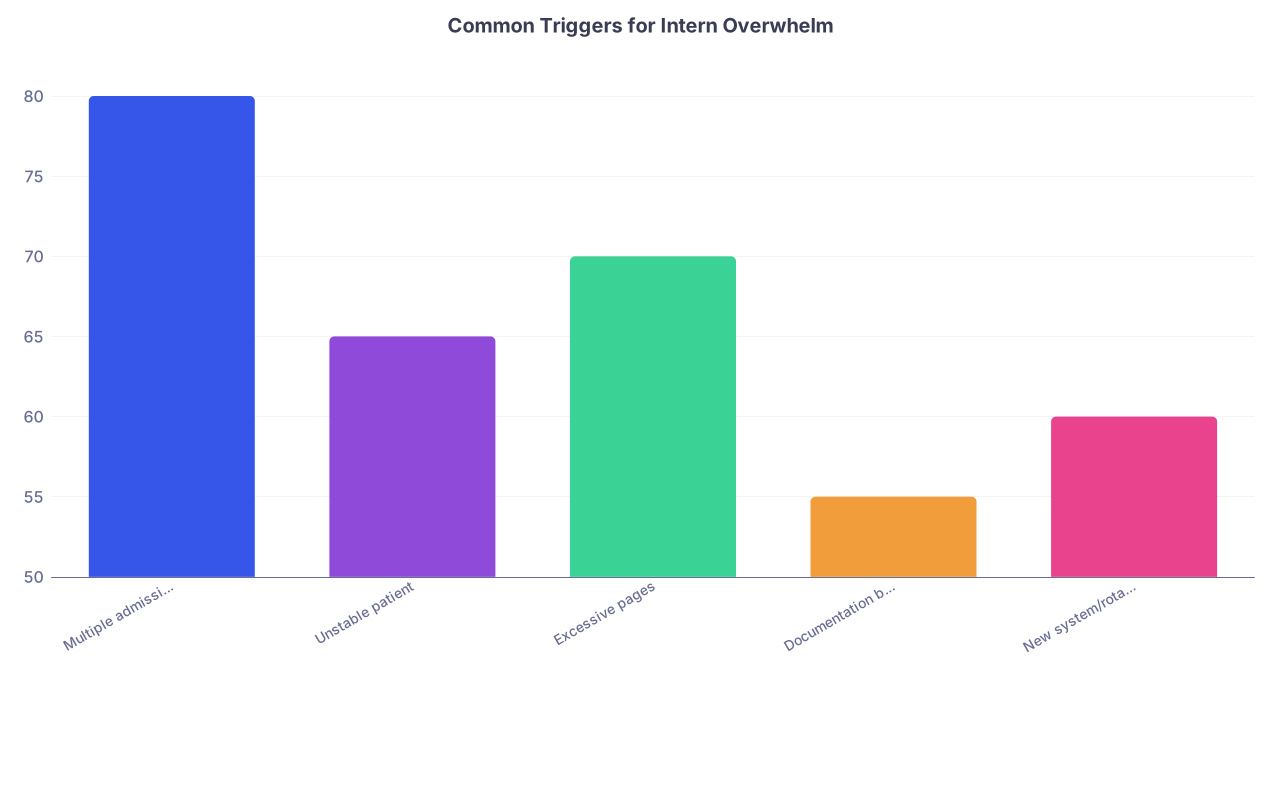
| Category | Value |
|---|---|
| Multiple admissions | 80 |
| Unstable patient | 65 |
| Excessive pages | 70 |
| Documentation backlog | 55 |
| New system/rotation | 60 |
Numbers are hypothetical, but that bar chart is the usual pattern I see. Multiple admissions + an unstable patient is the classic meltdown combo.
How to Say It: Exact Phrases That Work
Bad way:
“Uh… I’m overwhelmed.”
Better way:
“Hey, I’m at a point where I’m worried I can’t get to everything safely. Can I run my list by you and prioritize together?”
Your senior needs three things from you:
- Signal – “I’m at my limit.”
- Snapshot – “Here’s exactly what’s on my plate.”
- Specific ask – “Here’s how you can help me be safe.”
Use language that hits all three.
Here are practical scripts you can steal.
Script 1: On a busy call night
“Hey [Name], quick check-in. I’ve got:
- 2 new admissions I haven’t seen yet
- 1 patient hypotensive I’m still working up
- 4 cross-cover pages I haven’t addressed
I’m worried I’m not going to get to the new admits safely in time. Would you be able to either take one admit or help me decide what to drop or delay?”
That tells your senior:
- You have situational awareness.
- You’re not asking them to rescue you completely.
- You care about safety, not comfort.
Script 2: When you’re falling behind on your existing list
“Can I grab you for 2 minutes? I’m starting to fall behind. I still need to:
- Call back 3 families
- Put in discharge orders
- Follow up imaging on 2 patients
I’m concerned I’ll miss something important. Could you help me figure out what must happen before sign-out, and what can reasonably wait or be passed on?”
Now you’re asking for prioritization, not complaining about volume.
Script 3: When something feels unsafe
This is non-negotiable. Say it clearly.
“I’m not comfortable with my current patient load. I’m worried I can’t safely manage this many new sick patients at once. I need help with either seeing the new ones or stabilizing the ones we have.”
If you use the words “not safe” or “unsafe,” any competent senior will drop what they’re doing and reallocate.
What You Should Do Before You Call for Help
You don’t need to fix everything, but you do need to show you’ve done some thinking.
Here’s a quick 3-step check before you page your senior:
Clarify your list.
Write down every active task. Not in your head. On paper or in the EMR:- Who’s sick and needs you physically there?
- Who’s waiting for orders?
- Who’s waiting for documentation or calls?
Try a first-pass triage.
Put a star next to anything involving:- Hemodynamic instability
- Respiratory issues
- New chest pain, neuro change, or sepsis concern
- Time-sensitive discharges (transport, dialysis, procedures)
Define your limit.
Example: “I can handle 1 new stable admit and my current list, but I cannot safely take 3 new sick admits right now.”
When you then talk to your senior, you’re not just saying “help.” You’re saying, “Here’s my objective reality and what I think I can reasonably do.”

| Step | Description |
|---|---|
| Step 1 | Feeling overwhelmed |
| Step 2 | Make task list |
| Step 3 | Identify sick patients |
| Step 4 | Call senior now |
| Step 5 | Reprioritize and continue |
| Step 6 | Describe workload and ask for help |
| Step 7 | Unsafe or behind on critical tasks |
How Seniors Actually Interpret “I’m Overwhelmed”
There’s a fear every intern has: “If I say I’m struggling, they’ll think I’m weak or incompetent.”
Here’s what actually happens in a decent program.
You say: “I’m worried I can’t safely get to everything.”
A good senior thinks:
- “They’re paying attention to safety. Good.”
- “Let’s redistribute a bit and coach them.”
- “What system failure is feeding this? Paging? Admission flow? Bad cross-cover?”
Seniors have been in your shoes. Many still have nightmares about their own first months. I’ve heard seniors literally say, “The intern who admits they’re at capacity is safer than the one who insists they’re fine while the list burns.”
Where you get into trouble:
- You repeatedly fail to say anything until things are already unsafe.
- You present as totally disorganized and haven’t even tried to prioritize.
- You complain constantly without showing growth or ownership.
If you:
- Communicate early
- Are concrete and focused
- Show you’re trying to learn and improve
You build trust. Period.
How to Structure the Conversation in Real Time
Whether it’s in person or over the phone, use this simple structure:
Lead with safety / capacity.
“I’m concerned I can’t safely manage my current workload.”Give a concise status snapshot.
“Right now I have 2 new ED admits I haven’t seen, 1 patient with rising O2 needs, and 6 follow-up tasks that are pending.”Name what you can do.
“I can see one new stable admit and handle the follow-up tasks, and I’m happy to do that.”Ask for specific help.
“Could you either take one of the new admits or help me determine what should get delayed or reassigned?”
That’s how an adult colleague talks, not a helpless trainee.
If your senior is brusque, still stay anchored:
Senior: “We’re all busy, you just need to move faster.”
You: “I understand everyone’s slammed. I’m worried about missing something dangerous. The specific things I’m behind on are X and Y. Which of these would you be most worried about if they’re delayed?”
You are forcing a safety-based discussion instead of a feelings-based one.
How to Page/Text Without Sounding Lost
You won’t always catch your senior in person. Here’s how to structure a page or secure chat.
Bad:
“Can you call me? Overwhelmed.”
Better:
“Hi [Name], this is [You] on [Service]. I’m concerned I can’t safely get to all my tasks.
Currently:
– 2 new ED admits (not yet seen)
– 1 patient hypotensive 80s/50s, I’m at bedside
– Multiple non-urgent follow-ups pending
Can you call me to help prioritize / possibly redistribute?”
That message:
- Signals urgency without drama
- Shows you have situational awareness
- Makes it easy for them to decide how fast to respond
Common Mistakes Interns Make (And How to Avoid Them)
I’ve seen the same patterns every year.
Waiting too long to speak up.
You tell your senior only after you’re 3 hours behind and something already fell through. Fix: When your gut says “this is getting out of control,” that’s your cue—don’t wait until it’s a disaster.Vague complaining.
“It’s just too much” gets you less help than “I have 3 tasks that cannot all be done in the next hour; which one should I drop?”Framing it around fairness instead of safety.
“Why am I getting all the admits?” goes nowhere.
“I’m concerned that with my current volume, I can’t see new sick patients promptly” gets traction.Apologizing excessively.
You do not need to grovel. A simple “Sorry to bug you, but I think this is a safety issue” is fine. Stop there.Not closing the loop.
After your senior helps, update them:
“Thanks for taking that admit. I was able to stabilize Mr. X and finish the key follow-ups.”
That reinforces you used their help well.
Preventive Work: Make Overwhelm Less Frequent
You won’t eliminate overwhelm, but you can change how often you hit the wall.
Some very practical habits:
- Start every shift with a quick prioritization: who’s sickest, who’s a discharge, what’s time-sensitive.
- Batch low-level tasks (routine order changes, non-urgent calls) instead of reacting to every single page one by one.
- Use a physical list or a task system in the EMR you actually trust. Don’t rely on your memory at 3 a.m.
- Ask your senior on day 1: “How do you like to handle it if I’m at capacity? What’s the best way to reach you?”
That alone makes it much easier to call for help later.
| Situation | Weak Phrase | Strong Phrase |
|---|---|---|
| Busy call night | "I can't do this" | "I’m worried I can’t safely see all these new admits without help" |
| Falling behind on tasks | "I'm so behind" | "I have 5 pending tasks; I can realistically do 2 before sign-out. Which 2 matter most?" |
| Unstable patient plus new admits | "This is too much" | "I need to stay at the bedside of this unstable patient. Can you take the new admit from ED?" |
What If Your Senior Is… Not Great?
Sometimes you do everything right and the senior still blows you off. It happens.
If you’ve clearly stated safety concerns and you still feel things are unsafe:
- Document your actions in the chart clearly (time you evaluated, calls/pages made, recommendations).
- Escalate one level up if needed: chief resident, attending, night float, charge nurse—whoever your hospital culture uses.
- Debrief later with someone you trust (chiefs, program leadership) if this is a pattern with a particular senior.
You are never the problem for saying “this feels unsafe” in a clear, focused way. Ever.

Quick Mental Template to Use Tomorrow
When in doubt, literally say this:
“I’m worried about safety with my current workload. Right now I have [X, Y, Z]. I can realistically do [A, B]. I need help with either [C] or deciding what can wait. Can you help me with that?”
That’s the right way to tell a senior you’re overwhelmed with patients.

FAQ: Telling a Senior You’re Overwhelmed
Will my senior think I’m incompetent if I say I’m overwhelmed?
If you present it as “I can’t do anything, help,” maybe. If you present it as “Here’s my workload, here’s what I can do, and here’s where I think it becomes unsafe,” you’ll usually be seen as safe and self-aware. Most seniors are more worried about the intern who never asks for help.How early is “too early” to ask for help?
The line is simple: once you see a realistic chance that safety or essential tasks will be compromised, it’s time. You do not need to be in full crisis. Calling early for prioritization guidance is smart, not weak.What if everyone else seems to be handling more than I am?
You’re seeing the surface. You don’t know who’s quietly drowning, who has an easier patient mix, or who’s on their second year on that service. Your responsibility is to know your limits and protect your patients. Comparing volume without context is useless.How do I balance learning with asking seniors to take things off my plate?
You don’t learn well when you’re panicked and behind. Ask for help on volume or logistics, not on every decision. For example: let your senior take one admit so you can do a good job on the other and actually understand the case instead of rushing through both.What if my senior responds with “We’re all busy, just push through”?
Stay calm and redirect to specifics: “I understand. My concrete concern is that I have an unassessed unstable patient plus two new admits waiting. I think that’s unsafe for me to manage alone. Which piece can you help with or who else can we involve?” If you still get nowhere and it truly feels unsafe, escalate.How do I bring this up with my program if it’s a recurring problem?
Bring specific examples, not vague feelings. “On three separate nights, I had >4 new sick admits and no help despite raising safety concerns. Here’s what I said, here’s what happened, here were the outcomes.” Chiefs and leadership can work with patterns and details; they can’t do much with “I feel overwhelmed a lot.”
Key takeaways:
- Say something early—frame it around safety and capacity, not fairness or feelings.
- Be concrete: list your tasks, state what you can handle, and ask for specific help.
- Seniors and programs judge you far more on whether you keep patients safe than whether you silently suffer through impossible workloads.