
It’s 6:45 pm. Sign-out was at 5:00. Half your co-interns are already home. You’re still at the workstation, drowning in notes, discharge summaries, and a stack of “one quick thing” orders. Your pager just went off again. You’re thinking: “Why is everyone else done? Why am I always behind? Am I just bad at this?”
Here’s the answer you’re looking for:
Yes, it is absolutely normal to feel constantly behind during intern year. Almost everyone does. But “normal” does not mean “inevitable and unfixable.”
Let’s separate what’s truly a systems-and-learning curve issue from what’s a warning sign you should not ignore.
What “Feeling Behind” Really Means in Intern Year
Most interns confuse three different problems and call them all “I’m behind”:
- Time vs. tasks: You literally cannot finish the work in the allotted hours.
- Skill vs. speed: You are doing the right things, just slowly.
- Perception vs. reality: You feel behind because you’re comparing yourself to the wrong people.
Each one has a different solution.
Feeling behind your first 3–6 months? Completely standard. Feeling behind every single day at 10–12 months despite effort and feedback? That’s when I start asking harder questions.
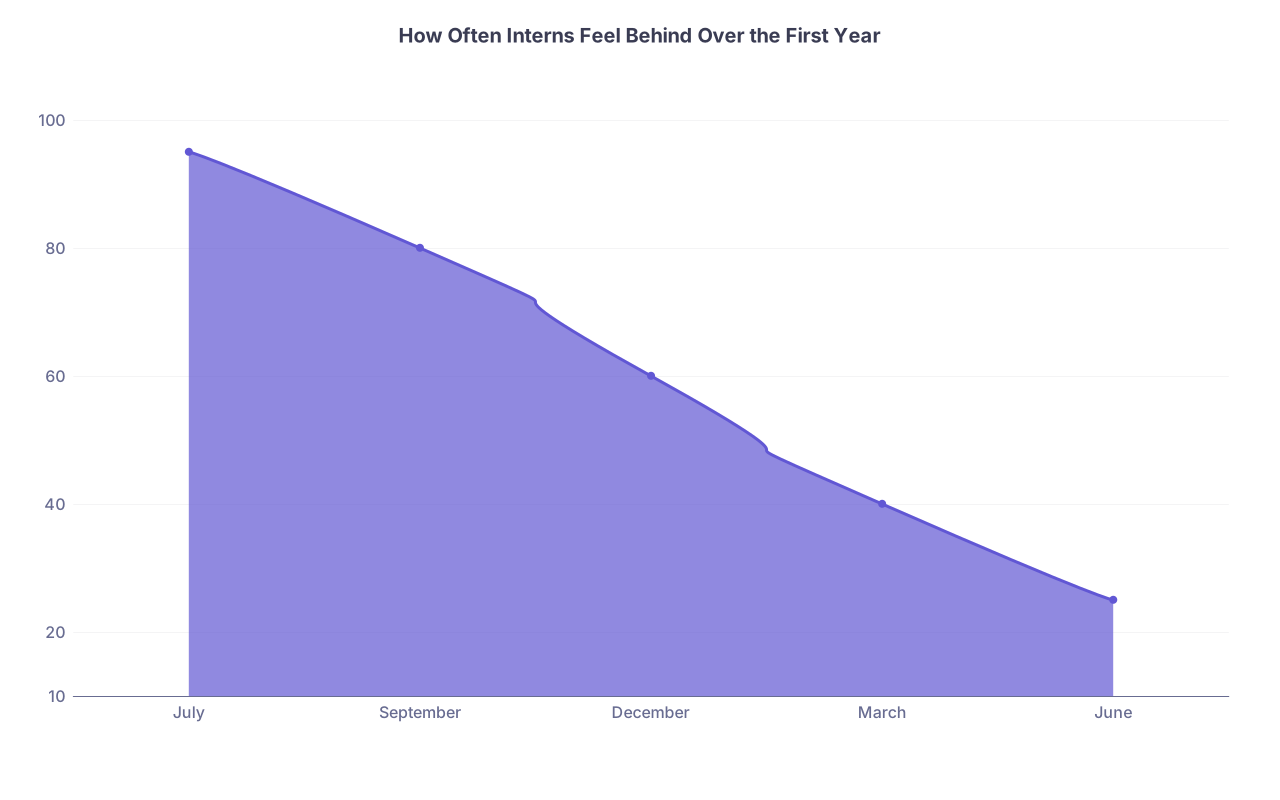
Here’s the pattern I’ve seen over and over:
| Category | Value |
|---|---|
| July | 95 |
| September | 80 |
| December | 60 |
| March | 40 |
| June | 25 |
Almost everyone feels underwater in July. By March, the majority feel overwhelmed some days but not every day. If you’re not trending in that direction, you don’t need to panic—but you do need to be intentional.
Why You (Correctly) Feel Behind All the Time
You’re not imagining it. The workload and expectations are structurally mismatched for a new doctor.
1. The job is designed for experience you don’t yet have
Intern systems are built with an unspoken assumption: by the time you’re a “normal” intern, you’ll have months of pattern recognition, EMR shortcuts, and practical judgment.
Problem: you’re brand new.
So what takes your senior 2 minutes (“change diuretics, adjust insulin, write quick note”) takes you 15–20 minutes because you’re:
- Looking up doses
- Second-guessing safety
- Double-checking orders
- Over-documenting because you’re terrified of missing something
You are doing more cognitive work per decision than they are. Of course you’re slower.
2. Medical school didn’t train you for the real bottlenecks
You were trained to:
- Present cleanly on rounds
- Memorize guidelines
- Pass exams
You were not trained to:
- Triage 7 simultaneous pages
- Decide which of 5 tasks gets done first at 4:45 pm
- Push back on consults that are trying to turf problems
- Create a safe “sign-out at 5:00” plan at 2:00 pm
The work that makes you feel “behind” is mostly systems work and task management, not medical knowledge.
3. Hidden time drains you don’t see yet
The killers are not the obvious tasks. It’s the micro-inefficiencies:
- Walking back and forth to the same room 6 times
- Re-writing your to-do list 10 different ways
- Entering the same note content from scratch each time instead of using smart phrases
- Answering pages one-by-one instead of batching callbacks
Those add up to hours a day. I’ve watched interns cut 60–90 minutes off their day just by fixing those.
How to Tell If Your Experience Is “Normal Struggle” vs. “Red Flag”
Feeling behind isn’t binary. Use this as a sanity check.
| Area | Normal Struggle | Red Flag Pattern |
|---|---|---|
| Time out | Leaving 1–2 hours late early in year | Leaving 3+ hours late most days by March |
| Feedback | “You’re doing fine, just speed will come” | “You miss key tasks” or “unsafe handoffs” |
| Emotions | Tired, occasionally overwhelmed | Daily dread, crying frequently, burnout |
| Trend | Gradual improvement in efficiency | Feels the same or worse after 6–8 months |
| Patient safety | Rare, discussed errors, learning from them | Repeated misses, near misses, chronic concern |
If you’re in the “red flag” column on more than one row, you’re not doomed—but you do need help beyond “just hang in there.”
Concrete Strategies to Stop Feeling Constantly Behind
You don’t fix this with vibes. You fix it with systems. Here’s the practical part.
1. Front-load your day ruthlessly
The interns who leave on time aren’t magically faster. They front-load.
By 10:00–11:00 am, aim to have:
- All critical orders in (antibiotics, electrolytes, imaging)
- All discharges identified and started
- All sick patients personally seen
That means during early morning:
- Do targeted prerounds: focus on unstable / leaving-today / high-risk patients.
- On stable patients, scan overnight vitals, new labs, nursing notes. If nothing scary, you sometimes do not need a long re-exam at 6:30 am.
Then, on rounds, be explicit:
“I’d like to discharge Mr. X and Ms. Y today; I’ve started their summaries.”
You’re pulling discharge work into the morning instead of discovering it at 3:30 pm.
2. Task-triage instead of linear working
New interns work down a list top to bottom. Good interns work by priority and clustering.
I tell people to use three buckets on paper or in a notes app:
- Now (time-sensitive, safety issues, orders that change care today)
- Today (needs to be done before you leave)
- Nice if done (chart cleanup, non-urgent follow-up)
And then cluster tasks:
- If you’re already in the EMR orders screen, batch several orders.
- If you’re going to the ED, see both ED admits while you’re down there.
- If you’re calling one consult, list all consults you might page in the next 30 minutes and do them together.

| Step | Description |
|---|---|
| Step 1 | New Task |
| Step 2 | Do now |
| Step 3 | Schedule today |
| Step 4 | Defer or delegate |
| Step 5 | Affects safety now |
| Step 6 | Needed before sign-out |
Every time something comes up, mentally run that flow for 3 seconds.
3. Build EMR shortcuts like your life depends on it
Because it kind of does.
You should have:
Smart phrases / dot phrases for:
- Admission H&P template
- Progress note template with auto-pulled vitals, labs
- Discharge summary skeleton
- Common phrases (e.g., “Discussed risks/benefits…”)
Order sets:
- “New CHF admit”
- “Post-op patient basic orders”
- “DVT prophylaxis + bowel regimen + basic labs”
I’ve watched interns go from 25–30 minutes per note to 10–15 minutes just by using consistent templates and cutting fluff.
If you don’t know how to build these in your EMR, ask the PGY-3 who always leaves on time. They almost always have strong templates.
The Comparison Trap: You vs. Co-Interns and Seniors
You’re probably comparing yourself to at least three unfair reference points.
1. The co-intern who seems done at 4:30 every day
Sometimes they are genuinely more efficient. Often:
- They’re cutting corners you’re not seeing (bare-minimum documentation, superficial exams).
- Their team structure is lighter.
- They’ve done a prelim or transitional year before.
If they consistently leave and patients are safe and seniors trust them, then copy their systems. Literally sit next to them for half a day:
“Can I watch how you structure your notes and to-do list?”
You’ll learn more in 2 hours than from any formal lecture.
2. Seniors comparing you to themselves now, not as interns
Attendings and seniors have selective amnesia. They remember themselves as heroic, not as the exhausted interns writing notes at 9:30 pm.
When a senior says, “You’re fine, this is how intern year is,” that’s reassuring but not actionable. Push for specifics:
- “Can you watch me preround tomorrow and point out what I’m doing that’s slowing me down?”
- “What are 1–2 things I could stop doing or shorten in my notes or workflow?”
Vague reassurance is cheap. Concrete feedback is gold.
3. Your own expectations from med school
In med school, your identity was “top student,” “efficient,” “on top of everything.” Intern year will smash that if you cling to it.
You’re not a top anything your first year. You’re a beginner in a different job. Cut the identity drama. Focus on:
- Are my patients safe?
- Am I learning?
- Am I getting a little faster each month?
That’s success as an intern, not being the fastest or the most liked.
When Feeling Behind Is Actually Burnout or Depression
There’s a line where “normal intern struggle” tips into pathology. If you’re here, you don’t need better time-management. You need help.
Watch for:
- You wake up with dread daily, not just on call days
- You cry in the call room bathroom more days than not
- You start fantasizing about getting into a minor car accident just to escape work for a while (I’ve heard this more than once)
- You stop caring about errors because you’re so numb
- Sleep and appetite are wrecked even on days off
That’s not “intern year is hard.” That’s your brain and body waving a massive red flag.
At that point:
- Talk to someone outside your program (therapist, physician support line, your own PCP).
- Use confidential institutional counseling if available.
- Loop in at least one person inside the program you trust (APD, chief, mentor) and say directly:
“I’m not okay, and I need help making this sustainable.”
Wellness emails and pizza are not going to fix this. You need actual intervention—schedule adjustments, mental health care, or sometimes a leave.
How to Ask for Help Without Looking Incompetent
You’re afraid that if you admit you’re behind, you’ll be labeled “weak” or “unsafe.” The irony is that the people who never ask for help worry me more.
Here’s how to do it in a way that signals maturity, not fragility.
Bad version:
“I’m drowning, I can’t keep up, I’m a mess.”
Better version:
“I’m consistently leaving 2–3 hours late even when I skip lunch. I’ve tried batching tasks and using templates, but I’m not improving much. Can you watch my workflow for an hour and help me see what I’m doing wrong?”
You’re showing:
- You’ve identified a concrete problem
- You’ve made a good-faith attempt to fix it
- You’re asking for targeted coaching, not a rescue
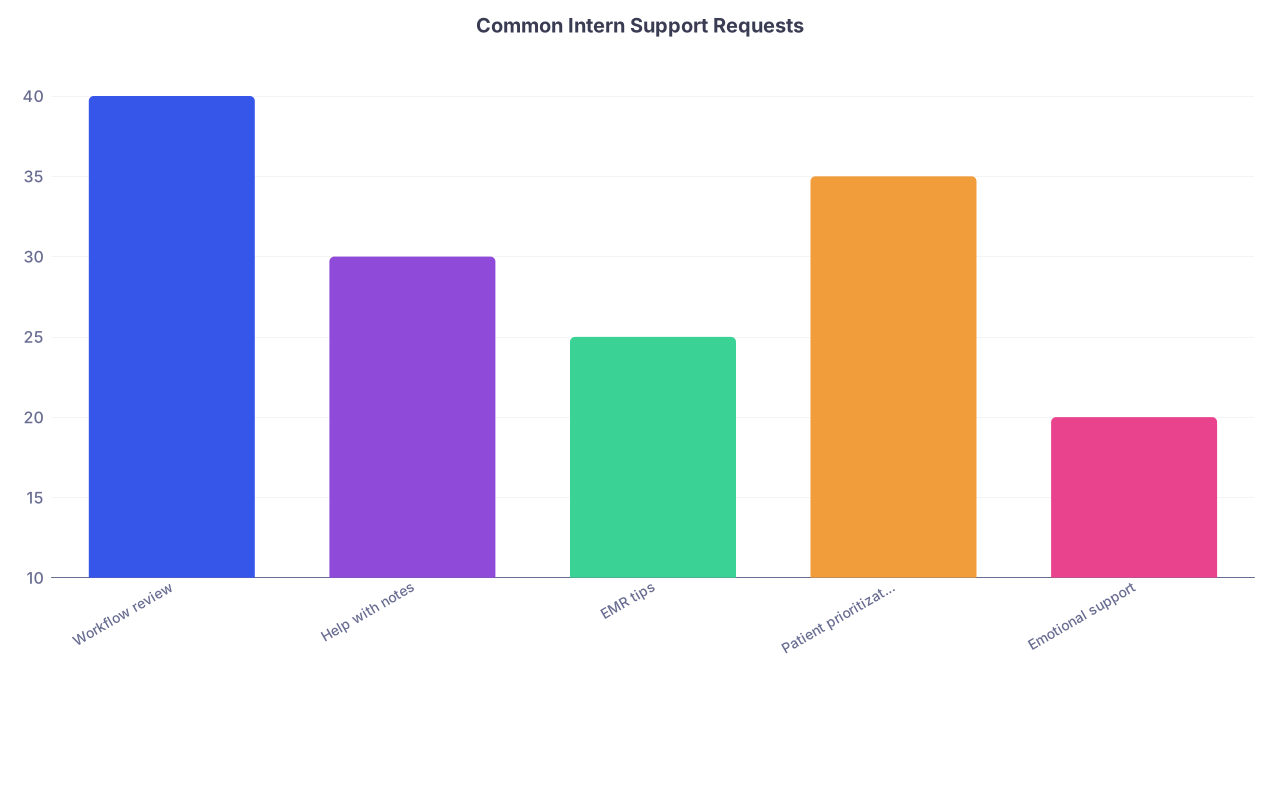
| Category | Value |
|---|---|
| Workflow review | 40 |
| Help with notes | 30 |
| EMR tips | 25 |
| Patient prioritization | 35 |
| Emotional support | 20 |
Most chiefs and APDs would love that kind of request. It shows insight and responsibility.
A Simple Weekly Reset to Stop the Constant Drowning
If you do nothing else, do this once a week on your post-call or golden day. 20–30 minutes, not a life overhaul.
Grab a piece of paper or open a blank note.
Write: “What made me feel most behind this week?” List 3–5 things.
For each item, ask:
- Was this lack of knowledge?
- Lack of system?
- Or structural (too many patients, no support)?
Pick one fix for the coming week:
- Build a new template
- Try a different prerounding order
- Ask a senior to watch your sign-out prep
- Talk to chief about patient caps
Try that single change for a week. Then reassess.

You’re not going to brute-force intern year into feeling easy. But you can make it feel less like drowning and more like swimming against a strong current.
FAQ: Feeling Behind During Intern Year
1. How long does it usually take before intern year starts to feel manageable?
Most people notice a shift between 4–6 months. You still work hard and stay late sometimes, but the daily sense of “I have no idea what I’m doing” eases up. If you’re at 9–10 months and still feel like it’s July, that’s a sign to get very intentional about your systems and to ask for direct feedback.
2. Is it okay to leave things for the night float or cross-cover if I’m behind?
Yes, with judgment. Your job is not to empty your task list at all costs; it’s to hand off a safe, prioritized list. If something can be safely done overnight without harming care—routine lab follow-up, a non-urgent note—hand it off clearly. If you’re staying hours late to finish purely clerical work, something’s broken.
3. My senior seems annoyed every time I ask for help. What should I do?
Some seniors are simply bad at teaching or are burned out. You still deserve support. Try asking very specific, time-limited questions: “Can I run these 3 patients by you in 5 minutes to make sure my plan is on track?” If you consistently get brushed off, talk to another senior, chief resident, or APD. One difficult senior does not get to define your whole year.
4. How do I know if my slowness is a real performance problem?
Look at feedback and outcomes, not just feelings. Are attendings or chiefs explicitly concerned? Have you been counseled about unsafe handoffs, missed critical labs, or repeated errors? That’s different from “you’re a bit slow on notes,” which is normal early on. Ask one trusted senior or attending: “From your perspective, am I just normal-intern slow, or are there specific performance issues I should address?”
5. What can I do right now if I’m on a shift and feel totally overwhelmed?
Pause for 2 minutes. Rewrite your to-do list into “Now / Today / Can Wait.” Call your senior and say: “Here’s my list. I’m worried I can’t finish X, Y, Z before sign-out. What should I prioritize, and can anything be handed off?” That one conversation often cuts your load and gives you permission to drop low-yield tasks.
6. Does it mean I picked the wrong specialty if I’m this behind and miserable?
Not necessarily. Almost everyone, even in their dream specialty, has stretches of hating intern year. Before you question your entire career, fix the controllable things: workflow, EMR efficiency, sleep, support. If after a year you still dread the core work of the field (not just the hours, but the actual patients and problems), then it’s reasonable to reevaluate.
Key points to walk away with:
- Yes, it is normal to feel behind during intern year—especially in the first 4–6 months.
- You can materially change that feeling with better systems, EMR tricks, and deliberate task triage.
- If you feel constantly underwater and hopeless, that’s not “just intern year”—that’s a signal to seek real support, not just grind harder.