
What do you do when you realize you’re dreading walking into the hospital more than you dreaded Step 1?
You’re an intern. You’re supposed to be tired, overwhelmed, a little in over your head. That part is normal. The hard part is knowing when “this is just intern year” crosses the line into “this is burning me out and something needs to change.”
Let me walk you through the difference, bluntly.
The Core Difference: Stress vs Burnout
Here’s the simplest way to separate them:
- Stress = You are overloaded, but you still care. You still feel things. You’re still “you,” just stretched thin.
- Burnout = You are emptied out. You start not to care. You feel detached from patients, numb, or cynical. You don’t feel like yourself anymore.
Under stress, you think: “This is a lot. I’m exhausted. But I can push through.”
With burnout, I’ve heard interns say things like:
“I don’t care if I’m a good doctor anymore.”
“I feel nothing when a new admit shows up.”
“I hate who I’m becoming on this rotation.”
That’s a different category. That’s not “just tired.”
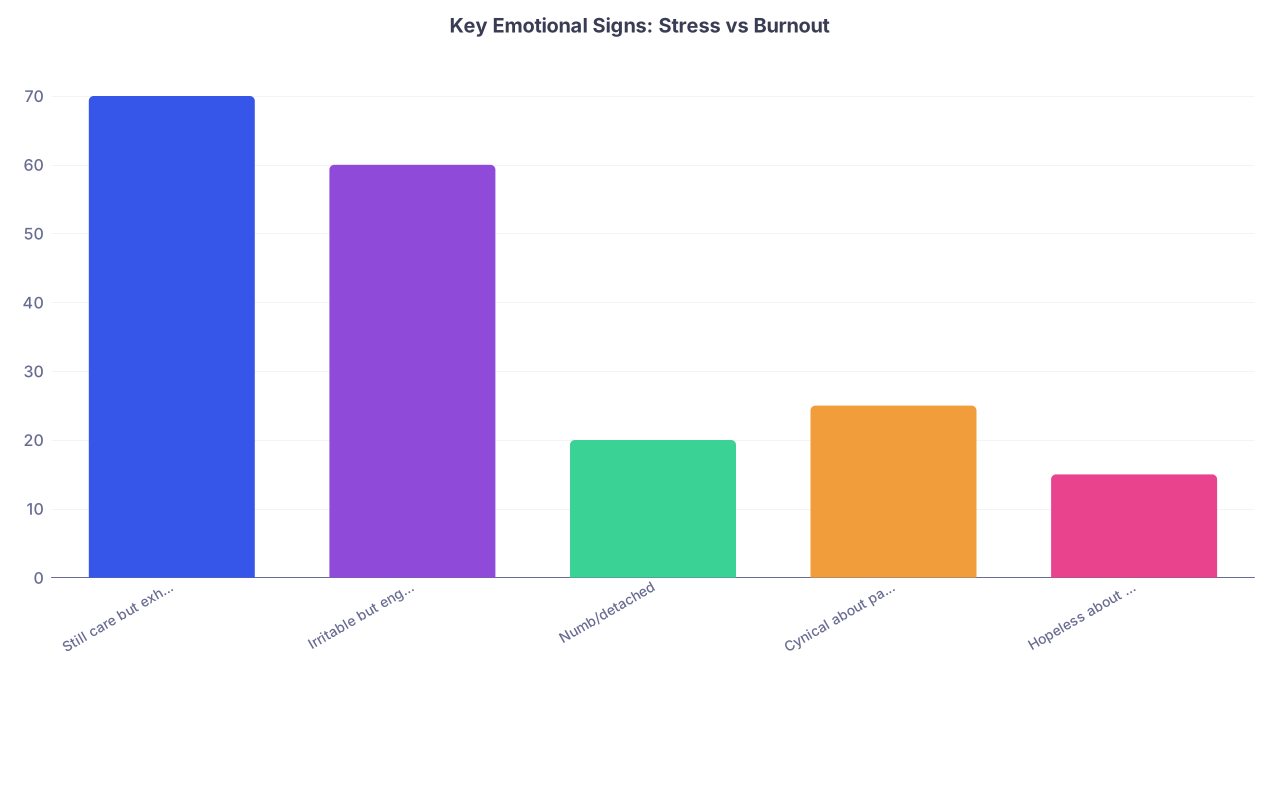
| Category | Value |
|---|---|
| Still care but exhausted | 70 |
| Irritable but engaged | 60 |
| Numb/detached | 20 |
| Cynical about patients | 25 |
| Hopeless about work | 15 |
The first two are what most stressed interns report. The last three? Those are classic burnout territory.
Quick Self-Check: A 3-Minute Reality Scan
You don’t need a 20-item inventory to get clarity. Sit with these questions, honestly.
1. Energy: Tired vs Drained
Ask yourself:
- Do I feel physically tired but still have moments of real interest or even enjoyment at work?
- Or do I feel drained all the time, even after a day off?
Normal intern stress: You crash on your post-call day, sleep 12 hours, and wake up still a bit tired but functional. You can rally for a good case, a cool attending, or an interesting patient.
Burnout: You wake up on a post-call day and feel like you got hit by a truck emotionally, not just physically. The idea of going back tomorrow makes you feel sick, trapped, or hopeless, not just tired.
2. Emotions: Frustrated vs Numb/Cynical
Stress: You get:
- Snappy on a bad call night
- Irritated when orders get ignored
- Frustrated by endless pages
But you still:
- Feel bad if you snap at a nurse
- Care when a patient improves or worsens
- Feel joy when something goes well
Burnout: You notice:
- You just don’t care if the patient likes you or not
- You talk about patients as “tasks” or “numbers” only
- You feel nothing when a very sick patient does poorly—or you feel a dark, guilty sense of relief when someone dies because the work got “easier”
If you’re starting to scare yourself with how cynical or cold you sound—even just in your own head—that’s not “normal stress.”
3. Identity: Stretched vs Lost
Stress feels like: “This is really hard, but I’m still me underneath all this.”
Burnout feels like: “I don’t recognize myself.”
Common burnout phrases I’ve heard from interns:
- “I used to be kind. Now I’m just angry or flat.”
- “I don’t have an off switch anymore; I bring this version of me home.”
- “I don’t remember why I wanted to do this.”
If that resonates uncomfortably, pay attention.
Normal “Intern-Level” Misery vs Red Flag Patterns
You are going to be miserable some days. That’s not a pathology; it’s residency. Let’s separate typical pain from danger signs.

Here’s a practical comparison:
| Area | Normal Intern Stress | Possible Burnout Warning |
|---|---|---|
| Sleep | Short, fragmented, but you can still recover | Even with sleep, you wake up exhausted and empty |
| Mood | Irritable, emotional swings | Persistent numbness, hopelessness, or cynicism |
| Work attitude | “This is hard” | “This is pointless” or “I hate this” |
| Performance | Slower, more mistakes when tired | Ongoing decline, trouble focusing even when rested |
| Motivation | Low at times but spikes with good moments | Almost no interest in getting better or learning |
If you’re mostly in the left column, that’s probably heavy stress.
If you see yourself in multiple items on the right, that’s moving toward real burnout.
The Three Burnout Dimensions (And How They Actually Feel as an Intern)
Burnout is usually described in three buckets. Let’s make them concrete for internship.
1. Emotional Exhaustion
This isn’t just “I need a nap.”
It looks like:
- Feeling utterly used up by noon
- Dreading your pager going off because you have zero capacity left
- Sitting in the bathroom or stairwell between pages because you need 60 seconds to not exist
Normal stress is being tired and overloaded but still able to “turn on” when needed. Emotional exhaustion is when you have no “on” left.
2. Depersonalization (or Cynicism)
The ugly part no one likes to admit.
It can sound like:
- “Here’s another CHF train wreck.”
- “She’s being non-compliant again, of course.”
- “Great, another social disaster admit at 4:30.”
Everyone vents. That’s not the issue. Depersonalization is when this becomes your default lens. When you stop seeing human beings and just see problems, annoyances, or billing codes.
On some teams, this gets normalized as “dark humor” or “coping.” There’s a line. When you can’t easily shift back to genuine empathy, the line’s been crossed.
3. Reduced Sense of Accomplishment
This one sneaks up quietly.
You might notice:
- You feel like a bad doctor, constantly
- Positive feedback bounces off; criticism sticks like glue
- A good day doesn’t feel good; it just feels like “I didn’t fail today”
You could be doing totally fine objectively and still feel like you’re failing everyone. Chronic, unshakeable “I’m not good enough” in the setting of constant overwork is a strong burnout sign.
The Time Factor: How Long Has This Been Going On?
Everyone has rotations that wreck them temporarily. ICU, trauma, night float. A few weeks of being a more irritable, exhausted version of yourself is normal.
Here’s the rule of thumb I use with residents:
- Stress spike: 1–3 weeks of feeling rough on a heavy rotation, then you bounce back somewhat on an easier block.
- Burnout pattern: 6+ weeks of persistent dread, numbness, or hopelessness with little or no improvement even when the schedule eases a bit.
If you switch from nights to a lighter elective and you still:
- Feel dread every morning
- Have no interest in patients
- Can’t enjoy normal life outside the hospital
…this is not “just the rotation.”
When It’s Actually Something Deeper: Anxiety, Depression, or Both
Another honest point: sometimes what you think is “burnout” is actually clinical anxiety or depression. Or both. Residency just poured gasoline on something that was already smoldering.
Red flags that this is beyond burnout:
- Thoughts like: “I wish I wouldn’t wake up” or “They’d be better off without me”
- Self-harm thoughts, even passive
- Crying spells out of proportion to specific events
- Panic attacks about going to work
- Completely losing interest in things you loved before residency (music, exercise, friends, anything)
That’s not “part of training.” That’s treatable mental health stuff and you should not white-knuckle it alone.
What To Do If You Suspect Burnout (Today, Not Someday)
Let’s say you’re reading this and thinking: “Yeah, I’m on the wrong side of this line.”
You don’t fix burnout by taking one Sunday off and buying a scented candle. You’re going to need actions in two categories: immediate and structural.
1. Immediate Moves (Within the Next Week)
Pick at least one of these and actually do it:
Tell one person the truth.
A co-intern, chief, trusted senior, partner, or friend. Not the “LOL I’m so dead” version. The “I’m not okay and I’m worried about myself” version.Use institutional resources.
Most programs have some combination of:- Resident wellness or mental health services
- Confidential counseling
- Employee Assistance Programs
Those exist for exactly this. Yes, people actually use them. Quietly. Often.
Have a direct conversation with your chief or PD (if safe).
You do not have to open with “I’m burned out.” You can say:- “I’m really struggling to keep up. I’m worried about how I’m doing.”
- “I’m noticing I’m not myself anymore. I could use some support or adjustment if possible.”
Get a real sleep reset.
One night where you are off, phone off, pager off. No swapping into a worse call to “be a team player.” One full night is not a cure, but it gives you a cleaner read on what’s going on.
2. Structural Changes (Next Month or Two)
You cannot work your way out of burnout with pure willpower. You need to change the setup somewhere.
Some realistic intern-level levers:
- Ask to shift one high-intensity elective to a lighter one later in the year.
- Protect one half-day a week as truly off-limits when not on call—no extra moonlighting, no volunteering to cover.
- Negotiate with your team for clearer task division so you’re not the automatic dumping ground.
- Establish one non-negotiable outside-work anchor: gym twice a week, therapy, weekly dinner with a friend, a standing call home. Something that reminds you you’re a person, not just an intern.
None of this solves systemic problems. It just gives you enough oxygen to function while you’re in them.
A Simple Decision Flow: Where Do You Actually Fall?
Use this as a quick mental map.

| Step | Description |
|---|---|
| Step 1 | Feeling overwhelmed at work |
| Step 2 | Possible burnout - emotional exhaustion and detachment |
| Step 3 | High but normal intern stress - monitor and adjust basics |
| Step 4 | Contact mental health support or crisis line now |
| Step 5 | Talk to chief, PD, or counselor about burnout |
| Step 6 | Still care and feel like myself sometimes? |
| Step 7 | Symptoms better on lighter rotations or days off? |
| Step 8 | Any thoughts of self harm or hopelessness? |
If you land in D, G, or H in that diagram, that’s your sign to stop telling yourself “it’s just intern year.”
The One Thing I Want You To Hear
Feeling overwhelmed, tired, emotional, even occasionally hating this—that’s all normal intern ground.
Feeling:
- Numb toward patients most of the time
- Detached from who you are
- Hopeless that anything will change
…is not just the job. That is a warning light.
You are not weak for struggling. Some of the most capable residents I’ve seen hit a wall in PGY-1 because they tried to power through what really needed support and adjustment.
You do not get a medal for suffering silently. You do sometimes get harmed by it.
So here’s your next step:
Tonight, before you crash, write down three honest sentences about how you’re actually doing. No filters. Then decide: who is one safe person you can show that to this week—chief, co-intern, therapist, partner—and ask for help if those sentences scare you.
Do not let “it’s probably just stress” be the excuse that keeps you stuck.
FAQ: Normal Stress vs Burnout for Interns
1. How much misery is “normal” in intern year?
You should expect: frequent fatigue, feeling behind, occasional dread before tough shifts, and sometimes crying in your car or call room. That sounds dramatic, but it’s standard on certain rotations. What should not be “normal” is unrelenting dread most days for months, emotional numbness toward patients, or feeling like there’s no point in trying. Temporary spikes are normal; persistent, flattening distress is not.
2. Does everyone get burned out in residency at some point?
No. Most people experience high stress and transient burnout symptoms, but not everyone meets true burnout criteria. And the ones who fare best are not magically tougher—they’re the ones who set boundaries earlier, use support systems, and adjust expectations realistically. “Everyone is suffering so I should just take it” is a terrible metric.
3. If I’m burned out, does that mean I chose the wrong specialty or should quit?
Not automatically. I’ve seen interns convinced they picked the wrong field while drowning in q4 call and sleep debt—only to love the same specialty on a less brutal service later. Burnout usually reflects workload, support, and culture more than your core fit. Address the conditions first (schedule, support, mental health). If, after that, you still hate the work itself, then it’s reasonable to revisit the specialty question.
4. Will talking to my program director or chiefs about burnout hurt my career?
Handled poorly, in a toxic culture, it can cause awkwardness. But in most halfway decent programs, bringing concerns early, calmly, and specifically is seen as mature, not weak. Focus on function: “I’m worried about my performance and well-being and want to address this before it worsens.” If your program punishes that, that’s a red flag about them, not you—and another reason to loop in GME, counseling, or external support.
5. What’s one concrete sign that I need professional help, not just better self-care?
If you have persistent thoughts that life is not worth living, that people would be better off without you, or you’re imagining ways to escape permanently—stop calling that “burnout” and treat it as a mental health emergency. Also, if your ability to function is dropping (med errors, constant lateness, inability to concentrate) despite trying to rest or adjust your schedule, it is time to involve a mental health professional, not just try harder on your own.
Now: open your calendar, pick one 30-minute block in the next 7 days, and label it “Check-in about how I’m actually doing.” During that block, revisit these questions and decide who you’re going to tell the truth to.