

The wrong choice here can quietly wreck your career five years from now.
You’re not choosing between “DO vs MD.” You’re choosing between “U.S.-trained physician with some roadblocks” and “maybe-physician with massive structural disadvantages.” Those are not the same thing.
Let me walk you through this like I would with a real advisee sitting in my office, because I’ve seen this exact situation more times than I like: accepted to a lower-tier U.S. DO school and also accepted to a “top” Caribbean MD program (usually SGU, Ross, AUC, Saba). Family is confused. Your ego likes the letters MD. Reddit is screaming a hundred different things. You need a clear path.
Here’s how to make this decision like an adult who actually wants to match into residency, not just “get into med school.”
1. The Core Reality: U.S. DO vs Caribbean MD Is Not a Close Call
Let me be blunt: for the vast majority of students, the U.S. DO school is the better — and safer — option.
Not because DO is magically superior. Because of structure. Pipeline. Data. U.S. accreditation. Clinical networks. Residency program bias. Federal loans. All of it.
Yes, there are exceptions. But they are exceptions. If you’re looking for a clean, default rule:
If you have an acceptance to an accredited U.S. DO school, you do not go Caribbean unless a very narrow set of serious constraints forces your hand.
To see why, look at what residency program directors actually care about:
| Factor | U.S. DO (Lower-Tier) | Top Caribbean MD |
|---|---|---|
| Location | U.S.-based | Offshore (Caribbean) |
| Accreditation | COCA (U.S.) | International, ECFMG pathway |
| Federal Loans | Yes (Title IV) | Usually yes, but more complex |
| Match Rate (Overall) | Higher, closer to U.S. MD | Lower, especially for competitive specialties |
| [Clinical Rotations](https://residencyadvisor.com/resources/international-med-schools/if-your-international-school-lacks-us-clinical-rotations-salvage-options) | More structured, U.S.-integrated | Often scattered, variable quality |
| Visa Issues | None as citizen/PR | Possible if international |
Even a “lower-tier” DO school is part of the U.S. medical education ecosystem. That matters more than prestige. More than MD vs DO. More than your feelings about OMM.
So if you just needed someone to tell you the answer: pick the U.S. DO.
But if your brain is now saying “Yeah but…” keep reading. We’ll go scenario by scenario.
2. What Actually Happens Down the Line: Match Reality
This isn’t about bragging rights this year. It’s about where you are in 7–8 years.
Here’s the game you’re actually playing: can you get into a U.S. residency in the specialty and location you can live with?
Let’s frame the risk.
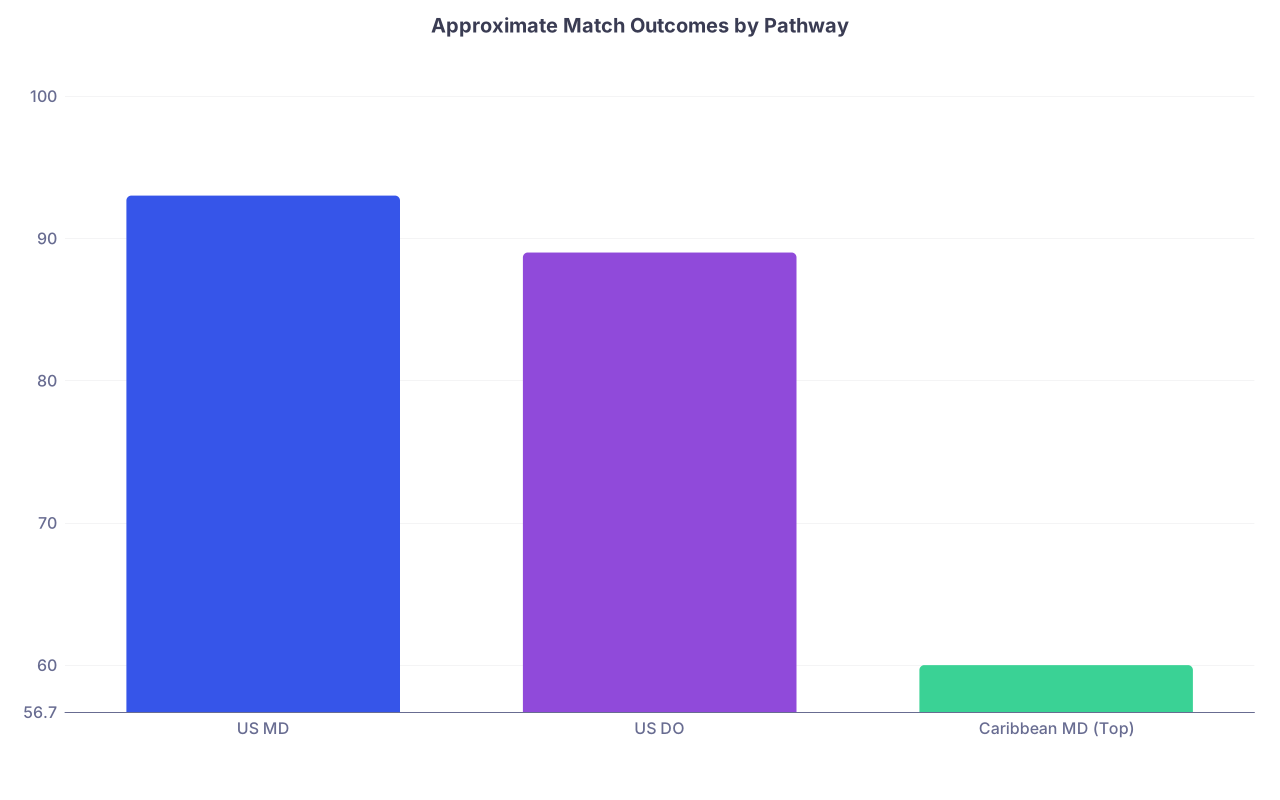
| Category | Value |
|---|---|
| US MD | 93 |
| US DO | 89 |
| Caribbean MD (Top) | 60 |
These are ballpark, illustrative numbers (they vary by year and definition), but the pattern is real:
- U.S. MD: highest match rate
- U.S. DO: slightly lower, but still strong
- Caribbean MD: much lower, with big variance and more unmatched grads
You’ll hear some Caribbean schools brag that their “match rate” is 90%+. Here’s the trick: they often only count students who actually apply for the Match and meet internal criteria. They quietly exclude:
- People who failed out
- People who failed Step 1/2 and never applied
- People who never finished clinicals
- People who applied weakly or didn’t meet some “good standing” internal threshold
I’ve personally talked to grads who thought their school’s “high match rate” meant they were safe, then discovered half their classmates never even made it to ERAS.
With a U.S. DO:
- Programs know your training environment
- You’re in the same applicant pool as U.S. MDs and DOs
- You’re not automatically filtered out by “no IMGs” in program policies
With a Caribbean MD:
- You are an IMG (international medical graduate), even if you’re a U.S. citizen
- Many programs simply do not interview IMGs at all
- You’re competing for a smaller slice of residency positions with more hoops
So your starting point is this: do you want to stack the odds for yourself or against yourself?
3. When Caribbean MD Even Enters the Conversation
Now, here’s where I’m not going to sugarcoat things.
A top Caribbean MD might be a rational option if:
- You have no U.S. MD or DO acceptance after multiple cycles
- You’ve fixed as much of your application as reasonably possible (MCAT, GPA trend, clinical exposure, letters) and still hit a wall
- You fully understand the risk of not matching to a residency and are prepared to live with it
- Your alternative is essentially: give up on becoming a physician
But that is not your situation. You already have a U.S. DO offer.
So what are the usual arguments for Caribbean MD that pull people in anyway?
- “But it’s MD, and I want those letters.”
- “The Caribbean school is more ‘prestigious’ than a low-tier DO.”
- “They said I can start sooner and finish faster.”
- “They match to great places — look at their website list!”
- “My uncle did SGU and he’s fine.”
Let’s take those one by one, practically.
4. The Ego Trap: MD vs DO
If you’re honest with yourself, some of this is ego. You grew up thinking MD = real doctor, DO = backup. Your parents might share that view. Your extended family definitely does, especially if they’re not in medicine.
Reality check from the residency side:
Most program directors care about:
- Board scores (COMLEX/USMLE)
- Clinical performance
- Letters of recommendation
- Interview fit
- Reliability of your school’s clinical training
Not the two letters on your white coat.
Yes, in a few ultra-competitive academic spots, DOs are underrepresented. But Caribbean MDs are even more underrepresented. This is not a “MD beats DO” world. It’s “U.S.-trained beats not-U.S.-trained.”
If you go DO:
- You can still take USMLE (depending on timing and evolving rules, but historically yes)
- You can enter most primary care, IM, peds, psych, EM, anesthesia, etc., if your performance is strong
- You’ll have to tolerate some jokes and ignorance about OMM. You’ll live.
If you go Caribbean:
- You get “MD” on paper
- You accept a baseline penalty as an IMG in the Match for the rest of your career path
Trading long-term structural disadvantage for two letters is bad strategy.
5. The Marketing Trap: “Top Caribbean” Prestige
SGU, Ross, AUC, Saba — they spend real money on marketing. Pictures of beaches. High-tech labs. Happy students in white coats. “Top Caribbean medical school” plastered everywhere.
The uncomfortable truth: their business model depends on volume. They accept many students U.S. schools rejected. Their first two years are offshore. Clinicals are scattered across multiple states and hospital systems, often with variable quality and limited choice.
Meanwhile, your “low-tier” U.S. DO might be:
- Unimpressive on paper
- Located in a city you’ve never heard of
- Newer, with less of a track record
But it’s still:
- U.S.-based
- Under the same system that trains the doctors who will later hire you
- Regulated alongside every other U.S. med school
Do not confuse heavy branding with actual career advantage.
6. The Timeline and Money Reality
People underestimate how brutal the financial and logistical grind is with Caribbean schools.
Let’s compare the big moving pieces.
| Aspect | U.S. DO | Top Caribbean MD |
|---|---|---|
| Preclinical Location | U.S. campus | Island campus |
| Clinical Rotations | More centralized, U.S. hospitals | Often scattered, rotation-by-rotation |
| Travel Costs | Usually limited | Flights, housing changes, visas (if not U.S. citizen) |
| Step/COMLEX Pressure | High | Extreme (often single-shot pipeline to residency) |
| Attrition Risk | Moderate | Higher (students disappear quietly) |
Logistics with Caribbean MD look like this in real life:
- Move to island
- Adjust to new country and infrastructure
- Hustle for strong basic science performance
- Come back to the U.S. for clinicals at different hospitals, often relocating multiple times
- Navigate visa/housing/transport issues repeatedly
- Deal with limited audition rotation slots in desirable places
Meanwhile, your DO classmates:
- Live in one U.S. city for preclinicals
- Do clinicals mostly within a known regional network
- Build relationships in the same system where they’ll apply for residency
Also, don’t ignore federal loans. U.S. DO schools:
- Are Title IV schools
- Have straightforward access to federal loans, REPAYE/SAVE, PSLF, etc.
Caribbean schools:
- Often have federal loans for U.S. citizens at bigger schools, but details are messier
- Still leave you with the same or higher debt, plus higher risk of not matching
If you picture yourself unmatched, $300k+ in debt, and stuck — which path would you rather have chosen?
7. Specialty Ambitions: What You Want vs Where Each Path Takes You
Let’s map specialties to risk level, because this absolutely should influence your decision if you have strong preferences.
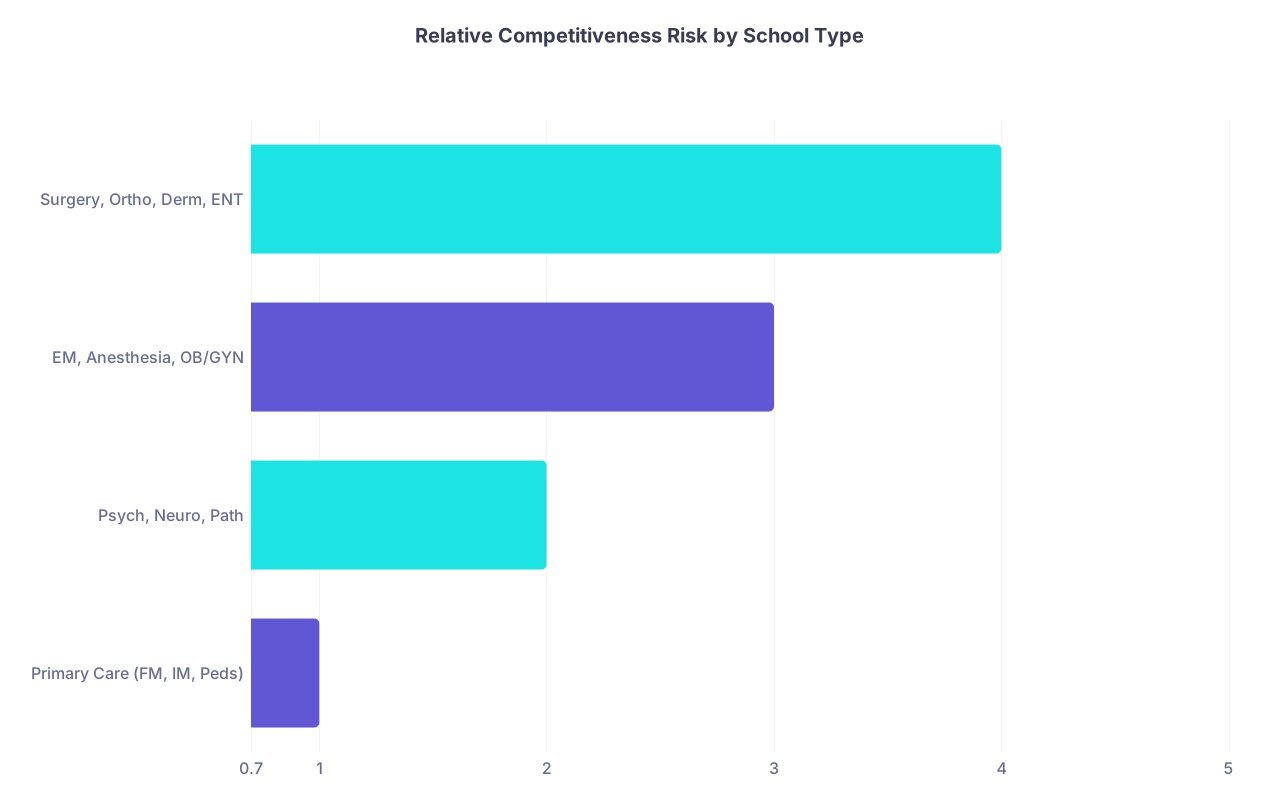
| Category | Value |
|---|---|
| Primary Care (FM, IM, Peds) | 1 |
| Psych, Neuro, Path | 2 |
| EM, Anesthesia, OB/GYN | 3 |
| Surgery, Ortho, Derm, ENT | 4 |
(Think of 1 as “least problematic” and 4 as “highest risk,” especially for Caribbean grads.)
If you want:
Family medicine, internal medicine, pediatrics, psych:
U.S. DO is very workable. Caribbean can still get you there but with more friction.EM, anesthesia, OB/GYN, some fellowships:
DO is viable if you’re strong. Caribbean is an uphill climb; you’ll have to be top-tier with great scores and strategy.Ortho, derm, plastic surgery, neurosurgery, ENT, urology, ophtho:
Caribbean is almost always a terrible bet. Even DO will be an uphill climb, but at least the door is not bolted shut.
If you’re not sure what you want yet (which is normal), you should choose the path that preserves more doors, not fewer. That’s the DO.
8. Real-World Scenario Walkthroughs
Let’s run through some common situations I’ve seen and how I’d advise.
Scenario A: You want primary care and don’t care about prestige
You’ve got:
- DO at a newer or less-known U.S. school
- MD at a top Caribbean
You want to be a family medicine or internal medicine doc, maybe in your home state.
You should:
- Take the DO
- Embrace it fully
- Crush your preclinicals and boards
- Aim for solid but realistic residency programs that value DOs
In 12 years, no one in your clinic will care that you went to “X DO school” vs “SGU.”
Scenario B: You dream of a competitive surgical subspecialty
You’re thinking ortho, neurosurgery, plastics. You have:
- One DO acceptance
- One Caribbean MD acceptance
Hard truth:
- Even from DO, your odds are limited unless you’re exceptional — top of class, strong scores, research, networking
- From Caribbean, your odds drop from “long shot” to “basically none” outside rare outliers
If you absolutely cannot tolerate the idea of anything but, say, neurosurgery:
- First question: are you sure, or are you chasing status?
- Second: your best move is usually to decline both, strengthen your application, and reapply to U.S. MD/DO, not run offshore
Given only these two options and no chance to reapply:
- DO is still the better shot at a competitive specialty
- But you need to mentally prepare that you might end up in a less competitive field
Scenario C: Family pressure is pushing you toward MD
Parents say:
- “Real doctors are MD.”
- “In our country nobody knows what DO is.”
- “Your cousin did SGU and is a cardiologist now — why can’t you?”
You need to separate cultural perception from career risk.
You can:
- Explain that DO is fully licensed in all 50 states
- Show them match statistics by school type
- Point out that Caribbean MD = IMG, and many U.S. programs don’t even interview IMGs
But if they still don’t get it? You choose the path that protects your future, not their social bragging rights. That’s the DO.
9. Personal Fit and Non-Negotiables
Now, let’s assume you’ve accepted the broad truth: DO is usually better. Are there any legitimate non-career reasons to pick Caribbean?
You’d need something serious, like:
- A spouse whose career is tied to a Caribbean island for a few years (rare)
- A citizenship/visa situation where being in the Caribbean temporarily is easier than being in the U.S. (also rare if you already have a U.S. DO acceptance)
Stuff like:
- “Beaches look nice”
- “The weather is better”
- “I want to start sooner”
These are not real reasons to gamble your entire future.
Look at:
- Support systems: family, friends in the U.S. vs isolated on an island
- Mental health: big transition + high-stress academics + foreign environment
- Academic style: Caribbean basic sciences can be high-volume, high-attrition
Nine times out of ten, people do better when they’re physically and culturally closer to home. That’s your DO school.
10. A Simple Decision Framework You Can Use Today
If I had to give you a bare-bones checklist to make the call, it would look like this:

| Step | Description |
|---|---|
| Step 1 | Accepted to U.S. DO and Top Caribbean MD |
| Step 2 | Talk to immigration/financial aid expert |
| Step 3 | Re-examine motives. Talk to residents/PDs. |
| Step 4 | Choose U.S. DO |
| Step 5 | Caribbean MD with eyes wide open |
| Step 6 | Any major legal/visa barrier to attending DO? |
| Step 7 | Are you willing to accept higher risk of no residency for MD letters? |
| Step 8 | Understand IMG match stats and still prefer Caribbean? |
For almost everyone, you’ll land on: Choose U.S. DO.
11. What You Should Do This Week
Here’s how to stop spinning and actually move forward:
Talk to real people in training
Not Instagram doctors or YouTube influencers. Email or call:- A DO resident or attending
- An IMG from a Caribbean school (preferably someone who struggled, not just the one success story)
Pull actual data
- Look up your DO school’s COMLEX/USMLE pass rates and match lists
- Look up the Caribbean school’s true outcomes beyond their marketing site — forums, NRMP data, state licensing boards
Clarify your non-negotiables
- Are you okay living in a smaller U.S. city for 4 years?
- Are you okay being an IMG with structural disadvantages for the rest of your career?
Make a decision deadline
Do not let this drag for months. Pick a date (within 1–2 weeks), commit to one path, and then stop re-litigating it every night at 2 a.m.
FAQ (Exactly 3 Questions)
1. If I choose the DO school, should I still take USMLE or just COMLEX?
If you’re at a DO school and want to keep the widest range of residencies open, you should strongly consider taking USMLE Step 2 (Step 1 is now pass/fail and policies are changing, so check current guidance). Many program directors still prefer or understand USMLE scores better than COMLEX. However, do not tank COMLEX performance to chase USMLE. Priority: pass all required boards on time, then add USMLE if you can prep adequately without burning out.
2. Are there any Caribbean schools you’d consider “safe” if someone already has a DO acceptance?
“Safe” is the wrong word. Even the “best” Caribbean schools carry much higher risk than a U.S. DO program if your goal is a U.S. residency. I would not recommend any Caribbean school over an accredited U.S. DO for someone whose primary goal is becoming a practicing physician in the U.S. If you already have that DO acceptance, taking a Caribbean seat instead is almost always a downgrade in terms of match probability.
3. What if I go DO and later want to work internationally, where MD is better recognized?
Outside the U.S., the DO degree is less familiar. But in many countries, what really matters is: are you licensed in the U.S.? Are you board-certified in a recognized specialty? There are pathways for DOs to work abroad, especially after U.S. residency and board certification. If your main goal is a stable U.S. career with optional international work later, DO → U.S. residency → board certification is a perfectly viable route. The bigger constraint is usually immigration law in the destination country, not the two letters on your diploma.
Open a blank document right now and write, in one sentence, what you actually care about most: “I want a ___ career, in roughly ___ specialty, with this level of risk: ___.” Read that sentence, then circle the offer — DO or Caribbean MD — that best matches those words and commit to it.


