The biggest mistake future international medical graduates make is assuming all “IMG-friendly” regions are the same. The data says otherwise. Where you go to medical school strongly correlates with your probability of failing to match later.
I am not talking about vague reputation. I am talking about measurable differences: failed match rates by region, score distributions, visa burden, and specialty choice. You can quantify the risk you are taking on by choosing the Caribbean vs Eastern Europe vs South Asia.
Let’s walk through that risk with numbers, not marketing brochures.
1. The baseline: how often IMGs fail to match
The first thing you need is a reference point. What is a “normal” failed match rate?
Using recent NRMP data (2023–2024 cycles, rounded for clarity):
- U.S. MD seniors: ~93–94% match rate → ~6–7% failed to match
- U.S. DO seniors: ~90–91% match rate → ~9–10% failed to match
- Non‑U.S. citizen IMGs: ~60–62% match rate → ~38–40% failed to match
- U.S. citizen IMGs: ~67–68% match rate → ~32–33% failed to match
So right away: if you are an IMG, your failure risk is roughly 4–6 times higher than a U.S. MD senior.
But “IMG” is not one homogeneous category. Once you segment by region of medical school, the picture changes dramatically. Caribbean schools do not look like Eastern European public universities, and neither resemble top Indian or Pakistani colleges.
To frame this properly, think in cohorts. Out of 100 IMG applicants:
- About 60–68 will match
- 32–40 will not match that cycle
The regional question is: how much does your choice of school move you closer to 40% failure vs closer to 20–25% failure?
2. Regional clusters: how the data splits
We do not have perfect, public school‑by‑school failure rates. But patterns are crystal clear when you combine:
- NRMP outcome data by citizenship and country of medical school
- USMLE performance distributions
- ECFMG certification statistics
- Program director survey responses
- Published / leaked internal data from certain large for‑profit schools
Broadly, you can think in four regional buckets for non‑U.S. IMGs:
- English‑language Caribbean schools
- Eastern Europe / Former Soviet bloc
- South Asia (India, Pakistan, Bangladesh, Sri Lanka)
- Middle East / North Africa / Latin America (large mixed group)
I will focus on the first three because that is where most premeds actively choose to go when they cannot get a U.S. seat.
3. Caribbean vs other regions: the disproportionate risk
Let me be blunt: if you pick a lower‑tier Caribbean school, you are volunteering for one of the highest failed match probabilities in the entire ecosystem.
Not everyone in the Caribbean fails to match. Far from it. But the variance is brutal.
3.1 What the pipeline looks like
Caribbean schools optimize for enrollment, not outcomes. That changes the math:
- Extremely high intake
- Large first‑ and second‑year attrition
- USMLE Step 1 pass rates often 65–85% (vs 95%+ at solid U.S. MD schools)
- Many students never make it to ECFMG certification or the Match
If you look only at those who actually apply for residency, you have already filtered out a substantial volume of failures. The true “entered school → matched” rate is significantly worse than any NRMP table will show you.
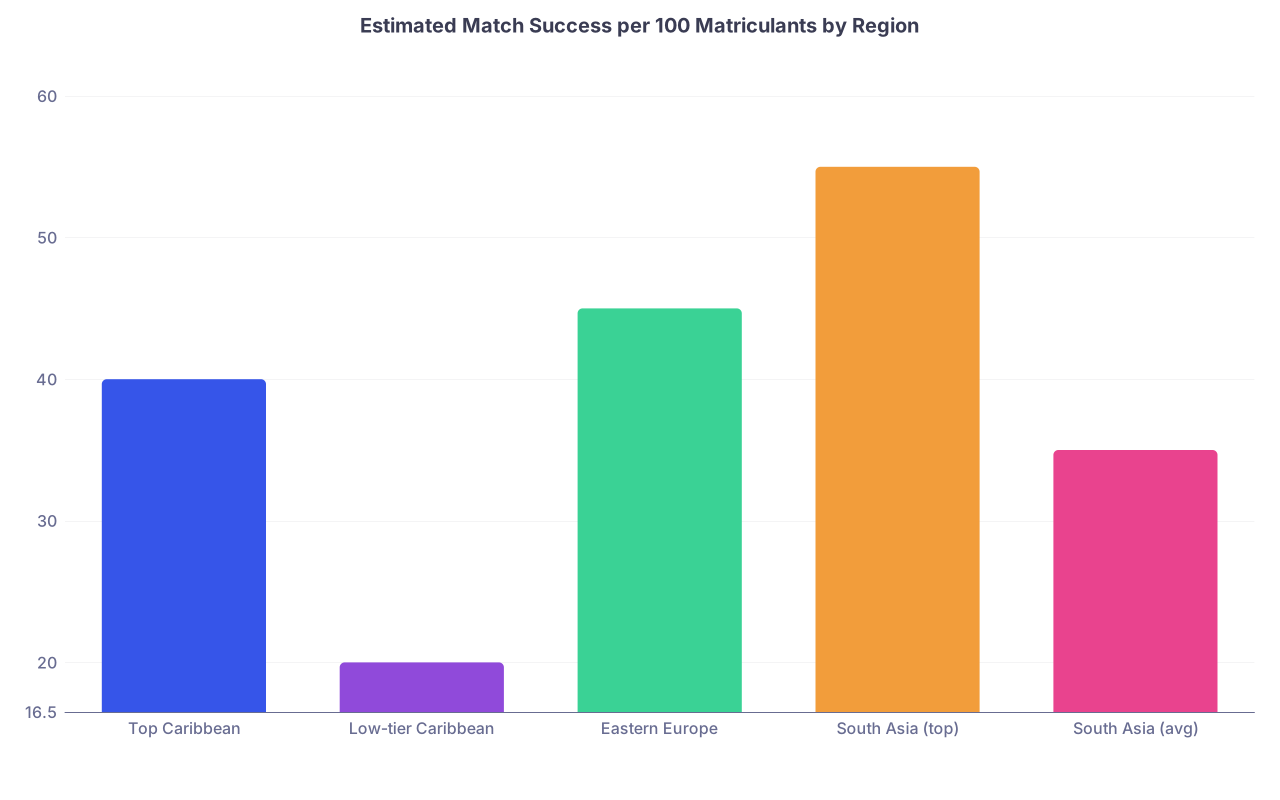
| Category | Value |
|---|---|
| Top Caribbean | 40 |
| Low-tier Caribbean | 20 |
| Eastern Europe | 45 |
| South Asia (top) | 55 |
| South Asia (avg) | 35 |
Interpretation of that chart (approximate, but directionally right):
- Top Caribbean schools (the big 3–4) might see ~40 out of 100 original matriculants eventually match
- Lower‑tier Caribbean programs may be closer to 20 per 100
- Eastern Europe roughly mid‑40s
- Top South Asian schools over 50
- Average South Asian private schools mid‑30s
That is not “NRMP applicant match rate”. That is a pipeline view from the start of medical school. Which is the only metric that matters to you when choosing where to enroll.
3.2 Caribbean failed match profile
What does a “failed match” Caribbean candidate look like in the data and in real life?
Pattern I repeatedly see:
- Step 1: pass with a low score or barely passed when numeric scores existed
- Step 2 CK: mid‑220s or lower, sometimes multiple attempts
- Clinical rotations: heavily U.S. community hospital based, but minimal academic exposure
- Specialty choice: heavy clustering in internal medicine and family medicine, where the bar is lower but competition from U.S. grads is intense
- Visa: mix of U.S. citizens and non‑U.S. citizens; the latter are hurt more
Caribbean failed match rates are driven by three mechanisms:
- Lower average USMLE performance
- School reputational discount (programs have seen too many marginal applicants)
- Oversupply: some schools send hundreds of applicants into the Match every year
The more marginal your metrics, the harsher that reputational penalty becomes.
4. Eastern Europe: moderate match, high variance
Eastern European and former Soviet‑bloc schools (Poland, Romania, Ukraine pre‑war, Czech Republic, Hungary, etc.) exhibit a different pattern.
Admissions are somewhat selective, curricula can be rigorous, but:
- Clinical exposure sometimes misaligned with U.S. expectations
- Language barriers create real limitations in patient interaction
- Few structured U.S. clinical rotations unless you arrange them yourself
4.1 What the aggregated data suggests
From NRMP + ECFMG patterns and institutional reporting:
- Non‑U.S. IMGs from Eastern Europe: match rates in the mid‑50s to low‑60s
- U.S. citizens who went to Eastern Europe: often slightly better, say mid‑60s
Failed match rate: likely in the ~35–45% range for those who actually apply.
The key is self‑selection. A higher fraction of weaker Eastern European graduates never bother applying to the Match, so the applicant pool is somewhat stronger than the total graduate pool.
| Region / Group | Match Rate | Failed to Match |
|---|---|---|
| U.S. MD seniors | 93–94% | 6–7% |
| U.S. DO seniors | 90–91% | 9–10% |
| U.S. citizen IMGs overall | 67–68% | 32–33% |
| Non‑U.S. IMGs overall | 60–62% | 38–40% |
| Eastern Europe (mixed) | 55–65% | 35–45% |
| Caribbean (all combined) | 45–55% | 45–55% |
Again, these are blended approximations, but you can see the point: Eastern Europe sits between South Asia’s top schools and the Caribbean cluster.
4.2 Who tends to fail from Eastern Europe?
These are the recurring patterns:
- Late or low Step 2 CK scores, often ≤230
- Delayed ECFMG certification (late document collection, exam delays)
- Weak or generic U.S. letters (observership‑heavy rather than hands‑on electives)
- Limited research, especially for more competitive specialties
If you are not planning U.S. exams and U.S. clinical exposure early, your statistical odds deteriorate fast.
5. South Asia: bimodal outcomes
South Asia is where people misunderstand the statistics the most.
If you look only at named, top‑tier Indian institutes (AIIMS, KEM, MMC, CMC Vellore) or premier Pakistani schools (AKU, King Edward, Dow), their graduates’ outcomes often approximate or beat the generic IMG averages. Many match into solid internal medicine, pediatrics, even competitive subspecialties once they are in fellowship.
But that is the top 10–20% of schools.
The rest of the region—including hundreds of private colleges with poor clinical exposure, crowded wards, and minimal USMLE culture—produces a large volume of graduates who either never attempt U.S. licensure or fail multiple steps and quietly drop out of the pipeline.
5.1 What the numbers suggest
Among South Asian graduates who actually clear USMLE and apply to the Match:
- Match rates: frequently in the 60–70% range for serious candidates
- Failed match: more like 30–40% among applicants
But if you look from “entered medical school” to “eventual matched U.S. resident,” the proportion drops sharply, because many never get to ECFMG certification at all.
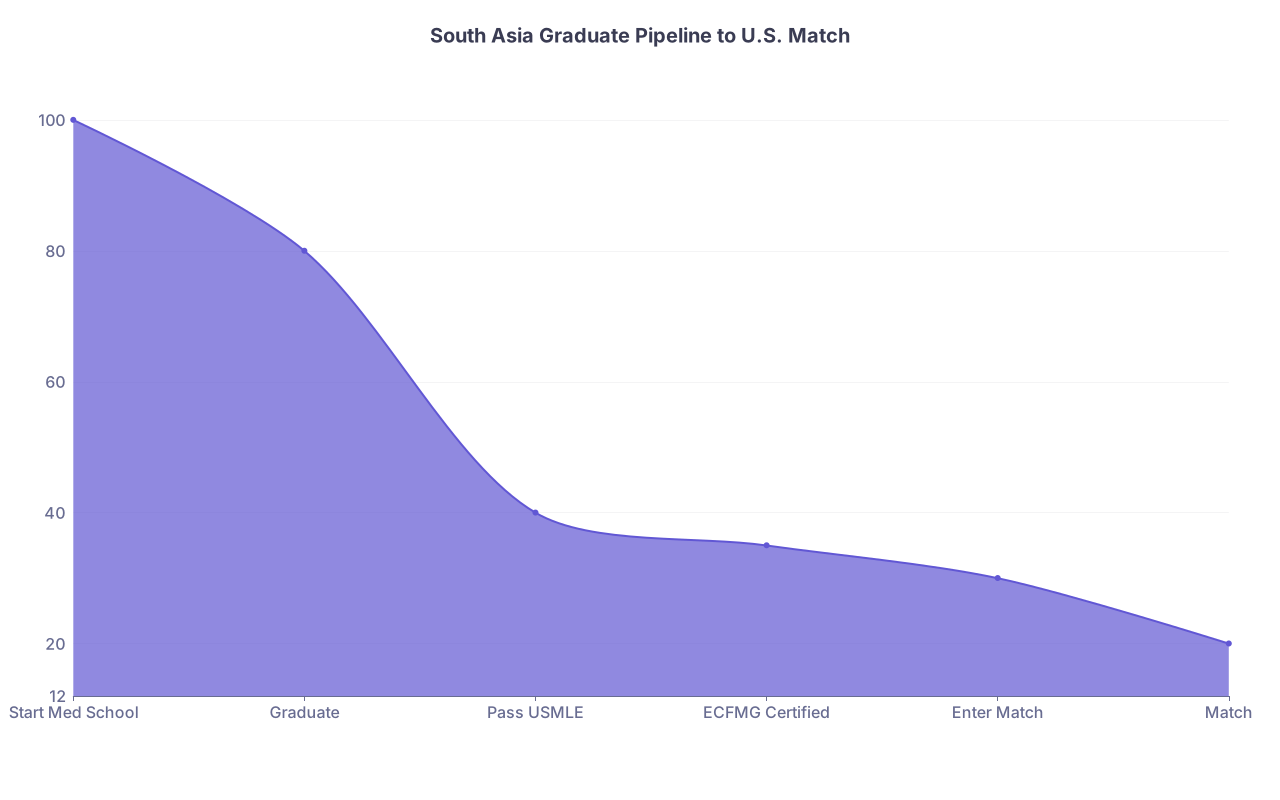
| Category | Value |
|---|---|
| Start Med School | 100 |
| Graduate | 80 |
| Pass USMLE | 40 |
| ECFMG Certified | 35 |
| Enter Match | 30 |
| Match | 20 |
Interpretation for a typical mid‑tier South Asian private medical college:
- Out of 100 starting students, maybe 80 graduate
- About half of those even try USMLE → ~40
- 35 achieve full ECFMG certification
- 30 apply to the Match
- 20 actually match
So from the perspective of a premed, the effective success rate is 20%. Looks eerily similar to low‑tier Caribbean when you view it from the starting line.
5.2 Who tends to fail from South Asia?
Three profiles pop up repeatedly:
- Late deciders who start USMLE prep in internship, rush exams, and underperform
- Strong clinicians with poor test strategy who stall around 210–220 on Step 2
- Graduation‑year mismatch: long gaps between graduation and application, which programs view as risk
The gap issue is heavily data‑driven: NRMP program director surveys consistently flag “years since graduation” as a major negative factor. Once you are 5+ years out, your failed match probability spikes.
6. The visa and citizenship multiplier
You cannot talk about regional differences without talking about passports. It changes the risk calculation.
Two facts from NRMP data:
- U.S. citizen IMGs have higher match rates than non‑U.S. citizen IMGs, even from the same regions
- Many community programs cap or completely avoid sponsoring visas
So, for the same school and the same scores:
- A U.S. citizen Caribbean grad with a 235 Step 2 may be competitive for several community internal medicine programs
- A non‑U.S. Caribbean grad with a 235 Step 2 is fighting an uphill battle simply because some programs will not even consider them
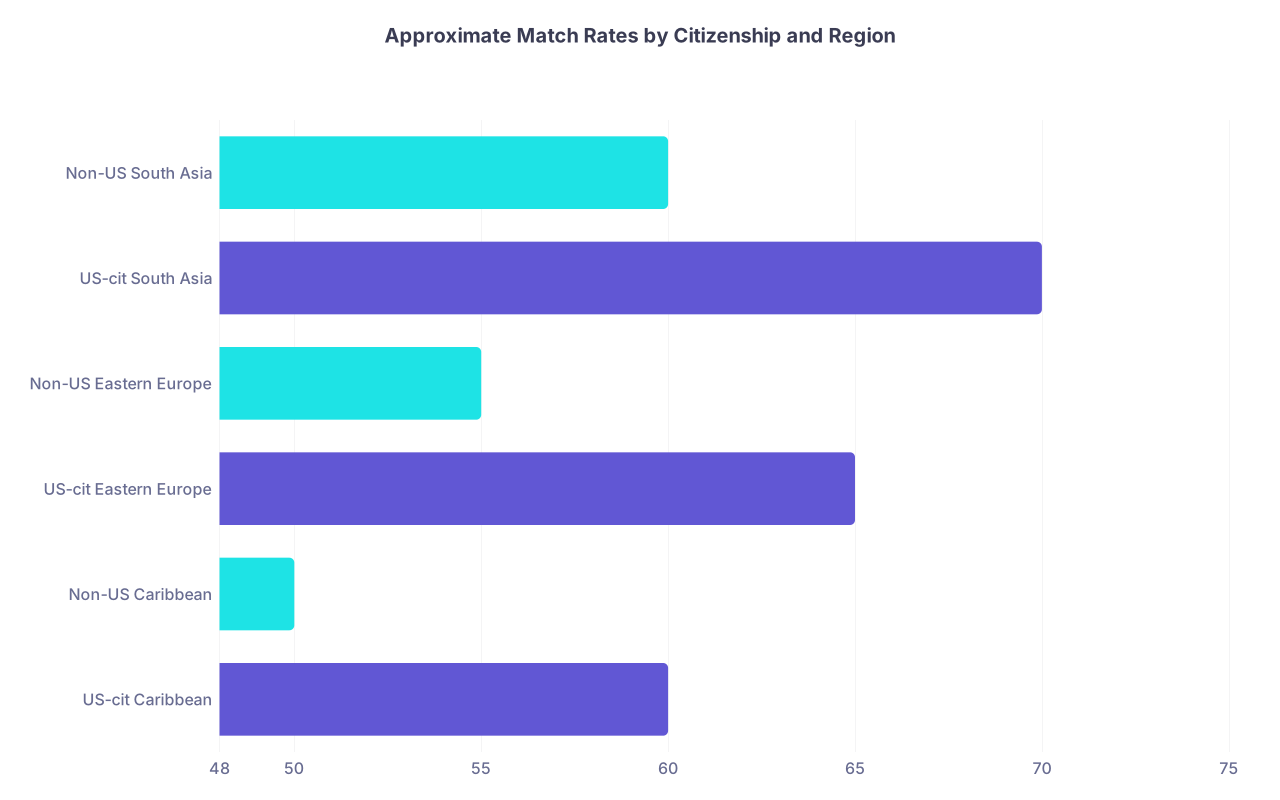
| Category | Value |
|---|---|
| US-cit Caribbean | 60 |
| Non-US Caribbean | 50 |
| US-cit Eastern Europe | 65 |
| Non-US Eastern Europe | 55 |
| US-cit South Asia | 70 |
| Non-US South Asia | 60 |
The exact numbers vary by cycle, but the pattern is consistent:
- Add ~5–10 percentage points to match rates for U.S. citizens vs non‑U.S. citizens from the same region
- That means failed match rates are systematically higher for non‑U.S. citizens
If you need an H‑1B or J‑1, your margin for error shrinks. By a lot.
7. Specialty choice: regional self‑sorting into risk
Regional differences in failed match rates are not just due to exam scores or school reputation. They are also driven by how graduates from each region cluster into specialties.
Caribbean and many Eastern European grads:
- Heavily concentrated in internal medicine, family medicine, pediatrics, and occasionally psychiatry
- Far fewer successfully land in surgery, orthopedics, dermatology, or radiology
South Asian top‑tier grads:
- More likely to attempt competitive specialties, but the Match realities still push many into IM and peds first, then subspecialty fellowships later
What matters here is the denominator. If 80–90% of a region’s graduates all target the same 3–4 “IMG‑friendly” fields, you get:
- Higher competition among IMGs for the same category of programs
- A “traffic jam” that inflates failed match rates even for fields that look numerically open
Program director surveys repeatedly show U.S. grads being preferred in almost every specialty. So when you squeeze more IMGs into fewer acceptable spots, regional oversupply drives up failure.
8. Process and timing: how regions differ in preparation
The regions also differ in how early students start aligning for U.S. residency.
South Asia (at good schools):
- Many students begin USMLE prep mid‑MBBS, with seniors passing down question banks and exam strategies
- Stronger culture of research in select teaching hospitals
- But still, many rely on last‑minute cramming and carry multiple‑year gaps after graduation
Caribbean:
- USMLE is baked into the curriculum, but quality control is inconsistent
- Students often underestimate the competition, assume that being physically in the U.S. solves everything, then wake up too late with mediocre scores
Eastern Europe:
- U.S. pathways are peripheral in many schools; local board exams dominate
- Students planning on the U.S. must self‑organize: Kaplan, UWorld, finding externships, etc. Those who do are usually highly motivated; those who do not end up non‑competitive almost by default
The data consequence: early, structured, exam‑aligned preparation reduces failed match rates. Regions that treat U.S. exams as an afterthought produce more last‑minute, low‑score attempts and higher non‑match rates.
9. Concrete risk comparisons for a premed
Let us translate all of this into practical, risk‑based decisions. Suppose you are a U.S. citizen who could not secure a U.S. MD or DO spot and you are choosing between:
- A top Caribbean school
- A mid‑tier Eastern European school
- A mid‑tier South Asian private school (where you have family ties)
Assume average performance, no major red flags, and serious intent to pursue U.S. residency.
Based on the data patterns:
Top Caribbean:
- Likely applicant match rate: ~55–65%
- Failed match probability as an applicant: ~35–45%
- From matriculation to eventual match: maybe 35–45 out of 100
Eastern Europe (mid‑tier):
- Applicant match rate: ~55–65%
- But more self‑selection; weaker students may never get to the Match
- Matriculation → match: maybe 40–50 out of 100
South Asia (mid‑tier private):
- Applicant match rate: ~60–70% for those who get certified
- But a smaller fraction will pursue and complete USMLE
- Matriculation → match: 20–35 out of 100 depending on culture and support
The top‑tier South Asian institutions can push that matriculation → match metric well over 50, but you usually need strong entrance exam scores to even get in.
10. Where regional choice matters less
There are a few situations where regional differences in failed match rates compress and your individual profile dominates.
Exceptionally strong USMLE performance
- Step 2 CK ≥ 250, clean record, no repeats
- At that level, most programs will at least read your application regardless of region
Consistent and relevant U.S. clinical experience
- Multiple U.S. core electives or sub‑internships with strong letters
- Not just two‑week observerships
Clear specialty targeting with realistic choices
- You choose internal medicine, family medicine, or pediatrics early
- You apply broadly (80–120 programs) and tailor your applications
In these cases, your failed match risk starts to converge to the overall IMG averages, with smaller regional effects.
11. The underlying drivers you can and cannot control
Let me separate the signal from the noise.
You cannot control:
- Program biases against certain regions or specific notorious schools
- Visa sponsorship policies
- Macro trends like U.S. MD/DO class expansion, which erodes IMG slots
You can control (to a substantial extent):
- Specialty choice and application strategy
- Step 2 CK performance and exam timing
- Quantity and quality of U.S. clinical exposure
- Graduation year relative to Match application date (avoid long gaps)
- How early you orient your entire medical education around U.S. standards
Regional differences in failed match rates are largely proxies for these underlying variables. Some regions simply stack more of the risk factors together:
- Caribbean: commercial intake, variable academic rigor, heavy oversupply
- Eastern Europe: US‑pathway as an afterthought, language and clinical mismatch
- South Asia: bimodal system; top institutions do well, bottom half barely engage with U.S. licensing
The data is telling you that your school choice will pre‑load your risk profile before you ever take Step 2.
12. Bottom line: what the numbers actually say
Condensing the whole picture into a few data‑driven takeaways:
- Regional origin of your medical school measurably shifts your failed match probability; the Caribbean and lower‑tier South Asian schools sit at the highest overall risk when you measure from matriculation to eventual match.
- Citizenship and visa status layer on top of region; non‑U.S. citizens from any region face 5–10 percentage points higher failed match rates than comparable U.S. citizens, especially in oversubscribed “IMG‑friendly” specialties.
- Strong exam scores, early U.S. clinical alignment, and realistic specialty targeting can partially neutralize regional penalties, but they cannot fully erase the structural disadvantages baked into certain regions’ educational and pipeline models.
If you are a premed looking at international schools, you are not just choosing a continent. You are choosing a statistical trajectory. The data is clear: where you train heavily influences how likely you are to end up among the 30–50% of IMGs who never match. Choose like those numbers are real, because they are.