

The biggest financial mistake physicians make is not overspending. It is mistiming. Right priorities at the wrong decade blow up more attending careers than bad stock picks ever will.
You need a sequence. A decade‑by‑decade script. At 28, you should not be obsessing over estate tax tricks. At 55, you should not still be “catching up” on student loans. Let’s fix the order.
Your 20s: Foundation Decade – Debt, Habits, and Basic Protection
In your 20s you are not “investing” in the sexy sense. You are building the scaffolding that makes serious investing in your 30s and 40s actually work. Residents who skip this and “wait until they are an attending” end up ten years behind.
Late Med School (22–26): Minimal Income, Maximum Leverage
At this point you should:
Lock in insurability cheaply
- Get an own‑occupation disability insurance quote while you are still healthy.
- Non‑cancelable, guaranteed renewable.
- With a future increase option so you can scale benefits when your attending income hits without new medical underwriting.
- Consider small term life only if:
- You have a spouse or dependents, or
- Someone co‑signed loans that are not fully federal and dischargeable at death.
- You are not yet buying whole life, variable universal life, or any permanent life product. Those are commission machines for agents, not tools for a 24‑year‑old med student.
- Get an own‑occupation disability insurance quote while you are still healthy.
-
- One checking account, one savings account.
- A separate card or account for “career expenses” (USMLE fees, Step resources, away rotations) so you can actually track what this phase costs you.
- Build a tiny emergency buffer:
- Target: $1,000–$2,500 in cash. You are not building a full emergency fund yet, just a “do not use credit card for a flat tire” fund.
Learn the investment language
- One afternoon on:
- Index funds vs active funds
- Expense ratios
- Roth vs Traditional
- You are not picking stocks. You are learning the difference between:
- “VTI” (total US market index, cheap)
- A random “growth opportunities” fund with 1.2% expenses (expensive garbage for you).
- One afternoon on:
Residency (26–30): High Debt, Low Income – Optimize the Levers You Actually Have
Stop telling yourself you will “start when you are an attending.” Residents who wait lose the entire Roth decade.
At this point you should:
Attack your student loans strategically
- Decide early: PSLF path vs Aggressive payoff path.
- If PSLF:
- Consolidate to Direct Loans if needed.
- File income‑driven repayment (IDR) right away.
- Track qualifying payments every year. Do not assume the servicer is right.
- If no PSLF:
- Refinance high‑interest loans once you are sure you will not use federal protections.
- Lock a reasonable fixed rate with a reputable physician‑friendly lender.
- Priority: You are not trying to pay everything off in 3 years. You are trying to avoid accruing unnecessary high‑interest debt while preserving flexibility.
Maximize Roth while your tax bracket is low
- Residents sit in one of the lowest tax brackets they will ever see as physicians.
- Investment priority order in residency:
- Employer match (if any) in 403(b) or 401(k) – never leave match on the table.
- Roth IRA (direct, not backdoor) – aim for the annual max if possible.
- Extra payments toward high‑interest debt (credit cards, >7% loans).
- Use a target‑date index fund or simple 3‑fund portfolio:
- Total US stock
- Total international stock
- Total US bond (small portion only, you have decades).
Get real disability coverage in place
- If you have not already, residency is the last “easy” moment.
- Add:
- Specialty‑specific definitions (e.g., “invasive cardiologist” vs generic “physician”).
- Residual disability rider.
- This is not optional. I have seen a PGY‑2 lose a hand in a car accident. No coverage. Career over, finances wrecked.
Micro‑invest in habits, not dollars
- Automate:
- $100–$300 per month into Roth IRA.
- $50–$100 per month into a simple taxable brokerage if you can do it without starving.
- Build the muscle memory: every 1st of the month, money leaves checking and goes to investments. No debate. No drama.
- Automate:
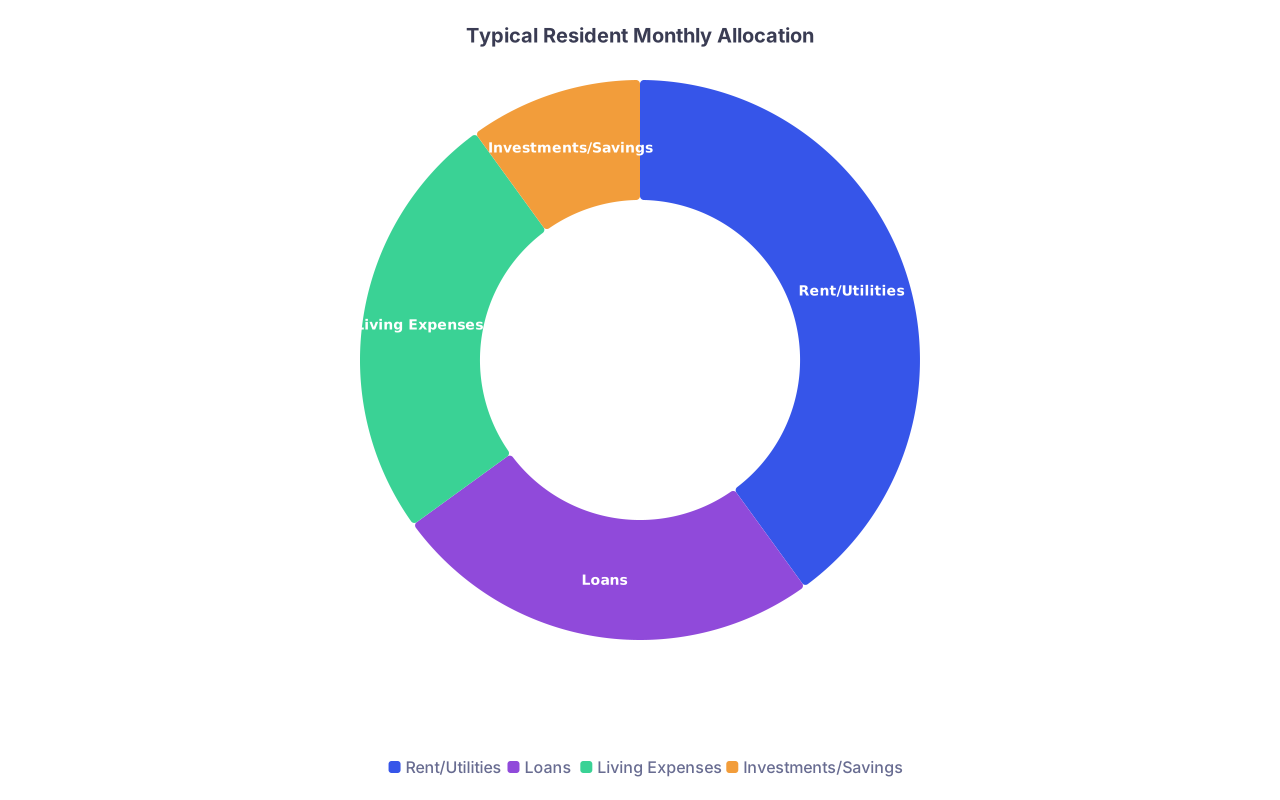
| Category | Value |
|---|---|
| Rent/Utilities | 40 |
| Loans | 25 |
| Living Expenses | 25 |
| Investments/Savings | 10 |
Your 30s: Acceleration Decade – From Survival to Serious Wealth Building
In your 30s, your priorities flip fast: attending income hits, lifestyle temptation explodes, and for a brief window your time, energy, and risk tolerance are still high. This is your highest‑leverage decade. You can either become wealthy almost by accident or lock yourself into a permanently stressed life.
Early Attending (30–34): Big Income, Big Decisions
At this point you should, in the first 12–18 months:
Freeze your lifestyle for one full year
- Pick a “resident plus 30%” lifestyle for year one.
- Use the surplus to:
- Build a full emergency fund: 3–6 months of core expenses in a high‑yield savings account.
- Attack high‑interest debt.
- Start maxing retirement accounts.
- Every attending who jumps straight to the BMW and $1.2M house spends the next decade “too tight” to invest correctly.
Set your debt payoff horizon
- Goal: Non‑mortgage debt gone in 5–7 years, not 15.
- For student loans:
- If PSLF, stay the course and invest aggressively on the side.
- If private/refinanced, choose a payment that kills the balance before 40.
- Do not let “my loans are at 3%” become an excuse to carry them indefinitely. Physicians with $0 loans at 40 play the investment game on easy mode.
Max out all tax‑advantaged accounts
- Typical order:
- 401(k)/403(b) up to employer match.
- Full 401(k)/403(b) max (traditional vs Roth depends on tax bracket; many attendings go pre‑tax here).
- Backdoor Roth IRA (for you and spouse).
- HSA (if on high‑deductible health plan) – invest it, do not just let it sit.
- Use broad, low‑cost index funds. If your hospital plan menu is awful, pick the least bad (usually the broadest index with lowest expense ratio).
- Typical order:
Start a taxable brokerage account
- Once tax‑advantaged buckets are full and high‑interest debts controlled:
- Automate monthly contributions to a taxable account at Fidelity, Vanguard, or Schwab.
- Use the same simple index strategy. No need for exotic stuff.
- Once tax‑advantaged buckets are full and high‑interest debts controlled:
Lock in the right insurance, then stop thinking about it
- Confirm:
- Sufficient term life (20–30 years) to cover your income until kids are launched and debts are gone.
- Umbrella liability policy (usually $1–3M) sitting on top of home and auto.
- Then you are done. Stop letting salespeople “review your coverage” to sell you whole life.
- Confirm:

Mid/Late 30s (35–39): Systems, Not One‑Off Decisions
At this point you should:
Automate the whole ecosystem
- On payday:
- Retirement contributions auto‑deducted.
- Automatic transfers to:
- Taxable investments
- 529 plans (if you have kids and have decided to fund college)
- Extra mortgage or loan payments as planned
- You should not be “deciding” every month how much to invest. The system decides.
- On payday:
Align your investing with your actual life timeline
- You are likely:
- Starting or growing a family.
- Considering practice partnership, private group, or academic promotion.
- Make investing match:
- If you plan to buy a home in 3–5 years, that down payment money belongs in cash or short‑term bonds, not stocks.
- Retirement money stays aggressively in stocks, mostly 80–90% equity for most doctors in their 30s.
- You are likely:
Refine—do not “spice up”—your investments
- Minor tweaks that help:
- Add a small real estate index slice if you want.
- Tilt slightly to small‑cap/value if you actually understand why.
- Things that waste time:
- Day trading.
- Chasing hot sectors.
- Crypto FOMO.
- Your advantage is steady high income and long horizon, not cleverness.
- Minor tweaks that help:
Your 40s: Consolidation Decade – Peak Earning, Lower Risk of Stupidity
Your 40s are usually your top income years and the point where major mistakes get permanent. You are too far along to “start over” if you blow it. This decade is about protecting the compound interest machine you built in your 30s and getting brutally clear on retirement targets.
Early 40s (40–44): Checkpoint Decade
At this point you should:
- Run a brutally honest net worth and savings rate review
- Tally:
- Retirement accounts
- Taxable investments
- Home equity (conservatively)
- Business/practice equity (even more conservatively)
- Subtract:
- Mortgages
- Loans
- Any lingering consumer debt (which frankly should be gone by now)
- Compare to your income. As a rough (and intentionally aggressive) guide:
- Tally:
| Age | Solid Net Worth (Multiple of Gross Income) |
|---|---|
| 35 | 0.5–1x |
| 40 | 1–2x |
| 45 | 2–3x |
| 50 | 3–5x |
- If you are way behind these ranges, you need higher savings, not a fancier investment product.
Dial in your target retirement age and lifestyle
- Decide:
- Do you see yourself working full‑time to 65? 60? 55?
- Do you want the option to go part‑time in your 50s?
- That determines your required savings rate far more than your fund choices.
- Decide:
Adjust asset allocation intelligently
- Typical shift:
- 30s: 80–90% stocks.
- Early 40s: 70–80% stocks, add more bonds, especially in tax‑advantaged accounts.
- No, that does not mean “panic sell” in a downturn. You set an allocation and rebalance.
- Typical shift:
Late 40s (45–49): Pre‑Retirement Infrastructure
At this point you should:
Get serious about tax optimization
- Maximize:
- 401(k)/403(b), 457(b) (careful with non‑governmental 457 risk), defined benefit or cash balance plans if offered.
- Use:
- Tax‑efficient funds in taxable accounts (total market, municipal bonds if appropriate).
- Asset location:
- Bonds in tax‑deferred accounts.
- Stocks in Roth and taxable.
- Maximize:
Clean up your investment lineup
- Eliminate:
- Stray high‑fee managed funds from the 2000s you never sold.
- Redundant sector funds and complex products you do not actually follow.
- Migrate toward:
- 3–5 core low‑cost index funds.
- Simplicity at 50 is not a luxury; it is risk control.
- Eliminate:
Revisit insurance and legal structure
- Term life:
- If you are on track for financial independence by 60 and kids are almost launched, you may be able to gradually reduce or let policies expire as they end.
- Disability:
- Decide how long you realistically need full coverage. Many physicians taper in late 50s.
- Legal:
- Updated will, health care proxy, powers of attorney.
- If you have meaningful assets: basic estate planning, possibly a revocable living trust.
- Term life:
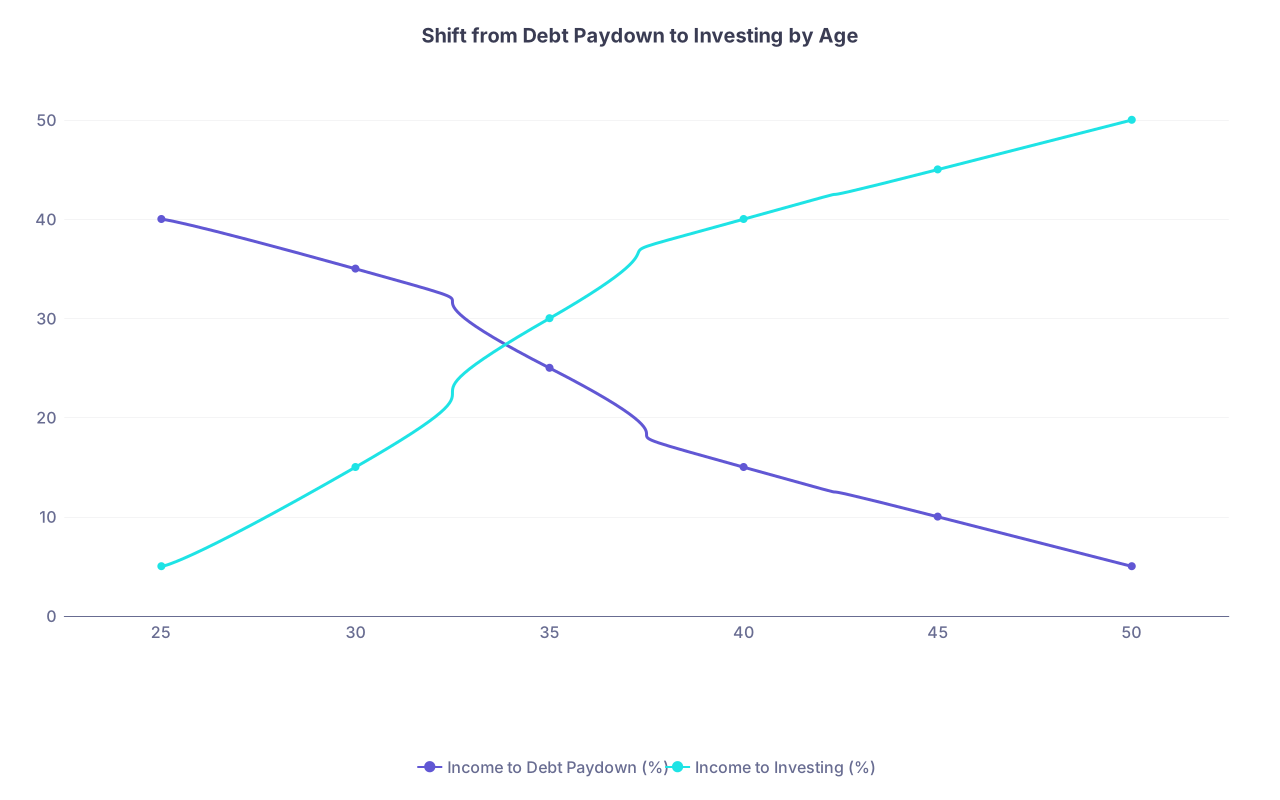
| Category | Income to Debt Paydown (%) | Income to Investing (%) |
|---|---|---|
| 25 | 40 | 5 |
| 30 | 35 | 15 |
| 35 | 25 | 30 |
| 40 | 15 | 40 |
| 45 | 10 | 45 |
| 50 | 5 | 50 |
Your 50s: Transition Decade – From Accumulation to Distribution Planning
Your 50s are not just “keep doing what you are doing.” This decade is about rearranging your finances so they can survive you not working. A physician who ignores this and keeps a 35‑year‑old’s portfolio at 58 is setting up for a nasty surprise in the first bear market of their retirement.
Early 50s (50–54): Last Big Push and Risk Calibration
At this point you should:
Confirm your retirement number with real assumptions
- Use conservative inputs:
- 3–4% safe withdrawal rate.
- Realistic portfolio returns (do not project 10–12%).
- Include healthcare costs before Medicare if you may retire early.
- If the math says you are short:
- You still have tools:
- Work a few more years.
- Downsize the house.
- Tighten lifestyle now while income is high.
- You still have tools:
- What you do not do is crank risk sky‑high to “catch up.”
- Use conservative inputs:
Shift asset allocation toward sequence‑of‑returns protection
- Goal:
- Enough in safe assets (cash, short‑term bonds) to cover 5+ years of spending by your planned retirement date.
- Rough pattern for many physicians:
- Early 50s: 60–70% stocks, 30–40% bonds/cash.
- This reduces the chance that a market crash right as you retire forces you back to full‑time work.
- Goal:
Plan a glide path to part‑time, if desired
- If you want to go part‑time in your late 50s:
- Model what reduced income does to savings.
- Front‑load extra savings in early 50s:
- Max every available retirement plan.
- Keep lifestyle escalation minimal while income is still full.
- If you want to go part‑time in your late 50s:
Late 50s (55–59): Practice Your Retirement Before You Actually Retire
At this point you should:
Rehearse your retirement spending
- For 6–12 months:
- Live on the amount you think you will spend in retirement.
- Invest the difference.
- This stress‑tests:
- Your budget.
- Your psychological tolerance for a lower “work‑based” inflow.
- For 6–12 months:
Finalize your withdrawal and tax strategy
- Aim to:
- Smooth income across years to avoid big tax spikes.
- Consider partial Roth conversions in lower‑income years before RMDs.
- General pattern for many:
- Early retirement years: draw from taxable accounts first.
- Delay Social Security to 67–70 if longevity likely.
- Protect Roth as a later‑life or legacy asset.
- Aim to:
Tighten estate and protection planning
- Update:
- Beneficiaries on all accounts (this is often wrong or outdated).
- Titling of taxable accounts.
- Decide:
- Which assets go to which heirs or charities.
- Reduce complexity for whoever will clean this up after you.
- Update:
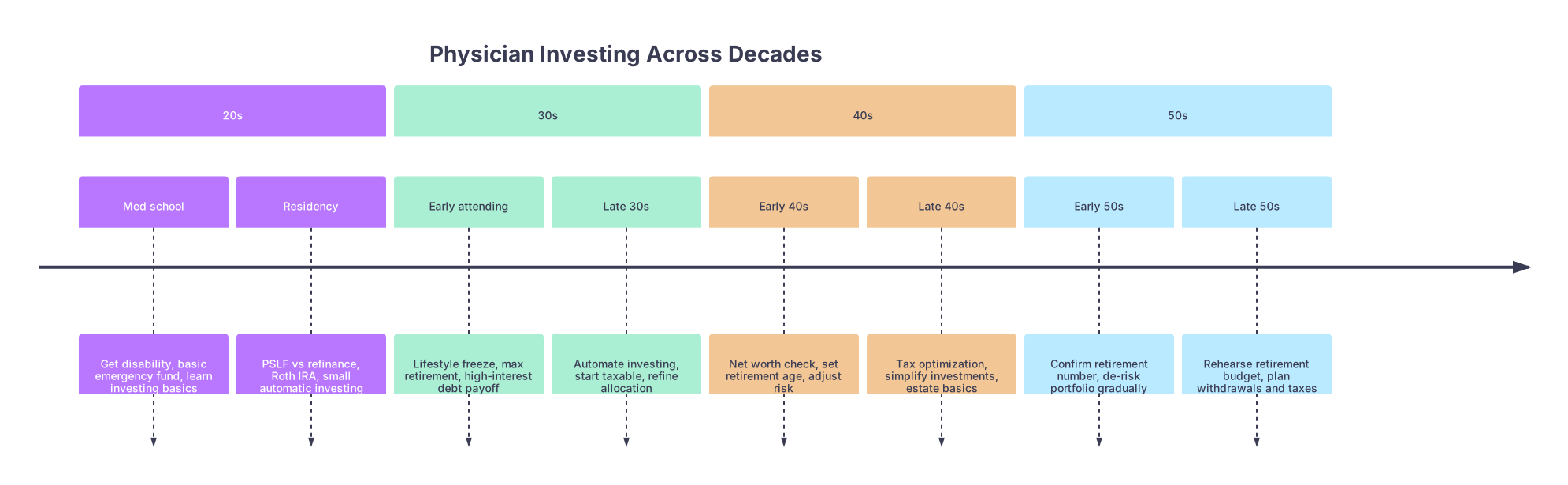
| Period | Event |
|---|---|
| 20s - Med school | Get disability, basic emergency fund, learn investing basics |
| 20s - Residency | PSLF vs refinance, Roth IRA, small automatic investing |
| 30s - Early attending | Lifestyle freeze, max retirement, high-interest debt payoff |
| 30s - Late 30s | Automate investing, start taxable, refine allocation |
| 40s - Early 40s | Net worth check, set retirement age, adjust risk |
| 40s - Late 40s | Tax optimization, simplify investments, estate basics |
| 50s - Early 50s | Confirm retirement number, de-risk portfolio gradually |
| 50s - Late 50s | Rehearse retirement budget, plan withdrawals and taxes |
Putting It All Together: Priority by Decade
Think of each decade as having one or two primary investment priorities. Everything else is secondary.
| Decade | Core Priority 1 | Core Priority 2 |
|---|---|---|
| 20s | Debt strategy + basic protection | Roth contributions + habits |
| 30s | Max tax-advantaged accounts | Lifestyle control + taxable investing |
| 40s | Net worth growth + risk tuning | Tax optimization + simplification |
| 50s | Retirement readiness check | Distribution and estate planning |
The 3 Things You Must Get Right
- Sequence beats sophistication. Doing the right things in the right decade matters more than clever investments.
- Savings rate beats returns. Particularly in your 30s and 40s, high, automated saving will do more than any fund choice.
- Risk must age with you. Aggressive at 30, moderated at 45, protected at 60. If your portfolio looks the same at every age, you are doing it wrong.


