

You finish charting at 10:47 p.m., close the EMR, and then open the email you’ve been avoiding. It’s from your spouse’s attorney, and the attachment is a “proposed settlement.” They want half your 401(k), a piece of your practice, and a cut of the surgery center you bought into 3 years ago. You’re exhausted, a little numb, and one thought keeps looping in your head: “I worked 15 years for this. Am I really about to hand half of it over?”
If you’re a doctor staring down divorce, the emotional hit is one thing. The potential financial blow—to your retirement accounts and your practice equity—is something else entirely. You cannot wing this. You need a playbook.
Let’s walk through it like I would if we were sitting in a quiet conference room after clinic, coffee getting cold, and you said, “Just tell me what to do, step by step.”
Step 1: Stop Guessing and Get Your Team in Place
If you’re a physician going through divorce and you have:
- Retirement accounts (401(k), 403(b), 457, IRA, cash balance, defined benefit), and/or
- Practice equity (solo, group, hospital-affiliated, or ancillary business)
…then you’re not in “simple divorce” territory. You need a specific kind of help.
Here’s your core team:
A family law attorney who regularly represents doctors or business owners.
Not just “a good divorce lawyer.” Someone who immediately asks about practice ownership, buy-sell agreements, and qualified plans. If they don’t ask that in the first call, move on.A financial expert who understands physician finances.
That might be:- A CDFA (Certified Divorce Financial Analyst) with physician experience, or
- A fee-only financial planner who has actually worked with doctors through divorces
This person models scenarios: cash flow post-divorce, retirement impact, tax angles.
For practice owners: a valuation expert.
Sometimes the practice already has a standard valuation formula in the shareholder agreement. If not, you’ll likely need a neutral or competing valuation.
Do not use your regular “guy from residency” financial advisor without asking bluntly: “How many divorces involving practice ownership and qualified plans have you actually worked on?” If the answer is zero, they can be background support, but not your primary advisor on this.
Your first concrete move today: make a short list of 3 attorneys and schedule consults. Do not wait for “more information.” You’re already on the field; you just haven’t suited up yet.
Step 2: Gather Every Financial Document—Fast and Quietly
Before things turn adversarial, you want a clean snapshot of your financial life. Not because you’re hiding anything, but because clarity equals leverage.
Here’s what you pull, without drama:
Retirement accounts (last 12–24 months if possible):
- 401(k), 403(b), 457, Solo 401(k)
- Traditional and Roth IRAs
- Cash balance or defined benefit plans
- “Hidden” plans: old residency 403(b)s, prior employers, HSA balances
Practice-related:
- Partnership/shareholder agreement
- Buy-sell agreement
- Recent K-1s
- Last 3 years of business tax returns
- Any documents from ASC, imaging center, lab, real estate LLCs
Personal:
- Tax returns (last 3 years)
- Pay stubs (W-2 and K-1)
- Brokerage and bank accounts
- Mortgage statements and major debts
Make digital copies. Store them in a secure, private folder (not joint cloud accounts, not a shared home computer your spouse also uses).
Why the urgency? Because I’ve seen people suddenly lose access. Logins changed. Documents “misplaced.” Memory gets selective when divorce starts hardening. You want your data before that happens.
Now you and your attorney can talk reality, not estimates.
Step 3: Understand What’s Actually “Marital” vs “Separate”
You can’t protect what you don’t correctly label.
Here’s the rough rule in most states (your attorney will refine it):
- Marital property: What was earned or accumulated during the marriage.
- Separate property: What you had before marriage, plus inheritances and certain gifts, sometimes growth on premarital assets if kept separate.
Applied to doctors:
Retirement:
- 401(k) contributions and growth during the marriage → usually marital.
- The portion of your IRA that came from before marriage → often separate, but growth might be partly marital.
- Pre-marriage residency 403(b) that you never rolled over → could be partially or entirely separate, depending on state and how it’s been handled.
Practice equity:
- If you bought into a practice during the marriage → that equity is usually marital.
- If you owned the practice before marriage → original value may be separate, but appreciation during marriage might be considered marital (again, state-dependent).
This is where people screw up: they emotionally feel like, “I did the 24-hour calls, I built this,” so they think of it as “theirs.” The law doesn’t care how many night shifts you did. It cares when the asset grew and under what circumstances.
What you want from your attorney and financial expert is a clear breakdown:
- “Here’s the approximate marital portion of each retirement account.”
- “Here’s the marital vs. separate component of practice equity, if any.”
Once you see that on paper, negotiations become strategy, not panic.
Step 4: Protecting Retirement Accounts – How Division Actually Works
You’re not writing a personal check for “half your retirement.” That’s not how this works, unless you let it.
Qualified plans: 401(k), 403(b), pensions, cash balance
These are usually divided via a QDRO (Qualified Domestic Relations Order). The QDRO tells the plan administrator: “Give X% or $X of this account to the ex-spouse, in accordance with the divorce judgment, without triggering taxes or penalties.”
Key points:
- A correctly drafted QDRO means no immediate taxes or 10% penalty on the division.
- If your ex takes money out after the transfer, those taxes/penalties are on them, not you.
- Mistakes here are expensive. Do not let a random paralegal “template” this. You want someone who regularly drafts QDROs for physician-level plans, especially for cash balance or defined benefit plans.
Where doctors get burned:
- Letting their lawyer “agree” to a percentage without verifying the actual plan rules and valuation.
- Not clarifying what date the account is valued (date of separation, filing, or QDRO execution). Market swings can mean tens or hundreds of thousands.
IRAs (Traditional, Roth)
These usually don’t need a QDRO. They’re split by a “transfer incident to divorce.” Custodian-to-custodian transfer, tax-free if properly documented.
Your action:
- Coordinate with your attorney and the IRA custodian.
- Confirm in writing that they will code it as a divorce-related transfer, not a distribution.
Strategy: Trade assets, don’t just split everything
You don’t have to cut every account in half. You can negotiate trade-offs:
- Example: Your ex gets more equity in the house; you keep more of the 401(k).
- Example: They get a taxable brokerage account; you keep the retirement accounts.
Use your financial expert to model the after-tax value. A $500k traditional IRA is not the same as $500k in a taxable account. Taxes make that a different beast.
This is where I see a lot of physicians “lose quietly.” They agree to “even” splits that are not actually even after taxes and time value.
Step 5: Practice Equity – What Is Your Practice Really Worth?
If you have practice equity, surgery center shares, imaging center ownership, or a medical office building LLC, this is where things can get ugly or very smart.
First, understand the type of practice:
| Practice Type | Divorce Complexity | Typical Equity Issue |
|---|---|---|
| Solo practice | High | Entire practice tied to you personally |
| Small group (2–10) | High | Buy-sell terms and valuation disputes |
| Large group (>10) | Moderate | Pre-set share prices or formulas |
| Hospital employed | Low | Usually no practice equity |
| Academic position | Low | No equity, but retirement is key |
Now we look at a few layers:
1. What does your governing document say?
Your partnership or shareholder agreement may quietly save you—or box you in. Look for:
- Buy-sell provisions: How are shares valued if a partner leaves or divorces?
- Restrictions on ownership: Many agreements require physician-only or partner-approved owners. That often means your ex cannot own shares directly, which is good.
- Mandatory redemption on divorce: Some agreements force a buyout if a doctor divorces. That can be a blessing or a cash-flow nightmare.
Bring that agreement to your attorney on day one. I’ve sat in rooms where nobody bothered to read it until 9 months into litigation. That’s malpractice-level sloppy.
2. How is the practice valued?
Valuation is not “my buddy sold his practice for 1x revenue.” It’s more structured:
Common methods:
- Income-based (earnings, adjusted physician compensation, etc.)
- Market-based (comparable practices)
- Asset-based (for low-profit or asset-heavy practices)
Special physician twists:
- A lot of your “value” is personal goodwill (patients seeing you). Many states treat personal goodwill as separate (not marital), while enterprise goodwill (practice systems, brand, contracts) is marital.
- If your salary is below market for your specialty, the valuation may need to “normalize” compensation.
Your valuation expert should understand how physicians are paid, RVUs, payer mix, shift differentials, and ancillaries. A generic small-business valuator who spends most of their time on restaurants and auto shops will often over- or under-value a medical practice.
3. Practical strategy: You keep the shares, they get value
In almost every physician divorce I’ve seen, the physician keeps the practice equity. The ex-spouse gets compensated with:
- A larger share of other assets (retirement, home equity, cash), or
- A structured payout over time based on the valuation.
You’re negotiating which pile of assets they get, not whether they walk into your partner meeting next Tuesday as a new owner. That’s almost never happening.
Your job: Don’t overpay for your own sweat equity because you’re scared or rushed. Use the valuation and the partnership agreement ruthlessly as anchors.
Step 6: Don’t Let Alimony and Child Support Wreck Your Retirement Plan
You’re not just splitting assets; you’re taking on new obligations. If they’re not planned for, they cannibalize retirement contributions.
Common trap:
Physician agrees to aggressive alimony/child support numbers based on current peak earnings, then:
- Reimbursement models change
- Call pay drops
- They burn out and want to cut back… but can’t, because their support is pegged to their full-throttle income.
What you do instead:
- Get a realistic income baseline: Strip out extra shifts, one-off bonuses, COVID hazard pay, etc.
- Show variability: If your RVU or collections swing, get those numbers documented to support why support should be on a conservative, average figure.
- Discuss future plans honestly with your attorney: If you intend to drop call or move to 0.8 FTE, plan for that now instead of pretending you’ll grind at max forever.
Why this matters for retirement:
Every dollar committed to fixed support is a dollar that can’t go into your 401(k), backdoor Roth, or taxable investments. Your financial expert should run retirement projections with:
- Current income and current support
- Post-divorce lifestyle and adjusted savings rates
- Different scenarios (e.g., working to 62 vs. 67)
If the numbers show you’ll be broke at 70 under the proposed deal, that’s not just “uncomfortable”—it’s negotiation ammo.
Step 7: Asset Location and Tax Strategy After the Dust Settles
Once the agreement is done, you’re in reconstruction mode. Your job is to rebuild without making dumb tax moves.
A few practical plays:
Prioritize tax-advantaged accounts you still control.
If your ex took a chunk of the 401(k), refill your side as aggressively as cash flow allows:- Max 401(k)/403(b)/457 where available
- Use backdoor Roth if your income is too high for direct contributions
- In some cases, use a defined benefit/cash balance plan if you’re an owner and need accelerated savings
Don’t forget asset location.
- Put higher-growth, tax-inefficient assets (like REITs, taxable bonds) primarily in tax-advantaged accounts.
- Use taxable accounts for broad equity index funds and more tax-efficient holdings.
Use tax-loss harvesting if you have taxable accounts hammered by market swings.
That can soften the tax hit from any one-time income events (practice buyout, asset sales).
Here’s how the rebuilding shift often looks:
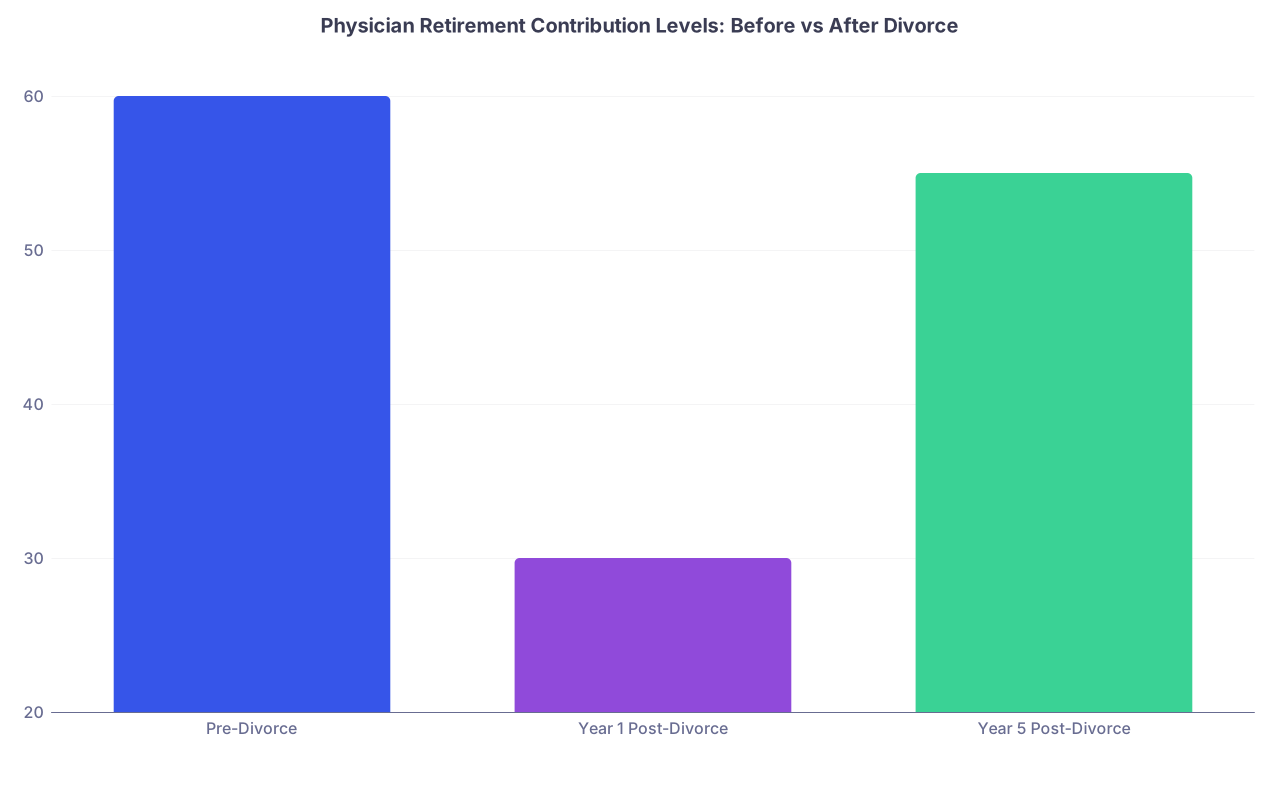
| Category | Value |
|---|---|
| Pre-Divorce | 60 |
| Year 1 Post-Divorce | 30 |
| Year 5 Post-Divorce | 55 |
Your goal isn’t to instantly get back to your old contribution level. It’s to build a clear ramp over 3–5 years based on an honest budget and new obligations.
Step 8: Common Mistakes Doctors Make in Divorce (And How to Avoid Them)
I’ve watched a lot of physician divorces from the financial and legal side. The patterns repeat.
Here are the top mistakes:
Trying to “be fair” without numbers.
You say, “Let’s just split everything,” to avoid conflict. You sign something that looks clean… and later realize you gave away post-tax gold in exchange for pre-tax pennies.Fix: Insist on valuations and tax-aware modeling before you agree to any split.
Overvaluing the house, undervaluing retirement.
Ex-spouse gets the house; you keep more retirement. Feels like “they got the big thing.” But houses eat cash (taxes, maintenance). Retirement accounts quietly grow.Letting guilt drive the deal.
You cheated. You were absent. You feel responsible. And you pay for it—twice, three times, for decades.Feel whatever you need to feel. Then tell your attorney, “Do not negotiate based on my guilt. Negotiate based on the facts.”
Not protecting your future ability to work.
Agreeing to insane production expectations just to afford support. Then burning out, getting depressed, or making medical errors. Not worth it.Ignoring disability and life insurance.
If you’re paying significant support, your ex (and your kids) depend on your income. The court may require life insurance. You should also think about disability coverage. If you go down, everyone goes down.Treating practice equity as a mystery box.
“I don’t understand it; let’s just give them half the value they want.” No. You can understand enough to negotiate smartly.
When you feel the urge to say “whatever, I just want this over,” recognize that as a red flag. That’s usually the moment people sign away 20 years of financial security.
Step 9: Concrete Game Plan If You’re Right in the Middle of This
If you’re already in divorce proceedings and worried about retirement and practice equity, here’s a prioritized list, not theory.
This week:
- Hire (or upgrade) to a divorce attorney who has seen multiple physician/practice-owner cases.
- Get a financial expert on board, even if just for 3–5 hours of consulting.
- Gather all documents listed above and organize them.
Over the next month:
- Clarify marital vs. separate components of each retirement account.
- Get or request a practice valuation, or at least review your partnership agreement’s valuation formula.
- Decide your non-negotiables:
- “I must keep X% of retirement.”
- “I must keep practice shares; I’m willing to buy them out with other assets.”
- “I cannot commit to more than $X/month cash flow without killing my future.”
Then:
- Start making specific proposals instead of reacting emotionally to theirs.
- Demand tax-adjusted comparisons of any proposed settlement.
- Push back—politely but firmly—on anything that jeopardizes your long-term solvency.
A Quick Visual: What You’re Balancing
You’re basically balancing three buckets: retirement, practice, and cash flow.

| Step | Description |
|---|---|
| Step 1 | Current Assets and Income |
| Step 2 | Retirement Accounts |
| Step 3 | Practice Equity |
| Step 4 | Cash Flow |
| Step 5 | Division by QDRO or Transfer |
| Step 6 | Valuation and Buyout Terms |
| Step 7 | Support Obligations |
| Step 8 | Your Future Retirement |
Every decision you make in divorce—how much equity they get, what share of the 401(k) moves, how high support is—flows into that final box: your future retirement.
Subtle But Powerful Moves That Help
A few smaller, tactical things that I’ve seen make a real difference:
- Timing QDROs and transfers carefully if markets are extremely high or low. You can’t time perfectly, but you can avoid obviously terrible timing when possible.
- Using structured buyouts for practice equity instead of giant lump-sum checks that destroy your liquidity.
- Negotiating for you to keep accounts that are annoying to divide (like certain pensions or complex defined benefit plans) in exchange for cleaner assets they can take whole.
- Being honest with your ex (where possible) that if they strip you now, your ability to pay steady support later drops. Some people actually get that math.
You’re not trying to “win” a divorce. You’re trying to walk out with a life you can sustain, relationships you can live with, and a retirement you won’t resent.
What to Do Today
Do one focused thing right now, not ten half-hearted ones.
Open a blank document and list:
- Every retirement account you have (where, approximate balance, when it started).
- Every ownership interest you have in a practice, ASC, imaging center, or real estate LLC.
Next to each, write one of three words: “Marital,” “Mixed,” or “Unsure.”
Then send that list to your attorney with this exact question:
“I want to protect my retirement and practice equity as much as possible. For each of these, how is it likely to be treated in our state, and what are my strongest options?”
That email starts a different kind of conversation—one where you’re not a passenger. You’re the one actually steering.


