

Most physicians are investing like it is 1995—and leaving six figures of long‑term return on the table.
Let me be blunt.
If your portfolio is just “a bunch of S&P 500 funds and some random active funds a colleague mentioned in the physician lounge,” you are not investing at the level your income and risk justify.
Factor investing is where serious, evidence‑based investing starts. Especially for physicians.
You do not need a PhD in finance to use factors intelligently. But you do need to understand what “value,” “size,” and “quality” actually mean in practice—because Wall Street will happily sell you nonsense dressed up as factor investing if you do not.
This is your crash course. Physician‑specific, no fluff, no sales pitch.
1. What Factor Investing Really Is (And What It Is Not)
At its core, factor investing is just this:
You tilt your portfolio toward characteristics (factors) that historically have been paid more over time—with rules, not hunches.
Classic equity factors include:
- Value (cheap vs expensive stocks)
- Size (small vs large companies)
- Quality (strong vs weak businesses)
- Momentum (recent winners vs losers)
- Profitability, investment, low volatility, etc.
The academic starting point:
Originally, the Capital Asset Pricing Model (CAPM) said stock returns were explained mainly by market risk. Then Fama and French showed that two extra factors—size and value—also systematically explained returns. Others later documented quality, profitability, momentum, and more.
For you as a physician, the theory details matter less than the practical consequences:
- You are not trying to “pick winners”.
- You are not forecasting the economy.
- You are choosing systematic, rules‑based tilts toward certain types of stocks.
Think:
Instead of “I like Apple,” your rule is, “I own more of cheaper, smaller, and higher‑quality companies—via diversified funds—with a clear, transparent methodology.”
That is factor investing.
What factor investing is NOT
I see three common confusions among physicians:
“Smart beta” marketing junk
Many “smart beta” products are just slightly tweaked index funds with higher fees and weak factor exposure. They use factor language but barely tilt the portfolio.Closet active management
A fund that owns 40 stocks with a manager talking about “our proprietary quality screen” is usually just active management with a buzzword.A free lunch
Factors have long periods of underperformance. If you cannot tolerate 5–10 years of “this is not working” while sticking to the plan, factor investing will sabotage you.
2. Why Factors Actually Matter More for Physicians
You are not a typical investor. Your situation has some very specific features:
- High human capital (your future earnings)
- Typically late investing start (residency + loans)
- High savings potential once attending
- High career risk concentration in healthcare
- Strong need to avoid catastrophic financial errors while still catching up
Factor investing matches that profile unusually well.
You can:
- Use value and size to modestly boost expected returns to help catch up.
- Use quality to reduce the risk of owning junk companies that implode at the worst time.
- Implement everything rules‑based, so your investment plan is not hostage to your post‑call emotions or an advisor’s hot take.
Let me be clear:
Factors are not mandatory. A total market index portfolio is already better than 80–90% of what I see physicians actually holding.
But if you want to be in the top 10–20% of investor sophistication—without day‑trading, without market‑timing—that is where factors come in.
3. Value, Size, and Quality: What They Really Mean
We will strip out academic jargon and go straight to physician‑relevant definitions.
| Category | Value |
|---|---|
| Market | 7 |
| Value | 10 |
| Size | 9 |
| Quality | 8 |
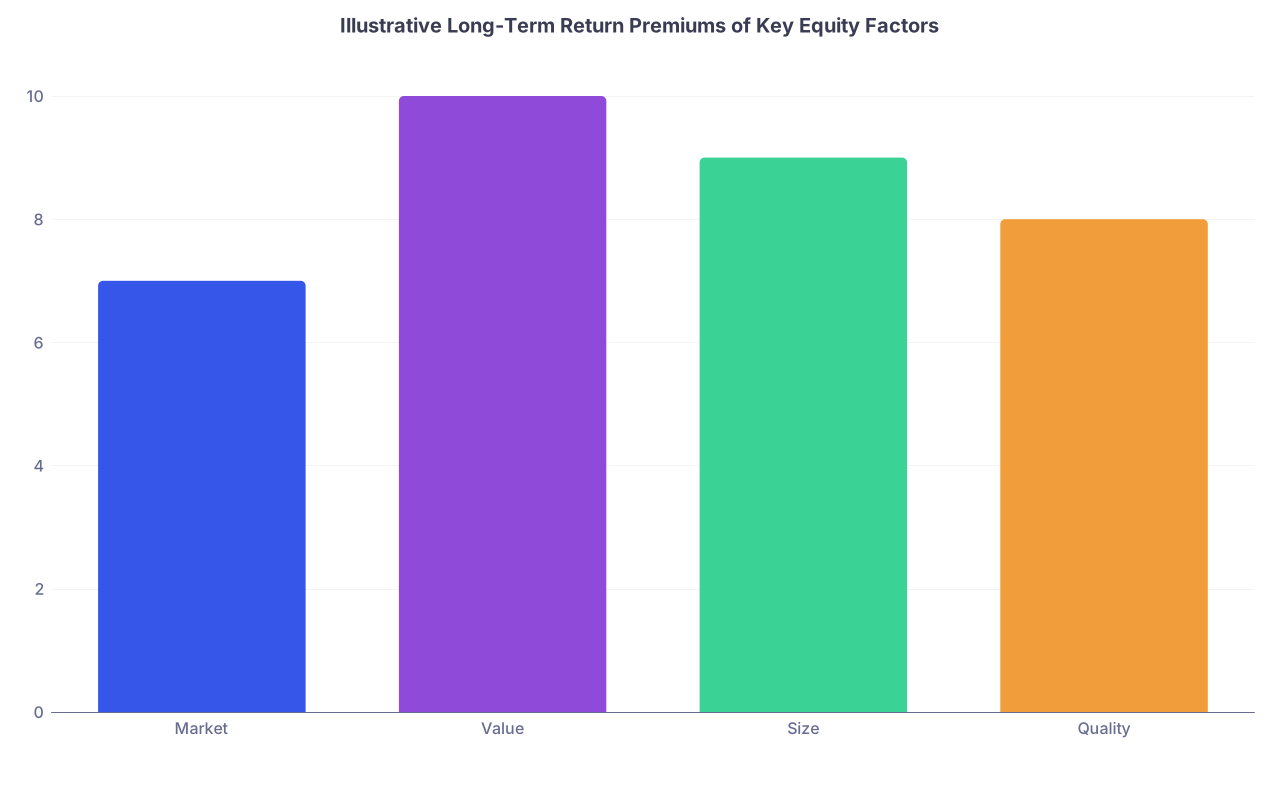
Assume (illustrative, not guaranteed) real annual returns over long periods:
- Market (broad global equities): ~7%
- Value tilt: maybe ~3% premium over market
- Size tilt: maybe ~2% premium over market
- Quality tilt: similar return to market, but smoother ride and less left‑tail risk
These are expectations based on history, not promises. But the direction is correct.
Value: Owning businesses that are currently unloved
Concept:
Value stocks are cheaper relative to their fundamentals. Common metrics:
- Price‑to‑book (P/B)
- Price‑to‑earnings (P/E)
- Price‑to‑cash‑flow
- Dividend yield, etc.
Plain English:
You are paying less today for each dollar of assets, earnings, or cash flow. These are not “bad companies”; they are often just unpopular, boring, or facing temporary headwinds.
Why might they pay more over time?
- Risk story: These companies really are riskier (more cyclicality, more distress). Investors demand higher long‑run returns as compensation.
- Behavioral story: Investors chase shiny growth stories and overpay for them, systematically underpricing the boring, ugly, or temporarily troubled.
In practice:
- Value outperforms over decades.
- Value can underperform brutally for 5–10+ years (see growth dominance post‑2009).
- Owning value effectively means you are constantly buying what feels uncomfortable.
For a physician:
- You already have a steady income.
- You can ride long dry spells if you set expectations correctly.
But only if you go in knowing: value will feel wrong for long stretches. If you treat a five‑year underperformance as “proof it does not work,” you should not tilt heavily to value.
Size: Small beats big (on average, over long horizons)
Concept:
Small‑cap stocks historically have had higher returns than large‑cap stocks. “Small” simply means lower market capitalization (company size by total market value).
Reality check:
- The size premium is real but noisy.
- It shows up more strongly when you look at small + value together.
- Many “small‑cap” funds are actually loaded with small growth junk, which historically has been terrible.
Why might smaller companies pay more?
- They are more volatile and risky.
- They have less access to capital, more concentrated businesses, thinner trading.
- Information is less widely disseminated; mispricing is more common.
For a physician:
- You do not need extreme small‑cap exposure.
- A modest tilt (e.g., 10–20% of your equities in a true small‑cap value fund) can change long‑term expected returns meaningfully without taking your risk profile off a cliff.
Quality: Owning businesses that actually deserve your capital
“Quality” is deceptively simple. Everyone says they want “quality companies.” But in factor investing, quality has defined characteristics:
- High and persistent profitability (e.g., high return on equity or assets)
- Strong balance sheets (low leverage relative to fundamentals)
- Stable earnings and cash flows
- Conservative investment policies (not chasing empire building with shareholder money)
Why quality matters:
Quality is less about juicing returns and more about shaping the distribution of outcomes. In other words:
- Similar or slightly higher average return vs the market
- Less blow‑up risk
- Shallower drawdowns in crises
- Better risk‑adjusted return (higher Sharpe ratio)
For physicians, this is underrated. You typically have:
- Enough risk already (career, malpractice, regulatory risk).
- Low tolerance for catastrophic loss right before retirement.
A quality tilt is one of the rare things where I am comfortable saying:
“It is hard to argue against this if implemented cheaply and systematically.”
4. How Factor Investing Actually Gets Implemented (Without You Day‑Trading)
You are not going to screen thousands of stocks or rebalance factors manually. Nor should you.
You implement factors via funds or ETFs that do the heavy lifting.

Broad structure for a physician:
- Core: Global equity index (low‑cost total US + total international)
- Satellite: Factor funds tilting to value, size, and quality
Think: 70–90% boring market cap index, 10–30% factor tilts. Concrete examples later.
What to look for in a factor fund
You want:
Clear, rule‑based methodology
Not “we use a proprietary, dynamic framework” without specifics. Read the index description or methodology PDF.Meaningful factor exposure
If a “value” fund has only slightly lower P/B or P/E than the broad market, the tilt is weak. Same for size and quality—look at factor loadings or holdings profile.Diversification
Hundreds of holdings at least. No concentrated 40‑stock “factor” portfolios for your core.Low cost
For broad factors, you should not be paying 0.6–1.0% expense ratios. In 2026, there are plenty of factor ETFs in the 0.15–0.35% range or better.Reasonable turnover
If turnover is 100–200% per year, trading costs may quietly kill the factor premium.
5. A Concrete Framework: Factor Allocation for a Typical Attending
Let’s mock up a typical scenario.
Profile:
- 40‑year‑old hospitalist
- $350k income
- Finally positive net worth after crushing loans
- 25‑year horizon to financial independence
Goal: Global equity exposure, modest factor tilts, simple enough to maintain between night shifts.
Here is an illustrative equity allocation:
| Component | Approx Allocation |
|---|---|
| US Total Market Index | 45% |
| International Total Market | 25% |
| US Small-Cap Value ETF | 15% |
| US or Global Quality ETF | 10% |
| Cash buffer / transition | 5% |
You then decide your overall stock/bond split (e.g., 80/20 or 70/30) based on risk tolerance and timelines.
Key points about this structure:
- Market cap index funds still dominate. You are not going “all factor, all the time.”
- The small‑cap value slice creates size + value exposure in one move.
- The quality slice smooths the ride and reduces catastrophic company risk.
- This is implementable in a 401(k)/403(b), Roth IRA, and taxable account with mainstream ETFs.
Rebalancing:
- Once or twice a year.
- Add new contributions to whichever factor sleeves are lowest vs target.
- No tactical “I think value will do well this year” nonsense. Just rules.
6. Risks, Drawbacks, and Where Physicians Screw This Up
Here is where people get burned.
| Category | Value |
|---|---|
| Market Only | 15 |
| Market + Value Tilt | 17 |
| Market + Size Tilt | 18 |
| Market + Quality Tilt | 14 |
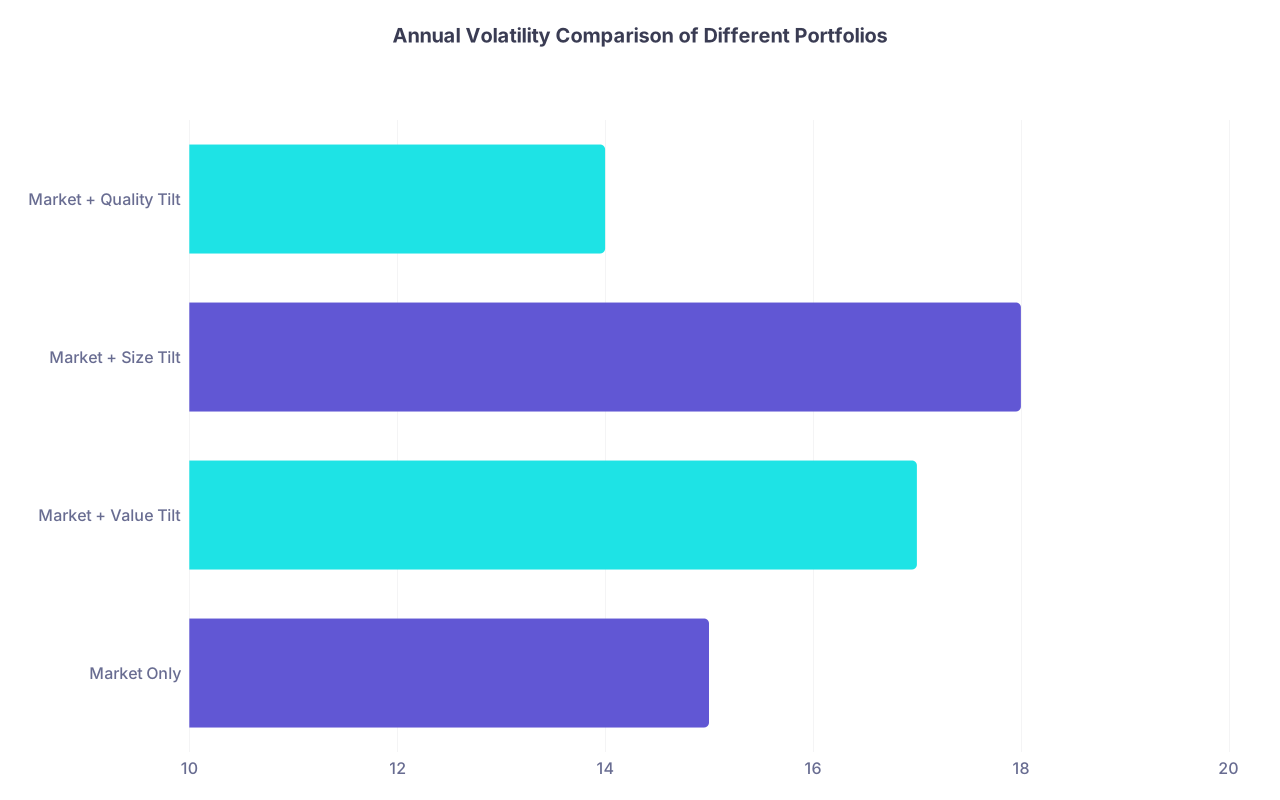
Annualized volatility (illustrative):
- Market only: 15%
- Market + value: 17%
- Market + size: 18%
- Market + quality: 14%
You pay for higher expected return with higher volatility and longer pain periods. If you are not fully honest about this, you will fold at the worst time.
Common failure modes I see in physicians:
Bailout risk
You tilt to value heavily, watch it lag growth for seven years, then capitulate and switch to a growth fund right before value finally outperforms.Overcomplication
Twelve factor ETFs, all slightly overlapping. You do not understand what you own, so you cannot stick with it. Complexity masquerading as sophistication.
3. Fee creep
A “factor‑enhanced” SMA (separately managed account) at 1% advisory fee plus ~0.6% product cost. You donate the entire factor premium to the advisor.
Tax inefficiency
Constantly switching factor products in taxable accounts, creating unnecessary capital gains. Factor investing must be tax‑aware if you are in a high bracket.Confusing story with exposure
Just because the marketing brochure talks about “quality” does not mean the portfolio has meaningful exposure to the quality factor. Check holdings and factor analytics when available.
7. Tax and Legal Angles Physicians Should Not Ignore
You said “financial and legal aspects,” so let me tackle the angles that actually matter.
Tax treatment of factor investing
In a perfect world, you place most factor exposure in tax‑advantaged accounts:
- 401(k)/403(b)/457(b)
- Backdoor Roth IRA
- HSA (if investing beyond cash need)
Why?
- Factor funds can have higher turnover than plain index funds.
- Value strategies in particular may realize more capital gains as they sell “winners” that leave the value universe.
- Quality strategies can be slightly more tax‑friendly but still not as clean as total‑market cap‑weighted funds.
If you must hold factor ETFs in taxable:
- Prefer low‑turnover, ETF‑structured funds with good tax management.
- Avoid frequent switching between factor styles (that is how you get hurt on taxes and performance at the same time).
Legal / compliance perspective
A few physician‑specific cautions:
Employer retirement plans
Some hospital systems offer “white‑label” or proprietary funds. These may be factor‑based without clear labeling. Request the underlying index or mandate. You have a legal right to disclosures.Using an advisor
If you hire an RIA or “wealth management for physicians” firm pushing factor strategies:- Ask: “Are these proprietary products? Do you get paid more if I use them?”
- Ask for the fund tickers and expense ratios in writing.
- Clarify whether factor exposure is from public ETFs or in‑house SMAs with higher fees.
Legally, fiduciary advisors must disclose conflicts. In practice, it often takes direct questions.
Avoiding “inside info” nonsense
You sometimes hear, “My patient is CEO of X biotech; I should buy it.” That is not factor investing. And if you ever get non‑public information, trading on it is a huge legal problem. Stay away. Stick to broad, rules‑based funds.Asset protection context
In certain states, retirement accounts (401(k), some IRAs) have robust asset protection. If you are adding higher‑volatility factor exposure, it is often preferable to locate it inside those protected accounts rather than in fully exposed taxable accounts, given your malpractice climate.
8. How to Evaluate a “Factor Strategy” Pitch as a Physician
You will absolutely be pitched this. At conferences. On webinars. On LinkedIn.
Here is a quick decision framework.

| Step | Description |
|---|---|
| Step 1 | Factor Pitch |
| Step 2 | Walk Away |
| Step 3 | Use Only in Tax Shelters |
| Step 4 | Potentially Reasonable |
| Step 5 | Clear Rules? |
| Step 6 | Low Cost? |
| Step 7 | Real Factor Exposure? |
| Step 8 | Tax Aware? |
Questions to ask, out loud:
“What is the exact index or methodology this product follows?”
If they cannot summarize it in one clear paragraph, pass.“How much does this cost all‑in, including fund expenses and advisory fee?”
Anything north of ~1% combined cost for plain factor exposure is hard to justify.“Show me the factor loadings or at least how the portfolio differs from the total market.”
You want to see meaningful tilts—cheaper valuation, smaller average size, better profitability metrics, etc.“What is the expected tracking error vs the market, and how long has this underperformed in the past?”
If they hand‑wave this away, they are not serious. A real factor strategy will underperform badly at times.“How do you handle this in taxable accounts?”
If the answer is “we just rebalance as needed,” without tax‑loss harvesting or explicit tax‑aware management, you are the one paying for their sloppiness.
9. Realistic Expectations: How This Feels Over a Career
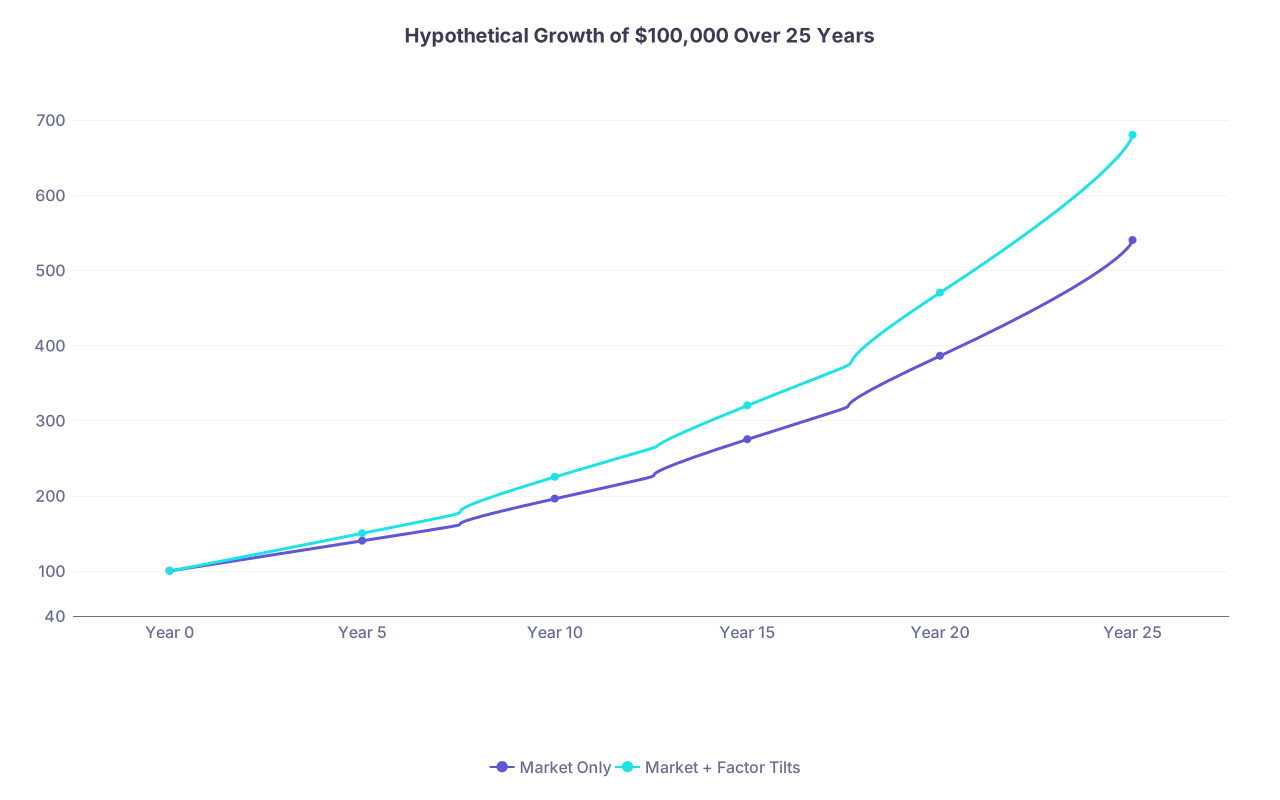
Let’s make this concrete over a 20–30 year attending career.
| Category | Market Only | Market + Factor Tilts |
|---|---|---|
| Year 0 | 100 | 100 |
| Year 5 | 140 | 150 |
| Year 10 | 196 | 225 |
| Year 15 | 275 | 320 |
| Year 20 | 386 | 470 |
| Year 25 | 540 | 680 |
Rough, illustrative numbers only, but directionally useful.
Difference between “market only” and “market + well‑implemented factor tilts” over 25 years can plausibly be on the order of tens to low hundreds of thousands of dollars per $100k initially invested.
Now layer that onto:
- Ongoing contributions of $50–100k per year
- A multi‑million dollar end portfolio
The cumulative impact is substantial. Not quite “magic,” but meaningful enough that you should at least consider it.
But you pay for it with:
- More performance anxiety in certain periods
- More tracking error vs your colleague’s plain S&P portfolio
- More temptation to fiddle
If your personality cannot handle being “wrong” for 5–10 years while the evidence says “stay put,” you are better off with a simple, total‑market portfolio and sleeping well.
10. A Minimalist Action Plan for Busy Physicians
If you want something concrete without turning investing into a hobby, here is a minimalist, evidence‑respecting plan.

Step 1: Get the foundation right
- Decide your stock/bond mix (e.g., 70/30, 80/20) based on risk tolerance and timelines.
- Use broad US and international index funds as your core.
Step 2: Add modest factor tilts
- Add 10–20% of your equity allocation to a small‑cap value fund.
- Add another 5–15% to a quality fund (US or global).
- Fund choice: low cost, diversified, transparent methodology.
Step 3: Put factor funds in tax‑advantaged accounts if possible
- Prioritize 401(k)/403(b)/Roth for higher‑turnover factor strategies.
- Keep taxable accounts heavy on plain total‑market and tax‑efficient funds.
Step 4: Create a written rule set
One page. Example:
- “Equity: 60% total US, 30% total international, 10% US small‑cap value, 10% US quality”
- “Rebalance annually or when any slice is off by >5 percentage points.”
- “No performance‑based fund switching for at least 10 years unless a fund closes or materially changes its strategy.”
Step 5: Ignore the noise
- Do not check factor performance monthly. That is how you panic.
- Once or twice a year, update your spreadsheet, rebalance, then walk away.
FAQ (Exactly 5 Questions)
1. Should every physician use factor investing, or is a total‑market index portfolio enough?
A broad total‑market index portfolio is absolutely sufficient to reach financial independence for most physicians, provided you save aggressively and stay disciplined. Factor investing is an enhancement, not a requirement. If you are naturally anxious about your investments or prone to second‑guessing, staying with plain, cap‑weighted index funds is usually better than adding factors you will abandon when they underperform.
2. How much of my portfolio should I allocate to value, size, and quality factors?
For most physicians, a 10–30% allocation of the equity portion to factor strategies is reasonable. For example, 10–20% to small‑cap value and 5–15% to quality, with the rest in broad US and international index funds. Going beyond ~30–40% factor allocation starts to increase tracking error significantly, which most busy clinicians struggle to tolerate over full cycles.
3. Is it better to use a single multi‑factor fund or separate value, size, and quality funds?
There is no universal winner. A single multi‑factor ETF (combining value, size, quality, etc.) is simpler and reduces the risk of you “timing” factors against each other. Separate funds give more control and transparency but add complexity and rebalancing overhead. For a physician who wants low maintenance, a well‑designed, low‑cost multi‑factor fund as a 10–20% satellite is often a very reasonable compromise.
4. Are factor funds too new or untested to trust for a 20–30 year horizon?
The underlying factors (value, size, quality, profitability) have been studied for decades across multiple markets and time periods. What is newer are the specific ETFs and commercial implementations. I care more about robust academic evidence and economic intuition than whether a particular product has a 30‑year track record. That said, avoid funds with highly complex, opaque rules or frequent strategy changes; choose providers with a history of sticking to stated methodologies.
5. How do I know if a fund’s “quality” or “value” label is actually delivering real factor exposure?
You can check this in a few ways. First, look at simple stats: compared with the total market, a value fund should have lower average P/E and P/B, while a quality fund should show higher profitability metrics and stronger balance sheets. Second, many major fund families or third‑party tools publish factor loadings (exposure to value, size, quality, etc.) relative to a benchmark. If the fund’s metrics are barely different from a standard index, the factor tilt is weak and probably not worth higher fees. If the numbers show clear, persistent tilts, then you are likely getting real factor exposure rather than marketing language.
Key points you should walk away with:
- Factor investing is not magic or stock‑picking; it is rules‑based tilting toward characteristics like value, size, and quality that have earned premiums over long horizons.
- For physicians, modest, low‑cost factor tilts layered on top of broad index funds can enhance long‑term outcomes, but only if you can tolerate periods of painful underperformance and avoid chasing recent winners.
- Implementation—fees, tax location, simplicity, and your ability to stick with the plan—matters more than squeezing out the last basis point of factor exposure.


