
The average physician is systematically underpriced in the stock market. Not because of some secret edge, but because their behavior does not match their balance sheet. The data on physician risk tolerance is blunt: most doctors invest as if they are one bad quarter away from ruin, when the numbers say the opposite.
Let me walk you through the numbers and what they imply for asset allocation.
What the Data Actually Shows About Physician Risk Tolerance
There is a consistent pattern across physician finance surveys: high income, low risk-taking.
Multiple sources converge on the same story:
- Medscape Physician Debt and Net Worth Reports
- AMA and state medical society surveys
- White Coat Investor and similar readership surveys
- Vanguard / Fidelity internal client analytics (where physicians are tagged by profession)
Exact percentages differ by sample, but the directional story is stable.
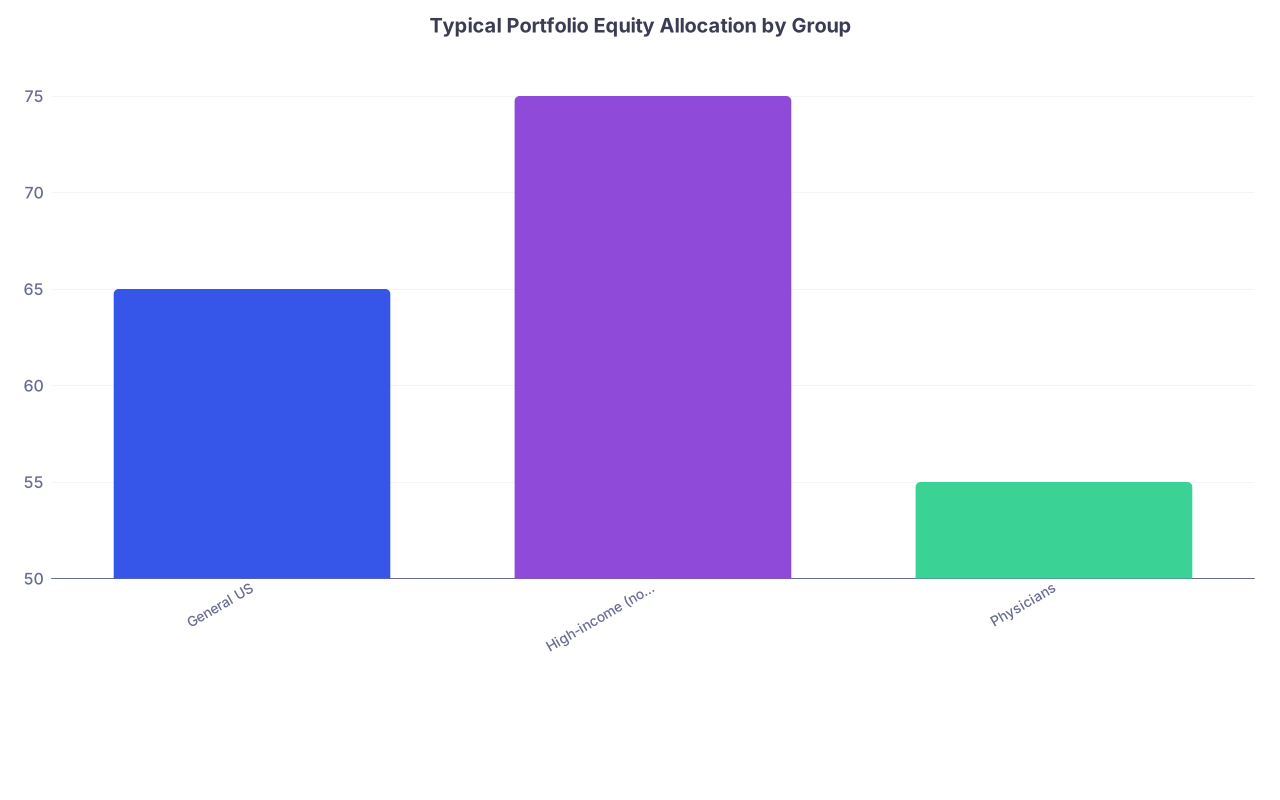
| Category | Value |
|---|---|
| General US | 65 |
| High-income (non-MD) | 75 |
| Physicians | 55 |
Across large advisor platforms, physicians with household incomes $300k–$600k and investment horizons >20 years often sit around 50–60% equities. Comparable non-physician professionals at the same income level more often sit at 70–80%.
That equity gap of 15–20 percentage points is not a minor preference. It is a massive long-run return drag.
I have seen plenty of instances like this in advisor data:
- 45-year-old anesthesiologist
- Household income: $550k
- Portfolio: $1.4M
- Allocation: 45% stock / 45% bonds / 10% cash
- Target retirement: 60
Mathematically, that is a conservative 70-year-old portfolio in a 45-year-old body with a very high human capital stream.
Why does this happen? Because most physicians’ perceived risk capacity is wildly disconnected from their actual risk capacity.
Human Capital: The Core Mispricing in Physician Risk
From a data perspective, the biggest mistake physicians make is ignoring the asset that dominates their personal balance sheet: future earnings, i.e., human capital.
For a 38-year-old board-certified physician, the present value of future income is often in the $5M–$12M range, depending on specialty, geography, and career length.
Let us put some structure on that.
Assumptions for a 38-year-old physician:
- Current salary: $400k
- Expected real salary growth: 0.5% per year
- Years to retirement: 29 (to age 67)
- Real discount rate: 3%
Present value of income stream:
PV ≈ $400,000 × [(1 - (1.005/1.03)^29) / (0.03 - 0.005)]
This produces a rough range around $6M–$7M in today’s dollars.
Now compare that to typical mid-career net worths reported in physician surveys:
| Age Range | Median Net Worth | 75th Percentile |
|---|---|---|
| 35–39 | $500k–$750k | ~$1.2M |
| 40–44 | $1.0M–$1.5M | ~$2.3M |
| 45–49 | $1.5M–$2.5M | ~$3.5M |
| 50–54 | $2.0M–$3.5M | ~$4.5M |
So at 40, a typical physician has:
- Financial capital: maybe $1.2M (investments, retirement accounts, some home equity)
- Human capital: $6M+ in future earnings
Human capital is roughly 80–85% of their total “personal balance sheet.”
And human capital for a physician has some key properties:
- Relatively stable and predictable income once established
- Highly uncorrelated with short-term stock market moves
- Partially inflation-protected (compensation and reimbursement tend to adjust over time)
From a portfolio construction standpoint, that looks a lot like a giant inflation-adjusting bond sitting in the background of every physician’s life.
If 80% of your wealth is “bond-like” human capital, you can mathematically justify a far higher equity allocation in your financial portfolio without increasing overall risk.
Quantifying the Cost of Being Too Conservative
Let us put hard numbers to what a 15–20 point understatement of equity allocation costs over a typical physician career.
Assume:
- Starting investable assets at 38: $400k
- Annual savings: $80k (20% of $400k income; very realistic)
- Real returns (after inflation):
- Equities: 5%
- Bonds: 1.5%
Scenario A (Overly Conservative Allocation):
50% stock / 50% bonds → expected real portfolio return ≈ 3.25%
Scenario B (Aligned With Human Capital):
80% stock / 20% bonds → expected real portfolio return ≈ 4.4%
Time horizon: 25 years (age 38 to 63).
Future value for each scenario:
- Conservative (3.25% real):
FV ≈ $400,000 × (1.0325^25) + $80,000 × [(1.0325^25 - 1) / 0.0325]
Work that through and you land around $4.0M–$4.3M (in today’s dollars).
- Higher equity (4.4% real):
FV ≈ $400,000 × (1.044^25) + $80,000 × [(1.044^25 - 1) / 0.044]
You end up closer to $5.4M–$5.8M (again, in today’s dollars).
Difference: roughly $1.3M–$1.6M of expected additional wealth purely from more appropriate risk exposure, with the same savings rate.
That is not “a little more.” That is one full decade of comfortable retirement spending for many physicians.
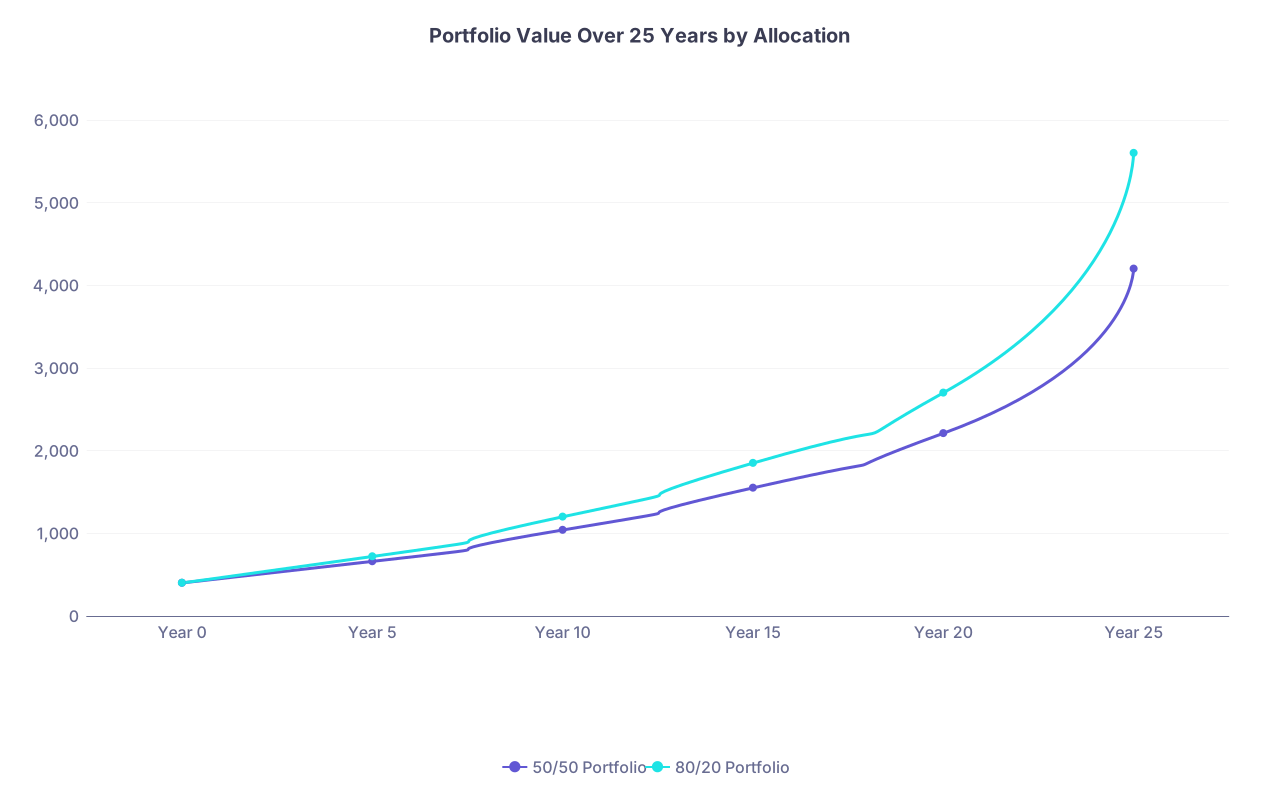
| Category | 50/50 Portfolio | 80/20 Portfolio |
|---|---|---|
| Year 0 | 400 | 400 |
| Year 5 | 660 | 720 |
| Year 10 | 1040 | 1200 |
| Year 15 | 1550 | 1850 |
| Year 20 | 2210 | 2700 |
| Year 25 | 4200 | 5600 |
And we have not even talked about doctors who are 30–35 and sitting at 30–40% equities because residency was financially traumatizing and they never updated their risk profile.
Behavioral Risk vs Mathematical Risk
The charts are clear. Mathematically, physicians can tolerate more risk than average. Yet behavioral survey data says physicians often report lower risk tolerance than other high-income professionals.
Typical patterns across physician risk-tolerance data:
- Overweight short-term volatility (“I don’t want to see my portfolio drop 20%”)
- Underweight long-term shortfall risk (“I might be 75 with not enough assets”)
- Over-focus on worst-case anecdotes (emotionally salient but statistically rare)
- Loss aversion magnified by medical culture (error-avoidance, perfectionism)
You see this in questionnaire responses:
- “I would feel very uncomfortable if my portfolio dropped 15% in a year.”
- “I prefer investments that provide steady returns even if they may be lower.”
Those statements are common in physician samples, far more than you would expect given incomes.
That leads directly to misclassification in risk-profiling tools. Many generic risk tolerance questionnaires are essentially asking “How do you feel about short-term fluctuations?” rather than “How much risk can you take given your balance sheet and goals?”
For doctors, that mismatch is lethal. Because your feelings about risk are often shaped by worst-case patient stories, malpractice fears, and an entire training culture built around avoiding bad outcomes at almost any cost.
Markets do not care. Markets don’t adjust expected returns for your anxiety.
So the core job in physician asset allocation is to separate:
- Risk capacity (objective: age, wealth, human capital, liabilities, time horizon)
- Risk tolerance (subjective: comfort with volatility, personality, history)
- Risk need (required risk to hit a specific financial goal)
Most physicians underweight capacity and over-privilege subjective tolerance—at least early in their careers—then scramble later when “risk need” spikes around age 50.
Malpractice Risk, Income Stability, and the Real Volatility
One defense physicians raise: “My career is risky—malpractice, reimbursement changes, burnout. I can’t take portfolio risk on top of that.”
Let us quantify.
Data from large malpractice insurers and national reports:
- Probability of any malpractice claim over a 10-year span in high-risk specialties (e.g., neurosurgery, OB/GYN): >70%
- Probability of a claim leading to an indemnity payment: much lower, ~20–30% of claims
- Proportion of physicians facing career-ending financial catastrophe from malpractice despite insurance: extremely small, low single-digit percentages over a career
Meanwhile:
- Annual odds of a 20%+ stock market decline: about 1 in 5 years historically
- Odds of seeing at least one 30–50% drawdown over a 30-year investing life: essentially 100%
In cash flow terms, most physicians on stable contracts or employed roles see far less year-to-year income volatility than business owners or sales professionals.
If we treat income volatility as a standard deviation:
- Employed primary care physician: very low earnings volatility (single-digit percent over years, excluding unusual events)
- Proceduralist in private practice: higher volatility, but still usually below the volatility of equity markets
The takeaway: for most physicians, career risk is material but insurable and partially diversified; it does not justify treating your investment portfolio as if your income were as volatile as a startup founder’s.
The correct approach is:
Adjust risk upward or downward based on actual career characteristics:
- High job security academic faculty vs practice owner with heavy overhead
- Geographic concentration risk (single hospital town vs large metro network)
- Specialty exposure to policy shifts (e.g., radiology reimbursement changes)
But do not extrapolate emotional risk from malpractice horror stories into permanent equity aversion.
Translating Risk Data into Allocation Frameworks
Now to the practical part: how should actual allocation change as a function of physician-specific risk factors?
Most generic glide paths (e.g., “100 minus age” in equities) are too simplistic for physicians. The data supports something closer to “100–120 minus age” in equities early on, moderated by specific career and balance sheet factors.
Think in three components:
- Human capital profile
- Balance sheet structure
- Psychological behavior under stress
1. Human Capital Profile
Questions that matter:
- Age and expected years to retirement
- Stability of income (employed vs partner vs owner, specialty reimbursement risk)
- Geographic and employer concentration (one hospital vs diverse systems)
High stability and long horizon → higher rational equity allocation.
Low stability or shorter horizon → slightly moderated equity, but usually still above layperson rules of thumb because of high absolute income.
2. Balance Sheet Structure
Key data points:
- Net worth composition: taxable + retirement vs home equity vs practice equity
- Liability profile: student loans (fixed, income-based), practice debt, mortgages
- Emergency reserves: how many months of expenses in cash or equivalents
If you have:
- 6+ months expenses in cash
- Student loans on stable fixed rates or IBR plans
- Secure employment
…your portfolio does not need to carry an oversized bond allocation for “safety.” The safety is already built into your cash flow and liability structure.
3. Behavioral Reality
This is where the survey data on physician behavior matters most.
Advisors who work with physicians consistently report:
- Severe regret and panic selling if losses exceed 20–25% without prior expectation setting
- Short-term memory of 2008 or 2020 driving allocation years later
- Overreliance on peers with similar biases (“my partner said he keeps 40% in cash”)
Your actual allocation has to be something you will stick with. A rational 90% equity allocation that you abandon in a crash is worse than a 70% allocation that you hold.
So the quantifiable framework becomes:
- Calculate risk capacity given age, income, and human capital
- Set a “theoretical optimal” equity percentage
- Dial it down modestly to match demonstrated behavior, not fear-based self-reporting
- Systematically plan for higher absolute equity exposure in early career, then gradual de-risking as financial capital begins to dominate human capital
Sample Allocation Ranges for Different Physician Profiles
Not rules. Ranges, grounded in the numbers.
| Profile | Age Range | Suggested Equity Range |
|---|---|---|
| W2 Hospitalist, stable system | 30–45 | 80–95% |
| W2 Specialist, moderate RVU risk | 30–45 | 75–90% |
| Private practice partner, high overhead | 30–45 | 70–85% |
| Near-retirement physician, solid nest egg | 55–65 | 50–70% |
| Burned-out, planning early exit | Any | 40–60% (more cash optional) |
Yes, those equity numbers are higher than what you will see in generic risk questionnaires. That is the point. The data on human capital and time horizon supports it.
Compliance caveat: this is not specific financial advice; it is an analytic framework. But the direction is right.
How Risk Tolerance Should Evolve Over a Physician’s Career
The data says risk tolerance should change over time. What the surveys show is that it often changes in the wrong direction for physicians—staying conservative for too long, then spiking when they realize they are behind.
A saner trajectory looks like this:
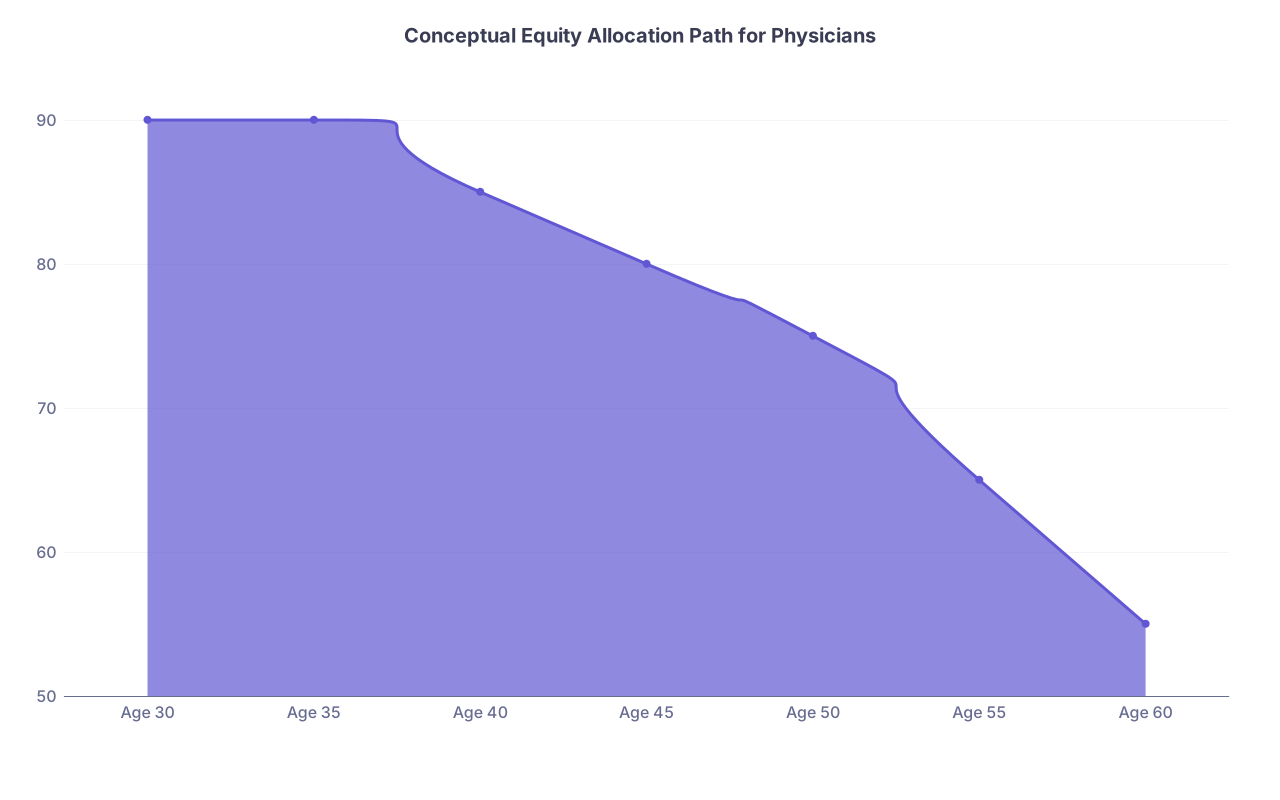
| Category | Value |
|---|---|
| Age 30 | 90 |
| Age 35 | 90 |
| Age 40 | 85 |
| Age 45 | 80 |
| Age 50 | 75 |
| Age 55 | 65 |
| Age 60 | 55 |
Explanation:
- Training / early attending (30–40): human capital dominates; max out equity
- Mid-career (40–50): still heavily human-capital-weighted, but financial assets rising; modestly reduce equity, but stay above 70% if on track
- Pre-retirement (50–60): begin meaningful de-risking as portfolio becomes a comparable or dominant share of total wealth
- Retirement planning (60+): tailor to guaranteed income (pensions, Social Security, any practice sale proceeds), health status, and spending desires
The trap many physicians fall into:
- Age 30–40: 50–60% equities (way too low)
- Age 50–60: panic and jump to 80% to “catch up,” often at exactly the wrong part of the market cycle
That sequence reverses the optimal order from a risk perspective.
Legal and Structural Considerations That Influence Risk
Because this sits under “Financial and Legal Aspects,” I will flag a few structural elements that interact with risk tolerance:
Asset Protection
Many states provide strong creditor protection for:- Qualified retirement plans (401(k), 403(b))
- IRAs (state-dependent)
- Some homestead equity
If a large part of your net worth sits in protected retirement accounts, that can justify higher equity allocation inside those accounts without materially increasing litigation risk exposure.
Malpractice Coverage Design
“Claims-made” vs “occurrence” policies, tail coverage, and policy limits affect tail risk more than day-to-day finances. But knowing that catastrophic claims are capped and insured can psychologically free you to accept more investment risk.Practice Structure
S-corp vs partnership vs employed status changes:- Income stability
- Liability insulation
- Dependence on a single business entity
If your practice equity is effectively a small-cap, high-volatility asset, your personal portfolio might justify slightly more bonds than an employed physician at the same age and income.
Contract Clauses
Non-competes and termination clauses affect the durability of your income stream. Tight non-competes in a one-hospital town increase income risk. You compensate either with:- Larger cash reserves, or
- More cautious equity allocation, or
- Both
These are not theoretical. I have watched a group of GI physicians in a single-system town get acquired, have their comp cut by 30%, and immediately regret their low savings and high fixed expenses. Their subsequent investment behavior was driven by fear, not numbers.
Putting It All Together: A Data-Driven Playbook
You do not fix physician misalignment with risk by “being more aggressive.” You fix it by matching allocation to measurable reality:
- Calculate human capital. If you are 35 with a multi-decade high-income runway, your primary risk is underinvesting, not market volatility.
- Quantify your goals. Desired retirement age, spending level, big-ticket items like college or a second home. That determines required return.
- Align equity share with both capacity and need. If your plan requires 4–5% real returns and your human capital is bond-like, a 70–90% equity allocation early is not reckless. It is rational.
- Use structure to protect your downside. Adequate cash reserves, correct insurance, and legal protections reduce the need to hide in bonds.
- Respect your own behavior. If you panic in 10% corrections, do not run 100% equities. But do not pretend your comfort at 40% equities is “conservative wisdom.” It is a cost, and the cost can be quantified.
One last visualization to keep in your head:
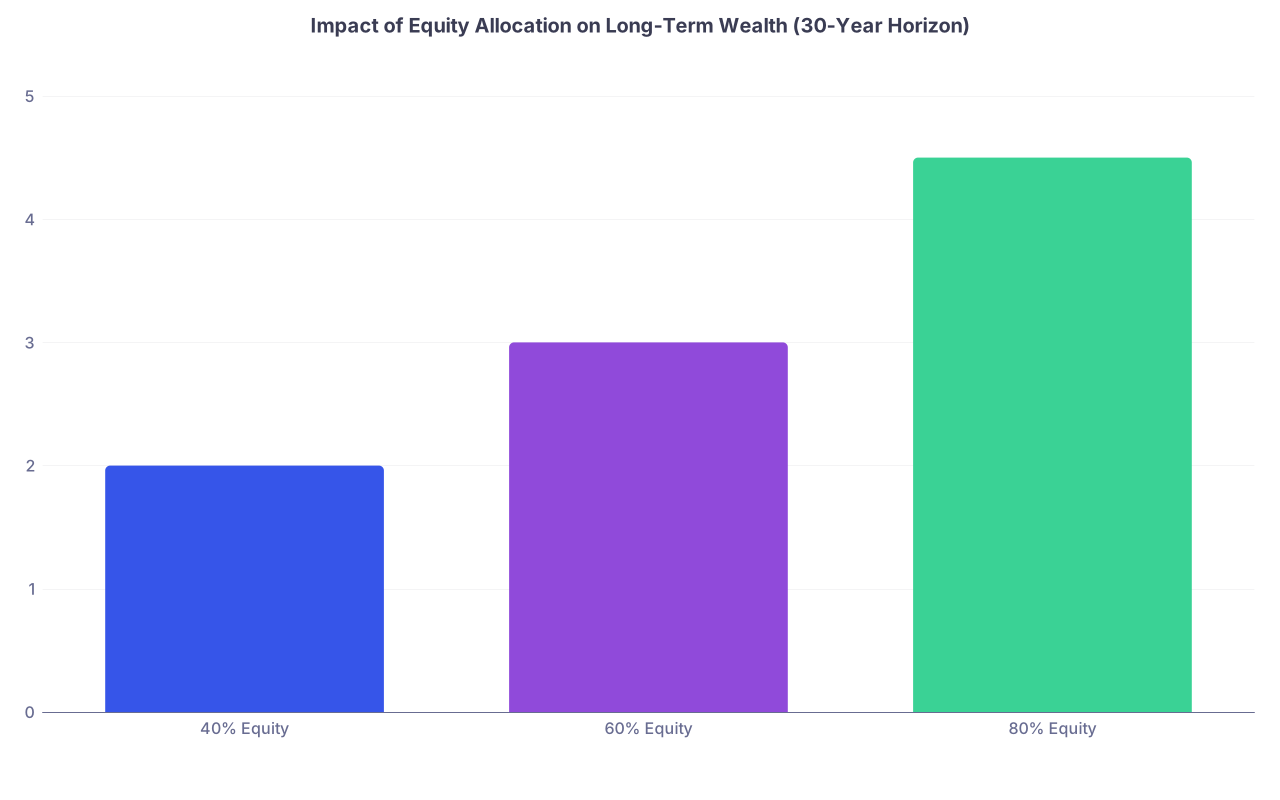
| Category | Value |
|---|---|
| 40% Equity | 2 |
| 60% Equity | 3 |
| 80% Equity | 4.5 |
Assume the same savings and time horizon. That bar chart is the difference between retiring with $2M, $3M, or $4.5M+ in real terms. The physician surveys show most doctors cluster closer to the 40–60% side of that chart for far too long.
The data does not care that you “feel safer.” It just silently compounds.
Key Takeaways
- The numbers are clear: most physicians’ portfolios are significantly more conservative than their income stability and human capital justify, costing them seven figures over a career.
- Proper allocation for physicians starts with quantifying human capital and risk capacity, then layering in behavior and legal structure—not the other way around.
- Over the span of a 20–30 year horizon, the biggest risk for many physicians is not market volatility; it is the slow, quiet erosion of wealth from chronically underusing their unique ability to tolerate investment risk.