

It’s 1:37 a.m. You just got home post-call. Scrubs still on, pager finally silent, brain buzzing. And this awful thought hits you:
“What if I feel this way for the next 30 years and I can’t leave because I need the paycheck?”
That’s the fear under all the burnout talk nobody really says out loud. Not just “What if I burn out?” but “What if I burn out and still have to keep doing this because I’m financially stuck?”
Let me say it bluntly: medicine can become a golden prison if you don’t plan for options. High income + high debt + lifestyle creep + no investing = you feel trapped.
So this isn’t some “rah rah, just be smart with money” piece. This is about building a financial escape hatch so if you ever hit the wall—like truly done, can’t do one more prior auth, can’t take one more 28-hour call—you’re not stuck because you never built a way out.
The Core Fear: “What If I Hate This And Can’t Leave?”
Here’s the nightmare scenario that plays in your head at 2 a.m.:
- You grind through med school, residency, maybe fellowship.
- You start attending life. Income finally jumps.
- Loans, mortgage, maybe kids, maybe helping family.
- You’re exhausted and quietly resentful.
- Ten years pass. You realize: you can’t quit. You need every check.
And then you start counting years to 65 like it’s a prison sentence.
I’ve watched people hit that point in their 30s and 40s. They don’t usually walk away. They seethe. They get cynical. They say things like, “I’d leave if I could, but what else can I do? I’m a doctor.”
That’s what we’re trying to avoid.
You don’t have to know now whether you’ll stay in medicine forever. Honestly, you probably can’t know. But you can plan so that future-you has options instead of chains.
At a high level, that means:
- Don’t build a lifestyle that requires your maximum income.
- Use your high-earning years to buy freedom, not just stuff.
- Put money into things that grow and pay you, even if you stop working.
That’s what investing is here: not “getting rich,” but buying optionality.
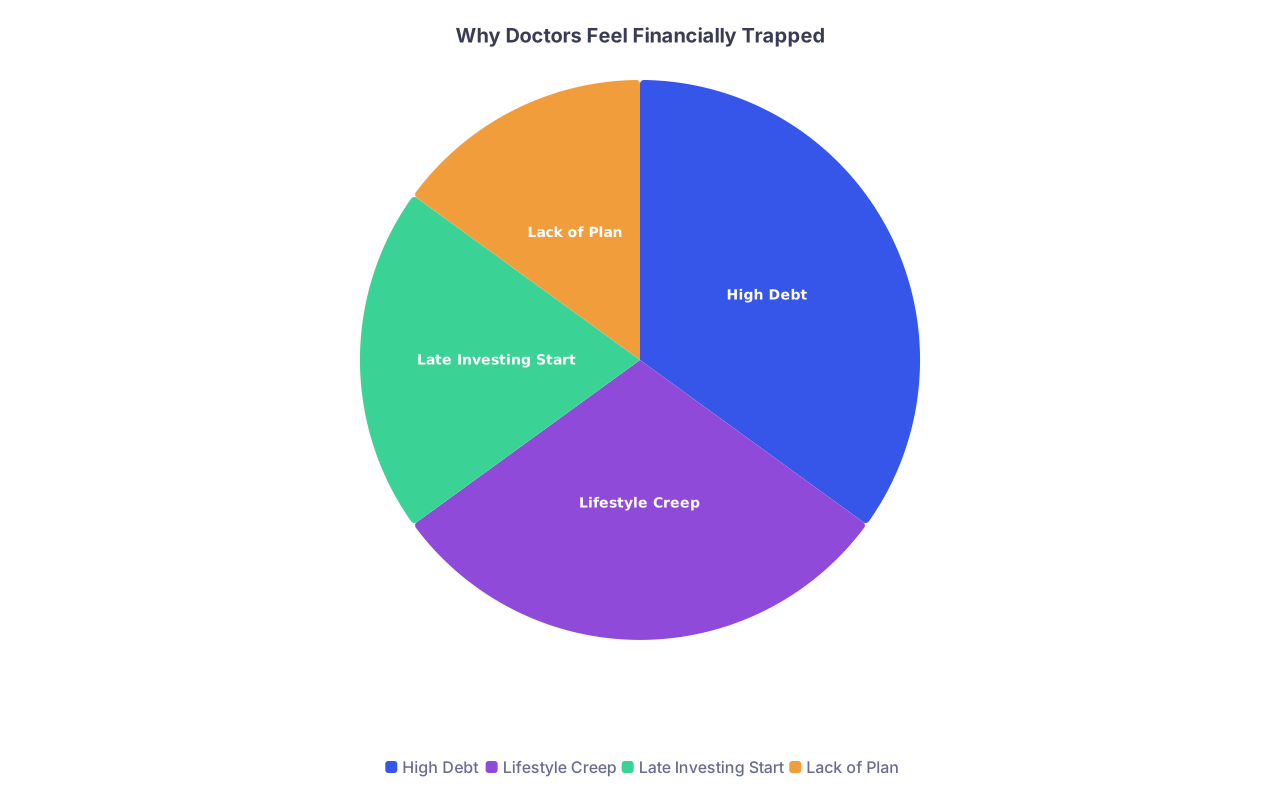
| Category | Value |
|---|---|
| High Debt | 35 |
| Lifestyle Creep | 30 |
| Late Investing Start | 20 |
| Lack of Plan | 15 |
Step One: Define “Escape” In Numbers, Not Vibes
Vague fear makes you feel powerless. Concrete numbers are less scary, even if they’re big.
There are basically three “freedom levels”:
- Mini runway – 6–12 months of expenses saved. You can quit a toxic job, move, change specialties (if possible), take a leave.
- Semi-FI (semi–financially independent) – Your investments cover a chunk of your expenses. Maybe 30–60%. You can reduce to part-time, locums, or switch to a lower-paying but more tolerable role.
- FI (financial independence) – Your investments can reasonably cover your life indefinitely. Medicine becomes optional.
For now, obsess about the first two. Full FI is a long game. The goal while you’re training or early attending isn’t “never work again at 40.” It’s “never feel trapped.”
Quick reality check with totally made-up but realistic numbers:
- Your core expenses (rent/mortgage, food, insurance, minimum loan payments, basic life) = $5,000/month.
- Mini runway (12 months) = $60,000.
- Semi-FI at ~40% coverage = your investments throw off ~$2,000/month.
If you had $60k cash plus enough invested to safely generate ~$2,000/month, how different would your life feel? You could drop a shift. Say no to another FTE increase. Leave a malignant group without panic.
That’s the target: not perfection. Leverage.
The Big Tools: Where Doctors Should Actually Put Their Money
People love to complicate this with crypto talk and “hot tips.” Ignore that. You’re not trying to win the stock-picking Olympics. You’re trying to build a boring, resilient, low-maintenance system so your future isn’t a hostage situation.
Let’s walk through the main buckets like a rational but tired resident would.
1. Emergency Fund: The “I Quit This Job” Money
This is cash, not investments. In a boring high-yield savings account.
Target: 3–6 months of expenses minimum, but if you’re burnout-prone or in a toxic environment, 9–12 months makes sense. Yes, that’s a lot. Yes, it will take time. Start anyway.
This is what lets you:
- Walk away from a malignant attending or group.
- Take a few months to regroup without grabbing the first terrible job.
- Take a mental health break without financial terror.
This is your first line of defense against feeling trapped.
2. Tax-Advantaged Accounts: The Boring, Powerful Ones
You’ll hear these again and again, but here’s what they really do for you psychologically: they shift your identity from “just a worker” to “person whose money works too.”
Typical stack:
- 401(k) / 403(b) – through your employer. Usually pre-tax.
- Roth IRA (or backdoor Roth when your income is high).
- HSA (if you have a high-deductible health plan).
For most doctors, the simplest path is:
- Use your employer plan up to the match (free money).
- Get money into Roth space (now or via backdoor later).
- Then go back and fill up employer plan more aggressively as your salary rises.
Invest inside those accounts with simple, broad index funds:
- One total US stock market fund.
- One total international stock fund.
- Maybe a bond fund later as you get older/more risk-averse.
No, you don’t need to pick individual stocks. No, you don’t need a fancy advisor charging 1% AUM to “beat the market.” As a doctor, your edge is earning power, not stock-picking brilliance.
3. Taxable Brokerage Account: Your Flexibility Machine
This is the part people ignore because they’re obsessed with retirement accounts only. A plain taxable investment account (Fidelity, Vanguard, Schwab) is huge for not being trapped.
Why? Because:
- You can access it anytime—no age restrictions or penalties like a 401(k).
- You can use it for bridge periods: cutting back at 45, taking a year off, starting a non-clinical venture.
- It still gets favorable long-term capital gains tax treatment if held >1 year.
You invest it basically the same way: low-cost index funds, very boring. Automatic monthly contributions so you don’t have to think.
That’s the account that lets a burned-out 38-year-old say, “I’m cutting back to 0.7 FTE and I’m fine.”
4. Student Loans: The Mental Weight
Debt is a huge part of feeling trapped. The number can be physically nauseating. $250k, $400k, more.
Here’s what I’ve seen help people calm down:
- Decide on a specific path: PSLF, long-term IDR with forgiveness, or aggressive payoff. Waffling between paths for 5 years is the real killer.
- If you’re truly PSLF-bound (academic hospital, government/non-profit), your “debt” is more like a 10-year tax.
- If you’re private practice–bound and not PSLF-eligible, refinance strategically once your attending income is stable and commit to a plan.
The enemy here is vague dread. Once you have a clear repayment plan and a timeline, the psychological burden drops. Still annoying. Less suffocating.

How Much Do You Actually Need Invested To Not Feel Trapped?
Let’s be concrete. This is rough, but directional beats hand-waving.
A common rule of thumb: you can safely withdraw about 3–4% of a diversified portfolio annually and have a good shot at it lasting long-term.
So:
- $500,000 invested → ~ $15–20k/year (~$1,250–$1,600/month).
- $1,000,000 invested → ~ $30–40k/year.
- $1,500,000 invested → ~ $45–60k/year.
Now combine that with some clinical work:
Say you’re IM hospitalist making $260k full-time. You’re fried. You want to go 0.6 FTE so you make maybe $155k instead.
If your investments can reasonably cover $20–30k of your annual expenses, you’ve suddenly got a very different life with fewer nights, fewer weekends, more mental space. Same person, same specialty. Very different existence.
| Portfolio Size | Safe Annual Amount (3–4%) | Example Impact |
|---|---|---|
| $200,000 | $6–8k | Small buffer, helps with emergencies |
| $500,000 | $15–20k | Can offset dropping one shift/month |
| $1,000,000 | $30–40k | Can support major reduction in FTE |
| $1,500,000 | $45–60k | Work becomes truly optional in many LCOL areas |
Notice I’m not saying, “You must reach $3 million or you’re doomed.” Even $200–500k invested gives you leverage and psychological breathing room.
The Legal / Protection Side: Not Sexy, But Crucial
This stuff feels boring until something blows up. Then it’s the only thing that matters.
Malpractice and Asset Protection
You worry about being sued. Everyone does. Here’s the less-scary truth: your best protection isn’t some exotic trust in Delaware. It’s pretty basic:
- Strong malpractice coverage (usually through your employer).
- Don’t own stuff in your own name that doesn’t need to be.
- Own property with your spouse as tenants by the entirety (where available), which can protect against creditors of one spouse.
- Use retirement accounts—they’re often heavily protected by law.
If you’re building real wealth and feel burned out, the last thing you want is to feel like one bad outcome wipes you out. A session with an actual asset-protection-savvy attorney in your state is worth it once your net worth starts climbing.
Disability and Life Insurance
This is the part nobody wants to think about. But if you’re already anxious about being trapped, imagine being forced out of medicine with no plan.
Bare minimum:
- Own-occupation disability insurance while young and (hopefully) healthy.
- Term life insurance if anyone depends on your income (spouse, kids, even parents).
Once you’re financially free, you can drop a lot of this. But on the way there, this is what keeps a medical emergency from becoming financial annihilation.
Contracts and Non-Competes
If you’re in training you may not have hit this yet. Once you’re job-hunting, every attending I trust says the same thing: pay an attorney to review your contract.
Why it matters for burnout and finances:
- Non-competes can literally keep you stuck in a toxic job unless you’re willing to move.
- Call expectations and RVU targets can turn a “reasonable” job into a slow-motion breakdown.
- Tail coverage details can cost you five figures if you leave.
Pay a few hundred or a thousand now, or pay with years of your life later.

| Step | Description |
|---|---|
| Step 1 | Training |
| Step 2 | First Attending Job |
| Step 3 | Pay Off High Interest Debt |
| Step 4 | Build Emergency Fund |
| Step 5 | Max Tax Advantaged Accounts |
| Step 6 | Invest In Taxable Account |
| Step 7 | Reach Semi FI |
| Step 8 | Option To Cut Back Or Pivot |
What If You’re Still In Med School Or Early Residency?
You might be thinking, “This is cute, but I literally have negative net worth and I’m eating instant noodles. What am I supposed to invest?”
Fair. So your job isn’t to max everything right now. Your job is to:
- Avoid making it worse by taking on lifestyle debt (credit cards, car loans, fancy apartment you can’t afford).
- Build the skills and habits that will matter when your income jumps: basic literacy about investing, live below your means a little, avoid lifestyle creep.
- Use any small windfalls (moonlighting, bonuses, tax refunds) intentionally—tiny emergency fund, Roth IRA if you can swing even $100/month, or paying down ugly debt.
The real turning point is the first 5 years after training. That’s when people either:
- Lock themselves into an expensive life that demands their full income forever.
or
- Keep living “resident-plus” for a while, shovel money into investments, build freedom, and never feel fully trapped.
You already know which of those you want to be.
What If You’re Already Burning Out?
Then the priority shifts.
You can’t spreadsheet your way out of full-blown burnout if you’re falling apart. The money plan is supposed to be a safety net, not a substitute for actual help.
That said, here’s the sequence I’ve seen work for people on the edge:
- Stabilize yourself: therapy, PCP, maybe meds, maybe schedule changes, maybe taking FMLA if needed.
- Cut bleeding: stop big unnecessary expenses, pause big purchases, get clarity on your monthly nut.
- Build micro-buffer: even $1–2k in cash reserved as “job-change fund” can lower panic.
- Run the numbers on worst-case scenarios:
- “If I take 3 months unpaid, can I survive?”
- “If I switch to a lower-paying job, what does that look like?”
- Start some investing even if it’s small. $100/month auto-transfer to an index fund isn’t about the amount; it’s about reclaiming some control over your future.
You’re not failing because you’re tired of a system that runs on your exhaustion. You’re allowed to look for the exit sign while still walking the hallway.
FAQ (Exactly 6 Questions)
1. Is it stupid to think about an “escape plan” this early in my career?
No. What’s stupid is pretending burnout never happens and then acting shocked at 42 when you hate your job and can’t leave. Thinking about optionality now doesn’t mean you’re doomed to hate medicine; it just means you’re not gambling your entire life on one outcome.
2. Should I pay off my loans first or invest first if I’m worried about feeling trapped?
If the loan interest is insanely high (credit cards, >7–8% private loans), knocking that down is priority. For federal loans at moderate rates, I’d usually do a hybrid: get on a rational repayment path, then start investing something early. It’s the investing muscle and habit that matters long-term, not waiting 10 years until every loan is gone before you start.
3. What if I’m terrible with money and feel overwhelmed even opening an investing account?
Honestly, that’s most of us at the beginning. Start absurdly small. Open a Roth IRA or brokerage at Vanguard/Fidelity/Schwab. Pick one target-date index fund. Set $50–100/month auto-invest. Don’t optimize, just begin. You can refine later. Paralysis is more expensive than any beginner mistake you’re likely to make with index funds.
4. I’m afraid if I think too much about escape, I’ll mentally check out of medicine. Is that a real risk?
I’ve watched the opposite more often: people feel less resentful once they know they’re not financially chained forever. A clear money plan can actually make you more present at work because you’re not silently panicking about being stuck until you die.
5. Are side gigs and non-clinical work essential if I want financial freedom?
No. They can speed things up or scratch a different itch, but your attending income plus a sane lifestyle and steady investing is enough to build serious freedom. Side gigs can also worsen burnout if they’re just extra work piled on. Optional, not mandatory.
6. What’s a realistic timeline to reach “semi-FI” as a doctor starting from zero?
If you finish training, avoid blowing up your lifestyle, and invest aggressively (like 20–30% of gross income), hitting a meaningful semi-FI level in 10–15 years is very doable. Faster if you’re in a high-paying specialty or low cost-of-living area, slower if you have huge obligations—but we’re not talking “impossible fantasy.” We’re talking “late 30s to 40s, life looks very different than trapped-forever.”
If you remember nothing else:
- You’re not crazy for wanting an exit option. You’re sane.
- Investing isn’t about becoming rich; it’s about never being fully trapped.
- Every small, boring step you take now—emergency fund, simple index investing, a clear loan plan—is future-you loosening the handcuffs, one notch at a time.


