
Least competitive specialties are not automatically safer or easier for IMGs and DOs. That belief is lazy, wrong, and gets people unmatched every single year.
You’ve probably heard the script:
“If you’re a DO or an IMG, just pick something non-competitive like family med or psych and you’ll be fine.”
I’ve watched people follow that advice straight into an unexpected SOAP scramble, stunned that their “backup” specialty quietly filtered them out months ago.
Let’s tear this apart using what actually matters: data by specialty, by degree type, and by IMG status—not the vague “competitive vs non-competitive” nonsense.
The Big Myth: Low Fill Scores = Easy For You
Programs don’t sit around saying, “We’re a less competitive specialty, let’s relax standards for DOs and IMGs.”
They say things like:
- “We only rank US MDs unless there’s something exceptional.”
- “We haven’t taken an IMG in 7 years.”
- “We don’t use COMLEX, we want USMLEs for DOs.”
I’ve heard these lines in real program meetings.
Here’s the core problem:
A specialty can have:
- A lower average Step score or
- Unfilled spots each year
…and still be brutal for DOs and IMGs if programs are biased or structurally closed off.
You care about your lane, not the average US MD lane.
Step One: Stop Looking at Overall Competitiveness
Overall “competitiveness” means nothing if the doors are closed to your group.
You need to ask two questions specialty by specialty:
- What percentage of positions in this field go to DOs and IMGs?
- What’s the match rate for DOs and IMGs who actually apply here?
Those two metrics are worth 100x more than “mean Step score” or “unfilled rate.”
Let’s look at some representative patterns using NRMP/visas/ERAS trends (exact numbers change year to year, but the pattern holds).
| Specialty | DO-Friendly | IMG-Friendly | Overall Competitiveness* |
|---|---|---|---|
| Family Medicine | High | High | Low |
| Internal Medicine | Moderate | Moderate | Low–Moderate |
| Psychiatry | High | Moderate | Moderate |
| Pediatrics | Moderate | Moderate | Moderate |
| Neurology | Moderate | Moderate | Moderate–High |
*Overall competitiveness = for US MDs, not you.
So yes, some “less competitive” specialties also happen to be more open to DOs and IMGs. But that’s correlation, not a rule.
And there are nasty exceptions.
Where “Least Competitive” Really Does Help You
Let’s be fair. There are specialties where lower overall competitiveness actually translates into better access for DOs and IMGs.
1. Family Medicine – The Classic Example
If you’re an IMG or DO, family medicine is one of the few fields where the party line “it’s easier” is mostly true.
- High proportion of DOs and IMGs in residency classes.
- Many programs are in community hospitals or underserved areas that actively recruit IMGs.
- Visa sponsorship is relatively common, especially in community and rural programs.
Translation: this is not just “low scores”; it’s structurally open.
But even here, reality is more nuanced:
- University and “academic” family med programs can be surprisingly picky—higher Step 1/2, fewer IMGs, more US MDs with research.
- Some states and regions (e.g., West Coast university-affiliated FM programs) are much less IMG-friendly than Midwestern community programs.
The myth is not “family med is IMG-friendly.” That’s largely true.
The myth is “all programs within the least competitive fields are equally friendly.” That’s fantasy.
2. Psychiatry – Open, but With a Catch
Psych has exploded in popularity. It’s not the easy backup it was a decade ago.
Yet for DOs and IMGs, it’s still considerably more open than, say, dermatology or ortho (obviously), and often more IMG/DO friendly than people realize.
Patterns I’ve seen:
- Many community psych programs have 50–70% DO and/or IMG residents.
- Some university psych programs are DO-friendly but selectively IMG-friendly.
- A few elite academic psych departments basically only take US MDs.
The trend line on psych is upward: higher scores, more US MD interest, fewer unfilled spots. But the door is still very much open—if your application isn’t an afterthought.
If you’re an IMG with:
- Step 2 CK in the ~230–240+ range (for USMLE-based systems),
- Strong US clinical experience,
- Good letters from US psychiatrists,
Psych is actually one of the best mix-of-interest-and-access specialties for you.
Where “Least Competitive” Is Actually a Trap
Now let’s get to the landmines. These are specialties where people think “not super competitive = safer,” but for DOs and especially IMGs, that’s simply wrong.
I’ll focus on three: radiology, anesthesiology, and emergency medicine.
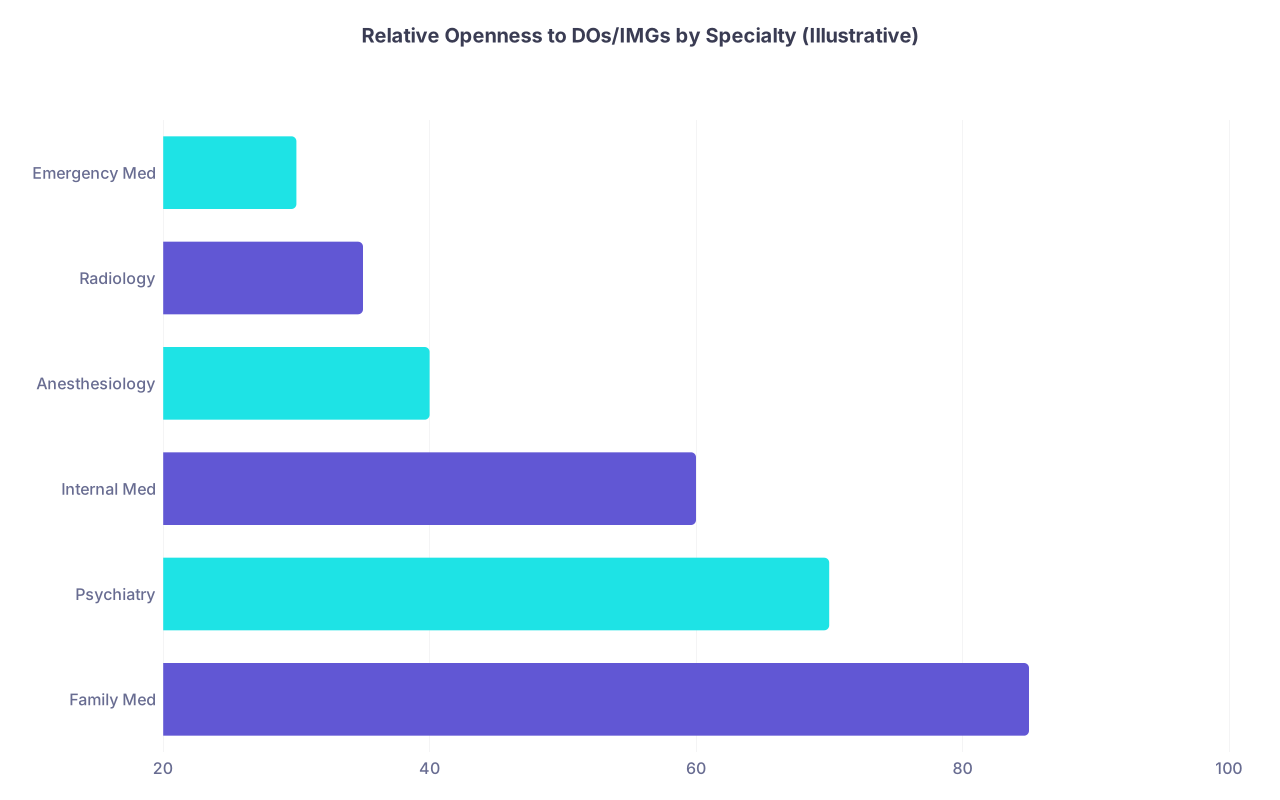
| Category | Value |
|---|---|
| Family Med | 85 |
| Psychiatry | 70 |
| Internal Med | 60 |
| Anesthesiology | 40 |
| Radiology | 35 |
| Emergency Med | 30 |
(Values are conceptual “openness scores” blending DO + IMG representation, not exact percentages.)
1. Diagnostic Radiology – “Not Ultra-Competitive” Doesn’t Mean Open
Radiology’s perceived competitiveness has swung wildly over the last decade. Some cycles it’s “tough,” some it’s “recovering,” but in most years it’s not at the absolute top with derm and plastics.
Still: being “less competitive than derm” doesn’t help you if the field quietly prefers US MDs.
Typical patterns:
- Many rad programs expect higher Step scores than IM/FM/psych, even if they aren’t neurotic about 260+.
- A lot of programs are very MD-heavy; DOs may be 5–15% of a class, IMGs even less.
- IMG-accepting programs often cluster in certain regions; other areas are basically IMG-closed.
If you’re a DO or IMG with average scores, betting on radiology as your “backup” because “it’s not that competitive” is a great way to spend ERAS money and end up unmatched.
2. Anesthesiology – Quietly Selective for IMGs
Anesthesia looks appealing from 10,000 feet:
- Not ortho-level competitive.
- Not derm or plastics.
- Some unfilled spots in some years.
But then you drill into the match data and resident rosters:
- Many academic anesthesiology programs are MD-heavy with limited IMG intake.
- DOs are present but not dominant; you see them more in certain regions and community programs.
- Some programs openly say: “We do not sponsor visas.”
Here’s the key:
Anesthesia cares about board scores, clinical performance, and—crucially—perceived reliability. Programs get extremely nervous about “red flags” (gaps, failed attempts, weak letters). They have enough US MD and DO applicants to fill their spots without going deep into the IMG pool.
If you’re an IMG aiming anesthesia, it can work—but it’s not easier than something like family med or psych. The bar is higher and the door is narrower.
3. Emergency Medicine – A Shifting, Risky Landscape
EM is in flux. Some years there are large numbers of unfilled positions. People see that and immediately think:
“Ah, least competitive now = golden opportunity for DOs and IMGs.”
No. Here’s what is actually happening:
- Some EM programs are struggling to recruit anyone they want, especially in less desirable locations.
- Others—big academic university programs, desirable cities—are still picky, heavily US MD/DO focused, and not particularly IMG-friendly.
- There’s a growing identity crisis in EM: job market anxiety, burnout, scope-of-practice fights. Programs are becoming more selective about who they’re willing to invest in.
Add to that:
- Many EM programs historically have not been strong IMG havens.
- Some have stopped sponsoring visas entirely.
- There are structural politics: EM is very “clubby” in certain regions. Away rotations and SLOEs (standardized letters) are king, and IMGs often struggle to get the right rotations.
For DOs, EM can still be reasonably accessible if you have strong SLOEs and solid scores. For IMGs, especially those without US rotations in EM, it’s not some easy fallback just because the national fill rate dipped.
The Real Variable: Specialty Culture Toward Non-MDs
You cannot reduce this to “low competitiveness = easier.”
You have to think about the culture and historical behavior of each specialty:
Family Med, Psych, Internal Med (community-heavy)
Used to working with IMGs, DOs, visa issues. Mission-driven. Underserved. They value people willing to serve unglamorous populations.Radiology, Anesthesia, some Surgical Fields
More academic, more centralized around university hospitals. Some are absolutely DO/IMG-friendly; others quietly filter them out and always will.Emergency Medicine
Emerged as heavily US-based, EM-residency-specific culture. Rotations & SLOEs inside the EM network matter more than paper stats, which disadvantages IMGs who can’t easily get those rotations.
So the real question isn’t “Is this least competitive?”
It’s: “Does this specialty, and these programs, historically use DOs and IMGs as a normal part of the workforce?”
If the answer is no, then “low competitiveness” just means weaker US MDs fill it. Not that IMGs and DOs suddenly become welcome.
Data Over Feelings: How to Actually Judge a Specialty
Here’s a simple framework I’d use if I were an IMG or DO thinking about “easier” specialties.

| Step | Description |
|---|---|
| Step 1 | Pick a Specialty |
| Step 2 | Check % DO or IMG Residents |
| Step 3 | Good Structural Access |
| Step 4 | High Risk Field |
| Step 5 | Review Program Websites and Resident Lists |
| Step 6 | Stronger Target List |
| Step 7 | Consider Different Specialty or Strategy |
| Step 8 | Low or High? |
| Step 9 | Visa and Exam Rules |
You do three things:
Look at who is actually in the programs you like.
Go to their websites. Count DOs. Count IMGs. If you’re an IMG and there are zero IMGs in the last 5 years, that’s not “least competitive.” That’s “not for you.”Check their stated requirements.
- “USMLE required for DOs”
- “No visa sponsorship”
- “2 digits attempts accepted” vs “must pass on first attempt”
Look at national NRMP data for DO/IMG fill rates by specialty, not just overall.
Don’t trust vibes. Trust patterns.
A Quick Reality Check: Internal Medicine vs Radiology
Let’s compare two fields that are often lumped together as “not that competitive” for US MDs—internal medicine and diagnostic radiology—from the perspective of IMGs and DOs.
| Factor | Internal Medicine | Diagnostic Radiology |
|---|---|---|
| DO presence | High–Moderate | Low–Moderate |
| IMG presence | High (esp. community) | Low–Moderate, clustered |
| Visa sponsorship | Common in many programs | Limited, region dependent |
| Academic bias | Lower (community heavy) | Higher (many university hubs) |
| True “backup” potential | Often yes | Usually no |
Both might be “middle” on overall competitiveness charts.
Only one is reliably forgiving to DOs and IMGs with non-stellar applications: internal medicine, especially community programs.
Radiology remains selectively open. Not closed—just not “easy mode.”
The Harsh Truth About “Backup” Specialties
Here’s the pattern I see every year:
- US MD applies derm or ortho + a “backup” like internal med. Often matches backup easily because IM is US-MD friendly.
- DO applies EM or anesthesia + “backup” radiology or neurology. Ends up with a scramble because neither is truly backup-friendly for DOs with average stats.
- IMG applies to a spread of “less competitive” fields—anesthesia, neuro, EM—without bothering to check if those programs historically take IMGs. Out thousands of dollars, no match.
The harsh truth:
A backup is only a backup if:
- The specialty is structurally open to your degree/status, and
- Your current stats put you well above the minimum for that group.
If you are a DO with 215–220-level USMLE applying anesthesia and calling radiology your “backup,” you do not have a backup. You have two primary applications to moderately DO-skeptical, score-sensitive fields.
If you’re an IMG with 225–230 Step 2 CK and your entire list is EM/anesthesia/rads/ortho, same story: you have an expensive fantasy, not a safety net.
So, Are Least Competitive Specialties Easier for IMGs and DOs?
No, not by default.
They’re only “easier” if the specialty:
- Has a strong history of using DOs and IMGs in large numbers,
- Has broad geographic spread in community/underserved areas, and
- Is willing to sponsor visas and accept non-perfect transcripts.
Family medicine? Often yes.
Psych? Frequently yes.
Internal med (community-heavy)? Mostly yes.
Anesthesia? Sometimes, but not safely by default.
Radiology? Open in pockets, not broadly.
EM? Turbulent, regionally variable, and not a classic IMG harbor.
Bottom Line
Three things you should walk away with:
- “Least competitive” on paper does not mean “easier for DOs and IMGs.” Specialty culture and historical behavior matter far more than national mean scores.
- The only real measure of safety is: “Do programs in this field regularly take people like me—same degree, same exam profile, same visa needs?” Check resident pages and NRMP data, not Reddit.
- A backup specialty is only a backup if it is structurally open to you and you’re objectively strong within your subgroup (DO or IMG), not compared to US MDs.
Ignore that, and you’re not playing on easy mode. You’re playing blind.