
The couples match will punish vague planning and blind optimism. If one partner needs a less competitive specialty, you cannot wing this.
You’re in a very specific, high‑stakes situation: you want to match together, but one of you needs (or clearly fits) a less competitive specialty. Maybe Step scores are lower. Maybe there are red flags. Maybe there’s an international grad in the mix. Or maybe one of you is strong and gunning for a tougher field, while the other just wants a secure, realistic match.
This is manageable. But only if you treat it like a logistics and probability problem, not a romance story the NRMP will magically honor.
Let’s walk through what to do.
Step 1: Get Bluntly Honest About Both Partners’ Competitiveness
You cannot plan a couples match around vibes. You need a cold assessment of each person’s standing.
At minimum, each partner should know:
- Step 2 score and where it roughly sits for their target specialty
- Class rank/quartile or equivalent
- Red flags: failed exams, leaves of absence, professionalism notes
- Strength of letters and home program support
- Whether they’re US MD, US DO, or IMG (and if IMG, how “strong” they are on paper)
If one partner “needs a less competitive specialty,” that usually means at least one of these is true:
- Step 2 is significantly below national mean
- Limited or no research in competitive fields
- No home program in the originally desired specialty
- IMG/DO targeting a historically tight field
- Multiple red flags
Here’s the mindset you need:
You’re not picking “dream specialties.” You’re picking what each person can actually match into with a couples penalty.
Because yes, there is a penalty. As a couple, you need two jobs in the same geographic orbit. That makes life harder, especially if one partner already has constraints.
Step 2: Understand Which Specialties Give You Breathing Room
When one partner needs a less competitive specialty, the “less competitive” part is an asset—if you choose wisely.
I’m not going to pretend the competitiveness ranking never changes, but some patterns are stable. Fields with more spots, broader geographic distribution, and lower score thresholds give you leverage in couples matching.
Here’s a rough, practical snapshot for US grads (this is directional, not gospel):
| Specialty | General Competitiveness | Spots & Distribution |
|---|---|---|
| Family Medicine | Least competitive | Tons, wide |
| Internal Medicine | Low–moderate (varies) | Tons, wide |
| Pediatrics | Low–moderate | Many, decent spread |
| Psychiatry | Rising but manageable | Many, good spread |
| Neurology | Moderate, improving | Fewer, but spread |
If one partner needs a less competitive specialty, the realistic “anchor” options tend to be:
- Family Medicine
- Internal Medicine (especially community programs)
- Pediatrics (non-elite programs)
- Psychiatry (not the top academic places)
- Some prelim/TY + later transition plans (this is trickier, use cautiously)
Does that mean these are “backup” or “worse” fields? No. But program directors in these specialties, especially in community settings, are more willing to look past a weaker exam profile or non-traditional path.
The key: if the weaker partner insists on a specialty that’s mid‑competitive or higher (EM, anesthesia, OB/GYN, even neurology in some regions), your couples risk goes up fast.
Step 3: Decide Who Is the “Anchor” and Who Is the “Flex”
In couples matching, particularly in your situation, you should deliberately assign roles:
- Anchor partner: The one whose primary goal is to secure any solid position in a less competitive field in a broad geographic range. This is usually the partner with weaker stats or fewer options.
- Flex partner: The one who has more leverage and is willing to compromise location, program prestige, or even specialty to secure a joint match.
If one of you has a 250+ and wants derm and the other barely passed Step 2 and needs something like FM—do not pretend this is symmetric. The derm partner is the flex, whether they like it or not, because the other person’s field doesn’t have the luxury of being ultra location‑restricted.
Anchoring means:
- The weaker partner picks a specialty with:
- Lots of spots
- Broad geography
- Tolerance for lower scores or imperfect profiles
- Their priority is match anywhere reasonable, not “my dream city.”
Flexing means:
- The stronger partner asks:
- Am I willing to drop from hyper-competitive to mid-competitive (e.g., from ortho to general surgery)?
- Am I willing to give up Top 10 academic prestige for solid mid‑tier if it helps us both match?
- In the extreme, am I willing to choose a less competitive field too (e.g., IM, psych) so we have a more forgiving couples landscape?
A lot of couples skip this conversation until October. That’s late. You should lock the anchor/flex dynamic before ERAS submission.
Step 4: Match Your Specialty Choices to Reality, Not Ego
Here’s where people sabotage themselves: they talk as if the weaker partner is “aiming for psych or IM,” but then only apply to brand‑name academic programs in Boston, NYC, SF, and Chicago.
That’s not “less competitive.” That’s cosplay.
The partner needing a less competitive specialty must:
- Apply very broadly (60–120+ programs is normal, especially if DO/IMG or red flags)
- Emphasize community, smaller city, and non‑prestige programs
- Be geographically flexible across multiple regions
The stronger partner then decides how aggressively to push for their ideal specialty.
If the strong partner is dead‑set on something competitive like:
- Derm
- Plastics
- Ortho
- ENT
- Ophtho
- Urology
- Integrated IR
- Radiation Oncology (less popular now but still niche)
and the weaker partner truly needs a forgiving field and wide geography, you have to understand the math: your probability of matching as a couple in the exact city you want drops sharply.
There are three sane paths here:
Strong partner drops to a still-meaningful but less insane field
Example: from ortho to general surgery or anesthesia; from derm to IM or path with strong outpatient or procedural options later.Strong partner stays competitive but applies with massive breadth and realistic tiers
Example: casting a net across the entire country and not demanding top‑tier only, understanding you might be in a mid‑tier academic or even some community-based programs.You agree that location > specialty for the strong partner
They’ll accept a less-glamorous program in their field if it lines up with the weaker partner’s interviews.
Most couples don’t want to admit they’re picking among these three. But you are. You just either acknowledge it now, or the rank list forces the issue later.
Step 5: Program List Strategy – Build It Backwards from Geography
The couples algorithm doesn’t care how “amazing” one partner’s CV is if there’s no matching job for the other partner in that area.
Your planning order should be:
- Identify regions/cities you’re realistically open to
- Look up both specialties’ program density there
- Only then start building a program list
If one of you is going into Family Medicine and the other wants Neurology, places like the Midwest, South, and many mid‑sized cities will often have both. But if the strong partner wants, say, PM&R (limited programs) and you insist on staying in the Pacific Northwest near family, that’s a very narrow needle to thread.
Use tools and raw searching:
- FREIDA
- Residency Explorer
- Program websites directly
- Match rate by specialty from NRMP data (for realism)
You want clusters where:
- The less competitive specialty has many positions in a small radius
- The more competitive or limited specialty has at least a handful of options
Then you over-apply in those clusters.
Step 6: How to Actually Use the Couples Match Mechanism
Most people do couples matching wrong at the rank list stage. They either:
- Pair everything with everything (too many impossible combinations), or
- Only pair “both our dream programs in one city” and ignore backup structures
The tactical approach:
- You will rank pairs of programs, in order.
- You need tiers:
- High‑priority city/program combos
- “One partner gets top choice, other gets acceptable” combos
- Safety combos where at least both are matched, maybe in a less desirable place
Think in layers, not perfection.
Example with IM (anchor, weaker partner) + Psych (flex, stronger partner):
Top tier:
- (Anchor: Big Academic IM in City A, Flex: Big Academic Psych in City A)
- (Anchor: Community IM in City A, Flex: Big Academic Psych in City A)
Middle tier:
- (Anchor: Community IM in City A, Flex: Community Psych in City A)
- (Anchor: Community IM in Nearby Town B, Flex: Psych in City A) if commuting is realistic
Safety tier:
- (Anchor: Any IM in Region X, Flex: Any Psych in Region X)
- (Anchor: Any IM in less popular regions, Flex: Any Psych same region)
And yes, you should include pairs where one partner has a “reach” program and the other has a “safety” program in the same area. That’s often how couples end up together: one person at the flagship academic center, the other at the smaller community hospital across town.
Step 7: Communication With Programs – When and How to Use It
You’re allowed to tell programs you’re couples matching. You’re also allowed to say “My partner is applying to X at your institution / in your city and we’re hoping to be together.”
Some programs care. Some don’t. Some only care if you’re competitive enough already.
What I’ve seen work in your kind of scenario:
- The weaker partner’s field (often FM, IM, peds, psych) may give a small bump if they know taking you increases the chance of landing your stronger partner in, say, a higher-profile department.
- The stronger partner’s field may be more rigid, but if they like you, they’ll at least pay attention to couples info when building their rank list.
Do not send love letters to programs saying “We’ll rank you first no matter what.” That’s not what I’m talking about. I’m talking about:
- Mentioning couples match briefly in your email when updating programs
- Clarifying which specialty your partner is applying to and where
- Occasionally, a joint email to the program coordinators at the same hospital, aligning timelines
Some chairs and PDs literally discuss couples in their meetings: “If we rank this psych applicant high and the FM partner is borderline, are we okay taking them too?” You want them thinking of you as a package, especially when one package member is less bulletproof on paper.
Step 8: Prepare for “What If Only One of Us Matches?”
You must say the quiet part out loud with each other before you submit your rank list:
If one of us matches and the other doesn’t, what do we do?
You have a few realistic options:
The matched partner starts residency, unmatched partner:
- Does a research year
- Does a prelim or TY spot if available
- Reapplies with a sharpened, more realistic plan (usually even less competitive specialty, broader geography)
You both decide that physical separation is acceptable for 1–3 years
Rarely, someone tries to SOAP together into something else. This usually goes badly if you didn’t plan for it.
If one partner truly needs a less competitive specialty and still fails to match that field while couples matching, it often means:
- Application list was too narrow
- Red flags were not addressed
- Specialty was still too ambitious given the profile
- Couples rank list was too top‑heavy and ran out before hitting viable backup pairs
You protect against this by:
- Making the weaker partner’s individual list deep and realistic
- Making the couples list long, including “less ideal” but acceptable combos
- Having an honest Plan B conversation: “If you match and I don’t, we’re not breaking up; we’re doing one year apart while I fix my file.”
Step 9: Common Dumb Mistakes You Need to Avoid
I’ve seen couples blow up their match for reasons that were entirely preventable. Here are the big ones in your specific context:
Pretending the weaker partner is more competitive than they are
Applying to 30 shiny programs in major cities is not a strategy. That’s fantasy.Letting the stronger partner drive everything
“Well, my dream specialty and dream city are X, so we’ll just start there and figure out yours later.” No. If someone needs a less competitive field, their flexibility is your lifeline, not an afterthought.Not applying enough as the weaker partner
If you have low scores, red flags, or you’re an IMG/DO in a US urban market, 40 applications in IM or FM is not “reasonable.” It’s under-shooting.Over-valuing prestige as if it matters more than your relationship
I’ve watched people chase brand-name programs and end up long‑distance for years or scrambling through SOAP while their partner starts residency alone in another state. You’ll care about your co-resident culture and your schedule far more than your program’s Doximity rank.Failing to sync interview geography
If you’re not watching where each of you gets interviews and adjusting future signals, emails, and scheduling to cluster around overlapping areas, you’re wasting opportunities.
Step 10: Day-to-Day Tactics During Interview Season
Once invites start rolling in, you shift from planning to tactical coordination.
Concrete tips:
Share a live spreadsheet with:
- Program name
- City/region
- Specialty
- Interview date options
- Relative interest level (1–3 scale is enough)
When one of you gets an invite in a city where the other has applied:
- The other partner can send a short, polite interest email to that program: “I’m couples matching with someone who just received an interview at your institution. This is a high-interest program for me as well.” It doesn’t always work. But it sometimes nudges you from “maybe” to “invite.”
If you both get interviews in the same city:
- Try to schedule them close together (same week). Programs know couples do this. No one is shocked.
If one program in a city seems much more enthusiastic than others:
- Both of you give that city more rank list weight than your initial ego might want. Enthusiasm matters more than vibes from their website.
This is where the less competitive specialty can quietly carry the team: those programs often have more interview flexibility and more spots, which can anchor you in a region where the more competitive specialty has fewer but still enough positions.
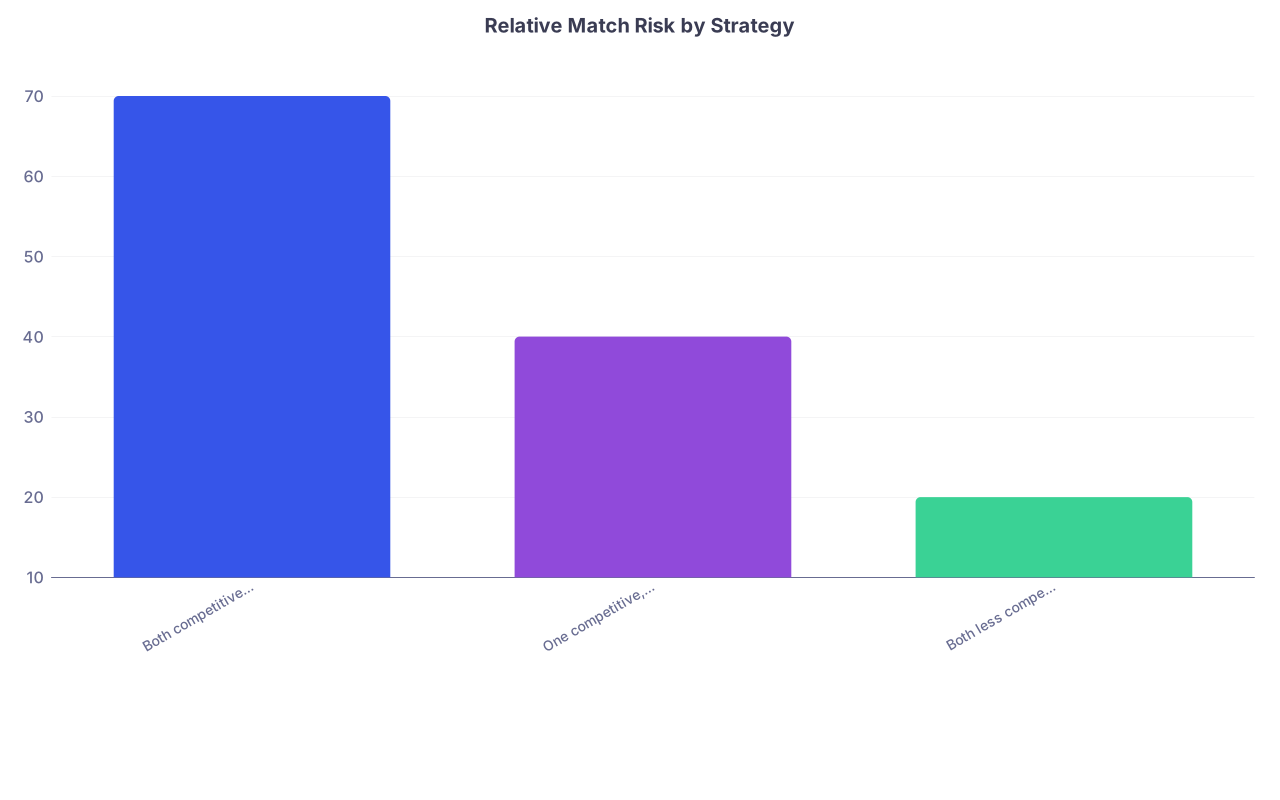
| Category | Value |
|---|---|
| Both competitive specialties | 70 |
| One competitive, one less | 40 |
| Both less competitive | 20 |
(Think of this as a rough “stress level index,” not a literal percentage. The more you push both partners into tight fields, the more unstable the couples match becomes. Your specific scenario—one competitive, one less—is actually fixable, if you lean into that asymmetry instead of denying it.)
A Simple Flow to Keep Yourself Organized

| Step | Description |
|---|---|
| Step 1 | Assess both partners competitiveness |
| Step 2 | Designate anchor and flex |
| Step 3 | Choose realistic specialty for anchor |
| Step 4 | Map overlapping cities and programs |
| Step 5 | Apply broadly, especially for anchor |
| Step 6 | Coordinate interviews and communication |
| Step 7 | Build layered couples rank list |
| Step 8 | One partner needs less competitive field |
When to Consider Not Using the Couples Match
Last uncomfortable point. There are rare cases where, given your exact situation, not using the couples mechanism and just informally trying to end up near each other is smarter.
Red flags for that:
- One partner is going for an ultra-competitive, tiny specialty (e.g., derm, plastics) with a borderline file
- The other has major red flags and is barely viable even in the least competitive fields
- You’re both geographically inflexible to one tiny region with limited programs
In those cases, tying your fates algorithmically can drag both of you down. Sometimes it’s better for the more constrained person to maximize their odds solo, then the other tries to find a spot nearby after.
Not common. But if three advisors in a row say, “I’m worried both of you will go unmatched if you couples match,” you need to listen.

Quick Reality Check Before You Commit
Run through these questions together:
- Do we clearly know who is anchor and who is flex?
- Is the less competitive specialty truly less competitive in how we’re applying (broad, realistic programs), or are we just calling it that while only aiming at big-name cities?
- Are we both more committed to matching together than to prestige or a hyper‑specific city?
If you can answer yes to those three, you’re ahead of most couples.
Final Takeaways
- Treat the weaker partner’s specialty as your anchor and plan everything around maximizing their odds first.
- Make the stronger partner the flex: adjust specialty ambition, prestige expectations, and geography so your joint probability stays high.
- Build a layered, realistic couples rank list backed by brutally honest self-assessment, broad applications (especially for the less competitive field), and active coordination during interview season.
Do that, and the fact that one of you needs a less competitive specialty stops being a liability—and becomes the thing that quietly holds the entire couples match together.