
The worst career decisions in medicine are made when you’re burned out and desperate.
Let me be blunt: switching into a “less competitive, better lifestyle” specialty will not magically fix a life you’re running into the ground. But if you’re genuinely considering the least competitive specialties because you’re exhausted, I’m going to walk you through how to do this intelligently instead of impulsively.
Step 1: Admit What Kind of Burnout You Actually Have
Before you Google “easiest specialties” for the fiftieth time, you need to identify what’s actually draining you. Because different problems need different fixes.
Most residents and med students I talk to fall into one (or more) of these:
Systems burnout
You’re crushed by:- Endless charting
- Useless non-educational tasks
- EMR hell
- Prior auths, metrics, administrators breathing down your neck
This doesn’t magically disappear in “easy” specialties. It just changes flavor.
Schedule burnout
You’re wrecked by:- Nights
- 28‑hour calls
- Flip-flopping circadian rhythm
- No predictability to your life
Here, specialty choice really matters.
Emotional burnout
You’re drowning in:- Death, codes, angry families
- Constant bad news conversations
- No time to process anything
Identity burnout
You’re realizing:- “I actually don’t like this kind of medicine.”
- “Procedures bore me / clinic bores me / hospital chaos drains me.”
- “I chose this for prestige or pressure, not fit.”
Sit down, no phone, 15 minutes. Write out:
- What exact days feel the worst?
- What specific tasks make you dread showing up?
- When do you feel most alive at work, even a little?
If you cannot answer those, you’re not ready to pick a “lifestyle” specialty. You’re just trying to escape.
Step 2: Know What “Least Competitive” Really Means
Everyone throws around “less competitive” like it’s a life hack. It’s not that simple.
Here’s the cold reality:
- Less competitive ≠ easy life
- Less competitive ≠ always low hours
- Less competitive often = lower pay, fewer procedure thrills, more monotony
- BUT can = more flexibility, more geographic options, more control over hours
Typical lower-competitiveness specialties (varies year to year, but pattern holds):
- Family Medicine
- Internal Medicine (categorical) at community programs
- Psychiatry
- Pediatrics
- PM&R (Physical Medicine & Rehab) – rising but still generally manageable
- Pathology
- Neurology (borderline)
- Some community OB/GYN and general surgery programs (but these are not “lifestyle”)
Let’s put some structure on this.
| Specialty | Typical Call/Nights* | Outpatient Potential | Subspecialty Options |
|---|---|---|---|
| Family Med | Light–moderate, varies | Very high | Sports, OB, Geri, etc. |
| Psychiatry | Often light, some nights | High | Child, Addiction, Forensic |
| Pediatrics | Moderate, can be heavy | High | NICU, Cards, Heme/Onc |
| Pathology | Minimal nights | Low (mostly lab) | Heme, Dermpath, Forensics |
| PM&R | Light–moderate | Moderate–high | Pain, Sports, TBI, SCI |
*“Typical” = rough trend. Any single program can be completely different.
You’re not choosing a label. You’re choosing:
- Schedule style
- Type of patients
- Level of acuity
- Degree of procedures
- Long-term flexibility
Step 3: Decide What Lifestyle You Actually Want (Not Just “Less”)
“Better lifestyle” is useless. You need specifics.
Ask yourself:
How many hours per week would feel sustainable long term?
- 40–50?
- 55–60?
- “I don’t care about hours if I control when I work.”
Nights:
- Never again if I can help it
- Occasional nights are fine
- Nights OK now, but I want options to quit later
Emotional intensity:
- I want less death / drama / constant crisis
- I’m okay with emotionally heavy cases if I have time to process them
- I prefer complex, messy psychosocial stuff
- I prefer technical/procedural problem-solving over talking
Interaction level:
- I like high patient contact, continuity over years
- I want shorter, focused visits
- I could genuinely be happy with minimal direct patient interaction
Now pair that with reality.
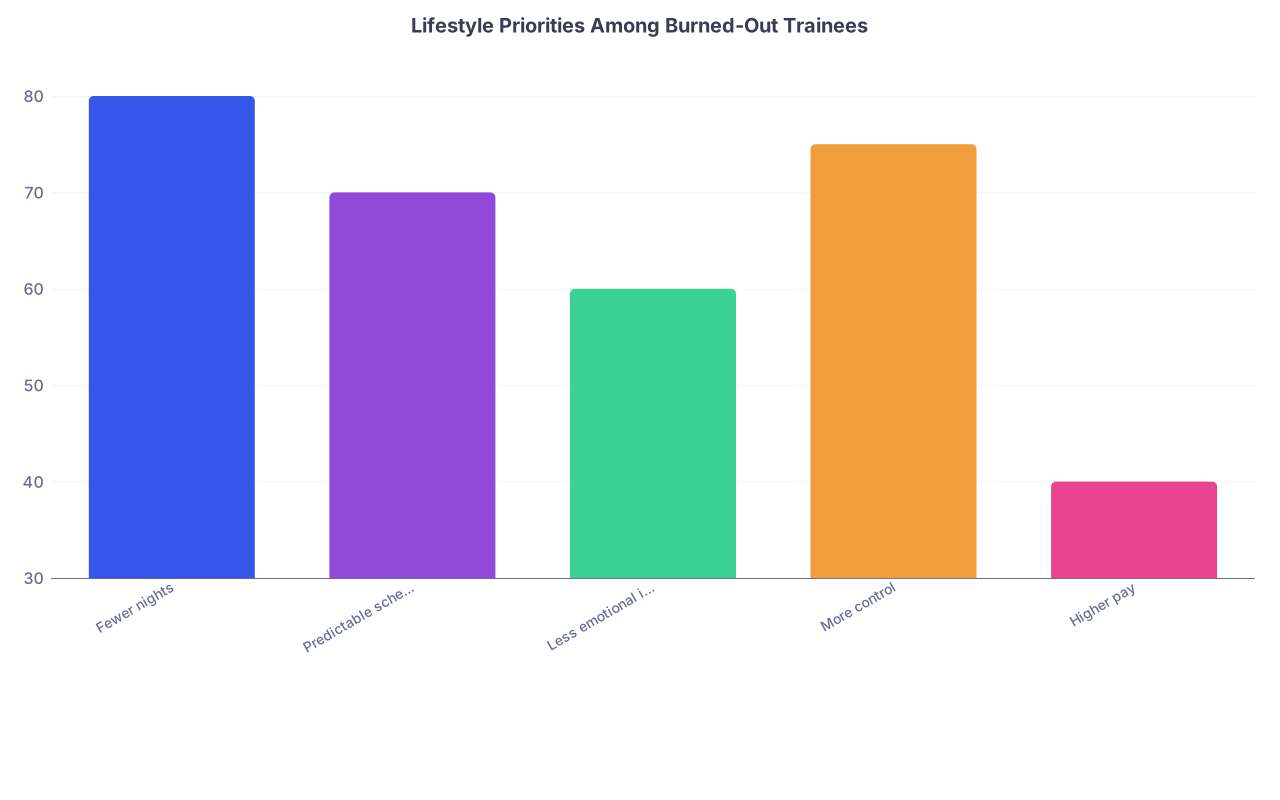
| Category | Value |
|---|---|
| Fewer nights | 80 |
| Predictable schedule | 70 |
| Less emotional intensity | 60 |
| More control | 75 |
| Higher pay | 40 |
These are the patterns I actually see among burnt-out residents:
- Fewer nights and more predictable schedules matter more than pure salary
- Control over how and where you work becomes the real currency
So you’re not just picking a specialty. You’re designing a future daily life.
Step 4: Quick Reality Check on 5 “Lifestyle-Friendly” Less Competitive Fields
I’m going to give you the unpolished version. The stuff residents actually say in call rooms.
1. Family Medicine
Good if:
- You want flexibility: urban, rural, academic, urgent care, direct primary care, telehealth
- You like breadth and continuity: cradle to grave, procedures if you want them
- You’re okay building the lifestyle you want after training (private practice, DPC, etc.)
Bad if:
- You hate primary care clinic
- You’re fantasizing about “9–5, low stress” with no intention of managing the chaos of 20 patients/day, chronic disease, and system failures
- You want prestige or niche technical depth
Burnout risk here:
- Administrative load is brutal in many systems
- RVU pressure and rushed visits can crush you
- But you have huge power to change jobs, settings, and practice models
2. Psychiatry
Good if:
- You like sitting, listening, thinking, talking
- You’re okay with chronic issues, slow progress, and complex social factors
- You want lots of outpatient potential and telehealth options
- Nights can be relatively limited, especially long term
Bad if:
- You get impatient when things don’t “fix” quickly
- You can’t tolerate uncertainty or vague symptoms
- You hate documentation-heavy notes (Psych notes can be long and detailed)
Burnout risk:
- Emotional load can be heavy—suicidality, trauma, manipulation
- Systems issues (no beds, poor resources) can be demoralizing
But if your burnout is from acute medical chaos, procedures, and relentless floor work, psych may feel like a pressure release.
3. Pediatrics
Good if:
- You genuinely like working with kids and families
- You enjoy advocacy and education
- You’re okay with lower income compared to adult fields in many regions
Bad if:
- You hate dealing with parents (some are amazing, some are… not)
- You’re already exhausted by nights and don’t want more NICU/PICU style intensity if you subspecialize
- You want high pay for your time
Burnout risk:
- Seeing sick kids wears on people
- Inpatient peds at big centers can be intense
But general outpatient pediatrics can be very livable schedule-wise—if your group or system is sane.
4. Pathology
Good if:
- You like pattern recognition, problem-solving, and being the “doctor’s doctor”
- You’re okay with minimal patient contact
- You want mostly daytime work in many jobs, with limited night emergencies
Bad if:
- You need frequent direct patient interaction to feel meaningful
- You get bored easily staring at slides or sitting at a desk
- You’re chasing high pay in saturated markets (some areas are tough)
Burnout risk:
- Isolation, feeling disconnected from patients
- High workload, pressure not to miss critical findings
But if your burnout is from chaotic wards, pager hell, and social conflict, pathology can feel like stepping into a library from a rock concert.
5. PM&R (Physical Medicine & Rehab)
Good if:
- You like functional outcomes: “How do we get you moving, working, living again?”
- You enjoy multidisciplinary teams (PT, OT, SLP)
- You want procedure options (EMG, injections, some pain procedures, sports)
Bad if:
- You want the emotional distance of pure diagnostic work
- You hate team meetings and coordinating care
- You only want high-acuity drama
Burnout risk:
- Can be frustrating if you want fast results—rehab is slow
- Some markets are tight, depending on region
But compared to surgical fields, schedule intensity is often far more humane.
Step 5: Do a Ruthless Fit Check Against Your Actual Situation
Now let’s get concrete. I’ll walk through a few scenarios I see constantly.
Scenario A: The IM Resident Who’s Done With Nights
You: PGY‑2 Internal Medicine, crushed by:
- Night float
- Cross-cover insanity
- Endless admissions, no continuity
You’re thinking: “Maybe psych or PM&R. I cannot keep doing this.”
What to do:
- Identify parts of IM you actually like:
- Family meetings? Complex chronic care? Procedures? ICU? Outpatient clinic days?
- Get elective time in:
- Psych consults
- Inpatient rehab or PM&R consults
- Outpatient psych or rehab clinics
Reality check:
- If you love thinking through complex medicine but hate nights, Hospitalist life will not save you.
- Outpatient IM or a subspecialty clinic might.
- Or a pivot to psych/PM&R might—but only if you actually like their core work, not just the idea of fewer codes.
Scenario B: The Surgery-Track Student Who Secretly Hates the OR
You: MS3/early MS4, thought you wanted ortho or gen surg. Now you dread long cases and standing for hours. Burned out. Miserable.
You’re thinking: “I’ll just do FM or psych. Anything but this.”
What to do:
- Admit the truth: you don’t enjoy the core of surgical life
- Schedule:
- FM inpatient + outpatient
- Psych inpatient + outpatient
- Maybe EM, PM&R, or even anesthesia if you like acute care but not operating
- Pay attention to:
- How you feel waking up on clinic/psych/FM days vs OR days
- Energy level at 3 pm
Do not:
- Pick FM or psych only because they feel “easier” in the moment. You’re biased right now because surgery clerkships are brutal.
Step 6: Use This Simple Flow to Narrow Down
You need a sanity framework, not vibes.

| Step | Description |
|---|---|
| Step 1 | Burned Out Now |
| Step 2 | Consider FM, Psych, PMR, Path, Outpatient Focus |
| Step 3 | FM, Psych, Peds, PMR |
| Step 4 | Pathology, Radiology if attainable |
| Step 5 | Do Rotations in 2 Target Fields |
| Step 6 | Talk to PGY3+ in Those Fields |
| Step 7 | Decide If Pivot Is Worth Cost |
| Step 8 | Main Pain - Schedule or Identity |
| Step 9 | Hate Nights and Chaos? |
| Step 10 | Hate Core Work of Current Path? |
| Step 11 | Like Patients or Not? |
If you skip the “do rotations + talk to PGY‑3+” step, you’re gambling with your life. People lie to MS3s. PGY‑3s are usually too tired to keep up the marketing spin.
Step 7: Understand the Tradeoffs You’re Actually Making
Every switch comes with cost. I see people ignore this and regret it later.
Real tradeoffs if you move into a less competitive, lifestyle-friendly field:
Money:
- FM / Peds / Psych / PM&R often pay less than procedure-heavy fields or cards/GI
- But you may be buying 10–20 extra hours of life per week. That’s not trivial.
Prestige/Ego:
- You might drop from a “prestige specialty” to one that family members do not brag about at Thanksgiving.
- If your self-worth is tied to that, you need to confront it now, not 10 years later.
Intellectual style:
- Some fields are complex-intellectual (psych, IM, path)
- Some are rapid-fire, protocol-driven (EM, urgent care)
- Some are long-game (FM, PM&R, peds)
Geographic freedom:
- FM, psych, general IM → jobs almost everywhere
- Niche subspecialties → great in cities, thinner in rural areas
You are not asking “What is easiest?”
You’re asking “What problems do I want to have?” for the next 30 years.
Step 8: What To Do This Month If You’re Seriously Considering a Switch
Concrete timeline. No vague “reflect and research.”
Next 7 days:
- Write down:
- Top 5 things currently burning you out
- Top 5 things you actually enjoy in medicine
- Rank 3 specialties that might better align with the second list
Next 30–60 days:
- Arrange at least two rotations/electives in realistic target fields
- During those:
- Show up on time, work like you belong there
- Ask residents privately:
- “What sucks most about this specialty?”
- “If you had to pick again, would you?”
- “What kind of person should not do this?”
Next 90 days:
- Talk to your current PD or trusted faculty mentor. Yes, actually have the hard conversation. Use:
- “I am concerned about long-term fit and burnout. I want your honest take on whether I should stay this path or consider [X/Y].”
You’re not the first person to question your path. Good PDs know this.
Step 9: Guardrails So You Don’t Make a Panic Decision
Here are my non-negotiables if you’re considering a jump to a “less competitive” specialty for lifestyle:
You must have done at least a full month in that field recently
You must have talked to:
- One PGY‑2
- One PGY‑4 or attending
ideally at different programs
You must be able to write, in one paragraph:
- What doing this specialty day to day actually looks like
- Why it matches your values and energy
You must accept:
- No specialty will protect you from bad systems, bad bosses, or poor boundaries
- You will still have hard days. You’re choosing which hard.
If you cannot clear those bars, you’re not ready to commit. You’re just tired. And tired people make bad lifetime decisions.
FAQs
1. I’m so burned out I can’t tell what I actually like anymore. How do I even start?
Pull it way back. Take one week and just observe your own reactions on shift. Keep a tiny note in your phone: “+” for things that give even a little energy, “−” for things that drain you. Could be “+ running family meeting,” “− rewriting discharge summaries 3 times,” “+ problem-solving a complex diagnostic case,” “− managing three simultaneous codes.” After a week or two, patterns show up. You don’t need perfect clarity, just enough to see what direction is obviously wrong.
2. Is it smart to choose a specialty mainly for lifestyle?
Choosing only for lifestyle is usually a mistake. Choosing between several decent-fit fields and weighting lifestyle heavily is smart. If you hate the core work, you’ll burn out even in a 40‑hour week. But if you genuinely like the work and the lifestyle is sustainable, that’s the sweet spot. So lifestyle should be a strong filter, not the only one.
3. I’m already in a residency I dislike. Is switching to a less competitive specialty actually realistic?
It can be, but it’s messy. People do it every year, especially into FM, psych, path, PM&R, and sometimes peds or IM. You’ll need:
- Honest discussion with your PD
- Updated application and letters from your target field
- A clear story that this is about fit and long-term sustainability, not just “I’m tired”
You may lose a year. You may move programs or cities. It’s a real cost—but staying in the wrong field for 30 years is worse.
4. How much does burnout during training predict burnout in my eventual specialty?
Some, but not perfectly. Training magnifies everything: bad schedules, weak support, poor sleep. You might feel dramatically better as an attending in the right practice. But patterns matter. If you’re consistently miserable with the type of work (not just the hours), that’s a red flag. If you’re mostly exhausted by night shifts and volume, but you still like the underlying medicine, adjusting practice type within your field may be enough.
Open your notes app right now and list the five most draining parts of your current life in medicine and the five best. That list is your map—use it before you jump into a “lifestyle” specialty you do not actually want.