
You are halfway through third year. You just finished your surgery clerkship, everyone on the team is talking about vascular, ortho, plastics… and going on and on about how “you basically need a 260+ and 15 first-author pubs.”
Meanwhile, you are sitting there thinking:
“I like procedures… but there is no chance I am competing for ENT or ortho.”
Or flip it: you actually enjoy clinic and thinking through complex problems, but every time someone mentions derm or radiology, they say “impossible to match” and rattle off Step 2 numbers that look like phone numbers.
So the real question you are trying to answer is not “what is competitive,” but this:
Among procedural vs cognitive fields, which least competitive specialties still let me do the kind of work I want without needing a hyper-elite application?
Let me break this down precisely.
Step 1: What “Least Competitive” Actually Means (and What It Doesn’t)
People toss around “competitive” like it is a vibe. It is not. Programs rank you on a handful of brutally simple dimensions.
When I say least competitive, I mean a combination of:
- Lower USMLE Step 2 CK averages and wider acceptable range
- Higher match rates for US MD/DO applicants
- Less obsession with high-tier research, AOA, and “pedigree”
- Reasonable number of spots nationwide (not bottlenecked like neurosurg)
And I am explicitly not equating:
- “Least competitive” with “easy”
- Or “least competitive” with “low quality”
Some of the least competitive fields are tough, unglamorous, and underpaid relative to work intensity. That is often why they are less competitive.
Before we split procedural vs cognitive, anchor yourself in one thing:
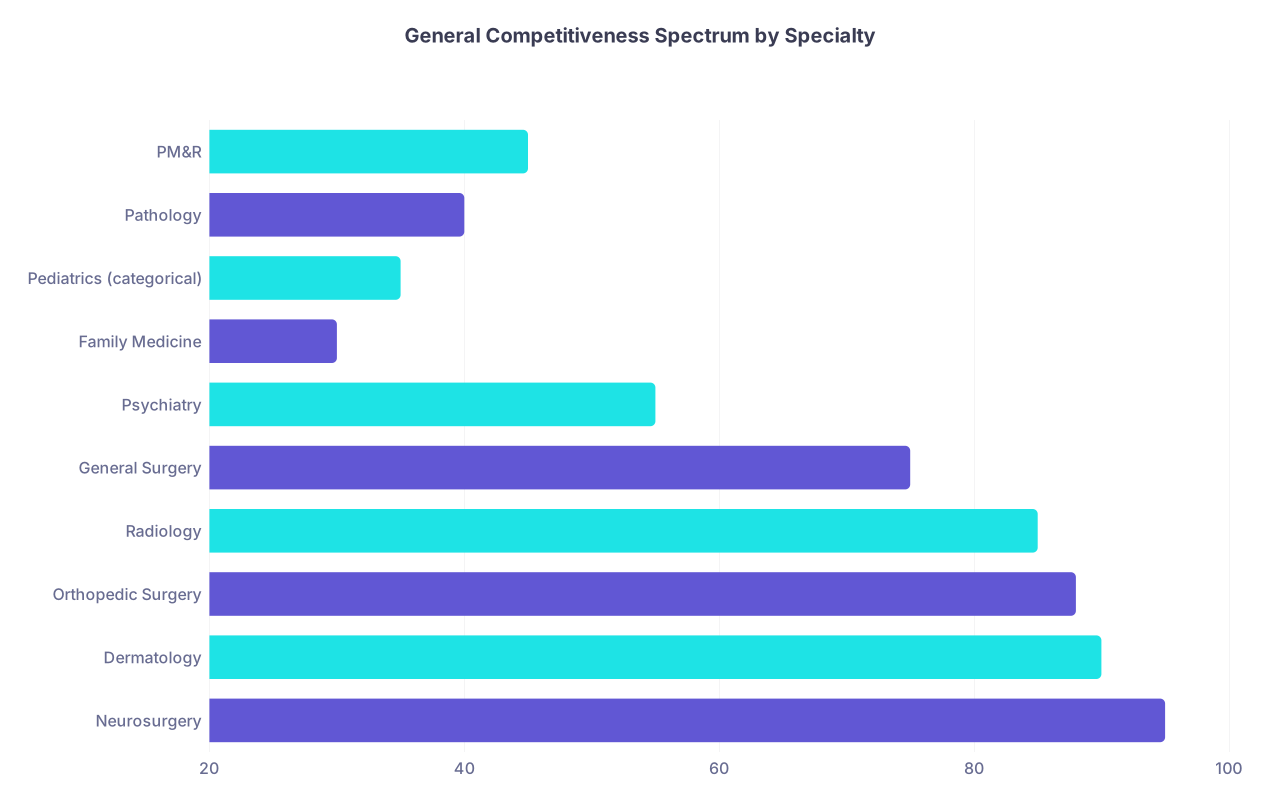
| Category | Value |
|---|---|
| Neurosurgery | 95 |
| Dermatology | 90 |
| Orthopedic Surgery | 88 |
| Radiology | 85 |
| General Surgery | 75 |
| Psychiatry | 55 |
| Family Medicine | 30 |
| Pediatrics (categorical) | 35 |
| Pathology | 40 |
| PM&R | 45 |
(Values here represent a relative “competitiveness index” — higher = more competitive, not an official score, but you get the idea.)
You are not comparing neurosurgery vs family medicine. You are picking within the “I like procedures” or “I like thinking/clinic” buckets and asking: where is the path of least resistance while still fitting my brain and preferences?
Step 2: The Procedural Side – Least Competitive Options That Still Involve Your Hands
Let’s talk about the resident who likes doing things. Needles, scopes, cutting, suturing, injections. But whose Step 2 is 230–240, not 255+. And whose research is a couple of posters, not a PubMed page.
1. General Surgery (Community-Oriented Programs)
Is general surgery “least competitive” overall? No. But within procedural fields, especially among the cutting specialties, it is the least elitist gateway into an operative career in many regions.
Who actually matches general surgery?
- Plenty of US MDs with Step 2 in the low–mid 230s, especially at community and mid-tier university programs
- US DOs with solid clinical performance and strong letters
- People who are hard workers and reasonably normal to be around at 3 AM
Where it is not “least competitive”:
- Big-name academic powerhouses (Mass General, UCSF, Michigan)
- Integrated community programs in trendy cities with few spots (Denver, Seattle, Austin, etc.)
What general surgery really selects for:
- Workhorse mentality. People who show up and grind.
- Being teachable in the OR. Chiefs will tell you outright if you are “coachable” or not.
- Strong letters from surgeons who explicitly state, “I would take this person as my own resident.”
Procedural density: very high. If you survive, you will operate. A lot.
Downside: brutal lifestyle during training, malignant pockets still exist, burnout risk is real. But from a “I want to cut and am not a 260 applicant” standpoint, general surgery (especially non-elite programs) sits near the bottom of the competitive ladder compared with other surgical fields.
2. Obstetrics and Gynecology (OB/GYN) – The Hybrid Workhorse
OB/GYN is not low intensity. But compared with ortho, ENT, urology, and plastics, it is more accessible to a mid-range applicant.
What it looks like:
- Mix of major surgery (hysterectomies, C-sections), minor procedures, and outpatient clinic
- Strong procedural volume in residency (especially if you choose a program with high L&D numbers)
From a competitiveness standpoint:
- Historically mid-tier. In recent years, it has trended more competitive, but it is still “reachable” for a lot of average applicants.
- Programs care a lot about:
- That you actually like women’s health and did not just “fall into” OB
- Your performance on OB rotations and electives
- Letters from OB faculty who back you hard
Where it becomes harder:
- Top academic OB programs with strong Gyn-Onc/MFM divisions
- Major coastal cities with small program numbers
If you want:
- Hands-on procedures
- A mix of clinic and OR
- High acuity and a clear patient population focus
…and you are not sitting on a 260, OB/GYN is one of the more reachable procedural hybrids compared with the top-tier surgical subspecialties.
3. PM&R (Physical Medicine & Rehabilitation) – Procedures Without an OR
PM&R is an odd duck. Technically a “cognitive” field by many people’s thinking. But in practice, especially in pain/spine/musculoskeletal tracks, it is very procedure-heavy:
- Joint injections
- Ultrasound-guided procedures
- Nerve blocks
- EMG and nerve conduction
Competitiveness profile:
- Historically under the radar
- Becoming trendier, but still less cutthroat than ortho, radiology, or anesthesia
- US MDs and DOs match with a wide Step 2 range (mid-220s up into 250s), and DOs have traditionally done well here
Where PM&R is easier:
- Community or lower-profile programs not tied to massive rehab institutes
- Regions outside big-name academic or coastal clusters
Where it gets tougher:
- Heavy-name programs linked to academic powerhouses and sports franchises (e.g., Mayo, Kessler, Spaulding)
If you like:
- Musculoskeletal medicine
- Neuro rehab, stroke, SCI, TBI
- Longitudinal relationships with patients and functional outcomes
- Procedures that are image-guided but not in the OR
Then PM&R is one of the least competitively gated procedural-ish fields you can enter. No, it does not match the “I’m an orthopedic surgeon” status. Yes, you can still have a procedural-heavy practice.
4. Psychiatry With Interventional Focus (ECT, TMS, Ketamine)
Traditional psychiatry is cognitive. But interventional psychiatry is turning it pseudo-procedural:
- ECT
- TMS
- Ketamine infusions / esketamine
- In some centers, close collaboration with neuromodulation teams
Is psychiatry competitive? It has trended significantly upward, but relative to derm, rad, ophtho, or neurosurg, it is still much more open.
From a “procedural” perspective:
- You are not an OR doctor. But you are using devices, anesthesia-adjacent workflows, and structured procedures.
- If you match into a good psych program with strong interventional exposure, you can carve out a very procedure-leaning career later.
So if you want a later-life procedural emphasis without surviving a hardcore surgical residency, psychiatry is a sneaky backdoor.
Quick Procedural Comparison Table
| Specialty | Type of Procedures | Relative Competitiveness | Lifestyle in Training | Notes |
|---|---|---|---|---|
| General Surgery | Major OR cases, endoscopy | Moderate | Heavy | Gateway to many fellowships |
| OB/GYN | OR + L&D + minor procedures | Moderate | Heavy, variable | Strong mix of clinic and OR |
| PM&R | Injections, EMG, US-guided | Lower–Moderate | Moderate | Can build very procedural practice |
| Psychiatry | ECT, TMS (select paths) | Lower–Moderate | Moderate, improving | Procedures depend on fellowship/job |

Step 3: The Cognitive Side – Least Competitive Thinking Fields
Now the other bucket: you enjoy diagnosis, complexity, and clinic more than you enjoy cutting. You want a brain-heavy field but do not have the portfolio to chase derm, rads, or some of the more selective medicine subspecialties.
The “least competitive cognitive specialties” conversation is very different. Here, the big players are obvious.
1. Family Medicine – The Benchmark for Least Competitive
If you stacked all specialties by raw competitiveness, family medicine almost always sits at the bottom. That is not an insult, it is a reflection of:
- Massive number of positions nationwide
- Many community and smaller programs
- Less obsession with Step scores; they still matter, but the cutoff bars are lower
- Strong DO and international representation
Clinically, family medicine is:
- Heavily outpatient
- Preventive care, chronic disease management, pediatrics, women’s health, basic procedures (IUDs, skin biopsies, joint injections) depending on training
- Cognitive in the sense of juggling broad, undifferentiated complaints and long-term management
Where FM becomes “more competitive”:
- Prestigious academic urban programs
- Very location-limited programs (e.g., 6-resident program in a super-desirable city)
But overall, if your main concern is simply “I need to match,” family medicine is the lowest bar in the cognitive world.
2. Internal Medicine (Categorical, Not Fast-Track Elite)
Internal medicine is a different beast. There are two internal medicines:
- The elite, subspecialty pipeline programs (think Hopkins, Brigham, UCSF)
- The rest of the IM universe: community programs, mid-tier universities, regional centers
IM as a whole is more competitive than family medicine, but there is still a huge range.
Cognitively, IM is:
- The classic “thinking” field: complicated inpatient cases, multi-morbidity, diagnostic puzzles
- Pathway to cards, GI, heme-onc, ICU, nephro, etc. (though those fellowships are competitive)
From a competitiveness standpoint:
- If your Step 2 is in the low–mid 230s and you have no disasters on your record, you can very realistically match IM at a decent community or mid-tier university program.
- Even with a weaker set of metrics, there are IM programs that will consider you if you show reliability and decent communication skills.
It is not “least competitive” like FM, but among cognitively heavy fields that still give you flexibility later, IM is one of the more forgiving entry points.
3. Pediatrics – Gentle Gatekeeping, High Cognitive Load
Pediatrics is usually:
- Less competitive than categorical IM
- More competitive than family medicine
- Very willing to take applicants with genuine interest and good pediatrics letters even if they are not statistical monsters
You will hear peds attendings say this outright:
“We want nice, reliable, caring residents. We are not screening for 260s.”
Cognitively, pediatrics is heavy:
- Neonatal and pediatric pathophysiology is its own language
- Development, congenital issues, genetics, complex chronic conditions
- Crucially, high emphasis on communication with families
From a competition perspective:
- Step 2 averages are lower than many medicine subspecialties and surgical fields
- There are lots of positions, and many mid-tier and community programs
If you want “intellectual but not cutthroat” and you actually like kids, pediatrics is one of the least competitively gated cognitive specialties.
4. Psychiatry – Cognitive with Growing Demand
Psych again. But now in its main form: cognitive, longitudinal, heavily verbal.
Competitiveness reality:
- It used to be among the lowest. Then lifestyle plus demand drove applications up.
- Now it is solidly mid-range: not trivial, not derm.
- Many solid applicants with 220–240 Step 2 scores, good clinical grades, and some mental health-related involvement match successfully.
Cognitive profile:
- Diagnostic frameworks (mood, psychotic, anxiety, neurocognitive, etc.)
- Medication management, psychotherapy models, interdisciplinary care
- Huge overlay with social determinants of health, for better or worse
Psych is now somewhat more selective than FM and peds at top programs, but nationwide it is still one of the more accessible cognitive/lifestyle combinations.
5. Pathology – Underrated and Often Ignored
Pathology is one of the most misunderstood specialties. Students either love it early or never see it properly.
Competitiveness:
- Lower–moderate overall; there are always unfilled spots each Match
- Many programs will look at a wide Step 2 band as long as you show clear interest and can function as a reliable team member
Cognitive load:
- Very high. You are the final common pathway for diagnosis.
- Histology, gross pathology, molecular, hematopathology.
- Minimal direct patient contact, but intense analytical work.
If you like puzzles, microscopy, and are comfortable being behind the scenes, pathology is one of the least competitively gated high-cognition specialties.
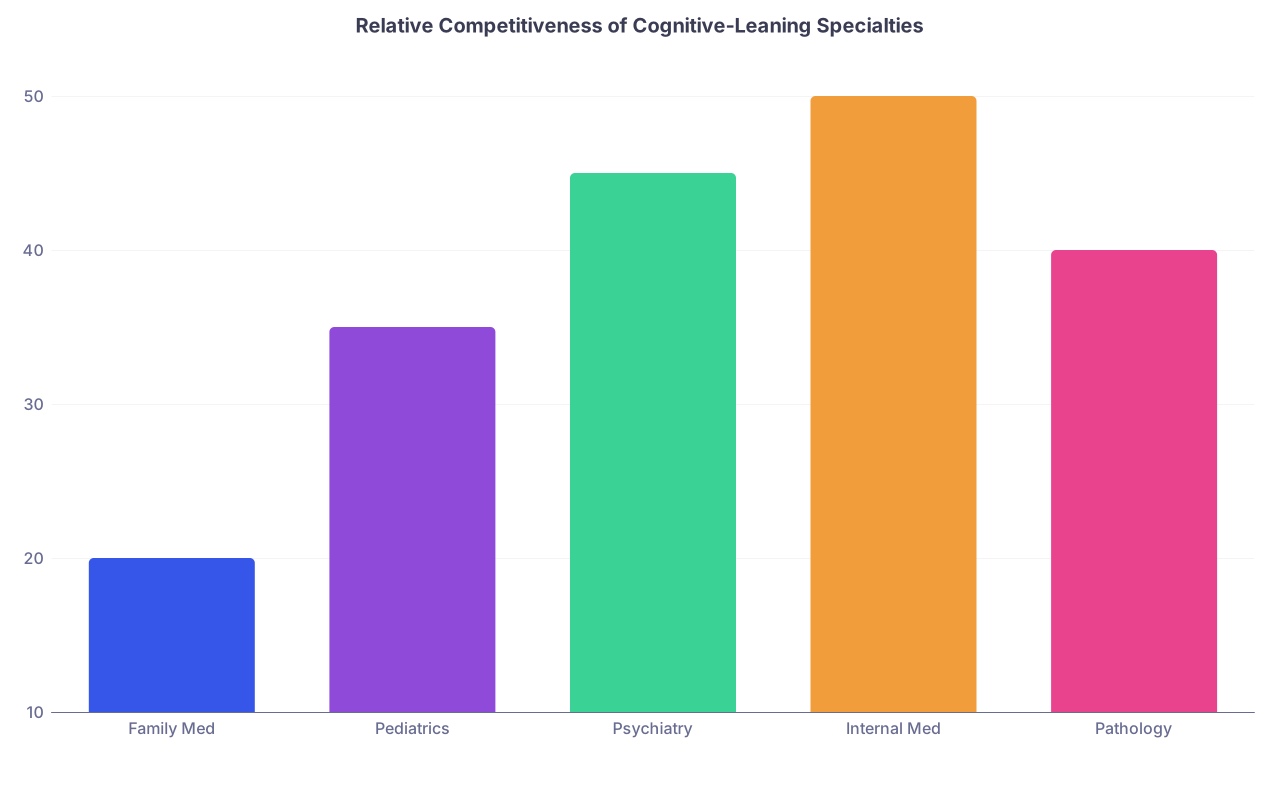
| Category | Value |
|---|---|
| Family Med | 20 |
| Pediatrics | 35 |
| Psychiatry | 45 |
| Internal Med | 50 |
| Pathology | 40 |
(Again, relative index, not official numbers.)

Step 4: Matching Your Profile to “Least Competitive” Options
Let us get practical. You are not a generic applicant. You have constraints.
If Your Scores Are Average (220s–230s) and You Want Procedures
You should be looking seriously at:
General Surgery (non-elite)
- Apply broadly, include a lot of community and hybrid academic-community programs.
- Be realistic about not chasing the top ten name brands.
OB/GYN
- Show genuine, specific interest (LORs, electives, maybe a small QI project).
- Understand it is still competitive enough that you cannot apply lazily or narrowly.
PM&R
- Very reasonable if you angle toward musculoskeletal interests.
- Great for DOs and MDs without a powerhouse research portfolio.
Psychiatry (with future interventional focus)
- Do not sell it as “I want to shock people’s brains.”
- Instead, frame interest in treatment-resistant depression, neuromodulation, systems of care.
If Your Scores Are Below Average or You Have Red Flags
Here is where “least competitive” really matters.
Your safest cognitive bets:
Family Medicine
- Broad application, emphasize reliability, communication skills, service, and continuity of care.
- Consider community-based programs and less glamorous locations.
Internal Medicine (non-elite)
- Many community IM programs will take a chance on a bounded red flag if the rest of your file shows maturity and progress.
- You will likely not walk into a GI fellowship at a top five institution, but you can build from there.
Pediatrics
- If you truly enjoy working with children and can get strong peds letters, many programs prioritize fit and personality above raw stats.
Procedural-ish realities in this scenario:
- You are probably not getting into ortho, ENT, urology, neurosurg. Let it go.
- General surgery and OB/GYN are not impossible, but become significantly more difficult. You will need stellar rotations and letters and a very broad list.
- PM&R and psych are more realistic if you show a clear, consistent trajectory of interest and no ongoing professionalism issues.
If You Want Cognitive Depth but Hate the Idea of Clinic All Day
Clinic burnout is real. Some of you want to think, but not necessarily see 25 patients a day.
Least competitive-ish, low-clinic options:
- Pathology – almost entirely non-clinical in the traditional sense.
- Radiation Oncology would have historically fit here, but the market and match landscape are unstable and it is no longer “easy” or safe from a jobs perspective. I do not recommend counting on it as a fallback.
Alternate strategy:
- Internal Medicine → Non-primary-care roles (hospitalist, academic clinician-educator, inpatient-heavy jobs)
- Psychiatry → Inpatient/consult-heavy practice (still face-to-face, but different flow than primary care clinic)

| Step | Description |
|---|---|
| Step 1 | Start - You |
| Step 2 | Consider Gen Surg, OB GYN, PM&R |
| Step 3 | Consider PM&R, Psych with Interventions |
| Step 4 | Consider FM, Peds, Psych, IM |
| Step 5 | Consider Pathology, IM with inpatient focus |
| Step 6 | Prefer Procedures or Cognitive? |
| Step 7 | Step 2 CK >= 235? |
| Step 8 | Comfort with High Clinic Volume? |
Step 5: Subspecialty Futures – Do Not Ignore the Second Gate
One mistake I see constantly: students think only about residency competitiveness and ignore fellowship bottlenecks.
You might get into a relatively less competitive residency now and then slam into a wall later trying to subspecialize.
Examples:
- Internal Medicine is easier to enter than dermatology, but a competitive GI or cards fellowship at a top institution is brutally selective.
- General Surgery at a mid-tier program is reachable, but plastics or peds surg fellowship from there is not guaranteed without substantial hustle.
- PM&R residency may be relatively accessible, but a top interventional spine or sports fellowship is another competitive filter.
Conversely:
- Family Medicine often leads to jobs directly after residency; many graduates do not fellowship.
- Psychiatry has fellowships (child, addiction, forensics, etc.), but the bottlenecks are generally less severe than, say, GI or interventional cards.
- Pathology fellowships can be competitive (heme-path, derm-path), but the overall funnel is still gentler than some hyper-saturated medicine subspecialties.
Point: Do not only ask “what is least competitive right now.” Ask:
- “If I go into this, what does the second gate look like?”
- “Am I okay with the most likely version of my eventual practice, not just the dream fellowship outcome?”
Step 6: So How Do You Choose Among the Least Competitive Options?
Strip away prestige. Strip away what your classmates brag about. Look at:
Do you actually like the day-to-day work?
Watching one cool surgery does not count. Think: pages, notes, follow-ups, scut, clinic flow, call structure.Can you tolerate the training lifestyle?
General surgery and OB/GYN residencies are hard. Family medicine and psychiatry, generally, are more humane. PM&R and peds somewhere in between. Pathology is qualitatively different.What kind of problems do you enjoy solving?
- Procedural problems: anatomy, technical skill, spatial reasoning
- Cognitive problems: diagnostic uncertainty, long-term management, multi-morbidity
- Social and behavioral problems: psych, FM, peds
What is your risk tolerance for competitive bottlenecks?
If your application is middle-of-the-road, do not build a plan that only works if you land the #1 program on your rank list and then match into the most competitive fellowship from there.

Key Takeaways
Among procedural paths, the relatively less competitive options are general surgery (non-elite programs), OB/GYN, PM&R, and psychiatry with an interventional focus. They are not “easy,” but they are more accessible than ortho, ENT, urology, plastics, neurosurgery, or ophtho for a mid-range applicant.
Among cognitive fields, family medicine, pediatrics, psychiatry, internal medicine (outside of top-tier programs), and pathology make up the core of the least competitive options. They differ a lot in clinic load, patient contact, and subspecialty futures, so lumping them together is a mistake.
You are not choosing “least competitive specialty” in a vacuum. You are choosing the least competitive option that still matches your tolerance for lifestyle, your intellectual preferences, and your actual statistical profile. Be honest about all three, and you will make a far better decision than just asking “what is easy to match.”