
The biggest mistake MS3s make when “keeping options open” is pretending competitiveness does not exist. It does. And if your record is not built for the bloodbath specialties, you need a deliberate pivot into lower-competition fields before MS3 ends—not during MS4 panic season.
This is your month‑by‑month roadmap to do exactly that.
Big Picture: What “Pivoting into Low-Competition” Actually Means
Before we go chronological, you need a working definition.
When I say lower-competition specialties, I mean things like:
- Family Medicine
- Internal Medicine (categorical, not fast-track cards spots)
- Pediatrics
- Psychiatry
- Physical Medicine & Rehabilitation (in many regions)
- Pathology
- Neurology (still variable, but generally less cutthroat than derm/ortho/ENT/plastics)
Are there exceptions, regions, and specific programs that are still very competitive? Of course. But you are no longer playing in the dermatology/orthopedic surgery/neurosurgery sandbox. Different rules.
Your pivot has four core goals:
- Claim the narrative – Why you’re moving toward this field, not away from your dream that ghosted you.
- Stack concrete receipts – Evaluations, letters, and experiences that scream, “I belong here.”
- Avoid sunk-cost traps – Not wasting MS3 time chasing a long shot while neglecting realistic options.
- Time your pivot – Early enough that your MS3 schedule, letters, and Step 2 all support the new direction.
Now let’s walk through the year.
Pre‑MS3 (0–2 Months Before Clinicals Start)
If you’re already mid‑MS3, skim this, then jump ahead. But if you’re in that limbo between pre‑clinicals and clerkships, this is where you quietly set the chessboard.
At this point you should…
1. Get brutally honest about your numbers
Pull them up:
- Pre‑clinical grades (especially if your school ranks)
- Step 1 (if you have it, even pass/fail context matters)
- Shelf‑style practice tests or NBME performance
- Red flags: remediation, professionalism issues
Then ask:
- Do these realistically support derm, ortho, neurosurgery, plastics, urology, ENT, integrated IR, etc.?
- If not, you are already a pivot candidate, even if you’re emotionally not there yet.
2. Learn which fields are actually less competitive
Not vibes. Data.
| Category | Example Specialty | US MD Fill % | All Applicant Fill % |
|---|---|---|---|
| Ultra-competitive | Dermatology | 99% | 100% |
| Competitive | Emergency Med | 92% | 95% |
| Mid-tier | Neurology | 80% | 90% |
| Lower-competition | Family Medicine | 60% | 85% |
| Lower-competition | Psychiatry | 70% | 90% |
You are looking for:
- High total fill (programs want residents)
- Moderately lower US MD fill (they consider DO/IMG, broader range of metrics)
- Broad geographic availability
3. Quietly shortlist 2–3 realistic fields
Pick one primary and one backup low-competition field that you’d be okay living in, not just “tolerating.”
Example:
- Primary: Psychiatry
- Backup: Internal Medicine (open to mental health focus, psychosomatic, consult‑liaison)
You’re not committing yet. You’re just building a short menu.
Months 1–2 of MS3: Core Rotation Reality Check
This is where most students fake “open-mindedness” while still secretly clinging to one impossible dream. Do not do that.
At this point you should…
1. Use each core rotation as a data point, not a destiny
First 2–3 rotations (often IM, surgery, FM, or OB/GYN) are scouting reports.
On each rotation, track:
- How you feel at 7am pre‑rounds
- How you feel at 4pm notes and dispo time
- Your feedback pattern: are attendings calling you “thoughtful,” “thorough,” “great with patients,” “detail-oriented”?
That language matters. Different fields value different traits.
2. Mark “field fits” in real time
End of each week, jot:
- Do I like the pace? (fast ED vs. slow outpatient vs. analytic lab)
- Do I like the problems this field solves? (chronic disease, acute crises, developmental, behavioral)
- Do I like the patients? (kids, older adults, psych patients, complex medical)
By end of Month 2, you should see at least one of the following emerging:
- “I keep enjoying talking to patients more than doing procedures.” → Psych, FM, IM, peds
- “I love complexity and long differential lists.” → IM, neuro, path
- “I like rehab and function, not just disease.” → PM&R
- “I like kids, but not the OR.” → Peds, peds neuro, peds psych
3. Notice where evaluations are strongest
If you’re consistently getting Honors/High Pass in certain rotations while scraping by in others, that’s a signal.
- Strong IM + Psych, but average Surgery? That’s a pivot‑friendly pattern.
- Great in FM clinic but bored in the OR? Same.
You are not overreacting. You’re collecting ammunition for later.
Months 3–4: Early Pivot Planning Window
By now, you’ve seen at least internal medicine and surgery or family medicine. The fantasy specialties should look less mysterious and more clearly skewed.
This is the first real decision point.
At this point you should…
1. Decide: Am I keeping a stretch specialty alive, or pivoting now?
You have three choices:
- Stay in the fight for a competitive field and accept you’ll need:
- Top shelf grades
- Strong Step 2 CK score
- Research in that specialty
- Letters from big‑name faculty
- Dual‑track – still exploring a competitive specialty but actively building a low‑competition option (smart middle ground).
- Full pivot – commit mentally to a low-competition field and stack everything toward it.
If your Step 1 is weak, your school rank is mid/low, and you’re already struggling on shelves, pretending option 1 is still viable is self‑sabotage.
2. Make a specialty short list with pros/cons
Not just “I like it.” Concrete.
Example for Psychiatry vs. Family Med:
- Psychiatry:
- Pros: Strong interest, pass/fail Step 1 less punitive, valued for empathy and communication, expanding job market.
- Cons: Need solid psych rotation performance, stigma from some families, fewer procedures.
- Family Medicine:
- Pros: Tons of programs, broad geographic spread, values continuity and flexibility, lower score cutoffs.
- Cons: Lower pay, chronic disease grind, some call burden depending on site.
3. Start lining up potential letter writers—even if you’re not sure yet
On rotations where you’re thriving, do the following in the last week:
- Ask for specific feedback: “What could I do to be a top resident in this field?”
- If they’re positive, respond: “I’m seriously considering [field]. If I end up applying, would you feel comfortable writing a strong letter?”
You’re not promising anything yet. You’re reserving the option.
Month 5–6: The Deliberate Pivot
By mid‑year, most students know what they don’t want. You need to know what you do want, especially if you’re moving toward lower-competition specialties.
At this point you should…
1. Declare (to yourself) a primary target field
Pick one: FM, IM, peds, psych, PM&R, path, neuro.
This doesn’t mean you can never change again. But you’ll now use that field as your tie‑breaker for decisions.
2. Tactically adjust your rotation behavior
On every remaining rotation, you will:
- Ask attendings in your target/adjacent fields for mentorship.
- Frame your interest appropriately:
- Example for psych: “I’ve been really drawn to the complexity of patient stories and longitudinal mental health care. I’m thinking seriously about psychiatry.”
- Example for FM: “I like the continuity and variety in clinic. I’m considering family medicine pretty strongly.”
This does two things:
- It makes them see you as “one of theirs.”
- It plants the seed for letters, research, or sub‑I recommendations.
3. Secure at least one home rotation in your prospective field
If you’re aiming for:
- Psych → Make sure you get your psych core done early enough to:
- Return for a psych sub‑I early MS4
- Get a letter from the psych clerkship director or inpatient attending
- FM → Use your FM rotation to:
- Work with the program director if your school has an FM residency
- IM → Treat your third‑year IM rotation like a weeks‑long interview
Your goal: end MS3 with 2–3 potential letter writers in your chosen field or close neighbors.
Step 2 Timing: The Critical Score Lever
Step 2 is your last big move. For a pivot into low-competition fields, the biggest mistake is timing it too late.
At this point you should…
4–8 months before ERAS opens (late MS3 / early MS4): Plan Step 2 with intent
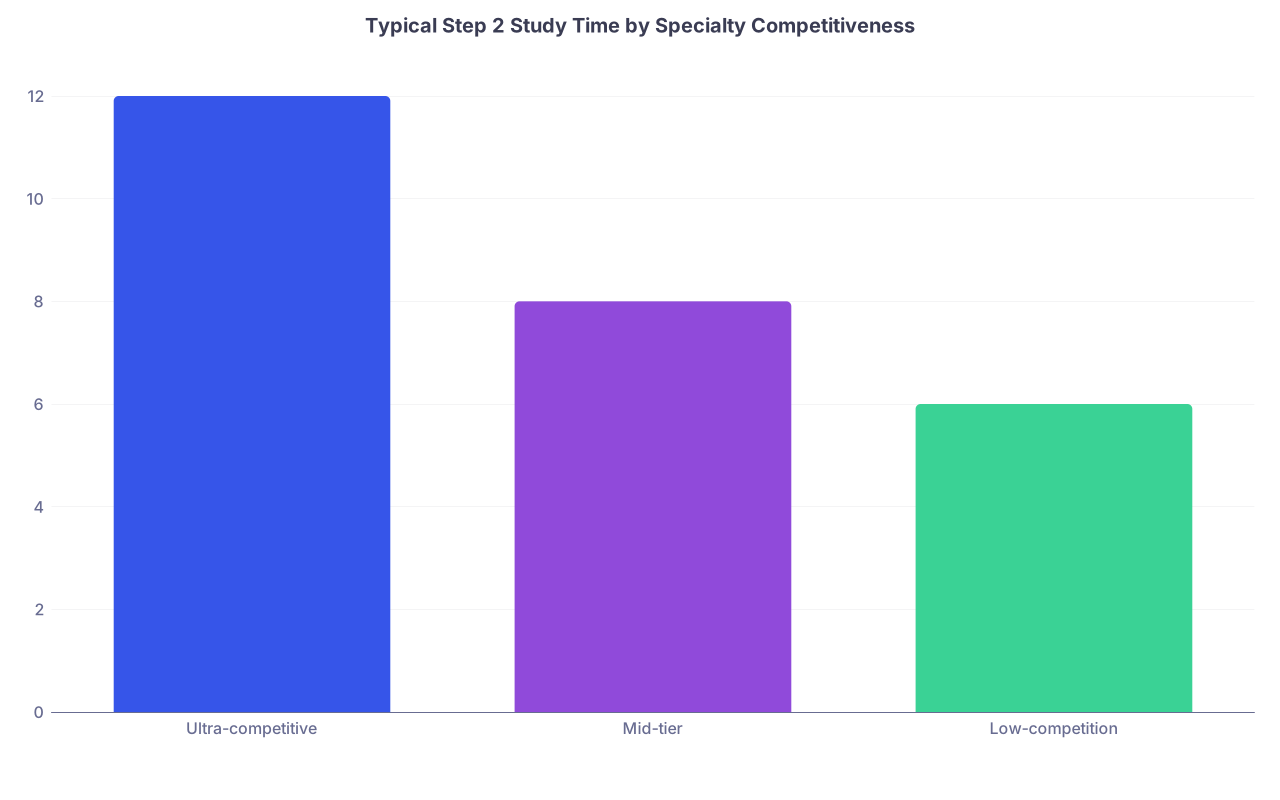
| Category | Value |
|---|---|
| Ultra-competitive | 12 |
| Mid-tier | 8 |
| Low-competition | 6 |
Just because you’re pivoting into a low-competition field doesn’t mean you coast.
For low-competition specialties:
- Target: A Step 2 score at or slightly above the national mean
- Timing: Take Step 2 before ERAS if:
- Your Step 1 is weak
- You need the Step 2 bump to reassure programs
- Preparation:
- 4–6 weeks dedicated, even if you’re still rotating
- UWorld pass + at least 2 NBMEs
Do not fall for “I’m going into FM, I don’t need to crush Step 2.” You may not need a monster score, but you absolutely need to avoid a disaster.
Month‑by‑Month: A Concrete MS3 Pivot Calendar
Now let’s stitch this into an actual timeline.
Month 1
- Start first core rotation (likely IM, surgery, or FM).
- Track:
- What parts of the day you enjoy vs. dread.
- What feedback you keep hearing.
- Action:
- Identify 1–2 attendings who seem aligned with your values and teaching style.
- Start an informal log of “fields that feel natural” vs. “fields I’m forcing.”
Month 2
- Rotate through another core.
- Action steps:
- Schedule a brief meeting with your academic advisor:
- Ask: “Based on my grades and Step 1, what fields seem realistic or smart for me?”
- Start a note file titled: “Pivot Options: Pros/Cons.”
- Schedule a brief meeting with your academic advisor:
Month 3
- You’ve usually hit at least IM + surgery or IM + FM by now.
- At this point you should:
- Narrow to 3–4 candidate specialties (include at least 2 lower-competition).
- On each new rotation, tell at least one attending: “I’m exploring [X, Y, Z] specialties right now and trying to see where I fit.”
Month 4
- Midpoint of clinical year for many schools.
- Critical pivot window.
- Actions:
- Decide primary vs. backup fields (e.g., Psych primary, FM backup).
- On your best-fit rotation so far, explicitly ask:
- “Would you be willing to write me a strong letter if I go into [field]?”
- Start early Step 2 planning:
- Rough date range
- How many weeks you can protect
Month 5
- You should be moving toward rotations that support your pivot field.
- Example:
- Considering Psych → take neurology, FM, and internal medicine seriously; psych values broad brain‑body thinkers.
- Considering FM → prioritize outpatient experiences; show you like continuity and breadth.
- Actions:
- If possible, schedule an elective in your target field late MS3 / early MS4.
- Email the clerkship director or program director in that field:
- Brief intro, interest, ask if there are students they mentor for that specialty.
Month 6
- You’re now closer to the end than the beginning.
- At this point you should:
- Lock in your primary specialty in your own head. Stop pretending you have 8 real options.
- Identify:
- 2–3 attendings in your target or adjacent fields who might write strong letters.
- Start assembling:
- Updated CV
- Short one‑page “why this specialty” reflection (for letter writers later).
Week‑by‑Week: During a Rotation in Your Pivot Field
Let’s zoom way in. Say you’re on psych or FM and you think this might be “it.”
Week 1
- Learn the workflow. Be low maintenance, high initiative.
- Ask residents:
- “What makes a student stand out positively on this service?”
- “Who here is really involved with students / residency selection?”
Week 2
- Target 1–2 attendings.
- Show:
- You read overnight admissions before rounds.
- You follow up on labs and imaging without being asked.
- You think in that specialty’s language (e.g., biopsychosocial formulations in psych, chronic disease plans in FM).
Week 3
- Request mid‑rotation feedback from your future potential letter writer:
- “I’m seriously considering [field]. Could you give me honest feedback on what I’m doing well and what I should tighten up if I aim for this specialty?”
- Then actually fix what they point out. Fast.
Week 4
- Ask for the letter if the feedback has been strong.
- Give them:
- Your CV
- A short paragraph on why you’re interested in that field
- Any personal context (career change, family, geography) that might help their narrative
Day‑by‑Day: A One‑Week “Pivot Sprint” You Can Do Any Time
If you’re reading this mid‑year and feel behind, do this over the next 7 days.
Day 1–2:
- List your:
- Exams, grades, Step scores
- Rotations you’ve completed and how you felt on each
- Circle:
- Rotations where you got the strongest feedback
- Fields that keep showing up in your thoughts uninvited
Day 3:
- Draft a rough priority list:
- #1 specialty target (realistic, not fantasy)
- #2 backup (also realistic, and ideally adjacent)
- Email your academic advisor for a 20–30 minute slot to pressure test that list.
Day 4–5:
- Identify 2–3 faculty in your target/adjacent fields you’ve already worked with.
- Email them:
- Thank them for prior teaching
- Update them on your interests
- Ask if you can schedule a brief conversation about the specialty and your fit
Day 6:
- Sketch a rough Step 2 study schedule:
- Ideal test date
- Weeks available for dedicated time
- How many UWorld questions per day
- Put those dates on your calendar. Lock them.
Day 7:
- Open your school’s scheduling system:
- Ensure you have at least 1–2 rotations (or early MS4 sub‑Is) directly in your primary target field.
- If not, submit change requests now.
Specialty‑Specific Angles for Low-Competition Fields
Not all “less competitive” specialties work the same. Tailor your pivot.

Family Medicine
- Loves: continuity, community service, broad interest, teaching, primary care experiences
- MS3 focus:
- Shine in FM, IM, peds, and OB outpatient if possible.
- Get at least one letter from a core FM attending, ideally tied to a residency program.
- Red flag myth: “FM will take anyone.” No. They reject plenty of sloppy, unmotivated applicants.
Internal Medicine (categorical, non‑fast‑track)
- Loves: thinkers, complex chronic disease, evidence‑based medicine, teaching
- MS3 focus:
- Treat your IM rotation like a months‑long audition.
- Show interest in academic conferences, morning report, complex patient write‑ups.
- Step 2: Very helpful to do reasonably well; IM still cares about exam performance.
Pediatrics
- Loves: people who actually like kids, patience with families, communication
- MS3 focus:
- Strong peds rotation with clear evidence you can handle both well‑kids and sick‑kids settings.
- Get a letter from inpatient peds or NICU/PICU if you worked there.
Psychiatry
- Loves: narrative thinkers, patient advocacy, communication, comfort with ambiguity
- MS3 focus:
- Excel on psych, but also on IM/FM because psych is increasingly medically grounded.
- Show interest in psychotherapy, community mental health, or CL services.
PM&R
- Loves: function-focused thinking, team‑based care, rehab goals, neuro/musculoskeletal interest
- MS3 focus:
- Neurology, ortho, rheum, and even primary care sports experiences help.
- Try to get a PM&R elective or shadowing in by late MS3 / early MS4.
Pathology
- Loves: detail‑orientation, pattern recognition, analytic thinking, academic interest
- MS3 focus:
- If you hated the wards but loved the puzzle of diagnosis, say that.
- Get a path elective and face time with the department; path is small, reputations move fast.
The Mindset Shift: You’re Moving Toward Something, Not Settling
The quiet shame many students feel when pivoting to a lower-competition specialty is both common and destructive. I’ve heard it a hundred times in call rooms:
- “Well, I couldn’t hack ortho, so I guess I’ll do FM.”
- “Psych is my backup if I don’t get EM.”
That attitude bleeds into personal statements, interviews, and even how you show up on rotations. Programs can smell it.
Your job over MS3 is to reframe:
- From: “I didn’t get X.”
- To: “I learned enough about myself and the profession to realize Y is where I’ll do the best work and actually have a life.”
That’s not spin. That’s maturity.
One Thing To Do Today
Open your calendar and block 30 minutes this week to do a hard audit of your rotations so far:
- List each rotation completed.
- Write one sentence under each: “What did this rotation teach me about what I want—or don’t want—in a career?”
- Then underline any theme that keeps repeating.
That’s the raw material for your pivot. Use it.