
You are here
It’s the second week of your medicine clerkship.
Everyone on your team is either:
- Talking about Derm vs Ortho vs ENT, or
- Freaking out about Step scores and “top 10” programs.
You? You’re pretty sure you want a less competitive specialty. Maybe Family. Psych. Peds. IM without a super cutthroat fellowship goal. You’re not chasing 270s or 20 pubs. You just want a solid match and a decent life.
Here’s the catch:
People will tell you, “You’re fine, those fields always need applicants.” That advice is lazy. And wrong.
Because even “least competitive” specialties have:
- Programs that are absolutely selective
- Residents who were not the bottom of their class
- Applicants who quietly did the right things on every rotation
You do not need perfection. But you do need a plan.
This is that plan—rotation by rotation, month by month—so by the time ERAS opens, you have exactly what a less competitive program director wants to see.
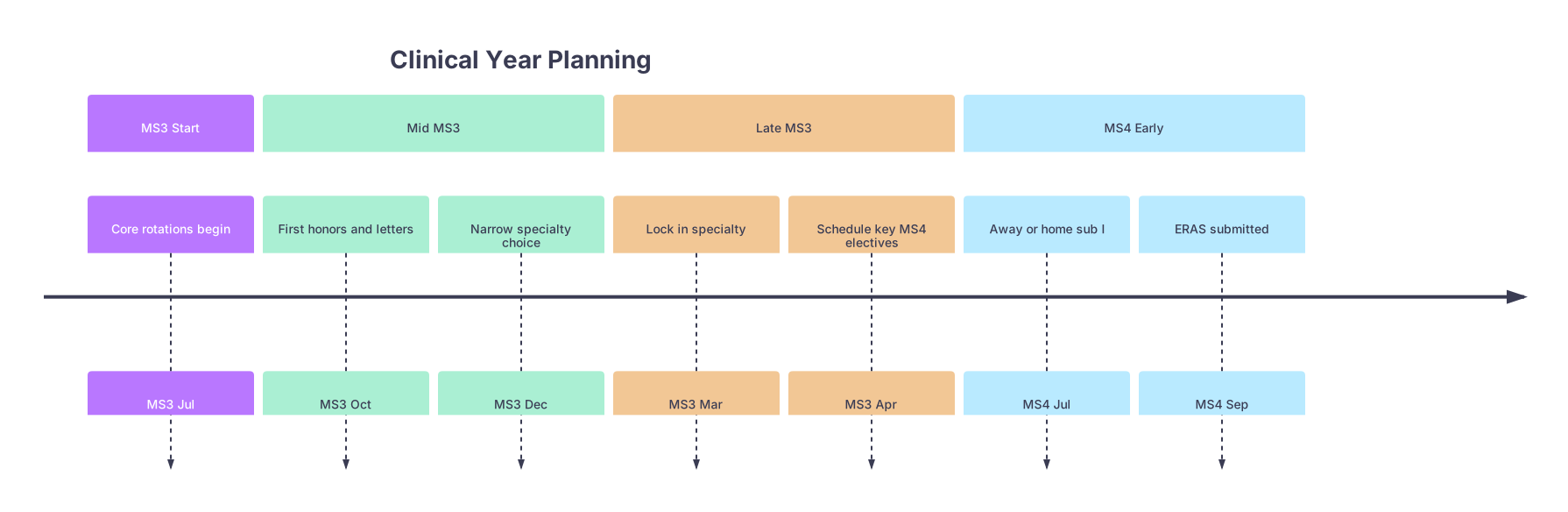
Big picture timeline: MS3 start → ERAS submission
| Period | Event |
|---|---|
| MS3 Start - Core rotations begin | MS3 Jul |
| Mid MS3 - First honors and letters | MS3 Oct |
| Mid MS3 - Narrow specialty choice | MS3 Dec |
| Late MS3 - Lock in specialty | MS3 Mar |
| Late MS3 - Schedule key MS4 electives | MS3 Apr |
| MS4 Early - Away or home sub I | MS4 Jul |
| MS4 Early - ERAS submitted | MS4 Sep |
At any point you should be asking: “What does this rotation do for my story on ERAS?”
Let’s build that story, rotation by rotation.
Core rotation priorities (for any less competitive specialty)
Does not matter if you’re heading toward FM, Psych, Peds, or IM. On every core rotation, you should be working on the same backbone:
- One strong clinical letter.
- A pattern of: “Shows up, works hard, patients like them.”
- No red flags. No drama.
To keep this concrete, I’ll walk through the big cores and tell you what to accomplish on that specific block if you’re aiming for a less competitive field.
I’ll group by typical MS3 order but the order does not actually matter. Just adjust the timing mentally.
Internal Medicine (8–12 weeks): Build your baseline rep
This rotation is your “are they safe to put in a residency?” test.
Weeks 1–2: Prove you’re coachable
At this point you should:
- Show up early enough that your intern never has to wait on you for prerounds.
- See 2–4 patients, write your notes, and have your plan thought out, even if it’s wrong.
- Ask your senior resident explicitly: “What can I do this week to be more helpful to the team?”
Concrete daily checklist:
- See patients early.
- Present without reading your note out loud.
- Always have the vitals, labs, and overnight events memorized, not hunted in Epic.
You are not trying to be brilliant. You’re trying to be low-maintenance and improving.
Weeks 3–4: Secure a generalist letter writer
At this point you should:
- Identify: “Who is the attending or senior who actually sees my work?”
- Start stacking small, visible wins: follow up on consult recs, call families, update signout, pre-chart.
End of week 3, say something like:
“Dr. Smith, I’m leaning toward a less competitive field—probably Family or Psych—but I really want to be a strong generalist. Are there specific things I should focus on in the next two weeks to get to that level?”
This does two things:
- Signals ambition without sounding like you’re trying to impress for Derm.
- Gives them a framework to later write: “She actively sought feedback and improved.”
Weeks 5–8 (if longer rotation): Turn one person into a letter
By the last attending block you should:
- Ask for feedback mid-block, not just at the end.
- Fix 1–2 things they mention within 48 hours and let them see it.
- Ask for a letter if:
- They’ve seen you on several patients over time, and
- They give you verbal comments like “your notes are very thorough” or “your presentations have gotten much better.”
For less competitive specialties, a strong IM letter that reads: “This student will be a reliable intern” is gold.
Surgery (8 weeks): Earn respect, don’t chase honors
You’re not going into Ortho or ENT. Fine. You still have to survive the rotation that makes or breaks many MS3s.
Weeks 1–2: Don’t be the weak link
At this point you should:
- Learn the consult questions for your service. Example for general surgery:
- NPO status
- Anticoagulation
- Last imaging
- Vital signs and lactate
- Show up early, help with dressings, remove drains, do the boring but necessary stuff.
The bar you’re aiming for:
“Even though they’re not going into surgery, they worked hard and were solid on the team.”
Weeks 3–4: Protect your narrative
You’re not trying to look like a budding surgeon, but you are trying to avoid:
- Comments like “disengaged,” “unprepared,” “unreliable.” These absolutely spread to your dean’s letter.
At this point you should:
- Scrub in on cases even when they’re not glamorous. Hernias, cholecystectomies, appendectomies.
- Be the one who volunteers for floor work or notes while the others fight for the cool cases.
You don’t need a letter from surgery. You do need attendings to remember you as:
“That student who wasn’t going into surgery but still worked their tail off.”
Pediatrics (6–8 weeks): Show you’re safe with kids and families
Even if you’re not going into Peds, this rotation is perfect for showing:
- Communication skills
- Patience
- Ability to manage anxious families
Weeks 1–2: Get comfortable with the exam and growth charts
At this point you should:
- Learn one system well: newborn exam, asthma visit, or well-child visits.
- Practice explaining things in parent language: “Breathing tubes are a little wheezy, but his oxygen and work of breathing look okay.”
Daily goals:
- Take the lead on 1–2 family updates per day.
- Ask the resident to watch you counsel once or twice and give feedback.
Weeks 3–6: Position yourself for a potential letter
If you’re remotely considering Peds, by mid-rotation you should:
- Tell one attending: “I’m thinking about Peds as a possible choice. I’d love to know what you look for in strong residents.”
Then you:
- Volunteer to carry a reasonable census and own those patients.
- Be meticulous on growth curves, vaccine status, and follow-up planning.
Even if you don’t go into Peds, the narrative “handles families well and is thorough” fits every less competitive field.
Family Medicine / Primary Care Rotation: Your alignment proof
If you have a Family Med or outpatient primary care block, this is where your “I want a less competitive, relationship-oriented field” story either becomes believable or not.
Week 1: Show you like continuity and ambiguity
At this point you should:
- Tell your preceptor: “I’m leaning toward outpatient-oriented fields—FM, Psych, maybe Peds. I want to get better at handling undifferentiated complaints.”
Daily targets:
- Take full ownership of a few follow-ups (chronic disease management, medication titrations).
- Practice efficient outpatient notes with clear A/P.
Weeks 2–4: Turn this into your strongest letter
For Family, Psych, Peds, and often even IM, a primary care/preceptor letter is powerful.
You want that letter to say:
- Shows up prepared
- Handles time pressure
- Communicates clearly with patients
To get that, by mid-block you should:
- Ask directly: “Could you give me honest feedback on clinic efficiency and how I communicate with patients? I want to be residency-ready for outpatient work.”
- Accept the criticism, fix it quickly, and let them see the change.
OB/GYN, Psych, Neuro: Supporting rotations with targeted goals
OB/GYN (6 weeks): Don’t get buried
You’re probably not going into OB if you’re reading this, but this rotation can still:
- Demonstrate work ethic on nights/call
- Show comfort with acute situations
At this point you should:
- Volunteer to help with triage and patient updates, not just OR time.
- Learn one or two “scripts” for common situations: labor progression, post-op check, early pregnancy loss.
Goal: solid pass or higher, no complaints. You do not need a letter here unless you’re strangely in love with OB.
Psychiatry (4–6 weeks): Golden rotation for many “less competitive” paths
If you’re considering Psych, this rotation is essential. If you’re not, it’s still a great way to stand out as a communicator.
Weeks 1–2:
- Learn to present an HPI in psych style: chief complaint, history, mental status, risk assessment.
- Ask to lead at least one family meeting or discharge planning discussion.
Weeks 3–4:
- If you’re leaning toward Psych, tell an attending by week 2: “I’m seriously considering Psychiatry and would value your mentorship and possibly a letter if you feel you can assess me fully.”
- Volunteer for new intakes and difficult patients where your behavior will be noticed.
Programs in less competitive psych markets still favor students with clear, consistent interest shown on rotations.
Neurology (4 weeks): Short but high-yield for narrative
You don’t need a Neuro letter. You do want comments like “organized,” “good presentations,” “patient.”
At this point you should:
- Get a systematic neuro exam down cold on day 3–4.
- Present with a clear localization and differential, even if it’s basic.
Side quest during MS3: Small, realistic “extras”
You are not building a Derm-level CV. But doing literally nothing beyond rotations is a mistake.
During MS3 (anywhere across the year) aim for:
1–2 low-effort scholarly things:
- Case report with a resident
- QI project on your IM or FM team
- Poster at a local/regional meeting
1–2 consistent service activities:
- Free clinic
- School health education
- Mental health outreach
Programs in less competitive fields like seeing that you:
- Commit to something longitudinally
- Understand their specialty’s patient population
Late MS3: Locking your specialty and planning MS4
By around February–April of MS3, you need to:
- Decide your target field (FM, Psych, Peds, IM, etc.).
- Identify your current letter situation.
- Choose targeted MS4 rotations.
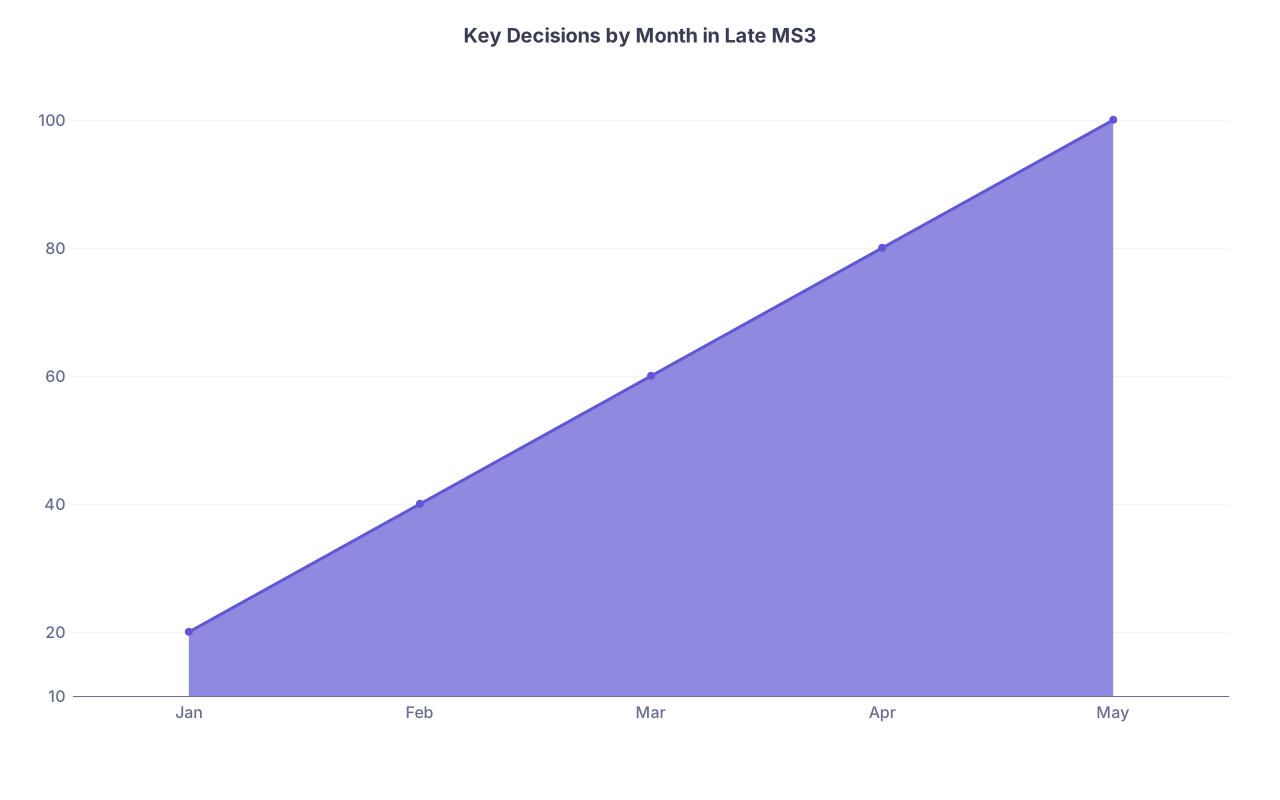
Here’s how that decision window usually looks:
| Category | Value |
|---|---|
| Jan | 20 |
| Feb | 40 |
| Mar | 60 |
| Apr | 80 |
| May | 100 |
(Think of that as “percent of specialty decision that should be locked in by that month.” Dragging past May is asking for chaos.)
At this point you should:
Meet with your dean or advisor and say bluntly:
“I’m aiming for Family / Psych / Peds / IM. Here are my grades and Step scores. I want to match solid mid-tier programs. What gaps do you see?”Schedule:
- 1 sub-I or acting internship in your chosen field at your home institution (July–September MS4).
- An optional away rotation if:
- You’re targeting a specific geographic region, or
- Your home institution has a weak department in your field.
MS4, early: Your home sub-I (July–August)
This is your audition for “Can they do the work of an intern in this specialty?”
Let’s say you’re going into:
- Family or IM: Do a medicine or FM sub-I.
- Peds: Peds ward sub-I.
- Psych: Inpatient psych or CL sub-I.
Week 1: Set expectations clearly
Day 1–2, tell your attending:
“I’m applying to [specialty] this cycle. I want this month to be the closest thing to an intern experience I can get. Please treat me like a sub-I and let me know if I’m not meeting that bar.”
Then:
- Ask how many patients they expect an intern to comfortably carry.
- Aim for that number by week 2.
Weeks 2–3: Operate at “almost intern” level
At this point you should:
- Pre-round independently and be ready with plans.
- Call consults under supervision.
- Write discharge summaries and do frontline family communication.
You are intentionally stretching. That’s the point.
Week 4: Turn this into your anchor letter
Last week:
- Ask your attending directly for a letter before the rotation ends.
- Offer a CV and a short paragraph of your career goals.
For less competitive specialties, a glowing sub-I letter in-field plus one strong core letter plus one outpatient/primary care or psych/peds letter is usually enough.
MS4, July–September: Strategy for ERAS and interviews
While you’re on your sub-I or early MS4 electives:
At this point you should:
Finalize 3–4 letters:
- 1–2 from your chosen specialty
- 1 strong IM/FM type letter
- 1 “this is a good human and team player” letter (often from outpatient, psych, or peds)
Polish your personal statement to:
- Emphasize continuity of care, communication, and team behavior.
- Show that your rotation experiences are consistent with your interest (e.g., “On my Family Medicine rotation, I…” with specific stories).
Build your program list:
- 25–40 programs for truly less competitive fields if your record is average.
- 15–25 if your school is strong and you’ve passed everything with some honors.
Here’s a quick structure check:
| Component | Target Status by Sept 1 |
|---|---|
| Letters (3–4) | Requested and uploaded |
| Personal Statement | Final draft complete |
| CV/Experiences | Entered and proofread |
| Program List | Balanced and realistic |
| Step Scores | Released and visible |
Rotations you can relax on (a bit) – and how not to blow them
Yes, there are rotations where you do not need to win MVP.
Examples:
- Radiology
- Anesthesia (if short and not your chosen field)
- Some electives
You may not need letters here. But you can still damage yourself with:
- Unprofessional behavior
- Chronic lateness
- Being openly disengaged
On these rotations:
At this point you should:
- Maintain your “floor”: on time, polite, do assigned work.
- Use the mental bandwidth to:
- Work on ERAS.
- Draft personal statements.
- Follow up on research posters or abstracts.
Think of these as “application admin” blocks rather than “vacation.”
Red flags that matter even in less competitive specialties
I’ve seen students aim for “easy” fields and still struggle because of:
- Multiple fails or remediation without a clear recovery pattern.
- Unprofessionalism comments on surgery or OB that bleed into the MSPE.
- Inconsistent effort—honors in Psych, but multiple barely-pass evals in core rotations.
If you know you have one of these:
At this point you should:
- Address it directly in your dean’s meeting and get a plan:
- Extra sub-I in your field
- More programs on your list
- Direct explanation in your personal statement or addendum
Less competitive does not mean “will take anything with a pulse.” You still need to show a stable, upward trajectory.
Final compressed checklist (what each rotation should give you)
Internal Medicine
- 1 strong generalist letter
- Reputation: reliable, improving, safe
Surgery
- No red flag comments
- Evaluation: professional, hard-working even if not going into surgery
Pediatrics
- Evidence you can handle families and kids
- Possible letter if considering Peds
Family Medicine / Outpatient
- One of your best letters, especially for FM/Psych/IM
- Demonstrated interest in continuity and primary care
Psychiatry
- Strong narrative about communication skills
- Possible anchor letter if applying Psych
OB/GYN / Neuro / Others
- Solid passes, no professionalism concerns
- One or two good comments for your MSPE
MS4 Sub-I in your chosen field
- Anchor in-specialty letter
- Proof you can function at near-intern level
Key points to walk away with
- Even if you’re aiming at a less competitive specialty, every core rotation has a specific job: letter, narrative, or “do not sink me.” Treat them that way.
- One in-specialty sub-I letter + one strong IM/FM/primary care letter + one more “good human” letter is usually enough—if your behavior and story are consistent across rotations.
- “Less competitive” is not a safety net for laziness. Respect the field, show up on every rotation, and by ERAS season, you’ll have a clean, convincing application that programs are actually happy to rank.