
You are post-call, 10:30 AM, sitting in the residents’ lounge with that particular combination of exhaustion and adrenaline. Someone just said, “Honestly, I want an easier match specialty. I don’t want to be the one making life-or-death calls at 3 AM.”
You paused. Because you know that line is half-truth, half-myth.
This is where people get burned: they pick “less competitive” fields assuming “less responsibility,” then discover that being the only doctor in the hospital at 2 AM for 40 nursing home patients is a very real thing. Or that “easy” outpatient specialties still have on-call responsibilities that feel very different depending on training level, hospital size, and how your attendings run the service.
Let me break this down specifically: if you choose one of the easier match specialties, what does on-call responsibility actually look like, by year of training and by specialty? And where are you really on the decision-making food chain?
We will focus on common, relatively less-competitive specialties (in the U.S. context):
- Family Medicine
- Internal Medicine (categorical, non-elite academic tracks)
- Psychiatry
- Pediatrics (general, not NICU-heavy tracks)
- Neurology
- PM&R (Physical Medicine & Rehabilitation)
- Pathology and Radiology are special cases and I will address them separately.
Big Picture: What “Responsibility” Actually Means On Call
On call, “responsibility” is not one thing. It breaks into:
Clinical decision risk
Are your decisions immediately life-and-death (airway, pressors, emergent OR) or lower acuity (med adjustments, disposition, “can this wait till morning”)?Volume and autonomy
How many patients are you covering? Are you one of many residents in-house, or the only resident? Is an attending in-house or at home?Supervision structure
Is there a senior resident buffering your decisions? Or are you the senior? Or is it direct attending-resident with no middle layer?Legal and chart responsibility
Who’s signing the orders and notes? Who gets called to court if something goes badly? The signature lines tell you a lot about real responsibility.
You are not escaping responsibility by picking a less competitive field. What you are doing is choosing the type of responsibility and how compressed the time window is between decision and consequence.
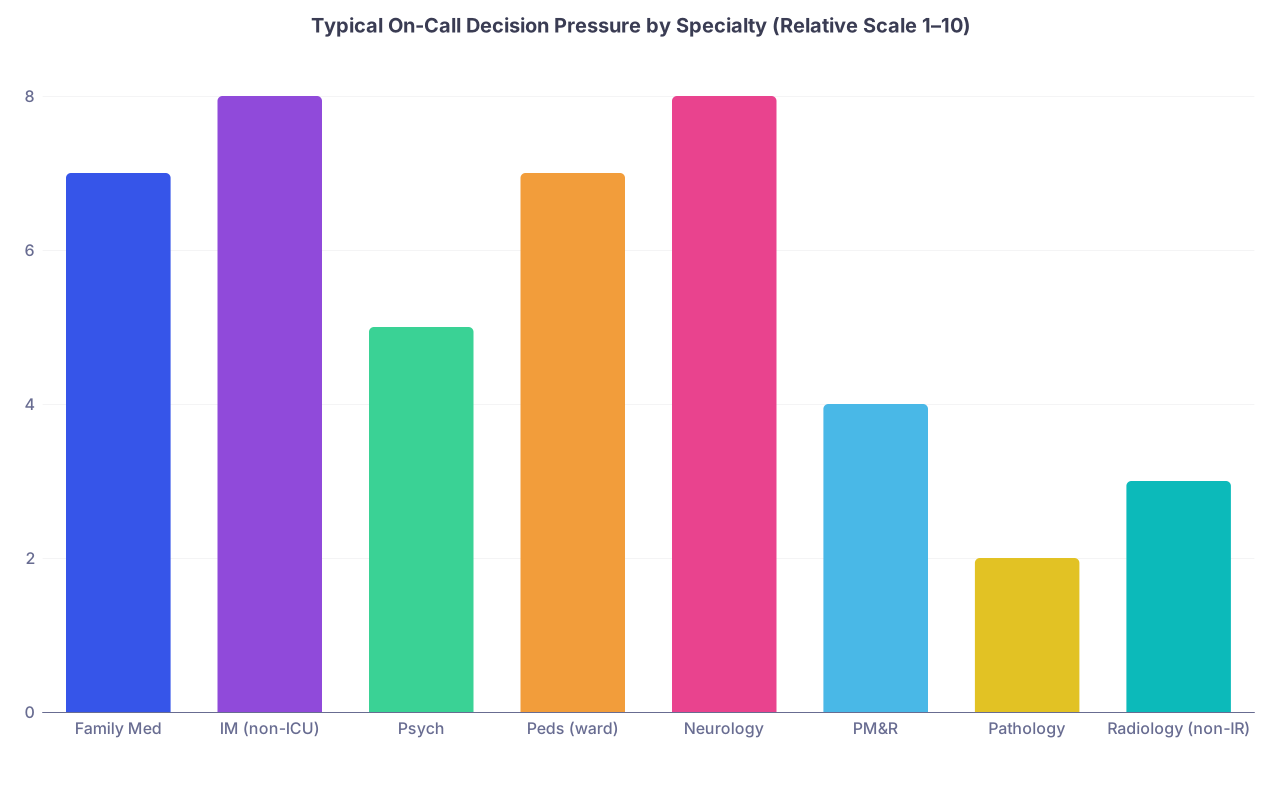
| Category | Value |
|---|---|
| Family Med | 7 |
| IM (non-ICU) | 8 |
| Psych | 5 |
| Peds (ward) | 7 |
| Neurology | 8 |
| PM&R | 4 |
| Pathology | 2 |
| Radiology (non-IR) | 3 |
Think of this as “acute stress per decision,” not “hours worked.” ICU and surgery are a 10+ on this scale. We are comparing among the “easier match” group.
Family Medicine: The Classic “Pager Never Stops” Responsibility
If you are talking “easier match,” Family Medicine is near the top of that list. But on call, especially in community settings, FM residents often carry heavy responsibility relatively early.
Typical Call Structures
Common setups I’ve seen:
Small community hospital:
- 1 FM resident in-house overnight covering FM inpatients + cross-covering nursing home / swing bed / sometimes OB triage (if FM-OB heavy program).
- Attending is at home, available by phone, may come in for admits or complex cases.
Larger academic center:
- FM residents may do call on a combined medicine service with IM, or have FM-only call.
- Intern + senior model for nights; seniors supervise calls and admissions.
PGY-1 On Call in FM
Responsibility level: Medium-high for match difficulty; moderate autonomy but high volume.
Typical tasks:
- Admit straightforward cases: COPD exacerbation, CHF exacerbation, UTI with delirium, cellulitis, uncontrolled diabetes.
- Cross-cover issues on known patients:
- “BP 210/110 on chronic hypertensive”
- “New O2 requirement from 2L to 4L”
- “Patient more confused than baseline dementia”
Decision-making reality:
- Most orders you write go through with no second look till morning, unless you call the attending.
- You are expected to know common algorithms cold: hypertensive urgency, DKA workup, sepsis bundles, ACS rule-out, stroke alert process.
- Nurses will absolutely see you as “the doctor in the hospital right now.”
Escalation:
- You call your senior for “I might need ICU” or “this could be sepsis/MI/stroke.”
- You call your attending for big dispo decisions (ICU vs floor vs transfer) and any code or near-code scenario.
BUT the first call is you. This is the key: even in an easier match specialty, you are the first layer of clinical responsibility.
PGY-2/3 On Call in FM
Now you are the senior. Responsibility jumps.
- You triage: “Is this something the intern can handle or do I need to see it myself now?”
- You decide when to wake the attending at 2 AM.
- You cover more patients. Often the same number of attendings but fewer overnight bodies.
You also start to feel the medico-legal weight. That ACS you thought was GI? That decision was yours clinically, even if the attending co-signed later.
Outpatient Call in Family Medicine
Post-residency, outpatient FM on-call is mostly phone triage:
- Refill requests, fever questions, med side effects, “should I go to the ER?”
- Rarely life-or-death, but you are the decision-maker on whether someone goes to the ED at 11 PM.
Less acute. But still your license, your choice.
Internal Medicine (Non-ICU, Non-Subspecialty Tracks)
Internal Medicine is borderline “moderately competitive” at top programs, but community or mid-tier categorical IM is still easier than derm, ortho, plastics, etc. It is also where people frequently underestimate the responsibility gradient.
Typical Night Structures
Academic:
- Night float system.
- 1–2 interns doing admissions + 1 night senior covering cross-cover.
- Hospitalist or nocturnist attending in-house or very easily reachable.
Community:
- 1 IM resident may cover entire floor for admissions + cross-cover, sometimes with attending at home.
PGY-1 On Call in IM
Responsibility: High in absolute terms. Your decisions can easily be life-or-death within minutes to hours.
You will:
- Admit chest pain, GI bleeds, DKA, CHF, COPD exacerbations, pneumonia, sepsis evaluations.
- Be first to respond to:
- “Patient tachycardic to 150”
- “New O2 requirement, rapid response called”
- “K is 2.7 / 6.2”
- “Blood pressure 70/40 on the floor”
Here the difference from ICU/surgery is not that your decisions do not matter. They absolutely do. The difference is:
- Most IM calls have at least a few minutes to think and pull up prior records.
- There is almost always a senior resident and attending to run decisions by.
But you will write the first orders: start fluids, give Lasix, start heparin infusion, adjust insulin. You cannot hide behind “I am just IM in a non-competitive specialty.” The pager does not care.
PGY-2/3 On Call in IM
As senior, you now:
- Review all admissions and decide on level of care.
- Field cross-cover calls and decide when to see the patient vs guide the intern by phone.
- Run rapid responses and codes at some hospitals.
This is real responsibility. You will be the one saying “call the ICU fellow now” or “we can manage on the floor.” And if you are wrong, you will remember that case.
This is why calling IM “easier” from a responsibility standpoint is wrong. It is easier from a “board score needed to match” standpoint at many programs, but the on-call responsibility is substantial.
Psychiatry: Lower Acute Physiology, High Behavioral and Safety Risk
Psych is one of the classically “easier match” fields. On-call, the risk profile is very different: less immediate hemodynamic collapse, more long-horizon risk (suicide, violence, involuntary commitment decisions).
Typical Call Setup
- Large academic centers:
- 1 psych resident on call overnight, often home call with in-house evals for ED and psych ED; attending backup by phone, rarely in-house.
- Smaller hospitals:
- Residents rotate on psychiatric emergency service; may do 24-hour or evening shifts.
PGY-1/2 On Call in Psychiatry
Responsibility looks like this:
- ED consults: “Suicidal ideation? Safe for discharge?”
- Admission decisions: inpatient psych vs partial vs outpatient.
- Medication changes: antipsychotic dosing, agitation management, benzos, sleep medications.
Your decision consequences are usually not in the next 5 minutes. But they are serious:
- If you clear someone and they complete suicide the next day, your note will be scrutinized in excruciating detail.
- If you inadequately assess violence risk and the patient assaults staff or another patient, that is on your risk radar forever.
Autonomy:
- Plenty. Psych attendings often rely on resident assessments by phone.
- Many programs have you present briefly, then you make the call with attending cosign.
Later Years in Psychiatry
As a senior, you might:
- Run the consult-liaison service overnight.
- Supervise juniors’ evaluations.
- Handle more complex cases (catatonia, delirium vs primary psychosis, capacity evaluations).
Responsibility is high in a forensic and ethical sense rather than a purely hemodynamic sense.

Pediatrics: “They Look Fine Until They Don’t”
General pediatrics is usually slightly less competitive than internal medicine. On call, though, the stakes feel higher than the scores suggest, because kids compensate until they suddenly fall off a cliff.
Typical Call Setup
- Academic children’s hospital:
- Night team with interns + senior + in-house attending for ICU and often for wards.
- Community hospital with peds unit:
- 1 peds resident in-house or at home, depending on volume, with attending backup.
PGY-1 On Call in Pediatrics
You will:
- Admit bronchiolitis, asthma exacerbations, gastroenteritis with dehydration, failure to thrive, febrile neonates.
- Get calls like:
- “Infant with increased work of breathing, sats now 89% on RA”
- “Post-op patient with borderline urine output”
- “Fever in oncology patient with central line”
Decision-making nuances:
- Kids crash fast. You must be aggressive about vital sign changes.
- The threshold to escalate to PICU is lower than IM to MICU.
- Parents’ anxiety adds pressure; every decision feels heavily scrutinized.
Responsibility:
- Interns often see the patient first, start initial management (O2, albuterol neb, bolus), then immediately loop in senior and attending.
- Real-time supervision is often better than in adult medicine, but you still write and own orders.
PGY-2/3 In Pediatrics
Seniors:
- Run codes and rapid responses for the floor.
- Decide: floor vs PICU vs transfer to higher-level center.
- Manage cross-cover for multiple teams (general peds, subspecialty services) overnight.
Here again, the “easier match” label sells a false sense of safety. Pediatric on-call decisions may be some of the most nerve-wracking because the margin for error can be slim.
Neurology: Easier to Match than Some, But Stroke Does Not Care
Neurology sits in that middle tier: not derm-competitive, not FM-easy, but many community or non-elite programs are accessible. On call, though, the field owns some of the most time-sensitive decisions outside the OR.
Typical Call Structures
Academic centers (stroke center):
- Night float or 24-hour call.
- Neurology resident handles: stroke codes, general consults, ward issues.
- Stroke attending often available 24/7, but initially by phone.
Non-stroke-center hospitals:
- Neurology may be consult-only with home call; ED physicians act first and call neurology.
PGY-1/2 On Call in Neurology
You will:
- Evaluate stroke codes quickly: NIHSS, imaging, tPA/tenecteplase eligibility, thrombectomy screening.
- Assess new-onset seizures, status epilepticus, meningitis/encephalitis concerns, altered mental status, worsening neuro deficits.
Decision-making:
- Some of the shortest time-to-consequence decisions outside trauma surgery:
- “Give thrombolytics or not?”
- “Transfer for thrombectomy or not?”
- Typically made as a team: resident + attending. But the resident often does the first assessment and presents a recommendation.
Responsibility profile:
- Very high cognitive responsibility even if the attending signs off on the final call.
- Your documentation and timing are critical for medico-legal protection.
By PGY-3+, you may be the “stroke fellow lite” at many programs, particularly overnight when the true fellow is at home.
PM&R: Less Acute, More Functional and Rehab Risk
PM&R is one of the classic “lifestyle” and “easier match” choices. On call, risk tends to be lower on an hour-to-hour basis than IM, peds, or neuro, especially at rehab-heavy programs.
Typical Call Setup
- Inpatient rehab hospital:
- 1 resident on home call, occasionally in-house.
- Attending backup by phone.
- Academic PM&R departments:
- Night or weekend call covering rehab units, consults, and sometimes trauma/SCI units.
PGY-1/2 On Call in PM&R
Common issues:
- Autonomic dysreflexia in SCI.
- Neurogenic bladder/bowel issues.
- Spasticity crises, baclofen pump issues.
- Anticoagulation management, pain management, falls.
Often non-immediately-lethal, but can be serious if neglected. For example:
- Missing autonomic dysreflexia can lead to hypertensive emergency.
- Mishandling a baclofen pump error can cause withdrawal or overdose.
Autonomy:
- Fairly high. Many calls are “resident manages and updates attending in the morning” territory.
- You will be the one choosing pain regimen adjustments, ordering imaging for falls, deciding whether to transfer to acute care.
This is one of the genuinely lower-acute-stress on-call environments among easier match specialties. But you still need real medical judgment.
Pathology and Radiology: “Call” Without the Bedside
These two live in a different category of responsibility. Call exists, but it usually does not look like the “pager chaos” of medicine or surgery.
Pathology
Pathology is one of the least competitive major specialties overall.
On-call responsibility usually involves:
- Frozen sections intraoperatively: “Is there cancer at the margin?”
- Blood bank consults: transfusion reactions, product selection for complex cases.
- Occasionally: microbiology issues, critical value sign-outs.
You are rarely making life-and-death decisions within minutes alone as a junior. Attendings are usually closely involved, especially for anything that will change surgical management immediately.
Real responsibility ramps up post-fellowship: final reads, cancer staging, diagnostic calls that determine treatment pathways. On a second-to-second basis, though, the acute “oh hell” moments are relatively rare compared with other fields.
Radiology (Non-Interventional)
Radiology competitiveness varies wildly by program, but overall has become less insane than pre–Step 1-pass/fail days at many places.
On call (as a resident):
- You read emergent CT heads, CT abdomen/pelvis, trauma pans, chest x-rays.
- You dictate preliminary reads used by ED and inpatient teams overnight.
- Attendings often over-read the next morning, but your preliminary report guides acute management.
Responsibility profile:
- Moderate-to-high for diagnostic accuracy; wrong reads can have serious consequences.
- Less direct bedside stress; more quiet mental pressure staring at a screen at 2 AM.
Interventional Radiology is completely different and much closer to surgery/ICU intensity, but that is not in the “easier match” bucket anymore.
How Responsibility Changes by PGY-Level Across Easier Match Specialties
Let me line this up so you can see the progression.
| PGY Level | Typical Role on Call | Autonomy Level | Example Specialty Context |
|---|---|---|---|
| PGY-1 | First responder, data gatherer, initial orders | Low–Moderate | FM intern admitting COPD, IM intern answering rapid response, Psych intern doing ED SI eval |
| PGY-2 | Shared management, more complex decisions, some supervision of juniors | Moderate–High | IM second-year running floor cross-cover, Peds resident deciding PICU vs floor, Neuro junior handling stroke eval with attending input |
| PGY-3 | Team leader for call, primary triage and escalation decisions | High | FM senior covering service overnight, Peds senior leading codes, Psych senior supervising ED consults |
| PGY-4+ | Often chief/senior roles or subspecialty call; near-attending level in judgment | Very High | Neuro senior making thrombectomy transfer calls, PM&R senior deciding acute transfer from rehab, Radiology senior doing high-stakes prelim reads |
Notice what does not change: on call, residents are never just “shadowing.” You are in the decision chain, and fairly high up, from the first year.
Practical Reality Check: Matching “Easier” but Handling Real On-Call Responsibility
If you are trying to reconcile a desire for a less competitive match with realistic on-call responsibility, here is the honest breakdown.
Fields With High Acute On-Call Responsibility (Even If Match Is Easier)
- Family Medicine (especially community programs with few residents per night)
- Internal Medicine (non-ICU but floor/stepdown coverage)
- Pediatrics (especially at children’s hospitals)
- Neurology (because stroke)
In these, your on-call nights will involve:
- True “can this patient die in the next hour” questions.
- Codes, rapid responses, sepsis, respiratory failure.
- Hard triage calls: floor vs ICU vs transfer vs comfort care.
Fields With Moderate, More Chronic or Behavioral Responsibility
- Psychiatry
- Radiology (diagnostic, non-IR)
- Some PM&R programs
Here the stress is less “airway now” and more:
- Suicide risk, capacity decisions, risk of harm.
- Interpretation errors that change management days later.
- Medication or device decisions with delayed sequelae.
Fields With Lower Acute Bedside On-Call Stress During Residency
- Pathology
- Many PM&R programs (rehab-focused, not trauma-heavy)
You will absolutely carry responsibility, but the immediate life-or-death pressure per minute tends to be lower.
How To Think About This When Choosing a Specialty
You need to be honest with yourself about three things:
Your tolerance for acute bedside pressure
Do you freeze, or can you function with a crashing patient? You do not need to love it, but you must be able to show up.Your interest in longitudinal vs immediate impact
In psych, pathology, radiology, PM&R, the impact is often downstream, not within minutes.Your comfort as “the doctor on call”
Every specialty has that moment where a nurse says, “Doctor, what do you want to do?”
There is no “I’m just the resident.” There is only: make a decision, or call for help, or both. Quickly.
If your real goal is to minimize on-call intensity, then purely “easier match” is the wrong metric. You want:
- Programs with strong in-house attending presence overnight.
- Robust senior coverage.
- Less emphasis on high-acuity services (for example, FM programs with heavy clinic and minimal ICU responsibility, PM&R programs with minimal acute trauma call).
Ask specific questions on interview day:
- “Who is physically in the hospital at night?”
- “How many patients does the night resident cover?”
- “Who runs rapid responses and codes?”
- “What are typical call scenarios for PGY-1 on your service?”
If they shrug and say, “Oh, it’s chill,” and cannot give you concrete examples, that usually means they are not paying attention. Or they do not want you to know the real answer.
FAQs
1. If I want the lowest on-call stress possible, which easier match specialties should I prioritize?
If your top priority is minimal acute bedside stress on call, look hardest at Pathology and PM&R, with attention to program specifics. Many PM&R programs have relatively low-acuity call focused on rehab units. Pathology call is usually consultative and supervised, with infrequent middle-of-the-night emergencies. Psychiatry can also be lower acute-stress physically, but behavioral and legal responsibility remain significant.
2. Is Family Medicine really that intense on call? I thought it was “chill.”
Family Medicine can be very intense on call, especially in community hospitals where FM residents are the primary in-house physicians overnight. You may cover a broad mix of adult medicine, geriatrics, post-op issues, and sometimes even basic OB triage. The relative competitiveness of FM has nothing to do with how scary that 3 AM hypotensive septic patient feels. It is not “chill” when you are the only doctor immediately available.
3. In psychiatry, how much backup do I actually have for tough suicide or commitment decisions?
At most training programs, attendings are available by phone and expect to be called for complex or high-risk cases. But in practice, your on-the-ground evaluation carries major weight. You are often the only person to see the patient face-to-face that night. Attending input does not erase your responsibility for a solid, well-documented assessment. If you want heavy real-time handholding for every tough call, you will be disappointed.
4. Does choosing a “lifestyle” field mean I will have easy call during residency?
Not necessarily. “Lifestyle” commonly refers to long-term attending practice patterns (more clinic, fewer nights, more predictable hours). Residency is different. Radiology residents still take night call reading emergent CTs. PM&R residents still get called for autonomic dysreflexia and falls. Psychiatry residents still assess dangerous patients in the ED at odd hours. You may have fewer total call nights than surgery or medicine, but “lifestyle” does not mean risk-free nights.
5. How can I prepare myself for on-call decision making if I know I am conflict-averse or anxious?
You can train this skill. During medical school and early residency:
- Force yourself to make a preliminary plan before asking for help (“I think we should do X because Y”).
- Read targeted resources on night float scenarios for your specialty (for example, “The Little Black Book” style guides, or specialty-specific on-call manuals).
- Debrief hard cases with seniors and attendings: ask what they saw, what they worried about, what they would have done differently.
Over time, you want to build pattern recognition, comfort with uncertainty, and a low threshold to escalate when your gut says something is wrong. You do not need to love being on call. You just need to be competent and honest about your limits.
Key points:
- “Easier match” does not mean “low responsibility”; several of these specialties carry very real on-call decision pressure, especially IM, FM, peds, and neurology.
- The type of responsibility varies: acute physiologic crises in some fields, behavioral and diagnostic risk in others. You are in the chain from day one.
- If you want lower-stress call, you must look beyond specialty labels and interrogate specific program structures, supervision, and patient populations.