
The biggest mistake third‑years make in winter isn’t “not knowing” their specialty. It’s waiting too long to admit they’re chasing the wrong one.
You’re not deciding whether you like medicine. You’re deciding whether to keep gambling on a competitive specialty… or pivot, on time, into a lower‑competition path that will actually match you.
This is the point where fantasy meets ERAS.
Below is a month‑by‑month, then week‑by‑week guide to third‑year winter: when to hold, when to fold, and how to pivot into lower‑competition specialties before the application year steamrolls you.
Big Picture: Your Winter Decision Window
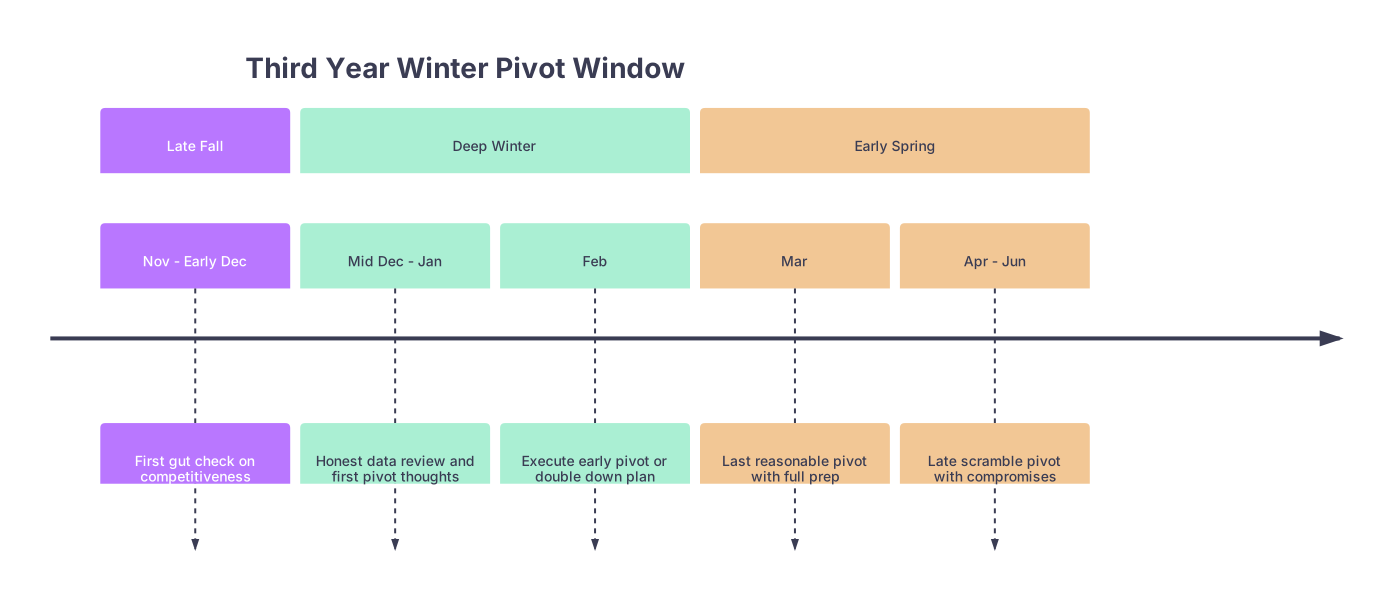
From December of MS3 to March of MS3, your options shrink faster than you think. Here’s the hard truth: if you’re applying in September, your realistic pivot deadline is March 31. After that, everything gets more desperate and more expensive.
Let me lay out your decision window.
| Period | Event |
|---|---|
| Late Fall - Nov - Early Dec | First gut check on competitiveness |
| Deep Winter - Mid Dec - Jan | Honest data review and first pivot thoughts |
| Deep Winter - Feb | Execute early pivot or double down plan |
| Early Spring - Mar | Last reasonable pivot with full prep |
| Early Spring - Apr - Jun | Late scramble pivot with compromises |
By the end of January, you should:
- Know your Step 2 CK target and study start date
- Have a short list of 2–3 specialties (including at least one realistic/less competitive option)
By the end of February, you should:
- Have either committed to a competitive specialty or
- Formally pivoted to a lower‑competition path and started stacking the right letters and rotations
By March 31, you should:
- Be all‑in on a specific specialty strategy:
- Competitive specialty with a strong back‑up plan or
- Full pivot to a lower‑competition specialty with a coherent application story
If you’re not there by March, you’re choosing chaos.
Step 1: Late Fall (Nov–Early Dec) – The Quiet Gut Check
At this point you’re usually mid‑clerkship: maybe IM then surgery, or peds then OB. You’ve had enough exposure to know what feels right, but you might still be clinging to an “aspiration specialty” that doesn’t line up with your record.
By Thanksgiving, you should:
- List your “dream” and “reality” specialties
Write down:
- Your current top choice (even if it scares you)
- 1–2 genuinely acceptable, lower‑competition options
Think along these lines:
| Category | More Competitive | Lower-Competition Pivot |
|---|---|---|
| Surgical | Orthopedics, Plastics | General Surgery, Vascular (still tough), or EM/Anesth from surgical interest |
| Lifestyle | Dermatology | PM&R, Pathology |
| Acute care | EM (getting tougher) | IM or FM with hospitalist focus |
| Procedure-heavy | ENT, Urology | Anesthesiology, some IM subs later |
Notice the pivot isn’t always “easy.” It’s easier than your original, not a free pass.
- Collect your current objective data
By early December, you should have:
- Step 1: Pass / Fail (and if you failed once, that matters a lot)
- Shelf trends: Above/below class average? Consistent or erratic?
- Any class failures / remediation?
- Research: count completed projects, not “in progress forever”
Stick this in one place – spreadsheet, notebook, whatever. You’ll need it in January when the denial starts leaking away.
- Start the “reality” conversation (quietly)
By early December, you should have:
- Talked to one faculty member in your dream specialty
- Asked a direct question: “With my current record and Step 1 pass, what would I need to be a realistic candidate for this field?”
If they start using words like “exceptional,” “perfect Step 2,” “research year” – that’s code. Pay attention.
Step 2: Deep Winter (Mid Dec–January) – The Cold, Honest Audit
Winter break and January are where serious people pull ahead. This is also where delusional people double down without a plan.
Mid December (before break): Quick status check
By this point, you should:
- Know your clinical strengths (patients like you? fast? detail‑oriented?)
- Know your patterns (always barely passing shelves? crushing wards but bombing exams?)
Ask yourself bluntly:
“If I were my own program director, would I take me into this competitive specialty over someone with better scores and more research?”
If the answer is “probably not,” you don’t have to pivot yet. But you must create a two‑track plan:
- Track A – If Step 2 CK is a bomb
- Track B – If Step 2 CK is a home run
Over winter break: Build your comparison board
Sit down one afternoon and make this chart. Not cute. Not aspirational. Real numbers.
| Metric | You | Typical Competitive Field | Typical Lower-Competition Field |
|---|---|---|---|
| Step 1 | Pass | Pass | Pass |
| Step 2 Target | 245 | 250–255+ | 220–235+ |
| Publications | 0 | 2–5 | 0–1 |
| AOA / Honors | No | Often Yes | Mixed |
| Red Flags | 1 fail/remediation | Rarely | Tolerated more |
That gap between “You” and “Competitive Field”? That’s what you must close by June. If it’s a canyon, not a crack, your pivot timer is already running.
January: Hard conversations and early pivot signals
By the end of January, do these three things:
- Meet with your dean / advising office
- Bring your numbers.
- Ask a clear question: “If I apply to [competitive specialty], what tier of program would realistically rank me? And what is my risk of not matching at all?”
If they hesitate, or say “you’ll need a broad application strategy,” that’s a polite warning.
- Talk to two residents in your dream specialty
- Ask what their Step 2 scores were.
- Ask how many programs they applied to.
- Ask if anyone in their class with numbers like yours matched.
I’ve watched students ignore this and then cry on Match Day. You don’t need to be one of them.
- Define your “bail‑out criteria” in writing
Before emotions take over, write down numbers that will trigger a pivot. For example:
- If Step 2 CK < 235 → fully pivot to IM/FM/psych
- If I cannot secure 2 strong letters from [specialty] by May → pivot
- If research project does not result in at least a submitted abstract by April → pivot
Future‑you will try to move the goalposts. Don’t let them.
Step 3: February – The Real Fork in the Road
February of MS3 is where serious career damage can start if you pretend everything is fine.
By February 1, you should:
- Have a Step 2 CK test window in mind (ideally by June/early July)
- Know your next two core rotations and whether they help or hurt your chosen path
At this point, divide into two paths:
Path A: You Still Have a Real Shot at Your Competitive Choice
You’ve looked at your numbers, talked to honest people, and your profile is borderline but not doomed.
Early February: Commit to a dual‑track, not a fantasy
By the second week of February, you should:
Pick a realistic back‑up specialty
Common lower‑competition pivots:- From Ortho → General Surgery or PM&R
- From Derm → IM, Pathology, or Pediatrics
- From EM → IM or FM
- From ENT/Plastics → General Surgery or Anesthesia
Slot at least one rotation in your back‑up before August Yes, before August. You need:
- 1 audition‑level performance
- 1 strong letter
- A coherent story: “I realized I enjoy broader medicine / continuity / X.”
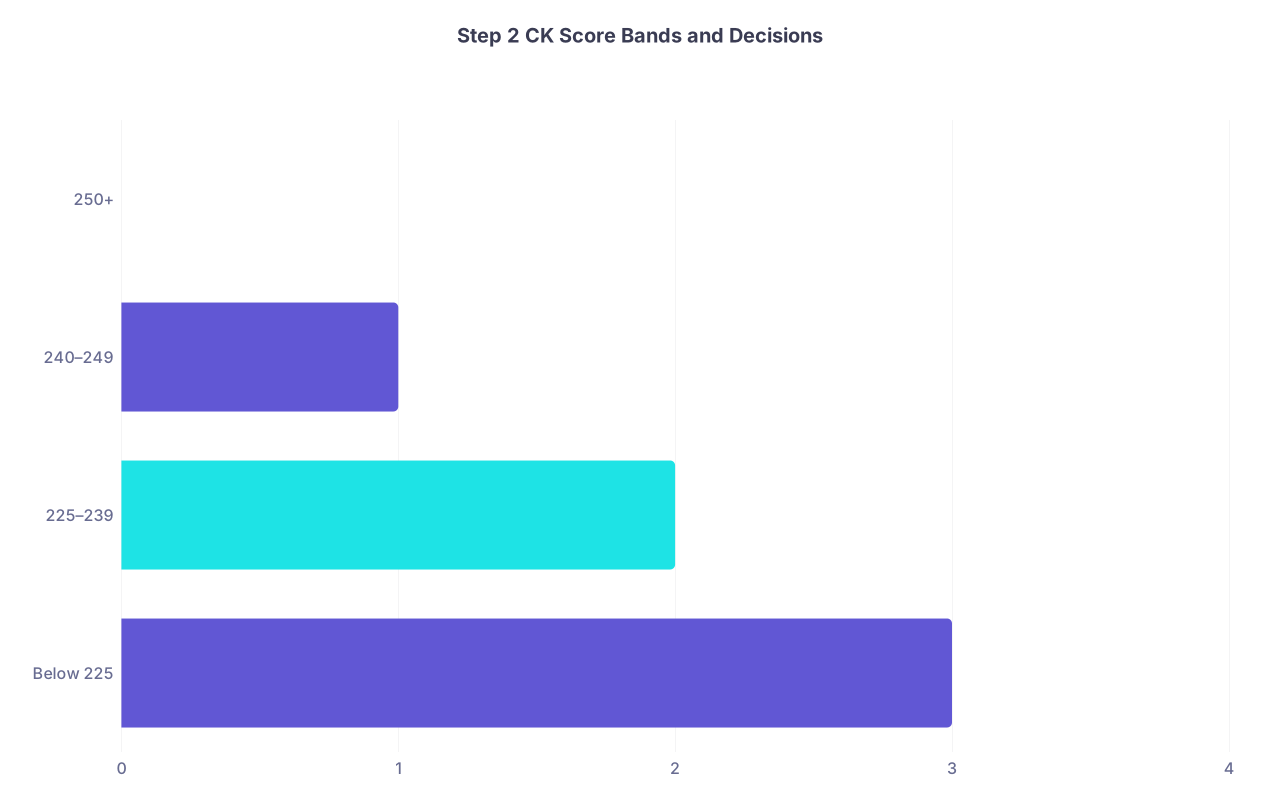
Set Step 2 CK score bands and responses
Use a chart like this:
| Category | Value |
|---|---|
| Below 225 | 3 |
| 225–239 | 2 |
| 240–249 | 1 |
| 250+ | 0 |
Interpretation:
- Below 225 → Immediate full pivot to low‑competition field
- 225–239 → Strongly consider pivot, use extra data like letters, research
- 240–249 → Apply competitive + robust back‑up
- 250+ → Reasonable to go all‑in, still keep back‑up specialty warm
The numbers will vary by field, but the band approach should not.
Path B: You’re Clearly Misaligned with a Competitive Specialty
If by February your situation looks like:
- Step 1 pass with major academic red flags (failures, repeated courses)
- No real research in the field
- Mediocre/poor clinical evaluations
- Faculty quietly saying, “Have you considered [less competitive field]?”
Then winter is not “too early” to pivot. It’s your best chance to have a strong low‑competition application instead of a panicked one.
By mid‑February, if pivoting, you should:
- Pick the new specialty and stop hedging publicly
Tell people (advisors, residents, letter writers):
“I’ve decided to pursue [family medicine / internal medicine / psych / PM&R / path]. I’d like your advice on building the strongest application I can.”
Half‑pivoting sends a bad signal. Programs smell it.
- Re‑organize your remaining MS3 schedule
Priority order:
- Core rotation that aligns most with the pivot specialty
- Elective in that field before June/July (for letters)
- Step 2 CK study buffer – you cannot bomb this after pivoting
Example: Pivoting to Family Med
- March–April: Internal Medicine (crush it; potential FM‑relevant letter)
- May: Family Medicine elective at a home or nearby program
- June: Lighter rotation / dedicated Step 2 CK time
- July: Sub‑I in FM at target program or similar
- Reframe your existing experiences
You don’t need a brand‑new biography. You need a new angle.
- Old story: “I want ortho because I love procedures and sports.”
- New story: “My interests in musculoskeletal care and longitudinal patient relationships led me toward FM with a sports med focus.”
You’d be surprised how often this is both true and acceptable.
Step 4: March – The Last “Clean” Pivot Point
March is your last month to pivot without it looking obviously desperate.
By March 1, you should:
- Have a clear primary specialty chosen
- Have a written plan for:
- Where you’ll get 3 strong letters
- When you’ll take Step 2 CK
- Which months are available for sub‑Is / aways
If you’re still telling people “I’m undecided,” that’s a problem.
Week‑by‑Week March Breakdown
Week 1 (Mar 1–7): Lock your specialty
At this point, your choices collapse to:
- Competitive specialty with a defined, realistic back‑up
- Fully pivoted to lower‑competition specialty
Pick. Stop collecting opinions. You need action.
Week 2 (Mar 8–14): Schedule letters and rotations
You should by now:
- Identify 3–4 attendings who can potentially write letters:
- 2 in your target specialty
- 1–2 in allied fields who love you as a worker and human
- Politely signal your intent:
- “I’m planning to apply in [X]. I’d be honored to work with you more closely to earn a letter.”
Also, if you’re pivoting to something like IM, FM, psych, or path:
- Get at least one rotation in that field before July for a flagship letter.
Week 3 (Mar 15–21): Adjust Step 2 CK strategy
Lower‑competition does not mean you can coast on Step 2. Many programs in IM/FM/psych now use Step 2 CK as their main filter.
By this week, you should:
- Have your dedicated period blocked off
- Have a realistic NBME score target based on your specialty choice
- Decide if you need to delay Step 2 to avoid a disastrous score (which might force an even more drastic pivot or prelim/transitional route)
Week 4 (Mar 22–31): Clean up loose ends
By the end of March, you should:
- Remove any electives you no longer need in fantasy specialties
- Add one generalist‑friendly elective (IM consults, geriatrics, palliative, psych, etc.)
- Start a simple tracker of:
- Letters promised
- Rotations completed
- Programs of interest in your specialty tier
If you reach March 31 still “seeing how things go,” you’re voluntarily walking into a weaker application cycle.
What Counts as “Low-Competition” – And What Doesn’t
Let’s kill a myth: “low‑competition” doesn’t mean “easy match.” It means lower relative risk given mediocre metrics, especially if you’re willing to apply broadly and geographically flex.
Fields that are often lower‑competition (subject to trends):
- Family Medicine
- Psychiatry
- Internal Medicine (community and mid‑tier academic)
- Pediatrics (non‑elite programs)
- Pathology
- PM&R (varies by year but often more attainable than ortho/derm/PMR‑adjacent dreams)
Fields that feel like pivots but can still be rough:
- Emergency Medicine (got more complex after the recent market shifts)
- Anesthesiology (variable by year; not a total safety)
- General Surgery (still competitive, though less than some surgical subs)
| Category | Value |
|---|---|
| FM | 1 |
| Psych | 2 |
| IM | 3 |
| Peds | 3 |
| Path | 2 |
| Gen Surg | 4 |
| EM | 4 |
| Derm | 5 |
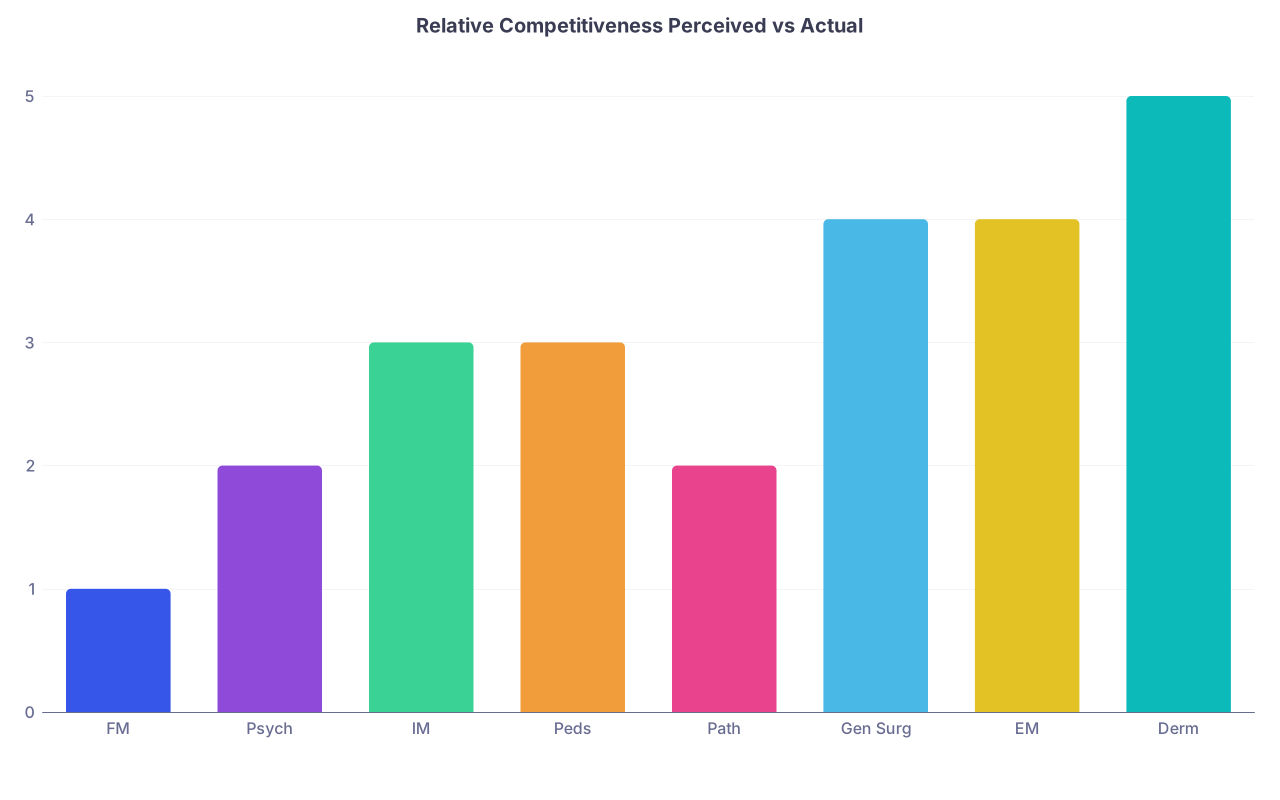
1 = generally lower, 5 = very high. This is directional, not gospel.
Your decision isn’t “pick the lowest competition.” It’s “pick the lowest competition field that you can honestly see yourself practicing and advocating for at 2 a.m. on call.”
Programs smell disdain. Do not pivot into a specialty you plan to resent.
Day‑By‑Day Micro‑Checklist for a Pivot Month
Let’s say it’s February and you’ve decided to pivot to a lower‑competition field. Here’s a 10‑day intensive to reset your trajectory.
Day 1–2
- Email your dean: “I’ve decided to pursue [specialty]. Can we meet to revise my 4th‑year schedule?”
- Make a one‑page CV with updated specialty focus.
Day 3–4
- Email 2–3 attendings in the new field:
- Ask for a brief meeting about career plans
- Ask where your profile is strong/weak for their field
Day 5
- Rewrite your “why this specialty” paragraph (no more than 200 words).
- Make sure it’s something you could say out loud on the spot.
Day 6–7
- Review your upcoming rotations:
- Can you rearrange to get a sub‑I or elective in the new field earlier?
- Can you move low‑yield electives later or drop them?
Day 8–9
- Sketch a program list tiering:
- “Reach” programs
- Solid realistic programs
- Safety programs (yes, even in low‑competition fields)
Day 10
- Create a simple ERAS prep folder:
- CV
- Potential letter writer list
- Personal statement ideas
- A document literally titled: “Why I Pivoted to [Specialty]” with bullet points that make sense
You can do all of that in 10 days—if you stop pretending you have infinite time.
The Line You Cannot Cross: Waiting Until After Step 2 Disaster
The one thing I’ve seen ruin more careers than anything else:
Students who say, “I’ll decide after Step 2,” then score far below expectations in July or August.
At that point:
- Your ability to rearrange 4th‑year rotations is limited
- Away rotations are already locked or underway
- Letter writers in a new field barely know you
- You’re applying in September with a fresh bad score and no coherent pivot story
Your winter decision is not just about specialty. It’s about avoiding a July panic pivot that everyone (including residency PDs) can see right through.
What You Should Do Today
Do this now:
Open a blank page and write three headings:
- My Dream Specialty
- My Realistic Pivot Specialty
- My Bail‑Out Criteria (for pivoting)
Under each, write 3–5 bullet points. Then email one faculty advisor and ask for a 20‑minute meeting to go over that page before the end of this month.
If you do that today, your third‑year winter won’t decide your future by accident. You will.