
The myth that “least competitive” specialties are easy to get into is dead wrong.
Some of the so‑called low‑tier fields guard their residency spots more aggressively than ortho or derm. Different weapons, same territorial instinct. I’ve sat in those rank meetings. I’ve watched PDs in supposedly “easy” specialties nuke entire piles of applications for reasons that would never show up on a Reddit spreadsheet.
Let me walk you through what’s actually happening behind those doors—and why you underestimate these specialties at your own risk.
The “Least Competitive” Label Is Misleading Garbage
Here’s the first truth: the phrase “least competitive specialty” is a crude, often misleading composite. People usually mean:
- Lower average Step scores
- Lower applicant‑to‑position ratio
- Higher match rate
But programs do not sit around saying, “We’re least competitive, let’s just take whoever.” They say, “We have 5 spots and our lives get harder if we pick wrong.”
Some specialties often thrown into the “less competitive” bucket:
- Family Medicine
- Psychiatry (historically, though this is changing)
- Pediatrics
- Pathology (in some years)
- PM&R (for non‑top tier programs)
- Neurology and some community Internal Medicine programs
Yet inside those programs, the guarding is intense. Different from surgical ego warfare, but intense.
Let me give you a quick comparison of “on paper” competitiveness vs how guarded they actually are.
| Specialty Type | Typical Board Scores | Applicant Demand | How Fiercely Spots Are Guarded |
|---|---|---|---|
| Derm/Ortho/Neurosurg | Very High | Very High | Obviously Extreme |
| Mid‑tier (EM, Anes, Rad) | High | High | Very High |
| Primary Care (FM, Peds, IM) | Moderate | High | High |
| Psych/Neuro/PM&R | Moderate | Variable | High |
| Pathology/Preventive Medicine | Variable | Lower | Surprisingly High |
That last column? That’s the part applicants misunderstand. Even a program that struggles to fill all of its spots can be brutal about who they will not take.
Why They Guard So Hard: The Unpretty Truth
Residency slots are not just names on a schedule. They’re risk, call, reputation, and future recruitment all baked into a three‑to‑seven‑year contract. When a PD signs off on you, they’re:
- Betting you won’t crumble under call
- Betting you won’t poison the culture
- Betting you won’t flame out, fail boards, or get them reported to the GME office
And if they’ve ever been burned badly once, they guard harder for a decade.
Here’s what you don’t see.
1. One Bad Resident Can Cripple a Small Program
Large IM program with 40 residents a year? They can absorb a weak link. Small FM program with 4 residents a year? One disaster and the whole place tilts.
I watched this happen at a small community Family Medicine program. They took a “we should help him, he’s local, low scores but kind” candidate. He failed Step 3 twice, disappeared during night float, and racked up patient complaints. Within a year:
- Faculty stopped giving borderline applicants a chance
- They started hard‑screening on Step 1/2 numbers after pretending “we’re holistic”
- Local DO and Caribbean students suddenly found the door quietly closing
Not because of bias on day one. Because the program got burned and decided never again.
Small “less competitive” programs guard spots more fiercely because their margin for error is smaller than big‑name powerhouses.
2. Reputation In a ‘Low‑Status’ Specialty Is Fragile
A top‑tier ortho program can graduate an occasional mediocre surgeon and survive. They still place people in fellowships off their name.
A small community Psych or Path program? They don’t have that buffer. One chronically incompetent or scandal‑ridden graduate can label the entire program as “sketchy” for years. Word travels fast in small fields.
So faculty become hyper‑protective. They would rather:
- Go unfilled and pick up extra call
- Scramble/SOAP carefully
- Overwork their current residents
…than bring in someone who might dent the program’s reputation further.
That’s why you’ll see PDs say publicly, “We’re open to non‑traditional, holistic review.” Then in the rank meeting they say, “We’re not going through that again, I’m not putting another risky project on my roster.”
The Silent Filters: What They’ll Never Put On The Website
Here’s the underbelly: “least competitive” specialties often use subtler, more personal filters than the obviously cut‑throat fields.
They may not have a 250 Step expectation. But they absolutely have:
- Unspoken red lines
- Personality archetypes they avoid
- Backgrounds they quietly prefer
And they do not publicize this because it looks bad in print.
Academic Red Flags They Care About More Than Scores
I’ve seen faculty in Family Medicine and Pediatrics be far more forgiving of a 220 than of these:
- Multiple failed clerkships
- Repeated professionalism write‑ups
- Being “the resident nobody liked” in a previous program
- Massive gaps in training with no coherent explanation
Scores are easy to defend. But if someone says, “He disappeared for 3 days on surgery and no one could reach him,” that story lives rent‑free in every PD’s head.
A Psych PD once said in a meeting: “I’ll take a 208 with clean behavior over a 240 with weird professionalism any day.” And they meant it.
Off‑Paper Reputation: Your Hidden Transcript
In small or “less prestigious” specialties, everybody knows everybody. PDs talk. Clerkship directors talk.
This happens constantly:
- Applicant rotates at a community Psych program
- Does the bare minimum, acts disinterested, complains about call
- Still gets a polite letter: “X completed the rotation…”
- Behind the scenes, the PD tells their friend at another Psych program: “Do not rank this person high.”
You’d never see it in the MSPE. But the informal blacklist is real.
These off‑paper impressions matter more in “less competitive” fields because the culture is tighter and the number of programs is smaller.
Why They’d Rather Leave Spots Unfilled Than Take The Wrong Person
You probably assume: “They’re not that competitive; they’ll be happy just to fill.” False.
There’s a calm kind of ruthlessness in some of these programs: they will leave positions open on purpose.
The Real Cost of a Bad Match
To understand this, you need to see what a “bad resident” really does to a program:
- Residents shoulder extra call when that person is unreliable
- Faculty lose protected time chasing remediation plans
- GME monitors the program more closely
- Accreditation reviews get tighter
- Morale tanks, senior residents start warning med students away
In a specialty already fighting for respect (e.g., FM in a surgically‑driven hospital, or Psych in a tight-budget system), that’s fatal. So they’d rather run short.
I sat in on a Pathology program’s rank meeting where they had 3 spots and ~40 interviewees. They agreed on 2 people they liked. The third spot? One associate PD said:
“We can leave it unfilled and take a SOAP candidate, or run with a smaller class. I’m not committing four years of my life to anyone else on this list.”
They ranked a few more “just in case,” but the explicit plan was: we will not force ourselves to like someone just to fill.
SOAP: The Second Gate
You might think: “Ok, I’ll just SOAP into one of those less competitive specialties.”
You’re underestimating how vicious those few SOAP hours are.
SOAP for these programs is not charity. It’s a second, compressed round of guarding:
- They pull applications, frantically call references
- They ask other PDs, “Have you heard of this person?”
- They heavily favor: home med school, known rotations, trusted letters
Someone with a shaky record who’s banking on, “It’s just FM, they’ll take me” gets passed over for the safer, known unknown.
Different Specialty, Different Guardrails
Each “less competitive” specialty guards for different reasons. The risk profile changes.
Family Medicine: Fit, Work Ethic, and Community
FM faculty have a sixth sense for people who are just treating FM as a backup or a short bridge to urgent care.
They guard their spots against:
- People who openly hate outpatient continuity
- Those who visibly check out on community or OB rotations
- Applicants who talk only about lifestyle and not at all about patient population
I’ve watched an FM PD close a file after reading, “FM is a good backup for me if I don’t match in anesthesia.” That’s death. They want people who mean it.
Psychiatry: Stability and Boundaries
Psych is not “easy.” It’s emotionally heavy, legally risky, and burnout‑prone. PDs are wary of:
- Unaddressed mental health issues with no insight
- Poor boundaries with patients
- Grandiosity packaged as “deep empathy”
Their guarding is subtle. They won’t say, “We thought you were unstable.” They’ll say, “We had many strong candidates.” But in the room, you’ll hear: “I do not want to supervise that dynamic for four years.”
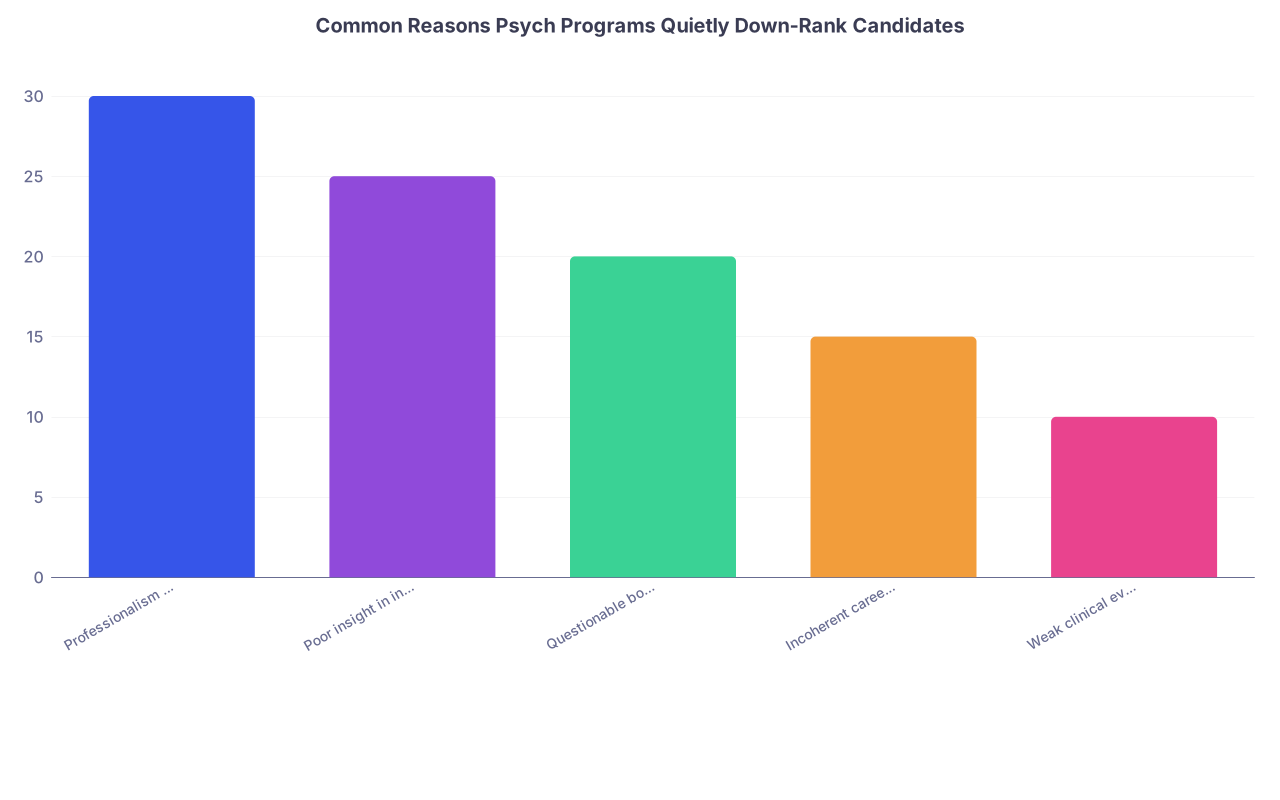
| Category | Value |
|---|---|
| Professionalism concerns | 30 |
| Poor insight in interviews | 25 |
| Questionable boundaries | 20 |
| Incoherent career story | 15 |
| Weak clinical evaluations | 10 |
Pediatrics: Reliability and Genuine Interest
Peds programs get a ton of “nice” applicants. But they guard against:
- People who are visibly lukewarm about kids
- Applicants who crumble under family conflict or CPS involvement
- Chronic lateness or disorganization on pedi rotations
A Peds PD once said to me: “Anyone can smile at a well child visit. Show me how they handle a 2am septic kid with an angry parent and a social worker on the phone.” That’s who they’re screening for.
Pathology: Discipline and Internal Drive
Path is less competitive numerically in some cycles, but they’re not picking randoms. They guard against:
- People using Path as a last resort after failing clinical medicine
- Candidates who clearly have no idea what Path actually is day to day
- Poor work ethic in self‑directed study
If your story is, “I didn’t like clinical rotations, so I chose Path,” most PDs read that as: you disliked accountability and patient interaction, and you might bring that inertia into a lab.
The Interview: Where They Decide If You’re Safe
In these specialties, the interview isn’t just a friendly chat. It’s a risk assessment. Not of your intelligence. Of your potential to become a long‑term problem.
They’re asking themselves:
- Will this person show up? Every day, on time, for years
- Will they drain faculty time with drama and remediation?
- Will they get along with nurses, social workers, techs?
- Will they embarrass us in front of other services or in the community?
The worst interviews are not the nervous ones. They’re the arrogant, aloof, or clueless ones.
I’ve seen Psych programs cut applicants instantly after faculty said, “I got a weird vibe.” That’s all. Same with FM: “Too transactional, too focused on shifts and money, no sense of community or continuity.”
In a spreadsheet, those people look fine. In the room, the alarm bells go off. And once that happens, there is zero chance they’re giving up a spot for you, even if they have to run the program understaffed.
How You Actually Get Through Their Guarded Gate
Let me be blunt: to get into one of these “least competitive” specialties, you do not need a 260. You do need to look like a safe, solid long‑term colleague.
You break through the guarding with:
- A coherent story: Why this specialty makes sense for you, backed by actual exposure and reflection, not vague “work‑life balance” lines.
- Clean professionalism: No patterns of drama, no unexplained gaps, no faculty comments about reliability.
- Strong, specific letters: Not “hard‑working and pleasant,” but “Showed up early every day, took ownership of patients, families specifically asked for them.”
- Evidence you understand the unglamorous parts: The 2am phone calls, the combative families, the SOAP notes, the autism evals, the CPS reports, the chronic noncompliance in FM.
If you present as a “project” with no clear advocates, you’re asking a PD to bet their reputation and their residents’ workload on your potential. In derm, they might still take that risk for a genius. In least‑competitive land, they don’t need to. They have plenty of solid 210–230, no‑drama, wants‑to‑be‑here applicants.

| Step | Description |
|---|---|
| Step 1 | ERAS Application |
| Step 2 | Reject |
| Step 3 | Screen narrative and letters |
| Step 4 | Interview |
| Step 5 | Rank list |
| Step 6 | Basic cutoffs met |
| Step 7 | Any red flags |
| Step 8 | Culture and risk fit |
The Biggest Miscalculation Applicants Make
Here’s the subtle trap.
Applicants who chase hyper‑competitive specialties usually over‑prepare. Multiple aways, research, perfect letters. They take the process too seriously, if anything.
Applicants who “settle” for a least competitive specialty sometimes under‑prepare. They think:
- “It’s just FM, I’ll get in somewhere.”
- “Psych is easy now, I’ll be fine.”
- “Peds always needs people; I don’t have to be perfect.”
Programs feel that. They can smell when you see their field as a consolation prize. And that’s when the guarding goes from quiet to absolute.
I’ve seen strong applications in “less competitive” fields get tossed because of one single thing: transparent lack of respect for the specialty.
You don’t have to worship FM or Psych. But if you treat it like a throwaway, PDs will treat your file like one.
FAQ: The Back‑Room Answers You Won’t Hear On Interview Day
1. “If a specialty is ‘least competitive,’ can a strong interview overcome major red flags?”
Almost never. A charming interview can soften minor concerns, but big issues—failed Step 2, multiple professionalism write‑ups, being dismissed from another program—trigger deep institutional fear. In these specialties, PDs are even more cautious about known problems because they lack the prestige shield. They don’t want to explain to GME why they took a high‑risk applicant when they didn’t have to.
2. “Do low Step scores matter as much in these specialties as people say they don’t?”
They matter differently. A 205 vs 230 may not change your life in Family Medicine the way it does in ortho, but very low scores become proxies for risk: risk of failing boards again, needing remediation, bringing extra oversight. If the rest of your file screams reliability and maturity, they’ll look past scores. If it doesn’t, the scores become one more reason to move on.
3. “How much does being ‘too competitive’ hurt in these specialties?”
Less than you think, but it can raise eyebrows. A 260 with a stack of derm research applying to FM with no real narrative about why will be viewed as flight‑risk or confused. If you’re ‘over‑qualified,’ your story has to make sense: geography, family, clear value alignment with the specialty. Otherwise, people worry you’ll be miserable or leave.
4. “Is SOAP really viable for getting into these less competitive specialties?”
Sometimes, but it’s not a soft landing. SOAP is frantic, political, and heavily favors: home students, people with prior connection to the program, and those with clean records. You will rarely beat a known, lower‑scoring but trusted candidate as a total unknown with red flags. SOAP is where programs guard even harder because there’s no time for deep evaluation.
5. “What’s the single biggest thing I can do to not get quietly blacklisted?”
Stop treating these specialties like a downgrade. Show sustained, real engagement: multiple rotations, consistent interest in the patient population, thoughtful conversations with faculty. And protect your professionalism record ruthlessly. In “least competitive” fields, the question isn’t “Are you a superstar?” It’s “Can we trust you not to blow up our lives for the next 3–4 years?”
Key takeaways:
Least competitive does not mean unguarded. These programs protect themselves—sometimes more fiercely than the prestige fields—because one bad resident can wreck their culture and reputation. If you want in, you don’t need to be a genius, but you do need to look safe, serious, and genuinely committed to the specialty—otherwise, they will gladly leave their spot empty rather than gamble on you.