
The worship of GPA in premed culture is lazy thinking.
It’s not that grades do not matter. They do. But the way students obsess over every hundredth of a GPA point while completely ignoring the power of the right mentor and the right letters of recommendation? That’s what is broken.
I’ve watched a 3.3 GPA applicant with a brutal sophomore year, a 513 MCAT, and two extraordinary letters walk into MD acceptances while straight‑A, 520‑MCAT robots with generic letters got “regret to inform you” emails. Over and over. Different schools. Same pattern.
The myth says: “If your GPA isn’t 3.8+, you’re done unless you fix it.”
Reality: If your GPA isn’t perfect, you need context, advocacy, and a human being with credibility willing to say, “You’re underestimating this person if you stop at their numbers.” That’s what a strong mentor does. That’s what a real letter of recommendation is supposed to be.
Let’s dismantle the GPA fixation and talk about how the right mentor can bend the odds back in your favor.
What the Data Actually Shows About GPA (Not the Reddit Version)
You’re being sold a fake equation online: GPA = destiny.
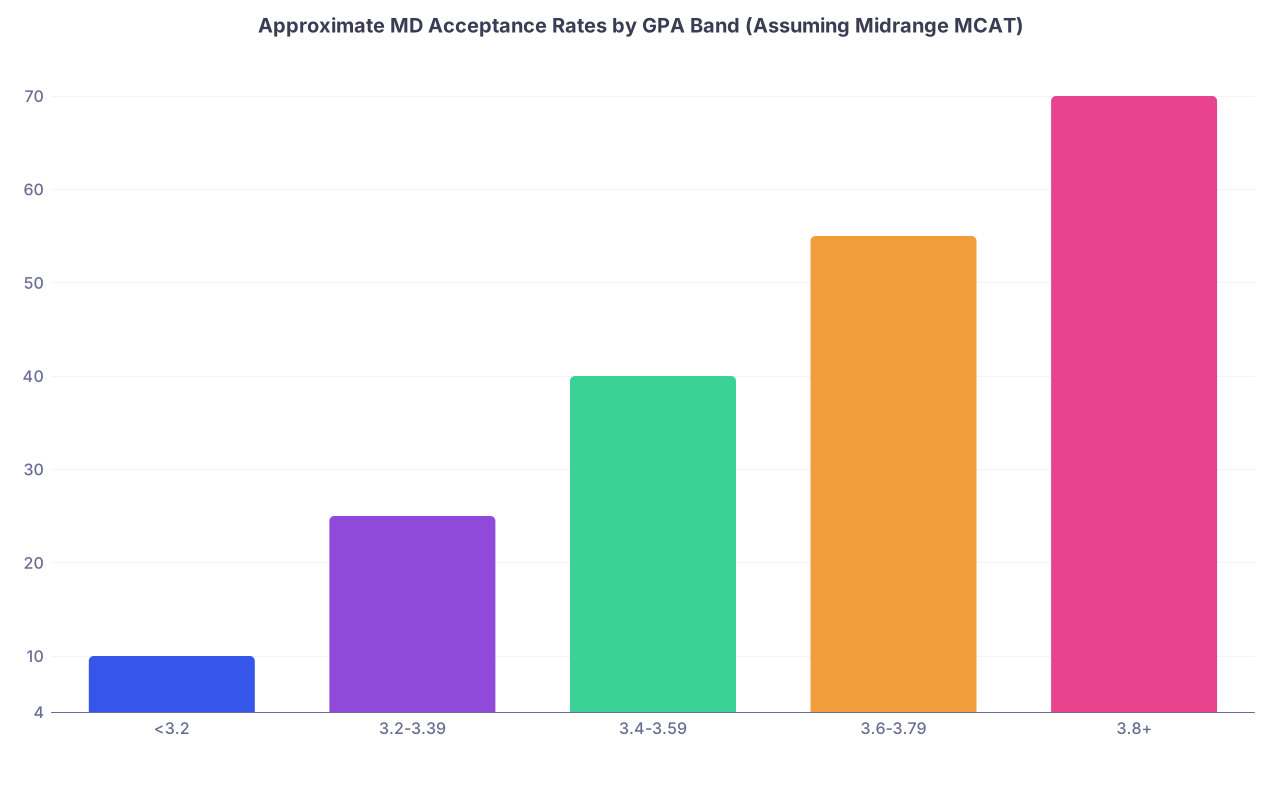
Let’s pull back the curtain. Take AAMC’s own data. They publish acceptance rates by GPA and MCAT. Yes, higher is better. No argument. But look at the spread:
| Category | Value |
|---|---|
| <3.2 | 10 |
| 3.2-3.39 | 25 |
| 3.4-3.59 | 40 |
| 3.6-3.79 | 55 |
| 3.8+ | 70 |
Those are approximate, but directionally accurate based on public AAMC grids.
What that chart actually says:
- Below ~3.2 is tough but not hopeless. People still get in.
- Between 3.3–3.6 is not “garbage” territory. It’s “prove to us who you really are” territory.
- Above 3.8 is safer, not guaranteed.
But here’s what the grid doesn’t show: who those accepted applicants had behind them. It does not list:
- The PI who called a dean and said, “You need this student in your class.”
- The physician who wrote, “I’ve been on admissions. This is the caliber of student I rank in the top 5%.”
- The course director who explained, in detail, the family illness that tanked one semester and what happened afterward.
The grid logs inputs (GPA, MCAT) and outputs (acceptance). It does not log leverage. Mentors and letters are leverage.
You’re not competing on GPA alone. You’re competing on how well your numbers are explained, contextualized, and framed by people the committee trusts.
What Strong Letters Actually Do Inside a Committee Room
If you’ve never sat in on an admissions meeting, you’re missing the actual game.
Here’s the usual flow when your GPA is less than shiny:
Someone sees your GPA first. 3.45. Trend a bit bumpy. They raise an eyebrow.
Then someone else flips to the letters.
This is where your mentor either saves you or leaves you for dead.
I’ve heard variations of all of these:
- “GPA’s a little low, but read Dr. Patel’s letter. She doesn’t write people up like this often.”
- “Yeah, 3.3, but look at the post‑bacc and read the PI’s letter. Big turnaround and clearly not a lazy kid.”
- Or the kiss of death: “Letters are… fine. Nothing special.” (That’s code for: no one is sticking their neck out for you.)
The job of a strong mentor letter is not to restate your CV. It is to reframe your weaknesses and amplify your strengths in a way that overrides lazy, surface-level judgments.
Think about the levers they control.
| Weakness on Paper | What a Strong Mentor Can Do |
|---|---|
| Low overall GPA | Emphasize rigor, growth, work ethic, resilience |
| Bad semester/year | Provide context + clear evidence of rebound |
| Uneven transcript | Highlight advanced coursework and intellectual curiosity |
| No-name school | Translate your performance into national context |
| Gap in activities | Show consistent commitment in one domain and maturity |
When an adcom member hesitates on your GPA, a powerful letter does one of three things:
- It explains: “Here is why those numbers are not the full story.”
- It reframes: “This student’s 3.45 from X program is not equal to a 3.45 from an easier path.”
- It reassures: “I’ve supervised residents. I’d trust this person with my patients.”
Put bluntly: a credible human vouching for your potential as a future physician can neutralize a lot of transcript sin.
Not all letters do this. Most don’t. Why? Because most “mentors” are actually just people who know your name and your grade.
The Mentor You Need vs The Letter Writer You Think You Need
Here’s where a lot of premeds screw this up.
They chase the biggest name. The department chair. The chief of surgery. The “famous” PI. And then they get a two-paragraph letter that reads like a LinkedIn recommendation written by a committee.
Meanwhile, the student who stuck with a mid‑career physician for two years in a free clinic gets a letter dripping with specific, hard-earned credibility.
The right mentor for offsetting imperfect grades is not necessarily the fanciest person on the hospital website. It’s the person who can do three specific things:
See you over time.
If they only knew you for one semester and have no idea who you were before and after, they cannot speak to trajectory. GPA concerns are fundamentally questions about trajectory. So you need someone who’s seen the before/after.Witness you under stress.
Admissions committees care less about your organic chemistry grade and more about what you do when you’re tired, behind, or under pressure. A mentor who’s seen you on a busy ward, late in the lab, or managing a crisis can write about the real you.Translate you into adcom language.
This one is underrated. Some mentors understand exactly how to talk to admissions folks. They know which phrases hit. “Top 5%” isn’t an accident. “I would rank this student above many of our current residents” carries weight. They know the code.
Let’s be concrete.
A mediocre “big name” letter sounds like this:
“John was a student in my Biochemistry II course and performed very well, earning an A. He was always on time, participated in class, and showed strong interest in the material. I am confident he will be successful in medical school.”
Translation: I barely know this kid. He got an A. He seems fine.
A strong mentor letter for a 3.4 GPA student might sound like this:
“I have known Maria for three years as her research mentor and clinical supervisor in our student‑run free clinic. Yes, her overall GPA does not put her at the very top of the applicant pool, and she is the first to tell you that her sophomore fall was a low point academically. I want to tell you why stopping at that number would be a mistake.”
Then the letter goes on to describe:
- The 20+ hour weeks balancing lab, clinic, and family responsibilities.
- How she retook a course, owned the failure, and then tutored others in it.
- The time she stayed late to comfort a terrified Spanish‑speaking patient that no one else could talk to.
Now the 3.4 looks different. Not magically transformed into a 3.9. But interpreted in the context of who you actually are.
That’s what the right mentor does.
How the Right Mentor Rewrites Your GPA Story
Let’s connect this to the “letters of recommendation” category you asked for, because this is where strategy actually lives.
GPA is a static number. The story around that number is dynamic. Mentors write that story.
There are a few key narratives that strong mentors can craft that directly offset GPA issues:
1. The “Rigor and Risk” Narrative
You didn’t chase easy A’s. You took hard majors, upper‑division science, or a brutal engineering program.
Committee bias: “Low GPA = less capable.”
Reframe: “Lower GPA partly reflects that this student consistently walked into the deep end.”
A smart mentor will write something like:
“Our biophysics track is notorious. Students are advised against it if they prioritize GPA. Alex chose it anyway, fully aware of the risk, because he is genuinely fascinated by the science. His 3.45 does not capture how intellectually ambitious his coursework has been compared to the average premedical path.”
Now your GPA is a sign of courage, not mediocrity.
2. The “Growth and Resilience” Narrative
Your early semesters were rough. Then you recovered and climbed.
Committee bias: “Downward trend = trouble.”
Reframe: “This is someone who can take a hit and come back stronger.”
A good mentor doesn’t hide your bad semester. They weaponize it.
“When her mother’s illness escalated during junior fall, Lisa’s grades suffered. She could have taken a leave or dropped courses. Instead, she accepted the consequences, then methodically rebuilt her academic performance. I’ve rarely seen such maturity in a college student.”
Suddenly, that 2.7 semester becomes a test you passed, not an indictment.
3. The “Real‑World Load” Narrative
You were working 20–30 hours a week, sending money home, or carrying serious family responsibility.
Committee bias: “Other students got 3.9s; why didn’t you?”
Reframe: “If you gave this applicant the same conditions as a ‘traditional’ premed, they’d probably have that 3.9 too.”
Mentor language matters here:
“Unlike many of her peers, Sarah funded the majority of her own education. She worked 25 hours a week in addition to full‑time coursework and research. Any assessment of her GPA without this context is incomplete.”
This is where the right advocate can move someone from “borderline” to “interview.”
Building the Mentorship That Actually Helps You (Not the Fantasy Version)
You cannot show up senior spring, ask for a letter, and expect magic.
If you want a mentor who can offset imperfect grades, you have to give them something to work with. That means you start earlier and act like an adult, not a recommendation‑seeking robot.
A few non‑fluffy, real behaviors that actually matter:
- Stick with one lab/clinic/PI long enough that they see the arc, not just snapshots.
- Tell them, honestly, when you’re struggling academically instead of disappearing.
- Ask for feedback and then visibly implement it.
- Let them see you operate on your worst days, not just your best ones.
Then, when it’s time for letters, you do not say: “Can you write me a strong letter?” You say something more honest:
“My GPA is a 3.42 with an upward trend. I know that’s lower than many applicants. You’ve seen me over three years in the lab and clinic. Would you feel comfortable addressing my academic trajectory and work ethic directly in a letter?”
A real mentor will either say yes and deliver, or tell you they’re not the right person. Both are wins. The worst scenario is a lukewarm letter from someone who doesn’t feel strongly either way.
GPA Still Matters. But It Isn’t the Whole Equation.
Let me be clear before you twist this into something else: you cannot simply “over‑mentor” your way out of a 2.6 GPA and a 495 MCAT. At some point the numbers are too far off, and you need more coursework, more time, and a different strategy.
But between “perfect” and “hopeless” is a huge, neglected middle. That’s where most of you live.
In that middle, the data says this:
| Category | Value |
|---|---|
| <3.2 | 10 |
| 3.2-3.39 | 25 |
| 3.4-3.59 | 40 |
| 3.6-3.79 | 55 |
| 3.8+ | 70 |
Conceptual, not literal numbers—but they capture what committees quietly admit:
- A spotless GPA with forgettable letters is not invincible.
- A solid but imperfect GPA with powerful, context‑rich letters is competitively alive.
- A low‑to‑mid GPA with bland letters is where applications go to die.
You cannot control every B+ you’ve already earned. You can still absolutely control who knows you well enough to go to bat for you, and how early they start gathering the evidence to support you.
Mentors are not a “nice to have” sprinkled on top of your stats. For many applicants, they are the difference between “your file did not advance” and “we’d like to invite you for an interview.”
Bottom Line: Stop Worshiping the Wrong Thing
If you take nothing else from this, take this:
Your GPA is a signal. It is not a sentence.
Admissions committees are not stupid. They know life isn’t a controlled experiment. They know a 3.4 from a brutal path with real hardship and serious responsibility is often more impressive than a 3.9 from a cushioned one. But they will only treat it that way if someone they trust spells that out for them.
That someone is your mentor.
So yes, try to earn strong grades. Retake what you must. Protect your trend line where you can. But stop acting like the story ends at 3.47 versus 3.62. It doesn’t.
The real question is: when an admissions dean asks, “Should we take a chance on this student?” is there a credible adult in the room who practically slams their hand on the table and says, “Yes—and here’s why”?
If the answer is no, start fixing that now. Years from now, you won’t remember the exact decimal of your GPA, but you will remember who believed in you loudly enough to change what that number meant.