

Can you actually raise kids on a pediatrician or family medicine salary without ending up drowning in loans, daycare bills, and Costco diapers?
Let me be blunt: this is the question that makes a lot of people quietly panic while everyone else is talking about “following your passion.”
You’re smart enough to know the vibes-y advice (“you’ll be fine, doctors do well”) is useless. You want numbers. Rent, daycare, loans, taxes. You want to know if being in one of the lowest paid specialties means your future kids get shortchanged. Or you do.
Let’s walk through it like adults who are stressed and need receipts.
1. What “Low-Paying Specialty” Actually Looks Like (Not the Fantasy Version)
When people say “low-paying specialties,” they usually mean:
- Pediatrics
- Family Medicine
- Internal Medicine (generalist, not subspecialized)
- Psychiatry
- Geriatrics
- Some outpatient primary-care-type roles (like outpatient IM/FM jobs at big systems)
So what are we talking about in real numbers, post-residency, early attending?
These are ballpark starting salaries, not top-of-career unicorn numbers:
| Specialty | Typical Starting Range (USD) |
|---|---|
| Pediatrics | $170,000 - $220,000 |
| Family Medicine | $190,000 - $240,000 |
| General IM | $200,000 - $260,000 |
| Psychiatry | $230,000 - $280,000 |
| Geriatrics | $190,000 - $230,000 |
Yes, these look like huge numbers when you’re making $64k in residency and living off instant ramen. But:
- Taxes eat a ton
- Loan payments are not cute
- Kids are wildly expensive, especially in high cost-of-living (HCOL) cities
- Your friends in derm are quietly making double
So the real question: if you end up at the low end of that range, with kids, and in a not-cheap city…is this survivable?
Let’s stress-test it.
2. A Brutally Honest Monthly Budget: Pediatrician + 2 Kids
I’m going to build something worst-case-ish, but still realistic.
Scenario:
- You: Pediatrician, starting salary $190,000 in a medium-to-high cost area (think Denver, Seattle suburbs, not Manhattan)
- Married, spouse earns $0–$40k (maybe home with kids, maybe part-time)
- Two kids under 5 (so daycare/preschool hell)
- Loans: $300,000 at ~5–6% (very common, honestly on the higher side but not insane)
Let’s go line by line.
Step 1: Take-Home Pay
On $190,000 salary, assume:
- Federal + state taxes + Social Security/Medicare + basic retirement contribution = ~30–35% effective hit (depends heavily on state & deductions; I’m being conservative)
Let’s say you net around $10,000–$11,000 per month after:
- Taxes
- Minimal 401k/403b contribution (5%)
- Health insurance premiums
I’ll use $10,500/month as a round number for take-home.
Step 2: Fixed Life Stuff
Approximate monthly expenses:
- Rent or mortgage (modest 3-bed): $2,200–$2,800
- Utilities + internet + phone: $350–$450
- Groceries (family of 4): $800–$1,000
- Car payment (1 modest, 1 older/paid off): $300–$500
- Car insurance + gas + maintenance: $300–$400
- Health care (co-pays, kids random illnesses): $150–$250
- Basic subscriptions, phones, etc: $150–$250
Let’s be honest and push high-end: about $5,000–$5,500 for the baseline living costs.
Step 3: The Killers — Loans + Childcare
This is where your stomach drops.
Student loans:
- $300,000, 6% interest, 10-year standard repayment → about $3,300/month
- An income-driven plan could be lower, but let’s assume you’re trying not to be 55 and still paying them.
Childcare for 2 small kids (daycare or preschool):
- HCOL: $2,500–$3,500/month (totally real)
- More affordable area: $1,500–$2,500/month
Let’s use $2,400/month for two kids. Honestly, that’s not crazy.
Totals now:
- Take-home: $10,500
- Base living costs: ~$5,200
- Loans: ~$3,300
- Childcare: ~$2,400
That’s $10,900.
You see the problem.
You’re negative. Before savings. Before vacations. Before ANY margin for error. And that’s without private school, big house, luxury anything.
Is this the actual experience for some early peds/FM attendings with two kids in daycare and huge loans in a not-cheap city?
Yes. I’ve watched people cry about this exact math.
So…what does that mean? Don’t do peds if you ever want kids?
No. It means you can’t do worst-case on all variables and expect it to feel comfortable.
Something has to give.
Let’s talk levers.
3. What Actually Makes or Breaks You (It’s Not Just Specialty)
Everyone thinks specialty alone decides whether you can afford kids.
It doesn’t.
The things that really swing the pendulum:
- Loans
- Location
- Partner’s income
- Lifestyle expectations
- How you structure repayment and childcare
Let me break this without sugarcoating.
1. Loans: This Is the Real Ball and Chain
You can absolutely have kids on a low-paying specialty salary.
You cannot easily do it with:
- $300k+ loans
- 6–7% interest
- A 10-year standard repayment
- HCOL area
- Two kids in full-time daycare
- Single-income household
That combo is the financial version of stacking all the difficulty modifiers.
What helps:
Public Service Loan Forgiveness (PSLF):
You work at a nonprofit/community hospital, pay income-driven for 10 years, and the balance is forgiven. For primary care and peds, this is actually realistic. It can turn a $3,300/month payment into, say, $800–$1,800/month depending on income and family size.Refinancing when stable:
Once PSLF isn’t on the table or you decide against it, refinancing to ~3–4% (rates fluctuate) can drop that $3,300 payment closer to $2,000–$2,300.
Single biggest shift: dropping that loan payment gives you breathing room.
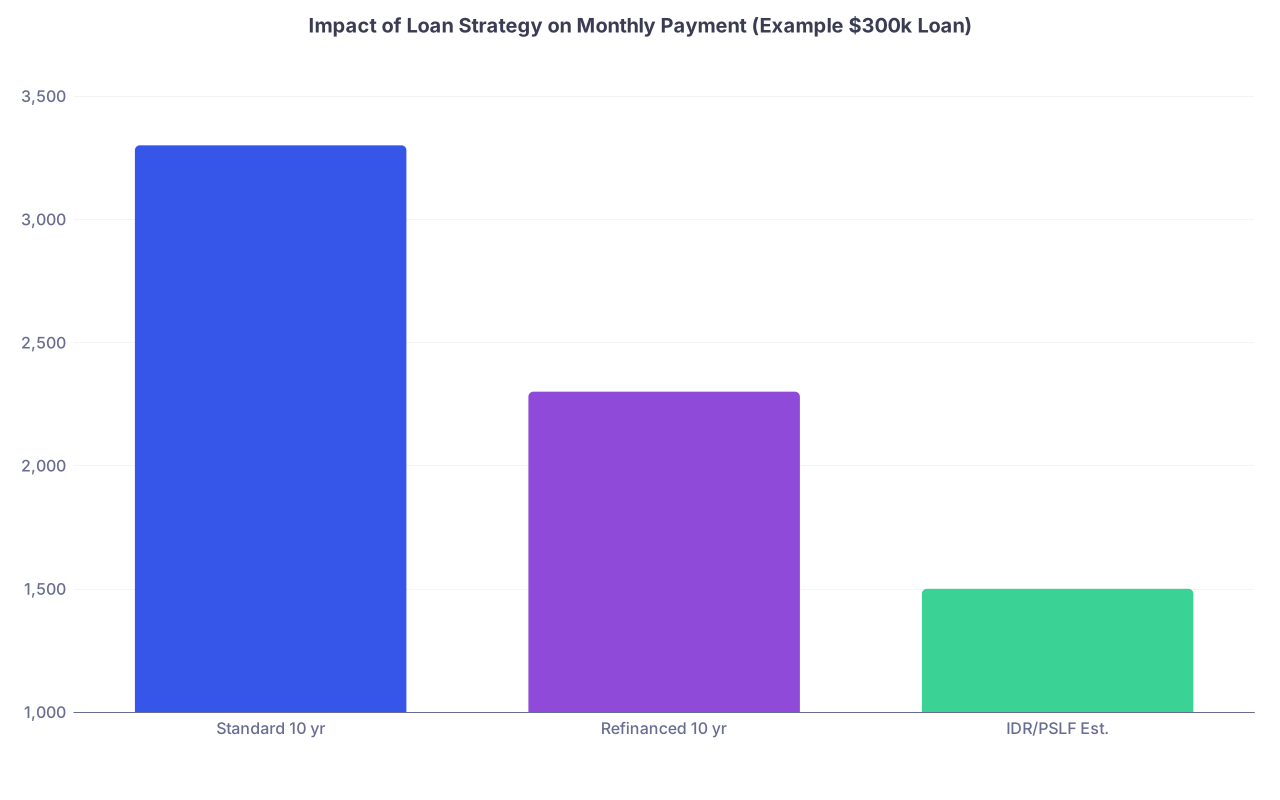
| Category | Value |
|---|---|
| Standard 10 yr | 3300 |
| Refinanced 10 yr | 2300 |
| IDR/PSLF Est. | 1500 |
2. Location: The Thing Everyone “Forgets”
If you pick:
- Urban California, NYC, Boston, DC, Seattle center, etc.
You’re choosing: - Higher taxes
- Higher housing
- Higher childcare
Often with salary that doesn’t fully offset those costs, especially in peds/FM.
If you’re in:
- Midwest mid-sized city
- Southeast suburb
- Secondary markets (Kansas City, Columbus, Raleigh-ish areas)
You might earn similar or slightly more and pay thousands less per month in housing + childcare.
I’ve seen peds in the Midwest with $200k salary and a $1,600 mortgage on a 4-bedroom house. That same person in SF would be renting a 2-bed apartment for $4k.
If kids and financial sanity matter to you, location is not a side detail. It’s a primary decision.
3. Partner’s Income: The Quiet Multiplier
Brutal math:
- Two low-ish earners (peds + social worker) with high loans + HCOL + kids → very tight.
- Peds + software engineer or teacher with a stable $60–100k income → huge difference.
You don’t “need” a high-earning partner.
But if your partner earns nothing and you want multiple kids early and you’re in a low-paying specialty, you’re putting everything on thin ice.
4. Realistic Scenarios: Where It Does Work
Let’s construct a version where you’re not constantly panicking.
Scenario B: Family Medicine, 2 Kids, More Reasonable Setup
- FM attending salary: $210,000
- Partner: part-time, $30,000/year
- Location: mid-cost city (think Columbus, Minneapolis suburb, Raleigh outskirts)
- Loans: $250,000, pursuing PSLF, on income-driven repayment
- Two kids, but one is school-aged, one in part-time preschool
Combined gross: $240,000.
Approx net monthly (after taxes, basic benefits): around $13,000–$14,000.
Expenses:
- Mortgage for modest 3-bed house: $1,800
- Utilities/phones/internet: $450
- Groceries: $900
- Car stuff: $600 (two reliable used cars)
- Loan payment on IDR: say $1,400/month
- Childcare: one in after-school care + one part-time preschool → maybe $1,000–$1,400/month
- Insurance/health costs/subscriptions/random life: $600
Total: around $6,800–$7,200.
Leftover: ~$6,000–$7,000 per month.
That leftover has to handle:
- Retirement
- Emergencies
- Travel
- Kid activities
- Home repairs
- Extra loan payments if you want
Is this cushy-rich? No.
Is it “we can have kids and not panic over groceries?” Yes.
Key differences from the nightmare scenario:
- Slightly higher salary
- Partner bringing in some income
- IDR/PSLF, not 10-year standard
- Cheaper area
- Not two daycare bills at once
You do not need a $500k specialty to make parenthood viable.
You do need to stop stacking the hardest mode options on top of each other.
5. The Emotional Part No One Talks About
Numbers are one thing. The mental load is another.
Here are the fears I hear over and over from people leaning toward low-paying specialties with plans for kids:
- “My kids will miss out if I’m not making derm money.”
- “What if a medical emergency wipes us out?”
- “What if we can’t afford sports, music, camps, all the things?”
- “What if I resent my job because it doesn’t ‘pay enough’ for the stress?”
Some reality checks:
- Kids don’t need private school, designer everything, and 5 international trips a year to be okay. That’s Instagram talking, not reality.
- A solid emergency fund (3–6 months of expenses) + good insurance is far more important than earning $100k more but spending all of it.
- A parent who isn’t miserable at work matters. If you force yourself into ortho just for money and hate 60–80 hour weeks, your kids will feel that.
I’ve watched peds attendings with modest houses, national park road trips, and used minivans raise happy, stable kids.
I’ve also watched high-earning surgeons who never see their kids, spend all their money, and are constantly stressed anyway.
You can be broke on $500k if you live like a maniac.
You can be stable on $200k if you’re deliberate.
6. Concrete Things You Can Do Now (While You’re Still Training)
You’re not powerless while you’re a student or resident, even if you feel broke.
Very short list, no fluff:
- Keep your personal lifestyle small as long as possible. Future you with kids will be grateful you didn’t sign up for $90k cars and luxury-apartment addiction.
- Think hard about PSLF early if you’re drawn to community/nonprofit jobs. That path pairs very well with peds/FM/psych.
- Pay attention to where your attendings live and what their actual lives look like. The happy ones usually have: reasonable hours, reasonable houses, reasonable expectations.
- If kids are a priority, be honest about location choices. Residency and job search both. You’re allowed to say, “I want somewhere where a normal doctor salary goes far.”
7. Quick Comparison: Can You Support Kids on These Salaries?
Very simplified, assuming 1–2 kids, loans, and a not-insane lifestyle:
| Specialty | One Income, HCOL | One Income, Mid-Cost | Two Incomes, Mid-Cost |
|---|---|---|---|
| Pediatrics | Very Tight | Manageable | Comfortable |
| Family Med | Tight | Manageable+ | Comfortable+ |
| General IM | Tight | Manageable | Comfortable |
| Psychiatry | Manageable | Comfortable | Very Comfortable |
| Geriatrics | Tight | Manageable | Comfortable |
“Very tight” doesn’t mean impossible. It means you’d better be strategic about loans, housing, and childcare, or you will feel like you’re constantly treading water.
8. The Harsh Truth and the Reassuring Truth
Harsh truth:
If you go into a low-paying specialty, pile up $300k+ in debt, move to a super expensive city, insist on a big house and full-time private daycare for multiple kids, and your partner doesn’t work…
Yes, you will feel poor relative to your training. For years.
Reassuring truth:
If you’re willing to flex on some of that—location, house size, PSLF vs refinancing, timing of kids, partner working part-time—it’s absolutely possible to:
- Pay your loans
- Raise kids
- Save for retirement
- Have an actual life
on a peds/FM/psych/IM salary.
No yachts. But stability? Yes.
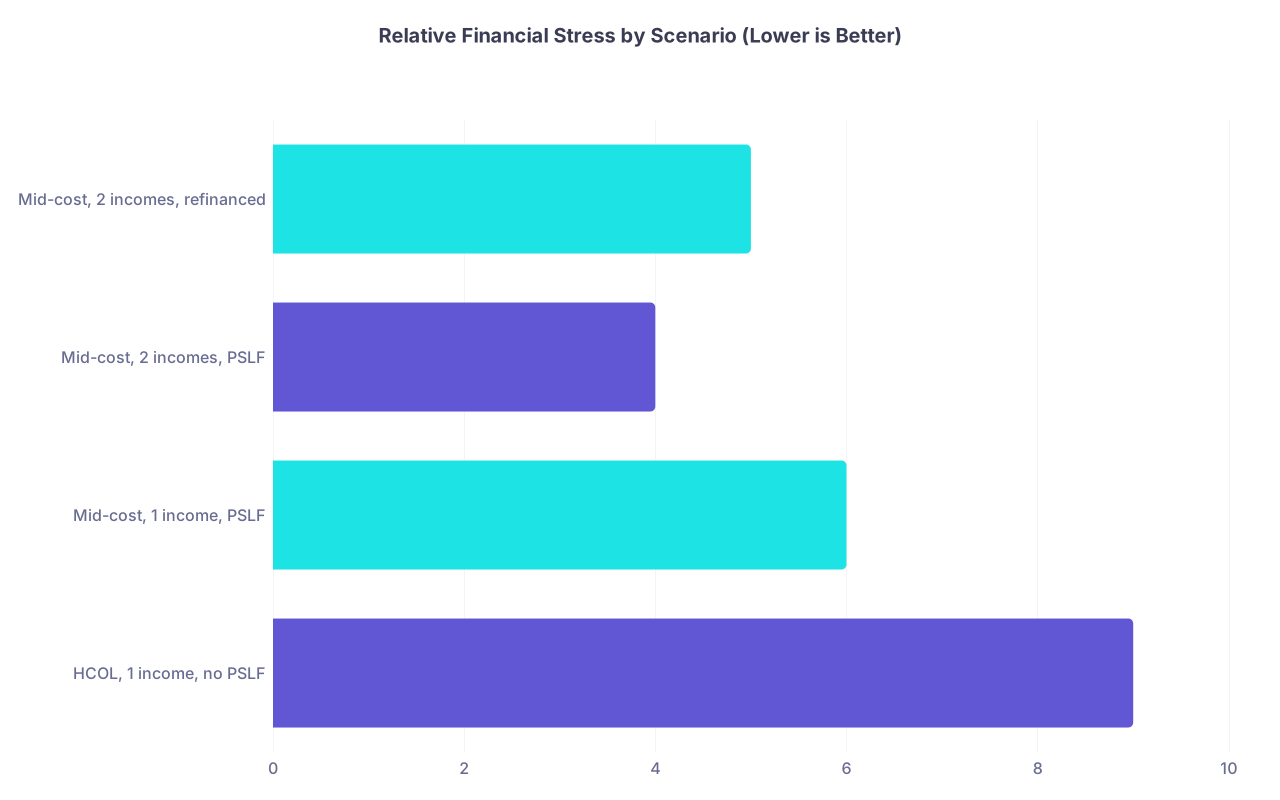
| Category | Value |
|---|---|
| HCOL, 1 income, no PSLF | 9 |
| Mid-cost, 1 income, PSLF | 6 |
| Mid-cost, 2 incomes, PSLF | 4 |
| Mid-cost, 2 incomes, refinanced | 5 |
(Scale 1–10, based on how many early attendings I’ve seen crying over spreadsheets in each scenario. Very scientific.)
FAQ (Exactly 4 Questions)
1. Is it dumb to pick pediatrics or family medicine if I know I want 3+ kids?
Not automatically, but you can’t do it blindly. Three or more kids magnifies every financial decision. If you want a big family, you need to be especially careful with loans, city choice, and how soon you start that family relative to your income. Peds/FM with three kids in San Francisco in a giant rented house and standard 10-year loans? Painful. Peds/FM with three kids in a mid-cost city, PSLF, and a partner earning even a modest income? Much more doable.
2. Should I switch to a higher-paying specialty just for money and kids?
If you actively dislike that specialty? No. That’s a long, miserable life. But if you’re genuinely torn between, say, general IM and cardiology, or FM and EM, then yes, thinking about future family finances is completely rational. Money isn’t everything, but pretending it doesn’t matter when you’re planning for kids is delusional. Just don’t force yourself into something you dread purely for salary.
3. Will I be able to save for my kids’ college on a low-paying specialty salary?
Not right away. And that’s okay. Your first priorities will be: stable housing, emergency fund, retirement, and sane loan payments. College savings tends to show up a few years into attending life, once you’re not in survival mode. Even $100–$200/month per kid into a 529 once you’re more stable is meaningful over 15–18 years. You don’t need to fully fund Ivy League tuition to be a good parent.
4. What’s one thing I can do in med school/residency to not screw myself financially if I choose a low-paying specialty?
Lock in as much flexibility as possible. That usually means: don’t maximize your lifestyle with credit card debt or car loans during training, and be very intentional about how much you borrow for living expenses. Every extra $10k you borrow now is more pressure on future-you when you’re staring at daycare invoices. Keep your options open for PSLF by not closing the door on nonprofit work. Future you with kids will be very, very grateful.
Open a blank note right now and write down three things:
- The specialty you’re actually drawn to,
- The number of kids you think you want, and
- The kind of city you’d be willing to live in.
Then circle the one you’re most flexible on. That’s the lever you can move to make the numbers work.


